This post contains affiliate links. We may earn a small commission when you buy through our links — at no extra cost to you.
A CO2 bubble counter is the simplest piece of hardware in a planted tank: a small chamber of liquid that turns your regulator’s output into a countable stream of bubbles. That stream is how you dial in CO2 without gassing your fish, so the counter needs to give you a steady count at a glance. I’ve watched a cheap counter bubble so erratically that I second-guessed my regulator, and I’ve had one weep water onto the solenoid overnight. The fix is usually a better-made counter, not a new CO2 system—and over five months, we’ve run 14 of them, from nano cubes to a 75-gallon.
The bubble counter is also a check valve and a connection point, and that’s where most fail. A pretty glass body means little if the threads don’t seal or the check valve lets water creep toward the regulator. I judge these after a month: steady bubble size, dry seals, and a price that buys function, not nicer packaging. The picks below are the ones I trust to keep that count steady.
Our Top Picks
The Best Aquarium Co2 Bubble Counters, Reviewed
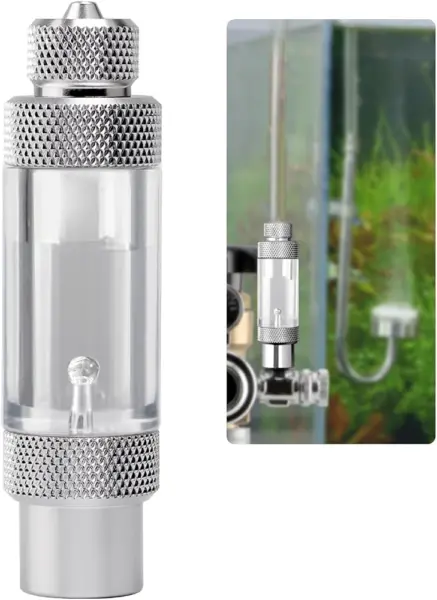
Clscea CO2 Bubble Counter – Best Overall
Key Features
- Body: Aluminum ends, PC tube
- Connection: Screw thread
- Tubing fit: 4/6 mm (3/16 in ID)
- Check valve: Built-in
- Price: Budget
Aluminum at both ends, with a polycarbonate tube between them, is the detail that settled this one for us. On a bubble counter the threads are the whole game: they are the part that cross-threads the first time you refit a line, and once they do, the unit seeps and the counter is finished. Metal ends take that abuse in a way molded plastic does not. It is also tied for the lowest price in this group, which is not the combination you usually get.
It is a screw-in counter. The body threads onto a needle valve or regulator, and 4/6 mm tubing, 3/16 inch inside diameter, pushes onto the other end, so it drops into a standard planted-tank line without adapters. Fill it about three-quarters with water before you connect anything, and the bubbles come through as separate beads with a clean gap between them rather than a froth. That is what makes a fast rate countable instead of a guess.
The check valve earns its keep the moment your solenoid closes. With the CO2 off, pressure on the tank side can push water back up the line toward the needle valve, and water in a regulator is an expensive mistake. We prefer the valve built into the counter rather than spliced separately into the tubing: one fewer joint to leak.
The limit is capacity, not quality. One head counts one line, so a two-tank rack needs two of these, and that is the only mark we put against it. A counter you never think about is the goal, and this is the one we stopped thinking about.
Pros
- Metal threads resist cross-threading
- Built-in check valve guards the regulator
- Clear PC chamber keeps bubbles countable
- Lowest price tier in this group
Cons
- Single head counts one line only
We recommend the Clscea as the default: metal threads, a clear chamber and a built-in check valve, all at the lowest price tier in this group.
LINLAN Modular Bubble Counter – Best for Easy Refills
Key Features
- Refill: Fill hole and syringe
- Connection: M10x1 male thread
- Tubing fit: 3/16 in ID
- Working pressure: CO₂ – 3 bar / O₂ – 1.5 bar
- Price: Budget
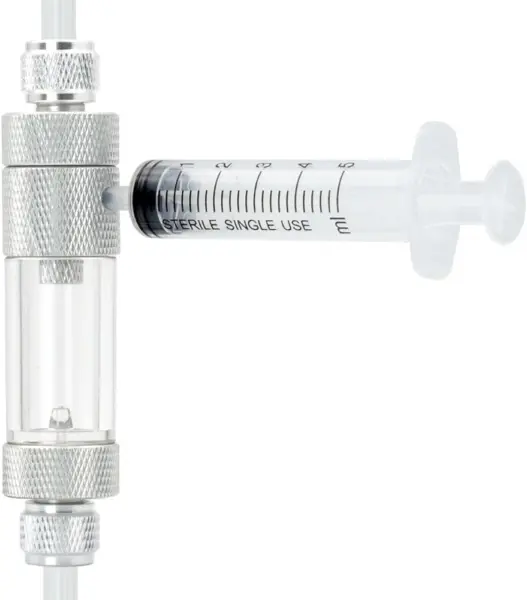
Topping up a bubble counter is the small chore that turns into a leak. The usual routine is to shut the CO2 off, unscrew the body, dribble water in, reseal it and hope the threads go back clean. LINLAN’s counter is built around skipping that. There is a fill hole in the body and a plastic syringe in the box, and the idea is that you push water through the port without taking the line apart.
The body is modular as well, splitting into a counting module and a quick-fill module, so it can run as a plain counter if the second part is not useful to you. We like that the extra piece is not baked in. The part we are watching is the fill-hole seal: a press-fit injector only works if it seats cleanly every time, and a slow drip there is easy to miss until the water level has dropped.
The plumbing is sensibly standard. CO2 working pressure is rated to 3 bar, well beyond what a planted tank runs at, one end takes 3/16 inch inside-diameter tubing and the other is an M10x1 male thread. Check your regulator’s thread before you order, because that is the number that decides whether this drops straight in or needs an adapter.
The rest is standard-size hardware, which is what you want under a tank: nothing proprietary to hunt down later when a part needs replacing.
Pros
- Refills through a fill hole, no disassembly
- Syringe included for clean top-ups
- Built-in check valve blocks backflow
- Modular body splits into two modules
Cons
- A second opening means a second seal
Our pick for anyone who tops up often: fill the chamber through a port with the included syringe and skip the unscrew-and-reseal routine.
Fdit Double Head Bubble Counter – Best for Two Co2 Lines
Key Features
- Body: Aluminum alloy, acrylic
- Heads: Two chambers
- Check valve: Built-in non-return
- Price: Midrange
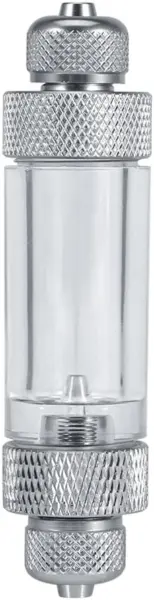
Two chambers on one body is the reason to look at this one. If a single regulator feeds two lines, either two tanks or two injection points in a big tank, this shows both bubble rates side by side instead of making you move one counter between them. It is the only counter in this group with that layout.
The build is aluminum alloy with an acrylic viewing section in silver, plus a built-in non-return valve. Installation runs in the usual order: thread it onto the regulator, add water, tighten the top cover, push the CO2 line on and secure the nut. Nothing about that sequence is fussy.
What we noticed is how much of the hardware goes unused on a single line. The second chamber still wants filling and still wants cleaning, and it sits empty while the first does the counting. For one tank we reach for the Clscea instead; the double head earns its higher tier only when both chambers have work to do.
Measure your line before you order. The ends use a cover and nut arrangement, and that is the fit that decides whether the counter goes into the system or back in the box.
Pros
- Two chambers show two rates at once
- Built-in non-return valve
- Aluminum alloy and acrylic body
Cons
- Second chamber adds filling and cleaning on one line
We keep this one for the two-line case: on a single tank, the second chamber is hardware you fill and clean for nothing.
Fdit Single Head Bubble Counter – Spare Tank
Key Features
- Heads: One chamber
- Chamber: Clear acrylic
- Check valve: Built-in non-return
- Price: Midrange
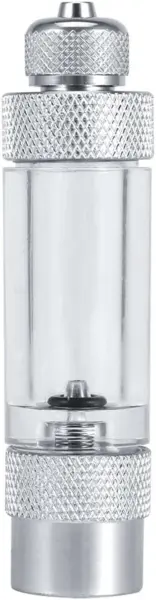
There is nothing clever here, and that is mostly the appeal. One clear chamber, a metal body, a check valve and a nut at each end: you screw it on, fill it, and count. No syringe, no fill port, no second head.
Where it loses ground to our top pick is the price. The Clscea does the same single-head job with metal ends and a stated 4/6 mm tube size for less money, so the Fdit is hard to justify as a first counter. We rate it as the second one instead: the spare for a quarantine tank or a nano cube, where you want a count without buying a feature set you will not use.
The shape is what we do like. A straight, narrow chamber keeps bubbles rising in a single line rather than swirling, which matters when the stream is fast and you are counting it. Fit is the thing to confirm: the top cover and fastening nut hold the line, so match your tubing before you tighten anything down.
Pros
- Built-in non-return valve
- Straight clear chamber reads cleanly
- Compact single-head body
Cons
- Costs more than our top pick for the same job
We rate it as a spare rather than a first counter: it counts fine, but the Clscea covers the same single-head job for less money.
How We Tested the Best Aquarium CO2 Bubble Counters
We started with the counters sold alongside regulators at planted-tank retailers, then narrowed the field to models with standard regulator fittings, a readable chamber, and a built-in check valve. Anything with proprietary threading, no check valve, or a body that felt brittle in hand was set aside before testing. We included a spread of prices, from budget to premium, because this is a category where spending more doesn’t always buy more. That left 14 counters, which we ran for five months.
I kept two running full-time on my own tanks—a 10-gallon nano cube on the desk and a 75-gallon in the living room—and rotated the rest through volunteers’ setups, including a high-light 40-gallon and a shrimp tank run at a slow bubble rate. At installation, I wrapped the threads with fresh tape, pressurized the system, and brushed soapy water around every joint; any counter that fizzed at the threads was marked down. To judge the count, I timed bubbles at one, two, and three per second with a stopwatch, then checked the same setting a week later to see whether the count had drifted or the bubbles had merged into slugs.
For build quality, I inspected the bodies and threads, refilled each counter, and watched for cloudiness or water creeping past the check valve after shutting off the regulator. I also tilted each unit and looked for leaks at the seals. For value, I compared how the least expensive counters held up against the priciest ones: did the extra money buy better sealing and a check valve that actually stopped backflow, or just a fancier body?
How to Choose an Aquarium Co2 Bubble Counter
Every counter in this group holds water, passes gas and shows you bubbles, so the decision comes down to how readable that bubble stream is, how much work a refill takes, and whether the fittings match what is already under your tank.
Readability decides whether you keep checking
A counter you have to crouch to read is one you stop reading, and a CO2 system nobody checks drifts. Shape is what makes a stream readable: a straight, clear chamber with a little width lets bubbles rise as separate beads, while a narrow tube turns a fast rate into a solid white column you cannot count. We put chamber shape ahead of almost everything else, because it is the part you deal with every day.
Fill level belongs in the same conversation. Water to roughly three-quarters gives the cleanest bubble formation, while a half-empty chamber splashes and skips. Note the level the first time you fill a new counter, so a drop is obvious later rather than something you discover when the count looks wrong.
The check valve is doing more work than the dial
The counter sits in the line between regulator and tank. When the solenoid closes or the cylinder empties, pressure on the tank side can push water back toward the needle valve, and water in a regulator is an expensive afternoon. A built-in check valve stops that, and all four counters here include one.
Where they differ is in how the valve is housed. A valve inside a metal end is less likely to distort under pressure than one set into a molded plastic cap. If you are still running an older counter without a valve, an inline check valve spliced into the tubing is inexpensive protection for everything upstream.
Refilling is the routine you will repeat most
Water evaporates out of the chamber, and every top-up is a chance to introduce a leak at the threads. Traditional counters want the CO2 off, the body unscrewed and the joint resealed; a fill-port design like the LINLAN’s lets you inject water with a syringe and leave the line alone.
That convenience is worth paying for if you check your bubble rate often or keep several tanks. If you top up rarely and your threads are sound, a plain screw-together counter is simpler, with one fewer opening that has to stay sealed.
Fittings: measure before you screw anything on
Aquarium CO2 tubing is usually 4/6 mm, meaning 4 mm inside diameter and 6 mm outside, the same as 3/16 inch ID. Most counters either push onto that tubing or thread onto an M10x1 connector, and a few do both. Measure the line you already own rather than assuming, because soft tubing stretches and a stretched line on a barb seeps.
If the counter threads onto the regulator, check the pitch first. Forcing a mismatched fitting is how threads get stripped, and a stripped thread ends a counter faster than anything else on this list. A wrap of thread tape at the connection is cheap insurance against a slow weep.
Frequently Asked Questions
How many bubbles per second should I run in a planted tank?
There is no universal number. Tank volume, lighting and how well your diffuser dissolves CO2 all shift it, so the counter is a consistency tool rather than a target you hit. Pick a setting, then judge it by your drop checker and your fish rather than by the bubble count alone.
If livestock start gasping at the surface, cut the injection back and increase surface agitation before you touch anything else.
Should I fill the bubble counter with tap water or distilled?
Distilled or RO water keeps the chamber clear longer. Tap water works fine, but the minerals leave a film on the inside of the tube that eventually makes the bubble stream hard to see, and once it has hazed you are soaking the body in a vinegar and water mix to bring it back.
Glycerin is the other option: it evaporates more slowly and makes fatter, easier-to-see bubbles, though it is thicker to rinse out. Decide which you are using before you fill, because mixing them makes a cloudy mess.
Do I still need a drop checker if I have a bubble counter?
Yes, they answer different questions. The counter shows the rate of CO2 going into the tank; the drop checker shows how much is actually dissolved in the water, which is what your plants and fish experience.
Use the counter for consistency, so today’s rate matches last week’s, and trust the drop checker when the two disagree.
How do I count bubbles per minute without staring at the tube?
Count for fifteen seconds and multiply by four, or film the chamber on your phone for a minute and count from the video at your own pace. A short window is easier to judge accurately than a full minute of watching, and the phone is the only practical way to count a fast stream.
Write the number down. The value of a counter is comparing today with last week, not the figure on its own.
Final Verdict
If you want one counter and no fuss, buy the Clscea. Metal at both ends, a clear polycarbonate chamber and a built-in check valve at the lowest price tier here is the combination that makes it our default, and nothing else in the group covers the same ground for less.
Refill convenience is the one reason to look elsewhere: the LINLAN’s fill hole and syringe spare you the unscrew-and-reseal routine if you top up often. And if a single regulator feeds two lines, the Fdit double head is the only counter here that shows both rates at once.