This post contains affiliate links. We may earn a small commission when you buy through our links — at no extra cost to you.
A canister filter that makes a racket or leaves puddles under the stand is a common frustration. Too many budget models develop hairline cracks in hose connectors or flatten their seals after a few months of regular cleaning. The good news is that certain engineering choices—well-braced plastic housings, high-quality O-ring rubber, and precision impellers—make all the difference.
The real separator is not the number of media trays but how the filter handles repeated pressure cycles and slight alignment shifts after cleaning. Designs with thick-walled canisters, smooth-locking mechanisms, and properly greased seals rarely become a puddle risk. The selections ahead reflect the units aquarists keep running silently year after year.
The right canister should fade into the background, letting you enjoy clear water without second-guessing your equipment. Each pick ahead is matched to a specific tank size and maintenance style so you land on the one that fits your routine—not the other way around.
Top Picks
Best for 55-100 Gal Tanks
Fluval 407

Rating: 4.5 ★ | Price: Premium | Flow Rate: 383 GPH | Noise Level: Ultra-quiet | Ease of Maintenance: Tool-free, EZ-Lift baskets | Leak Durability: Seals need lubrication | Included Media: Mech, bio, chemical
The Fluval 407 centers on quiet, easy-to-service external filtration for freshwater or saltwater aquariums. Its EZ-Lift basket stack gives you separate mechanical, biological, and chemical media access without turning maintenance into a full teardown, and the priming system keeps setup approachable for a premium-priced canister.
Water clarity is the main strength, especially for mid-to-large community tanks where a hang-on-back filter may be too visible or too limited. The flow rating suits tanks up to 100 gallons, though smaller aquariums can feel overpowered even at the lowest setting.
This is for aquarists with roughly 55- to 100-gallon tanks who want quiet cabinet operation, organized media access, and clear water without stepping up to a heavier large-tank canister. Seals may leak if not lubricated after cleaning, and a minority of motors stop within the first year, so it best fits buyers willing to do basic gasket care.
Pros
- Cabinet-friendly noise level keeps the filter from dominating quiet rooms.
- Strong water polishing helps keep mid-to-large aquariums visibly clear.
- Tool-free basket access makes media changes less tedious.
Cons
- After maintenance or outages, seals can weep if not seated carefully.
- Motor or impeller stoppage may require warranty attention or replacement.
The Fluval 407 is the canister filter to start with for a quiet, serviceable freshwater or saltwater setup in the 55- to 100-gallon range. Skip it for small tanks or if you want a filter that needs minimal seal upkeep.
Best for 100-250 Gal Heavy Stock
Fluval FX4
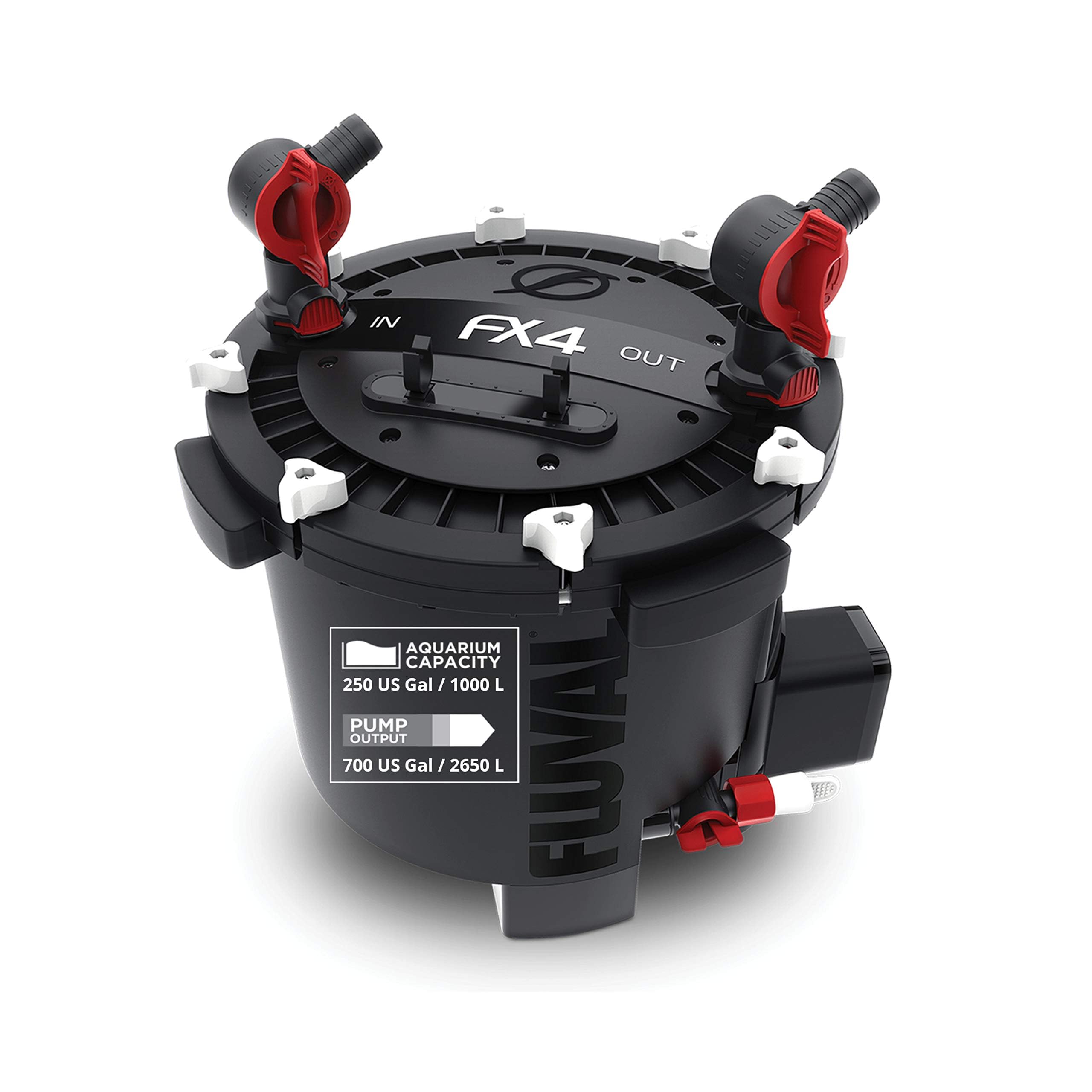
Rating: 4.5 ★ | Price: Premium | Flow Rate: 700 GPH | Noise Level: Quiet despite high power | Ease of Maintenance: Self-priming, drain valve | Leak Durability: No common leak reports | Included Media: All-inclusive bio media
The FX4 targets the niche the top pick doesn’t touch: tanks over 100 gallons with heavy bioloads. Its self-priming pump and integrated water-change drain make large-volume maintenance far less laborious than standard canisters. Media capacity is generous, and flow can be dialed down — though even the lowest setting may be too strong for tanks under 100 gallons.
This is the filter for oscar and turtle keepers who prioritize raw turnover and easy water changes over whisper-quiet operation or tool-free trays. The motor has been noted to stop working within months in some cases, and the warranty claim process can be a hassle — a tradeoff worth accepting only if your setup demands the FX4’s brute-flow capability and you’re prepared for occasional seal checks.
Pros
- Self-priming with built-in drain valve simplifies water changes
- Monstrous flow and media capacity for 100–250 gallon tanks
- Keeps water clear with messy fish and turtles
Cons
- Motor may stop working within months in some cases
- Warranty claim process can be frustrating when issues arise
Worth it for monster-tank owners who need brute flow and painless water changes, but only if you can accept a possible motor hiccup and are willing to navigate warranty service.
Best for Budget 65 Gal Tanks
Cascade 700

Rating: 4.3 ★ | Price: Mid-Range | Flow Rate: 185 GPH | Noise Level: Quiet for most | Ease of Maintenance: Push-button primer | Leak Durability: Cracks, leaks over time | Included Media: Floss, sponge, carbon
The push-button primer and simple, stackable tray layout make the Cascade 700 a genuinely approachable canister filter — water clears within hours at a price that’s hard to argue with. Unlike the top pick’s reinforced build, this model prioritizes upfront affordability over decades of rugged use. The plastic housing can develop cracks or leaks after a year or two of regular handling, so it’s best seen as a short-term solution or a secondary unit for tanks up to 55 gallons.
Pros
- Excellent value, delivering clear water at a budget price
- Quick setup and cleaning with push-button primer and handled trays
- Quiet operation that stays unobtrusive in most living spaces
Cons
- Plastic housing can crack or leak after a year or two of handling
If you need immediate, clear water on a budget and understand you may replace it within a couple of years, the Cascade 700 delivers where it counts.
Best for 75-100 Gal Uv
SunSun Hw303B
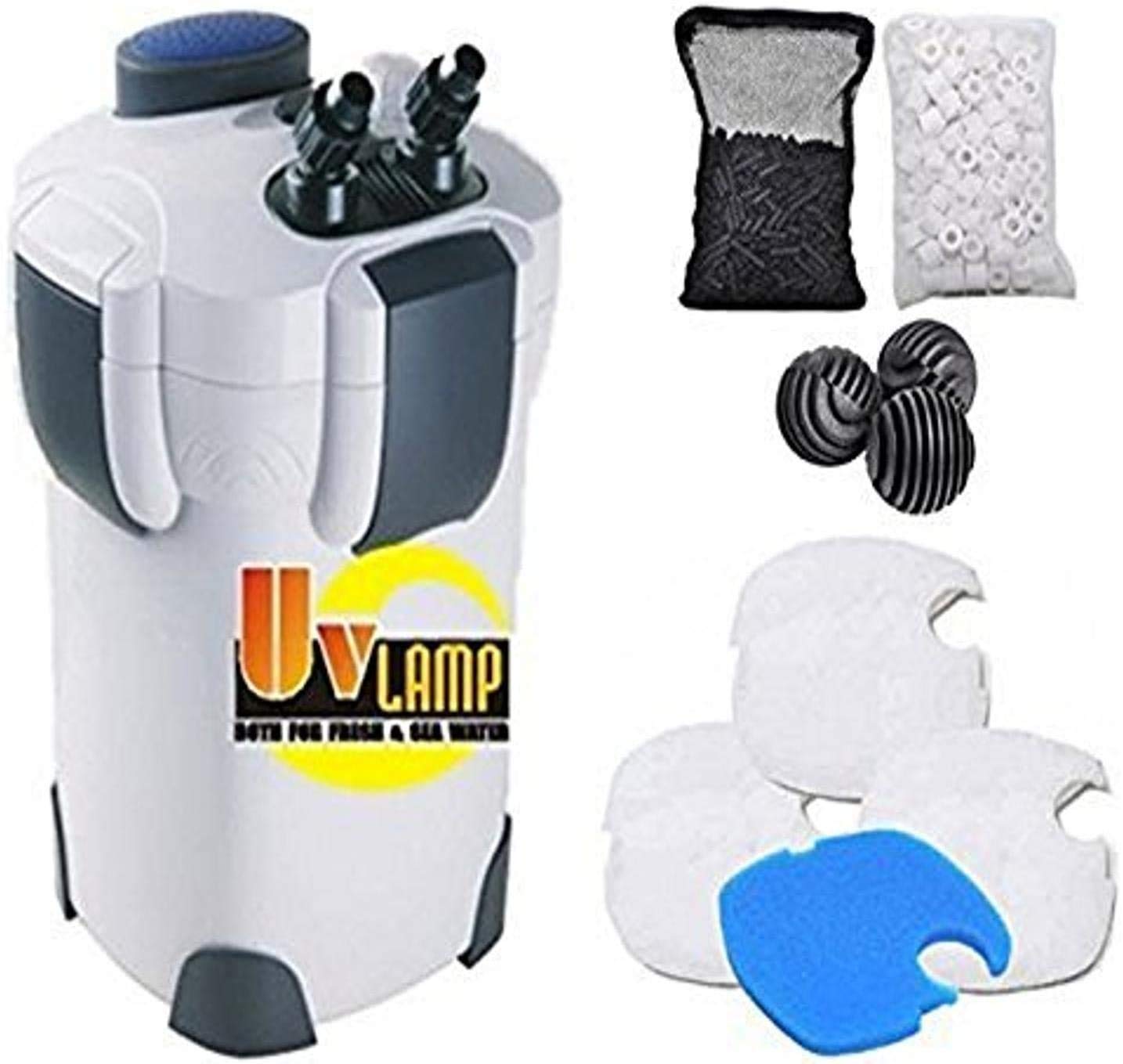
Rating: 4.3 ★ | Price: Mid-Range | Flow Rate: 370 GPH | Noise Level: Very quiet | Ease of Maintenance: 4 trays, easy setup | Leak Durability: Connector cracks if overtightened | Included Media: Sponges, bio, carbon, UV
The SunSun Hw303B delivers 370 GPH flow and built-in UV clarification that pushes it into a different tier than basic canisters, yet remains smaller and less bulky than its 150-gallon sibling. The four-tray layout and included biomedia offer ample capacity for large freshwater or saltwater setups, while the pump runs quietly enough for living areas. The tradeoffs are in the details: the plastic hose connectors feel flimsy and can crack if overtightened, so a gentle hand is essential. The UV bulb may burn out sooner than expected, though replacements are cheap. Aquarists who don’t mind those plastic fittings and occasional bulb swaps get a filter that punches above its price for keeping mid-sized tanks crystal clear.
Pros
- Filtration capacity well above its price point, keeping large tanks clean.
- Runs very quietly, making it suitable for living rooms.
- Maintains crystal-clear water in 75–100 gallon setups, even with heavy stock.
Cons
- UV bulb may need replacement earlier than anticipated, though replacements are inexpensive.
- Hose connectors are plastic and can crack if overtightened; a gentle hand-tightening is required.
For aquarists willing to handle plastic fittings with care and replace a UV bulb sooner, the Hw303B offers quiet, crystal-clear filtration and a sterilizer at a cost-effective price.
Best for Planted 66 Gal
Eheim Classic 250

Rating: 4.1 ★ | Price: Mid-Range | Flow Rate: 105-150 GPH | Noise Level: Dead silent | Ease of Maintenance: Manual prime, no quick disconnect | Leak Durability: Brittle clips, no leak pattern | Included Media: Mech, bio pads
The Eheim Classic 250 brings decades of German engineering that runs dead silent, making it a natural fit for planted tanks and CO2-injected scapes where gentle flow is essential. However, the multilingual instruction manual is nearly useless, and the green tubing aesthetic plus brittle plastic clips require patience and a YouTube tutorial for setup. This filter suits nostalgic hobbyists who value long-term reliability over modern convenience features like tool-free trays or self-priming.
Pros
- Dead silent operation when properly set up.
- Crystal clear water output with included high-quality media.
- Simple mechanical design that is easy to maintain over time.
Cons
- Setup requires a YouTube tutorial – the included multilingual manual is not helpful.
- Plastic hose connectors and clips can crack if overtightened or handled carelessly.
A classic choice for planted-tank enthusiasts who prioritize silent, gentle flow and decades-long operation over modern convenience.
Best for Clutter-Free 70 Gal
OASE BioMaster 2 Thermo
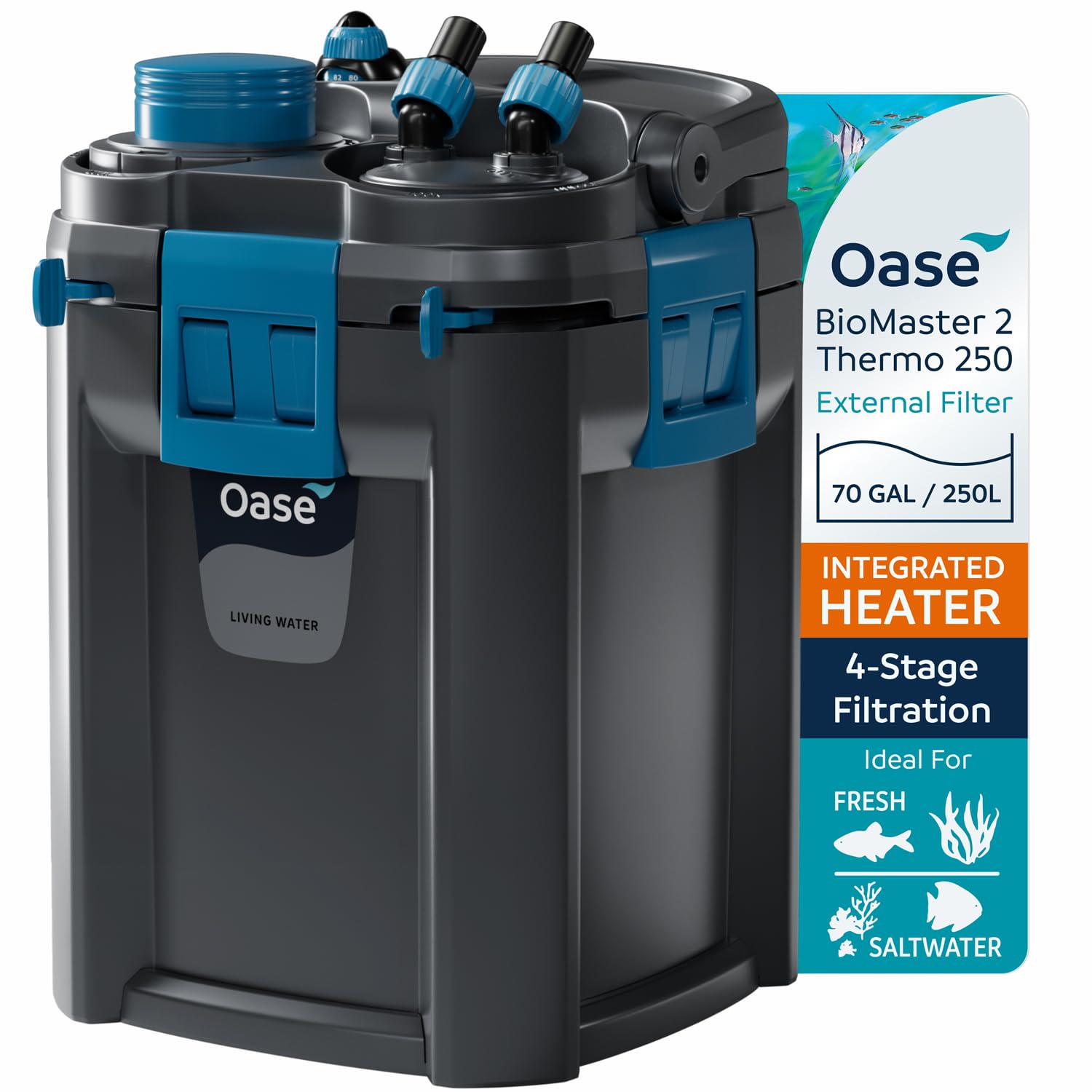
Rating: 4.7 ★ | Price: Premium | Noise Level: Silent (quietest owned) | Ease of Maintenance: EasyClean pre-filter | Leak Durability: Limited data, no leaks | Included Media: Hel-X biomedia
The OASE BioMaster 2 Thermo 250 combines an integrated 200W heater with a pre-filter module that cleans in seconds without disturbing the main media. This removes the need for an in-tank heater and simplifies routine maintenance compared to the standard BioMaster or the Fluval 407.
It suits aquarists who want zero visible equipment and value quick, mess-free filter upkeep. Best for tanks up to 70 gallons. Early units show occasional air purging if hose seals aren’t perfectly aligned, and long-term reliability under sustained use is not yet well-documented — worth considering if you plan to run the filter for many years.
Pros
- Silent operation — one of the quietest canisters on the market.
- Heater integration hides equipment and simplifies setup.
- Pre-filter cleans effortlessly without disturbing the main media.
Cons
- Air purging may occur if hose seals aren’t perfect.
- Durability beyond a couple of years is not yet established.
The BioMaster 2 Thermo is a clever all-in-one for aquarists who prioritize a clutter-free tank — just stay attentive to seal maintenance and treat it as a promising design with limited long-term feedback.
Best for 90 Gal Pre-Filter
OASE BioMaster 350

Rating: 4.3 ★ | Price: Premium | Noise Level: Quiet for most | Ease of Maintenance: EasyClean pre-filter | Leak Durability: Air purge, no water leak | Included Media: Spacious media trays
The pre-filter module lets you clean the mechanical sponge without opening the canister, preserving biological media — a genuine advantage for high-tech planted tanks. However, some units may draw air through imperfect hose seals, causing intermittent bubble spurts. Flow also feels modest for its 90-gallon rating, best suited to planted tanks where gentle circulation is an asset.
Pros
- Pre-filter module makes maintenance fast and mess-free — no need to open main canister.
- Spacious media trays and safety locks keep water contained during cleaning.
Cons
- In-tank bubbles can appear if hose seals are imperfect — careful setup is required.
Planted tank keepers who value fast, mess-free pre-filter cleaning and can methodically seal connections will find this filter a maintenance dream, especially if modest flow suits their setup.
Best for 150 Gal Uv Budget
SunSun Hw304B

Rating: 4.2 ★ | Price: Mid-Range | Flow Rate: 525 GPH | Noise Level: Some noise over time | Ease of Maintenance: 4 trays, easy access | Leak Durability: UV glass fragile, can crack | Included Media: Carbon, ceramic, bio, pads
The Sunsun Hw304B delivers 525 GPH and four large media trays with a built‑in 9‑watt UV sterilizer, keeping 100–150 gallon freshwater tanks crystal clear at a mid‑range price. The UV glass housing is fragile and can crack if tightened unevenly, and some units develop increased noise over time — making this a value play for aquarists who accept occasional part replacements rather than a set‑and‑forget fixture.
Pros
- High flow rate and UV sterilizer keep 100-150 gallon tanks crystal clear, offering a strong price‑to‑capacity ratio.
- Four large media trays with easy access make customizing filtration simple and maintain generous flow.
Cons
- The UV glass housing is fragile and may crack during maintenance, leading to water intrusion and leaks.
This filter earns its place in a budget‑conscious large‑tank setup where UV clarity is the priority and the owner is willing to handle the UV assembly with care.
Best for Small Budget Uv
PONDFORSE 225
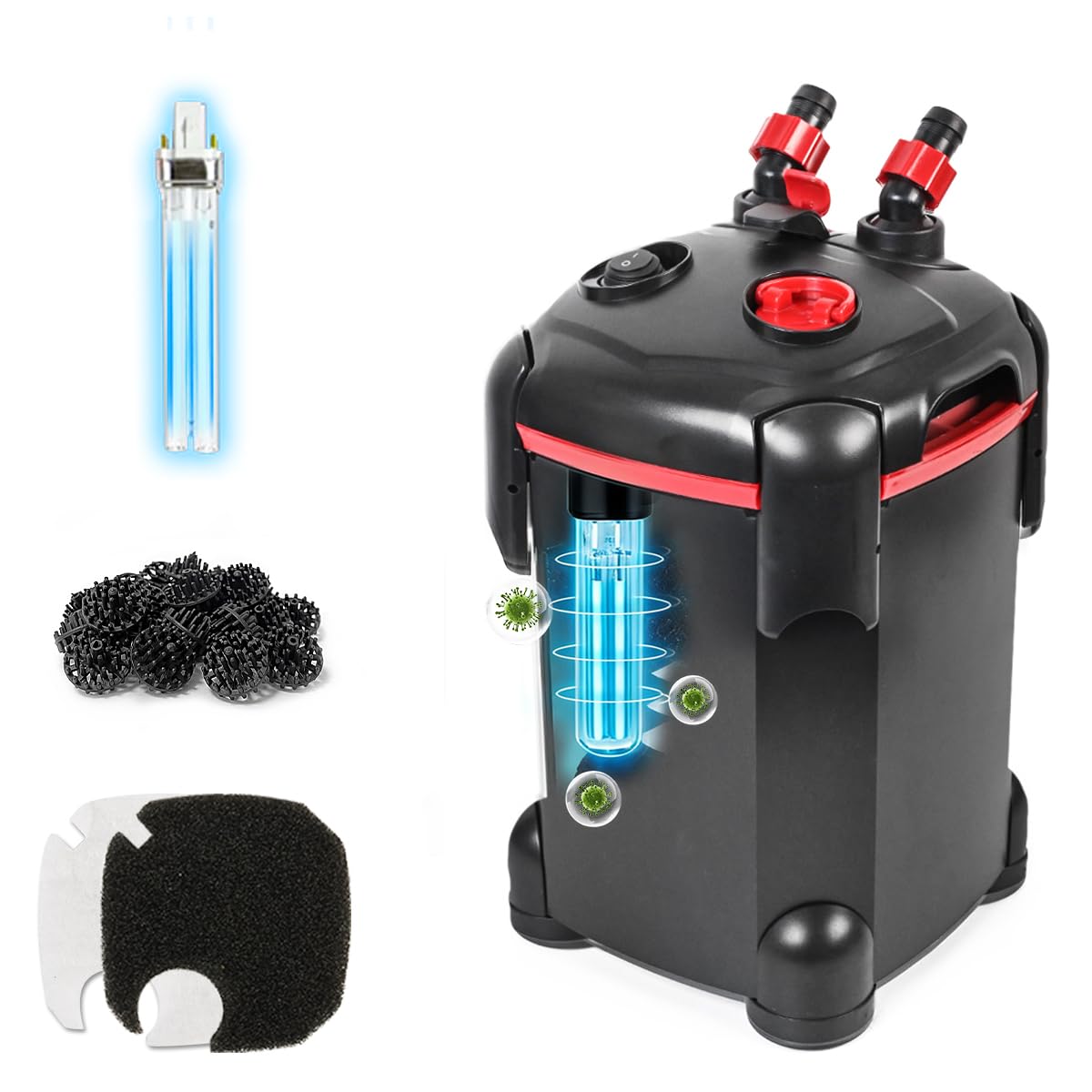
Rating: 4.1 ★ | Price: Budget | Flow Rate: 225 GPH | Noise Level: Incredibly quiet | Ease of Maintenance: Easy assembly | Leak Durability: Motor fail, limited leak data | Included Media: Sponges, balls, carbon
Unbelievably quiet for the price, the PONDFORSE 225 tucks away with its built-in UV that clears green water and algae blooms quickly. Motor reliability concerns mean it’s best suited for temporary algae outbreaks or small ponds where you can treat the whole unit as a short-term solution.
Pros
- Extremely quiet, with the air pump typically being the louder component.
- Built-in UV clears green water and algae blooms rapidly.
Cons
- UV bulb can fail early, sometimes after as little as 45 days.
If you need a quick algae fix for a small pond or temporary bloom and treat the whole unit as disposable, the price is right.
Best for Turtle 30 Gal
Zoo Med Turtle Clean 30

Rating: 4.3 ★ | Price: Budget | Noise Level: Very quiet | Ease of Maintenance: Easy disassembly | Leak Durability: Plastic cracks, leaks possible | Included Media: Carbon, ceramic rings
Quiet, easy-to-disassemble canister with carbon and ceramic media that keeps turtle tanks surprisingly clean. For general fish aquariums, motor reliability can be inconsistent, and similarly priced fish filters offer better long-term durability. It’s designed for aquatic turtles in 20–30 gallon habitats.
Pros
- Very quiet — only water splashing is audible
- Easy to disassemble and clean
Cons
- Plastic canister and clamps can crack over time
For aquatic turtle keepers who need a quiet, easy-clean filter in a 20–30 gallon setup, this fits the niche — but general-purpose fish tank owners will get better long-term durability from the Fluval 107.
How to Choose
A canister filter’s real-world flow rate is often half its advertised spec once media is installed, so choosing one rated for roughly double your tank’s volume is the surest path to silent, gentle circulation.
Flow Rate
Manufacturers test pumps empty, but foam, ceramic rings, and carbon pads all restrict flow. A 500 GPH unit on paper may only deliver 250 GPH inside a stocked aquarium.
For mixed freshwater tanks, aim for a true turnover of 3–4 times the tank volume per hour. If silence matters more than current, pick a filter advertised for 6–8x your tank’s actual gallons; the oversized pump will run at lower RPM and stay quieter.
Noise Level
A canister’s hum usually comes from impeller vibration, air trapped in the head, or the pump housing touching the cabinet wall. Precision-balanced ceramic shafts and soft rubber motor mounts reduce noise dramatically.
Even a dead-silent impeller can buzz if the canister lid isn’t fully sealed or the media layout creates air pockets. Placing a foam mat under the unit and keeping intake tubing fully submerged eliminates most unwanted sounds.
Ease of Maintenance
The chore of cleaning dictates how often you actually do it. Filters with tool-free lift baskets, a separate pre-filter sponge, or a quick-drain valve get serviced twice as often because they don’t require wrestling with a heavy, water-filled canister.
Models that force you to unscrew hose valves and carry the entire canister to a sink invite neglect. A simple pre-filter module you can rinse weekly keeps the main bio-media untouched for months.
Leak Durability
The #1 source of leaks is the main O-ring losing its seal after the lid is removed and reseated. A dry, pinched, or dirty gasket will leak even on premium canisters.
Food-grade silicone grease applied to every seal at setup, and after each deep clean, prevents drips. Pay attention to hose connections too—thick barb fittings with secure locking nuts resist cracking far better than thin, press-fit plastic.
Included Media
Basic kits bundle coarse foam, carbon, and some ceramic rings. More generous canisters include layered biological media and fine polishing pads, letting you skip an extra trip to the store.
Expandable tray systems are the real asset. Being able to add dedicated nitrate pads, purigen, or extra bio-media later means the filter grows with your tank’s bioload instead of becoming a bottleneck.
FAQ
Why does my canister filter leak after I clean it?
A cleaned filter often leaks because the main O-ring dried out, got pinched during lid closure, or collected a bit of debris. Lubricate the gasket with food-grade silicone grease every time you open the canister, seat it evenly around the rim, and tighten the lid slowly in a cross pattern. That five-second step stops nearly all post-maintenance drips.
How do I make my canister filter run completely silent?
First, make sure all air is purged by gently tilting the canister to release trapped bubbles. Check the impeller cavity for grit or wear, and place a soft foam mat under the unit to stop vibration transfer. If noise persists, ensure the intake hose isn’t sucking air from the surface and that no media is pressing against the pump housing.
Is a built-in heater in a canister filter worth it?
If you hate seeing cords and a glass tube inside the display tank, an integrated heater eliminates that clutter and heats water as it passes through the filter, providing even distribution. The trade-off is higher cost and less flexibility to replace the heater independently—when it stops working, the whole thermal circuit is compromised. It’s a clean-aesthetic choice, not a performance necessity.
Why does my canister filter keep sucking air and burping bubbles?
Air enters the system through a tiny leak on the intake side—often a loose hose clamp, a hairline crack in a strainer, or a water level too close to the surface. Inspect every connection from the tank to the filter body, replace brittle tubing, and keep the intake fully submerged. Even a pinhole will pull air and create a constant burping noise.