This post contains affiliate links. We may earn a small commission when you buy through our links — at no extra cost to you.
An anubias almost never arrives looking like the photo. It comes as a bare rhizome with a few leaves, sometimes a rubber band and a bag of water, and the first month decides whether you bought a plant or a slowly dissolving lesson. What a healthy one gives you is the closest thing a freshwater tank has to a sure thing — a plant that grows in dim light, needs no CO2, and survives fish that bulldoze everything else. That’s the appeal, and it’s also why it’s so easy to overpay for a weak one at checkout.
Over the past five months I’ve kept 16 anubias, spread across species and sizes, in tanks here and at my team’s places, and the first thing I’d tell a friend is that leaf count is a terrible way to shop. A three-leaf rhizome with a fat, firm base will outgrow a ten-leaf cutting with a skinny one, and it’ll hold its deep green while the other fades. The plants below are the ones that pushed new leaves, stayed firm at the base, and looked the same or better by month five.
Top Picks
Best for Midground Coverage
SubstrateSource Anubias Nana, 3 Pots

Rating: 4.5 ★ | Price: Premium | Light Needs: Low light | CO2 Injection: Not required | Pots Included: 3 | Height on Arrival: 4-6 in
Three pots is the whole argument. Anubias grows slowly — that’s the trade for a plant that tolerates low light and no CO2 — so a single pot leaves an obvious bare patch in the midground for months. Three pots of Nana at 4-6 inches gives you a clump to plant together behind a rock or a row to spread across the tank on the day it arrives.
They come rooted in wool, which is the only fiddly part: squeeze the pot, peel the wool back, rinse it off, and the rhizome is ready to tie to a stone, glue to wood, or sit in the gravel with the thick green stem above the surface. The roots were already long and pale out of the pot, the leaves dark green with no browning, and nothing came in on them that we could see.
In the tank it settles rather than sulking. A pot can stay together as a low bush, split into two, or be pushed into a gap between rocks, and it holds its color under an ordinary stock light. What it won’t do is fill quickly — a new leaf every few weeks is the pace, so the shape you plant is roughly the shape you have at the end of the season.
For most people setting up a first planted tank, this is where the money goes furthest: three plants, one order, enough material to build a real midground. Three pots also buys scheduling room, since an Anubias will sit in its pot in a bucket of tank water while you decide where things go. Plant two and hold the third back until you see how the first placement reads — that’s the habit we’ve settled into with a slow plant.
Pros
- Three pots of 4-6 inch Nana
- Grows in low light with no CO2
- Long roots already out of the pot
- Arrives clean, with no snails
Cons
- Pot-to-pot size varies more than the photos suggest
Our default for a first Anubias: three pots of low-light Nana, enough plant to fill a midground in one order.
Best for Nano Tanks
Marcus Nana Petite Pot

Rating: 4.6 ★ | Price: Budget | Pots Included: 1 | Leaves per Pot: 20-30 | Arrival Guarantee: Above 30°F
Nana Petite is a cultivar, not a small pot. The leaves stay thumbnail-sized however long you grow it, and one pot carries 20-30 of them crowded onto a single rhizome, which is why the plant reads as a dense dark rosette rather than a stem with a few leaves on it.
That density is what you’re paying for, and it travels well. The leaves come in a deep, almost blackish green, the rhizome underneath is thick enough that a pot often splits into two or three plants with a clean cut, and the roots are already gripping the wool. Split a pot and you can dot the pieces along a rock edge instead of planting one blob in the middle.
We plant it at the front — between stones, on a small piece of wood, along the edge of a sand path — and that’s the test we apply to it. As a midground plant it’s too small to carry the space, and no amount of waiting fixes that. Buy it for detail work and leave the mass planting to the Nana pots.
Pros
- 20-30 thumbnail leaves per pot
- Thick rhizome, often splits into two or three
- Deep green color that holds
- Live arrival covered above 30°F
Cons
- One pot per order, so a row means repeat orders
Small, dense, and easy to divide — we reach for this pot when the front of a nano tank needs finishing.
Best for Broad-Leaf Structure
Marcus Barteri Pot

Rating: 4.7 ★ | Price: Budget | Pot Width: About 2 in | Pots Included: 1 | Arrival Guarantee: Above 20°F
Barteri is the Anubias most people picture when they hear the name: broad, rounded, dark green leaves on a plant that reads as structure rather than texture. It’s the piece you put in the middle so the tank has a middle — a wide leaf canopy over a gap between rocks, with shade underneath for a shy fish or a few shrimp. The pot is about two inches wide, with roots already pushing out of it.
Two practical notes decide between this and the other singles. The live arrival guarantee here covers temperatures down to 20°F, ten degrees colder than the Nana Petite listing, which makes it the better order in a cold month. And the leaves came in clean, with no snail trail and no yellowing, which is the first thing we check on a potted plant. It’s slow even by Anubias standards — a broad leaf every few weeks rather than a bush — so give it the middle and let it get there.
Pros
- Broad, rounded dark-green leaves
- Live arrival covered down to 20°F
- Clean leaves, no snails in sight
- Roots already out of the pot
Cons
- Two-inch pot is a starter, not a specimen
Broad-leaf structure for the middle of the tank, and the one we order when the weather turns cold.
Best for Background Planting
SubstrateSource Hastifolia
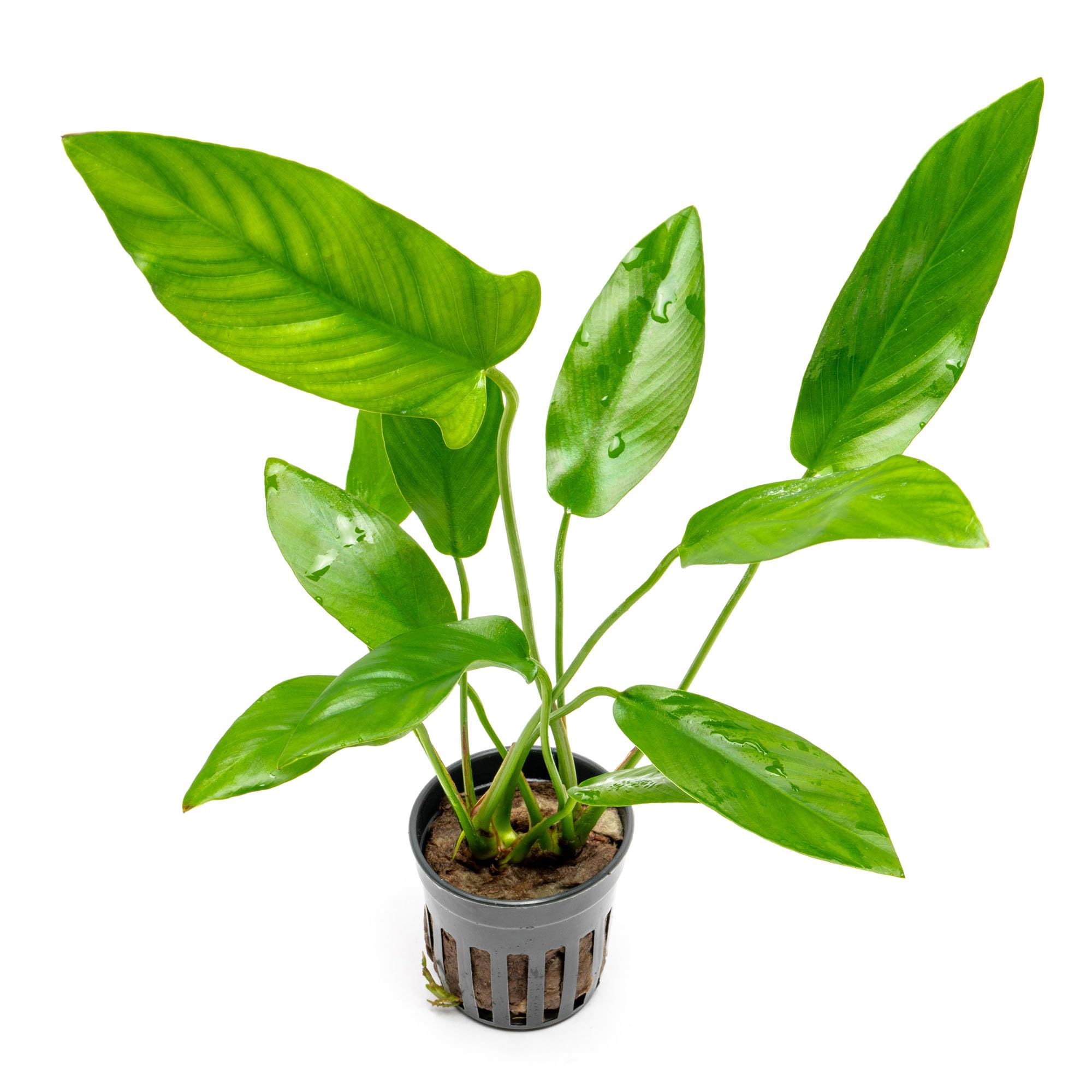
Rating: 4.5 ★ | Price: Budget | Light Needs: Low light | Expected Height: 10 in | Height on Arrival: 6-10 in
Hastifolia changes the scale of a tank. It ships 6-10 inches tall with long, spear-shaped leaves, and the listing puts the mature height around 10 inches — in a 20-gallon long that’s a plant that reaches for the waterline. The Nana pots here ship at 4-6 inches and the Petite is a fraction of that, so this is a different category of plant wearing the same genus name.
That size is why we rate it the best value here for a background. One pot covers a corner that three small Nana pots couldn’t cover in a season, it does it in low light without CO2, and the spear-shaped leaves give a different silhouette from the rounded Nana and Barteri — worth having if you’re planting more than one Anubias and don’t want them to blur into the same green mass.
The catch is the tank it goes into. Ten inches of Hastifolia in a nano cube is the entire aquascape, and you can’t trim it down to size without cutting leaves off, so there’s no version of this plant that suits a small tank. Put it at the back of something with depth, or put it back.
Pros
- Ships 6-10 inches tall
- Strong root system on arrival
- Spear-shaped leaves contrast with Nana
- Low light, no CO2 injection
Cons
- Too big for a nano tank, with no way to shrink it
For the back of a tank with real depth, this is the most plant we’ve found in a single pot here.
Best for Instant Placement
Aqualeaf Nana on Driftwood

Rating: 4.3 ★ | Price: Budget | Light Needs: Partial shade | Plant Height: 3 in | Driftwood Size: 1.5-2 in
This is the cheapest way into an Anubias and also the fastest: the plant is already attached to a piece of driftwood, so there’s no wool to peel, no thread to tie, no glue to set and no week of watching a rhizome float around the tank. Drop it in and the tank has a planted object in it. The wood is 1.5-2 inches.
The plants arrive settled onto the wood rather than strapped on as an afterthought, the color is deep green, and the pieces sink on contact instead of bobbing for a day. It’s the pick for a betta tank, a shrimp tank or a quarantine tub that needs somewhere for a fish to hide, since the wood gives cover before the leaves grow out.
What you accept at this size is a smaller margin for error. A small mounted plant carries less stored energy than a full pot, and die-back in the first week is a real risk — the potted picks in this guide arrive with more plant to lose. Watch the rhizome: firm and green means leave it alone and wait for new leaves, soft and brown means it’s over. On a piece this size, we don’t mind the gamble.
Pros
- Already attached and ready to drop in
- No wool, thread, or glue involved
- Sinks immediately and stays put
- Cheapest entry point in this guide
Cons
- 1.5-2 inch wood is an accent, not a centerpiece
The cheapest, simplest route to an Anubias in the tank this afternoon — and we mean that literally.
Best for Trying Three Species
Aqualeaf 3-Species Bundle
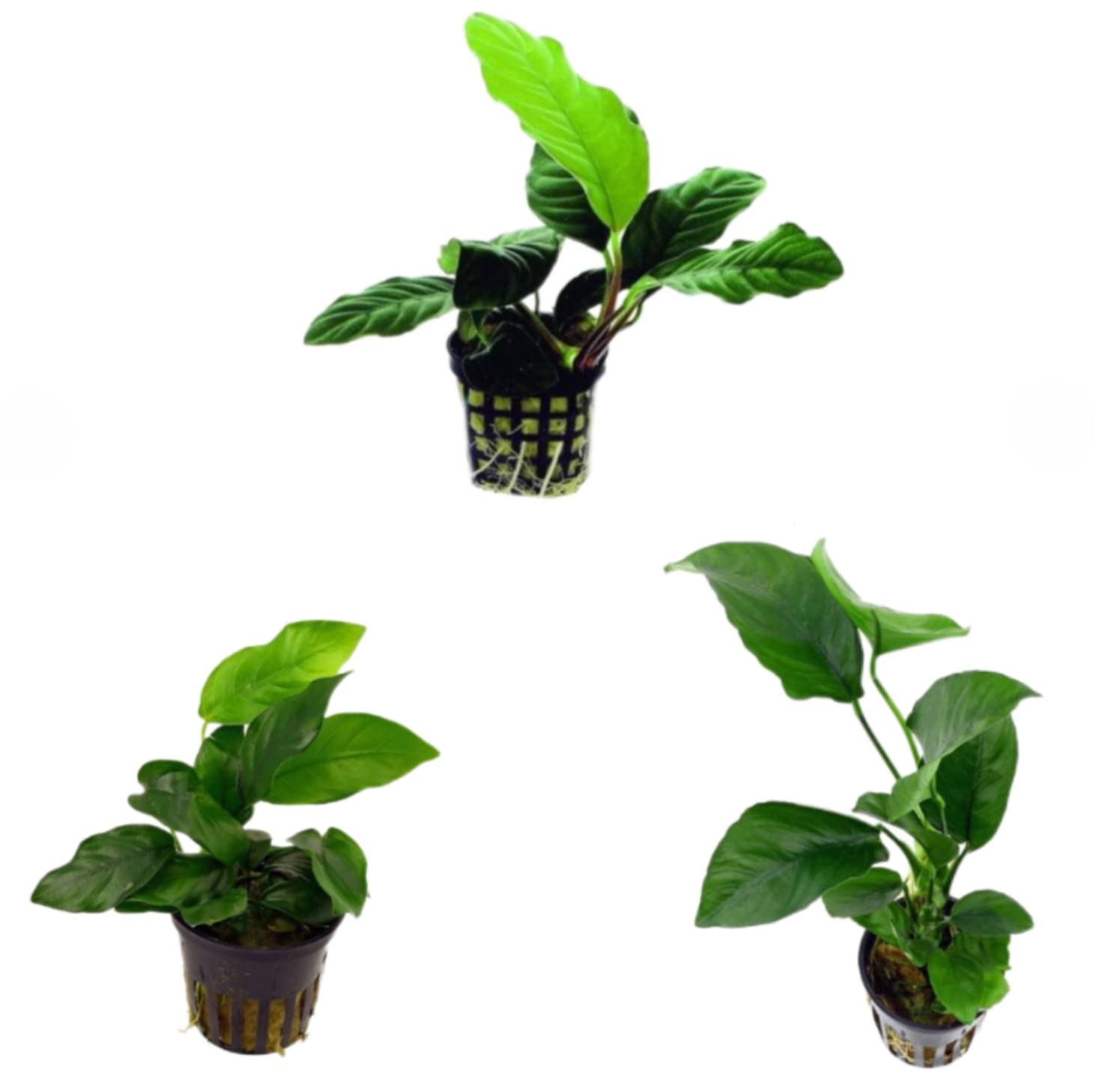
Rating: 4.4 ★ | Price: Midrange | Placement: Pot, planted, or driftwood | Pots Included: 3 | Species Included: Nana, Barteri, Coffeefolia
Three pots, three species: Nana, Barteri and Coffeefolia. If you’ve never grown an Anubias and don’t know which one your light and your eye will reward, this is the sampler — and Coffeefolia is the reason to consider it, with wavy, textured leaves that look nothing like the flat green of Nana. You can’t buy that species on its own in this guide.
In the tank we found the three read as genuinely different plants, which is the point of a bundle rather than three random pots. Barteri supplies the width, Nana the middle, Coffeefolia the texture, and each can stay in its pot, go into the gravel or be tied to wood depending on where it looks right. The pots are small but not token — this is a real planting, not a sample pack.
The judgment is that this is the cheapest education in the genus. Three species in one order, a chance to see which one your light rewards, and enough rhizome on each to split later. If you already know you want a wall of Nana, buy the Nana; if you’re still deciding, this decides for you.
Pros
- Three species, including Coffeefolia
- Each can stay potted or be attached
- Three distinct leaf shapes in one planting
- Arrives green and well packaged
Cons
- Small pots, so the bundle looks sparse for the first month
We point anyone who hasn’t settled on a species here: three Anubias in one order, Coffeefolia included.
Best for Nano Aquascaping
Nana Bonsai, 5 Plants
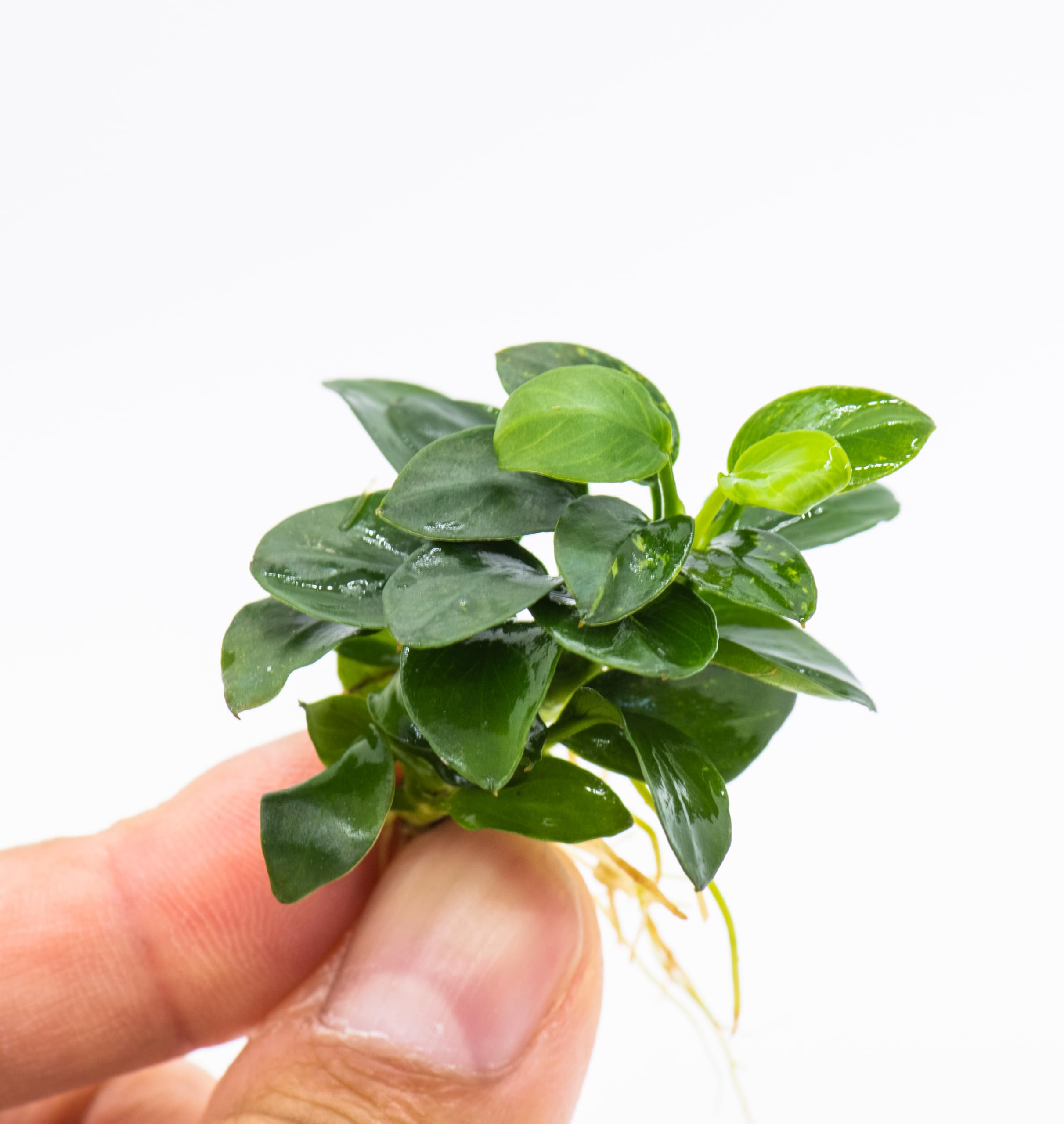
Rating: 4.8 ★ | Price: Premium | Form: Clump or loose | Light Needs: Partial shade | Plants Included: 5
Bonsai is the Anubias that looks bred rather than collected: short stems, leaves crowding into a rounded dome instead of fanning out, and a deep green that holds under ordinary tank light. It’s the closest thing here to a bush you can put in a nano tank, and this listing sells five plants rather than one pot.
Five is the useful number. Each plant is small, but the rhizomes are thick enough to divide, so you can dot them along a piece of wood, cluster two in a front corner, and still have one left for a shrimp tank. We found the plants arrive healthy with good root systems, and the color deepens once they’ve settled in.
The trade is speed. Bonsai is as slow as any Anubias, so the dome you’re picturing is months away. What you get instead is a scape that looks planted in the first week, because five separate clumps read as a colony rather than one lonely plant in the middle of a lot of gravel. For a nano cube or a shrimp tank, that’s the look worth paying for.
Pros
- Five plants rather than one pot
- Dense, rounded bonsai-type foliage
- Thick rhizomes that divide
- Deep green under ordinary light
Cons
- Small plants; five cover less ground than the count suggests
Five small Bonsai clumps beat one larger plant in a nano tank or a shrimp colony, in our book.
Best for Small Tank Accents
Anubias Petite on Driftwood

Rating: 4.3 ★ | Price: Midrange | Light Needs: Low to moderate | Driftwood Size: 1-2 in | Water Temperature: 72-82°F
A 1-2 inch piece of driftwood with a Petite already wrapped onto it — boil-treated, pre-drilled, and ready to sink. It’s the smallest footprint in this guide: an accent you can drop beside a filter or into the corner of a five-gallon without rearranging anything.
The photographs are the part to get past. A close-up of a two-inch piece of wood against a white background reads as a much bigger object than it is, and that gap between picture and box is where most of the disappointment with mounted plants this small comes from. Measure 1-2 inches against your own tank before ordering; if you want something that anchors a scape, this isn’t the piece.
Die-back in the first week is the other risk. A small mounted plant has less stored energy to draw on than a full pot, and some arrive and fade within days of going into a tank. There’s nothing to do but watch the rhizome — firm and green means wait for new leaves, soft and brown means the plant is gone. Keep it in low to moderate light and leave the rhizome exposed.
We keep it for a small tank that needs an object rather than a planting project — a betta tank, a shrimp cube, a hospital tank. The wood is treated, the plant is placed, and the whole thing goes in during a water change. For a display tank, buy the driftwood-mounted Nana or a pot and mount it yourself; for a five-gallon on a desk, this is the easy answer.
Pros
- Ready to drop in, no tying or gluing
- Boil-treated, pre-drilled wood that sinks
- Small enough for a five-gallon tank
- Gives fish and shrimp cover
Cons
- Wood is under two inches — smaller than the photos suggest
We keep this one for small tanks: pre-mounted, pre-treated, and small enough to drop in beside a filter.
How We Tested 16 Anubias Over Five Months
We started with every anubias sold by specialist aquatic nurseries and the larger online aquarium retailers — the unnamed assorted plants, the named varieties that cost more, and the potted and bare-rhizome versions of each. Listings that wouldn’t state rhizome size, sellers with a history of shipping single-leaf cuttings, and any plant whose photo didn’t match its species name got cut. That left 16 plants, which we ran through five months in real aquariums.
Every plant was unpacked on the kitchen counter, photographed next to a ruler, and checked leaf by leaf before it went near water. We squeezed the rhizome to judge firmness, looked for soft brown patches that signal rot, and turned each leaf over to check for snail egg clusters and algae. Leaves were counted and their color noted — saturated forest green versus pale or yellow-tinged — so we had a baseline to compare against later.
The plants spent the next five months wedged into rock crevices and tied to driftwood in three tanks: a low-light 20-gallon, a medium-light setup, and one housing cichlids that redecorate constantly, which is where we learned how much abuse the leaves could take. Every two weeks we counted new leaves as they unfurled, checked for torn or yellowing foliage, and noted how much algae settled on the leaf surfaces. At the end we compared what we’d paid against the rhizome we actually received, because large means wildly different things from one seller to the next.
By week six the pattern was obvious. Firm, thick rhizomes with clean undersides settled in and started pushing new leaves, while thin ones stalled and dropped leaves from the outside in. The survivors are the ones you’ll find below.
How to Choose an Anubias
Every Anubias here grows in low light without CO2, so the decision comes down to three things: the size of the plant, the form it arrives in, and whether it survives the trip.
Match the Cultivar to the Space
Anubias cultivars differ mostly in leaf size and final height, and that decides where they go. Petite and Bonsai stay small enough for the front of a nano tank and the gaps between stones. Nana is the all-purpose middle. Barteri’s broad leaves suit a midground focal point, and Hastifolia, at 6-10 inches on arrival, is a background plant that needs a tank with depth.
The trap is judging by the listing photo, which shows a mature clump rather than the pot that ships. Read the shipped height instead, then picture it roughly doubled once the plant has settled into your light. A plant that arrives at six inches is not going to look like the product shot in a month.
Potted, Mounted, or a Bundle
A pot gives you the rhizome and the choice: leave it in the pot, plant it into the gravel, or tie it to a piece of wood. Mounted plants cost more per plant but arrive placed, which matters when you’re outfitting a quarantine tank or setting up a small tank in an afternoon. Bundles are for the undecided, letting you see which species your light rewards before you buy multiples.
Whatever arrives, the wool packing comes off before the plant goes anywhere near the tank. The pots are shipping containers, not planting sites — though an Anubias will live in its pot indefinitely if that’s where you want it.
The Rhizome Rule
Anubias grows from a thick horizontal stem, and that stem has to stay above the substrate. Bury it and it rots, which is the single most reliable way to kill one of these plants. Tie the rhizome to a stone with thread, glue it to driftwood with a cyanoacrylate gel, or wedge it between rocks and leave the roots free to grip.
If you’re planting into gravel, push the roots in and leave the stem sitting on top. It’s the one rule that decides whether the plant lasts or rots, and it applies identically to a two-inch Petite and a ten-inch Hastifolia.
Ordering Live Plants in Cold Weather
Live plants are the one aquarium purchase where the forecast matters. Sellers set a temperature floor on their live arrival guarantee — 30°F on the Nana Petite listing, 20°F on the Barteri — and ordering below it voids the cover. Choose the seller with the lower floor if you’re buying in a cold month.
Order early in the week so the box doesn’t sit in a depot over a weekend, and open it the day it lands. A heat pack helps; it doesn’t rescue a week in a freezing truck.
How Much Plant You Actually Need
Anubias is slow, so buy the amount of plant you want to see now, not the amount you hope to grow into. One Petite pot finishes a palm-sized spot. A 4-6 inch Nana pot covers a hand’s width of midground, which is why three pots suit a 20-gallon. A single Hastifolia fills a back corner on its own.
If you’re scaping a new tank, budget one more pot than you think you need. The spare is what stops you from planting everything in the wrong place because you ran out of plant.
Frequently Asked Questions
Do Anubias need CO2 or fertilizer?
No CO2 injection is needed. Every plant here is sold as a low-light, no-CO2 plant, and they grow under an ordinary tank light. Add a liquid fertilizer if new leaves come in pale or yellow, and skip the special substrate — the rhizome feeds from the water, not the gravel.
Why is my new Anubias losing leaves?
Most Anubias are grown with their leaves above water, and they shed some of those when they go under. If the rhizome is firm and green, the plant is fine and new submerged leaves follow within a few weeks.
If the rhizome is soft or brown, it’s rotting — usually because it was buried, or because the wool was left packed around it.
Will live Anubias bring snails into my tank?
It can happen with any live plant, whatever the seller. Rinse the wool off in a bucket, look at the undersides of the leaves and at the wood, and pick off anything moving. If you keep shrimp or care about a snail-free tank, hold the plant in a separate container for a couple of weeks and check it before it goes in.
How fast does Anubias grow, and will it carpet?
Slowly. A new leaf every few weeks is normal in a low-light tank, and faster with more light and fertilizer. It won’t carpet: it grows from a creeping rhizome and spreads by sending out new growth points, so treat it as a focal plant to attach to wood or stone. If you want a ground cover, choose a different plant.
Final Verdict
Three pots of SubstrateSource Nana is the answer for most tanks: enough plant to build a midground in one order, low light, no CO2, and a species forgiving enough to survive a first attempt at live plants.
Change the tank and the pick changes. A nano cube wants the Petite pot, a deep tank with a bare back corner wants the Hastifolia, and a five-gallon on a desk wants the mounted Nana that goes in during a water change.