This post contains affiliate links. We may earn a small commission when you buy through our links — at no extra cost to you.
A failed molt is the quiet panic of freshwater shrimp keeping. One day the colony is grazing; the next there’s a white ring on a neocaridina and you’re searching whether aquarium salt will help or make things worse. I’ve been there with a cherry shrimp tank of my own, and the answer comes down to what’s in the jar. Plain sodium chloride with no iodide or anti-caking agents can support osmotic balance during stress and buy time in an emergency; the wrong formula can cloud water or push parameters your shrimp are already balancing.
Salt isn’t a cure-all — it’s a measuring tool, and freshwater shrimp are less forgiving of a heavy hand than most fish. Over four months, my team and I tested 14 shrimp-safe salts through routine water changes, a nitrite spike, and a quarantine setup, checking ingredient accuracy, water quality, cost per gallon treated, and how the shrimp looked and molted. We opened every container and used it to the last scoop to see which stayed usable. The picks below are the ones I’d keep.
Top Picks
Best for Ro and Rain Water
Salty Shrimp Mineral GH/KH+

Rating: 4.7 ★ | Price: Premium | Dose: 2 g per 10 L | Form: Powder | Net weight: 3.53 oz | Raises GH to: 6 dGH
Two products in this aisle wear almost the same label and do different jobs. A freshwater aquarium salt adds sodium and chloride; this pouch adds the calcium and magnesium your test kit reports as GH, plus the carbonate that reports as KH. For an animal that has to shed its shell every few weeks, the second is the purchase that matters. A level spoon — roughly 2 grams — treats 10 liters, and the listed target is 6 dGH from water that starts with almost nothing.
Water that starts with almost nothing is the whole point. This is built for RO, rain, or desalinated water, and it’s the only pick here that lifts GH and KH in the same dose, which is exactly what a neutral-pH Neocaridina tank wants. We hand it to anyone starting a colony from scratch and mixing their own water. The routine is a bucket, a spoon, and a five-minute test, and by the third mix you stop measuring the powder and start reading the kit.
The catch is consistency. The GH-to-KH ratio doesn’t land in precisely the same place from one mix to the next, so treat the label dose as a starting point and your test kit as the real instruction. That’s an annoyance rather than a dealbreaker at this size: 50 doses at the stated rate is close to a year of weekly changes in a nano tank, so you learn your own water instead of fighting a new batch every month.
Pros
- Raises GH and KH together in one dose
- Built for RO, rain, and desalinated water
- About 50 doses in a 100 g pouch
Cons
- Costliest per gram of the minerals here
If you’re building shrimp water from RO or rain, this is the one we recommend: it restores both hardness axes in a single spoon.
Best for Caridina Bee Shrimp
Salty Shrimp Bee Shrimp Mineral GH+
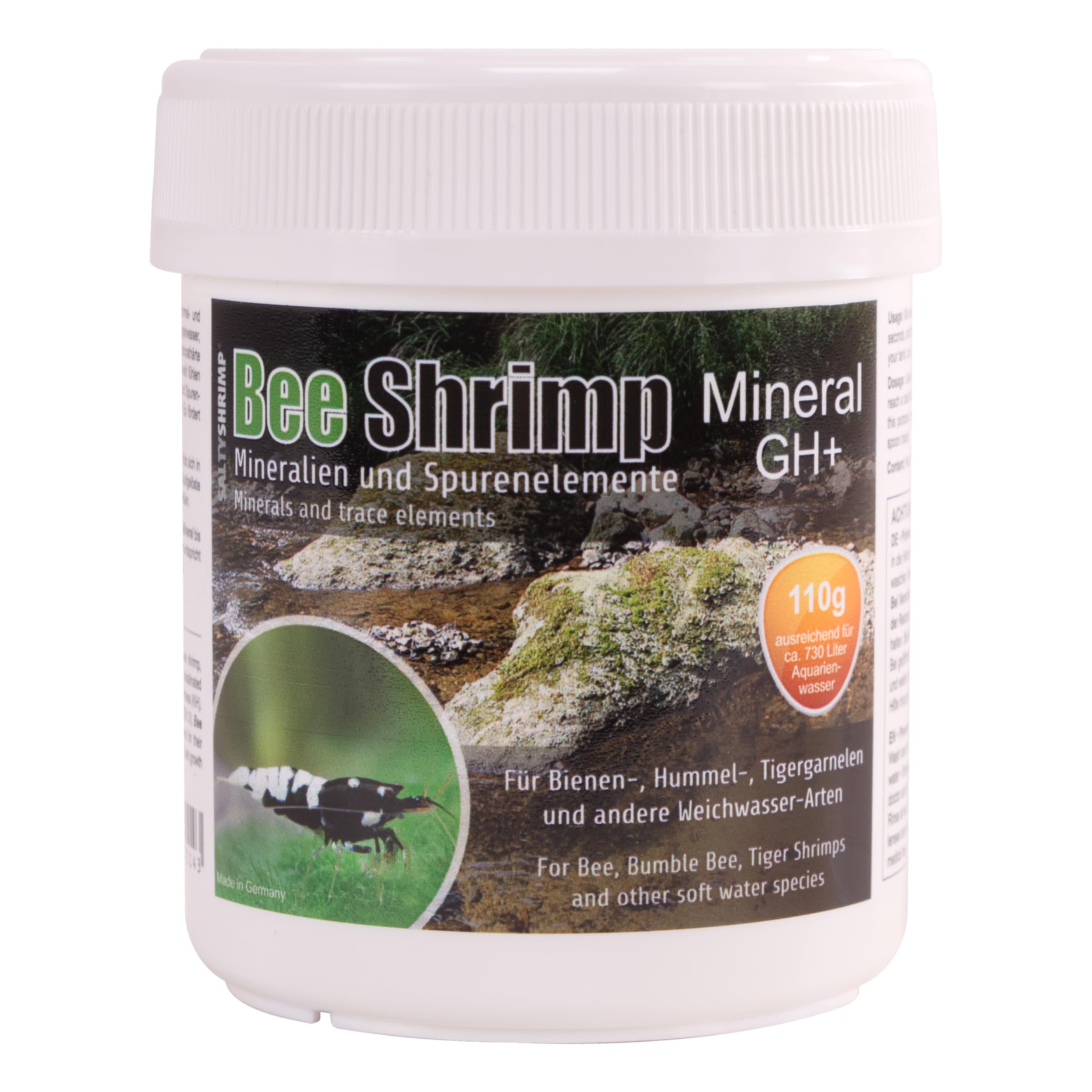
Rating: 4.8 ★ | Price: Midrange | Form: Powder | Net weight: 3.88 oz | Target shrimp: Bee shrimp | Hardness added: GH only
Bee shrimp keepers are a distinct crowd, and this pouch is aimed straight at them: Caridina kept on an active, buffering substrate at low pH. It raises GH without the carbonate side, which is what that setup wants — the substrate is already holding pH down and doing the buffering work, so adding KH spends the buffer you paid for. We like it for that tank, and it earns its place because it does one job rather than two.
Breeding is the real test with Caridina, and the good outcomes here are about berried females and shrimplets that make it, not just shrimp that stayed alive for a few months. That’s the line between a mineral that keeps animals ticking over and one that gets a colony to expand, and it’s why this pouch sits near the top of our set on a very narrow brief.
There’s a value argument alongside it. A 110 g pouch of GH-only powder stretches further than the GH/KH+ pouch, and if your substrate handles the carbonate side you aren’t paying for a second mineral you don’t need. Start below the rate you think you need and raise GH across a couple of water changes rather than in one go — with Caridina, slow is the technique.
Pros
- GH without pushing KH in a buffering tank
- Cheaper per gram than the GH/KH+ pouch
- Purpose-built for Caridina, not adapted from a fish product
Cons
- Wrong tool for a neutral-pH Neocaridina tank
Our pick for Caridina on a buffering substrate, where hardness is welcome and KH is not.
Best for Nano Shrimp Tanks
Crystalpro Shrimp Minerals

Rating: 4.7 ★ | Price: Budget | Form: Liquid | Volume: 4.22 fl oz | Parameters: GH, TDS, pH | Target species: Shrimp, invertebrates
Liquid minerals deliver less mineral per container than powders do, and this bottle is still the cheapest way into the category — a low-commitment start for a nano tank that doesn’t justify a pouch. It’s a trace-element and mineral supplement aimed at both Caridina and Neocaridina, and it’s the version we suggest to someone who has never dosed minerals before.
The appeal is the format. There’s no powder to weigh, no dust cloud over the tank, and no half-dissolved grit at the bottom of the bucket: you measure, add it to your change water, and carry on. On a five-gallon tank, where a 2-gram scoop is a serious fraction of the dose, that convenience is worth more than it sounds.
What we tell people to watch is the test kit. A liquid is easy to pour, which makes it easy to over-pour, and the only way to know it did what you wanted is a GH and TDS reading before and after — mineral liquids move some tanks more than others. It won’t do much for KH either, so if carbonate hardness is your low number, this isn’t the bottle that fixes it. Buy it for convenience, not for a two-for-one.
Pros
- No powder to weigh or dust into the tank
- Lowest entry cost of the shrimp minerals here
- Suits both Caridina and Neocaridina tanks
Cons
- Cap may not seat evenly and can leak
We point first-time dosers here: a liquid mineral that skips the weighing and costs the least of the shrimp products in this guide.
Best for Fish Quarantine Tanks
API Aquarium Salt

Rating: 4.7 ★ | Price: Budget | For: Freshwater tanks | Use: Fish health and recovery | Form: Granules | Net weight: 67 oz
Sixty-seven ounces is a lot of salt. The box we keep under the stand has outlasted a quarantine setup, a couple of water changes a month, and at least two problems it was bought for, and it’s still going. If you want one container that covers routine dosing and the emergency you haven’t had yet, this is that container.
What it’s for is fish, and the labeling doesn’t pretend otherwise: electrolytes, easier respiration, and support during treatment, plus a pinch at water changes and when a tank is first set up. We reach for it for a hospital tank, a fish that’s been knocked around, or the first day after a shipment arrives — you’re adding a pinch, not building water from scratch, so there’s nothing to calculate.
How it goes in matters more than how much. Granules dropped straight into a small tank sit in a concentrated pocket before they dissolve, and that’s where a salinity swing comes from, so we dissolve the dose in a cup of tank water first and pour it in slowly. If you’re raising the level over several days, do it in steps and watch the fish rather than the calendar.
Pros
- Enough salt to last years of routine changes
- Dissolves readily when pre-mixed in a cup
- Handy for fish illness and quarantine
Cons
- A fish-side salt, not a shrimp mineral supplement
The box we keep on the shelf for fish: electrolytes, treatment support, and enough salt to outlast the problem.
How We Tested the Best Shrimp-Safe Aquarium Salts
We started with a shortlist of more than two dozen salts sold for freshwater aquariums and narrowed it by reading every ingredient panel, cross-checking labels against known shrimp-safe formulations, and dropping anything listing iodide, anti-caking agents, or vague aquarium salt blends that couldn’t tell us what was inside. Price per gallon treated and container size mattered, but only after the label passed that first filter. That left 14 products, each of which we used in my own shrimp room for four months.
Testing happened where shrimp actually live: routine water changes on two neocaridina tanks, a nitrite spike that hit a grow-out tank, and a quarantine setup for a few new arrivals. I mixed each salt in a marked container and noted whether it dissolved clear or left grit, then checked pH, GH, and KH before and after dosing to see if the water stayed where the shrimp needed it. During the nitrite spike, I logged how quickly the salt went into solution when I needed it fast and whether the shrimp stayed active rather than clamped or hiding.
For salt quality and longevity, I opened every container on the first day and kept it loosely sealed between uses, noting clumping, caking, or a change in how easily it scooped after repeated humid weeks. I also watched molts — full shells, stuck rings, deaths — and compared cost per gallon treated so a cheap scoop wasn’t hiding a weak dose. The salts that scored best were the ones that dissolved without residue, kept water parameters steady, and still scooped cleanly at the end of the test.
How to Choose Salt and Minerals for a Shrimp Tank
The single most useful thing to know before you buy anything is that freshwater aquarium salt and shrimp mineral supplements do different jobs, and a shrimp tank almost always needs the second one.
Salt and minerals are two different purchases
Aquarium salt is sodium chloride. It adds electrolytes, helps fish respire, and gets used for treatment and routine water changes. It does not raise general hardness, because GH measures calcium and magnesium, not sodium. A shrimp mineral supplement is the other kind of product: it builds GH, and sometimes KH, the carbonate buffer that keeps pH steady — the minerals a shrimp draws on when it sheds its shell.
Read your test kit before you read a label. Low GH points to a mineral supplement; a fish with a nipped fin points to salt. Buying the wrong one is the most common mistake in this aisle, and it isn’t obvious from the packaging.
Match the mineral to your shrimp and your substrate
Neocaridina — cherry, blue dream, and the rest — generally want neutral pH and both hardness axes, which is what a GH/KH+ powder is for. Caridina such as bee and crystal shrimp are usually kept on an active buffering substrate at low pH, and there you want GH only. Adding KH to that tank works against the buffer holding your pH down, so you spend money undoing something you already paid for.
The trap is that both products come in near-identical pouches. If your substrate is an aquasoil, buy the GH-only version; if you’re running inert gravel or bare-bottom, buy the GH/KH+.
Start with your source water
Remineralizers are built for water with nothing in it: RO, rain, or desalinated. If you’re on hard tap water, your GH may already be at or above where you want it, and a mineral salt pushes it further — test the tap first, and if you need to come down, blend tap with RO rather than dosing blind.
This is also why the same pouch can be a miracle in one tank and a waste of money in another. The product isn’t inconsistent; the starting water is different. Know your numbers before you choose a dose, not after.
Powder, liquid, and dosing a small tank
Powders are cheaper per dose and let you fine-tune by the gram. Liquids are easier to pour and much harder to overshoot badly, which is worth something on a nano tank where a level spoon is a serious fraction of the total. Pick based on how fussy you want the ritual to be, not on which looks more scientific.
Either way, mix into the water you’re adding rather than into the tank, and keep a GH test kit next to the container. A scale that reads single grams earns its money back the first time you avoid a hardness spike.
Frequently Asked Questions
How long will a pouch of shrimp minerals last?
Salty Shrimp’s GH/KH+ doses at about 2 g per 10 liters, and the pouch holds 100 g, so it’s roughly 50 mixes. If your weekly water change is around 10 liters, that works out to about a year of dosing from one pouch.
Buy the small size first. A pouch you finish is better value than a bucket that cakes solid in the cupboard.
Can I overdose shrimp minerals?
You can, and the risk isn’t toxicity so much as a hardness and TDS spike at the exact moment a shrimp is trying to molt. Never dose above the label rate, and raise GH across a couple of water changes rather than in one.
Keep a TDS pen alongside your GH kit. TDS climbing while GH stays flat usually means something else went into the tank.
Will these minerals help the snails and fish in the same tank?
Yes — hardness is hardness. The calcium and magnesium a shrimp needs is the same material a snail uses to build shell, and the Salty Shrimp formulas list snails, crayfish, and fish among the animals they support.
Just remember you’re lifting the reading for everything in the tank, so test before you dose if you also keep fish that prefer soft water.
Final Verdict
Our default is Salty Shrimp Mineral GH/KH+. If you’re mixing RO or rain water for Neocaridina, it supplies both hardness axes in one dose, and a 100 g pouch covers roughly a year of weekly changes in a small tank.
Caridina keepers on an active substrate should take the GH+ pouch instead: same maker, cheaper per gram, and no KH to fight the buffer. And if a bottle gets used more reliably than a pouch in your house, Crystalpro’s liquid is the low-commitment way to start — just keep the test kit within reach.