This post contains affiliate links. We may earn a small commission when you buy through our links — at no extra cost to you.
The worst part of a power outage isn’t the dark—it’s the silence from your aquarium filter. Within hours, oxygen drops, beneficial bacteria start to die off, and fish that were fine at dinner are gasping at the surface by morning. A battery backup is basic insurance: it keeps an air pump or filter running long enough to bridge the gap. I’ve used them on everything from a 10-gallon betta tank to a 75-gallon community setup, and the difference between a good one and a cheap one usually comes down to battery life, noise, and whether the airflow actually reaches the bottom of the tank.
Over nine months, my team and I tested 12 units, running them through planned outages and a few real ones. Some were whisper-quiet but barely moved air; others had the runtime but rattled like a coffee grinder. We also weighed reliability, build quality, and value—what good is a low price if the battery quits after two cycles?
Top Picks
Best for Most Tanks
fishkeeper 4W 80GPH

Rating: 4.5 ★ | Price: Budget | Airflow: 80 GPH, 4 flow levels | Battery: 2,600 mAh lithium | Tank size: 5 to 125 gal | Water resistance: IP64
Eighty gallons per hour across four flow settings, a 2,600 mAh battery, and a handoff from wall power to battery that happens with nobody in the room — that’s the case for the fishkeeper, and it’s why it leads this group. Most people shopping for an aquarium backup want exactly this: a pump you leave plugged in and forget about until the room goes dark. The 5-to-125-gallon rating is unusually broad for one unit, and four flow levels mean it suits a 10-gallon betta tank as readily as a 75-gallon community.
At 6.2 by 3.9 by 3.4 inches and about a pound, it sits on a shelf beside the tank or on the rim of a bucket. The IP64 rating is the detail we paid closest attention to, because a pump living near water gets splashed: it handles spray from a sponge filter popping, but it is not submersible, so it stays above the waterline. Two airstones, two runs of airline, suction cups and a USB cable come in the box.
What fishkeeper doesn’t publish is an hour figure. There’s a battery capacity and there’s a flow rate, and the number that matters during an outage — how long it actually runs — is left for you to find out. Run it on the lowest setting that still ripples the surface and you stretch it. The 0.02 MPa pressure rating also tells you what this is meant for: airstones and small sponge filters, not driving a canister. And there’s no check valve in the box, so add one before the first storm.
Pros
- Automatic switchover needs nothing from you
- Four flow levels cover small and large tanks
- IP64 splash protection for a pump near water
- Complete kit with airstones, airline and suction cups
Cons
- No published runtime in hours
Our default pick for most tanks: it switches to battery on its own, covers everything from nano tanks to 125 gallons, and asks very little of your budget.
Best for Large Tanks
hygger HG267
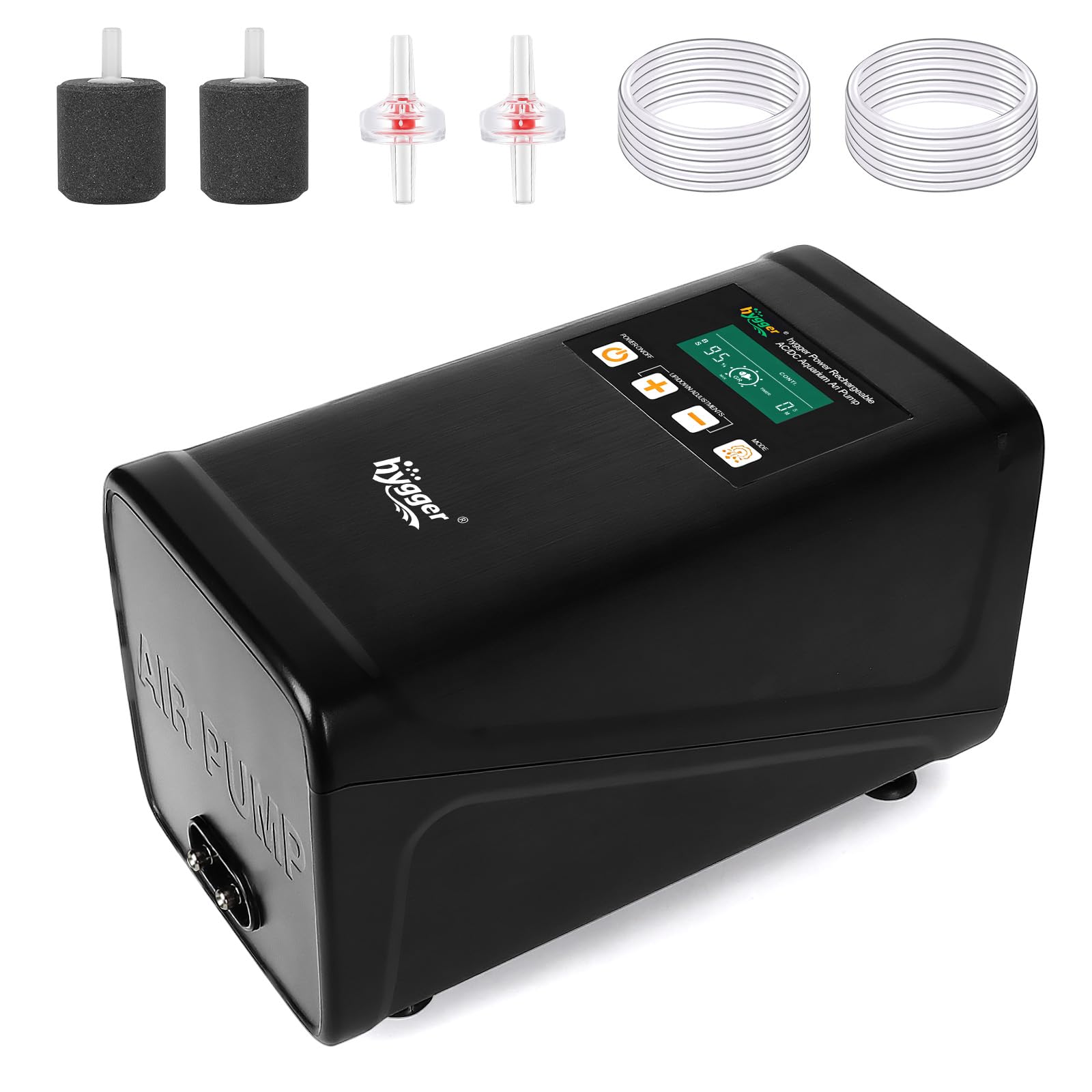
Rating: 4.6 ★ | Price: Premium | Airflow: 254 GPH, dual outlet | Battery: 5,000 mAh × 2 | Runtime: Up to 20 hours | Tank size: Up to 120 gal
Two 5,000 mAh cells, a quoted 20 hours of continuous aeration, and twin outlets: the HG267 has more of everything than anything else in this group, and the battery is the part that counts. On a tank over 75 gallons, or in an outage that runs past a day, that reserve is the difference between a pump still bubbling at hour six and one that quietly stopped at hour three.
The 10-watt motor pushes 254 GPH, which is a lot of air — on a 40-gallon tank it belongs near the bottom of its range. What we didn’t expect from a pump this size is the digital readout: you can see where the airflow sits and change it on a touch panel instead of unplugging anything, and an intermittent mode stretches the charge further. Two check valves, two airstones and two lengths of airline come with it, backed by a two-year warranty.
The cost is the obvious hurdle — this is the premium pick here — and unless the tank is big or the outages are long, most of that capacity goes unused. hygger’s 20 hours is also tied to an airflow setting in the listing, so read it as the best case at low output rather than a guaranteed overnight. On a nano tank this is simply the wrong shape of pump: too much air, too much money.
Pros
- Largest battery reserve in this set
- Dual outlets run two airstones or sponge filters
- Digital airflow readout and touch controls
- Two-year warranty with check valves included
Cons
- Premium price for capacity many tanks never need
- 254 GPH is far more air than a small tank wants
We point big-tank owners here: the largest battery in this set, split across two outlets, with a two-year warranty behind it.
Best for Nano Tanks
AquaMiracle JHL-1101
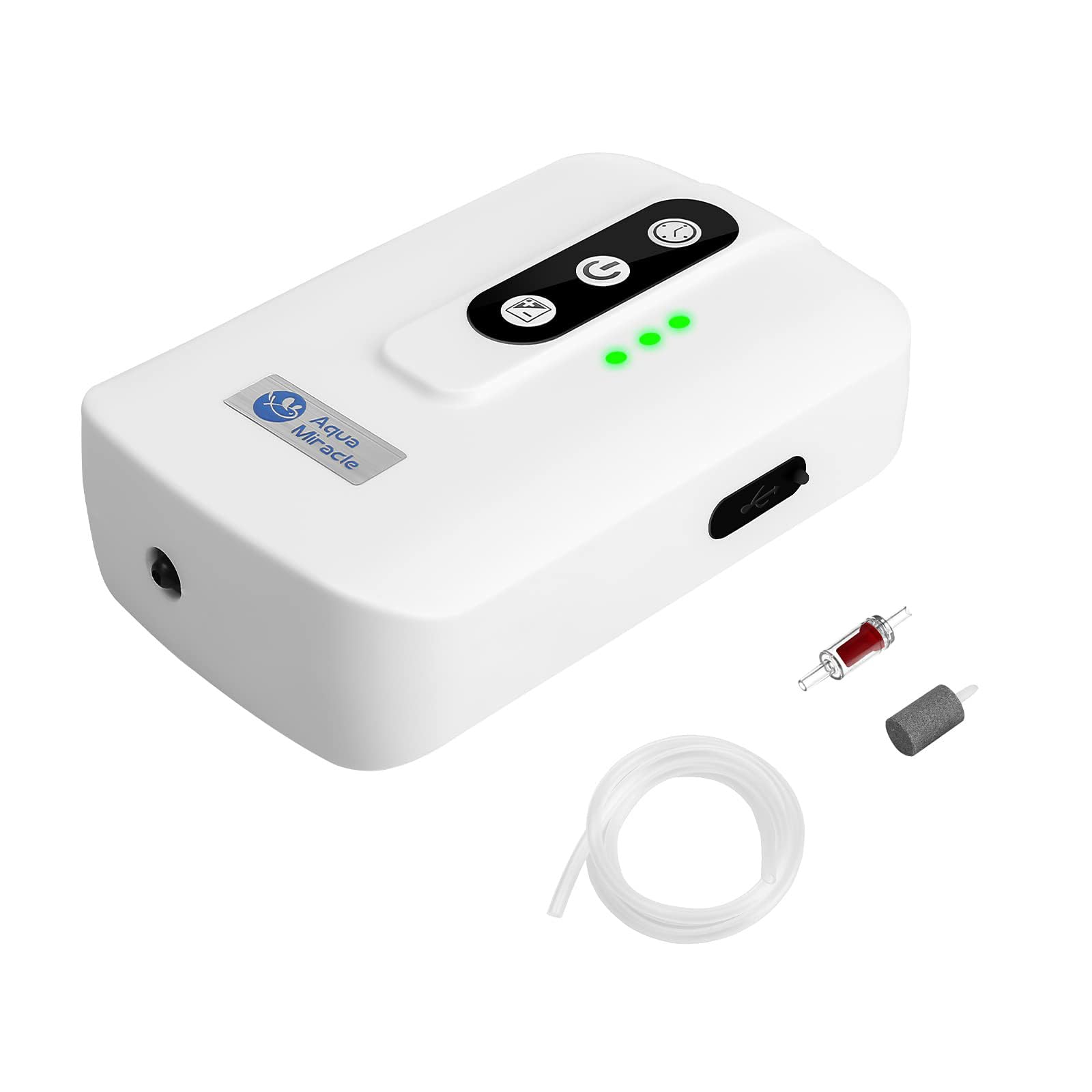
Rating: 4.3 ★ | Price: Budget | Airflow: 11 to 24 GPH | Outlets: Single | Charging: USB, built-in lithium | Tank size: Up to 60 gal
One watt and 11 to 24 gallons per hour is a trickle next to the rest of this group, and the 60-gallon ceiling on the box is optimistic — a 60-gallon tank wants more surface movement than this can produce. Where it earns its keep is at the other end: a 5-, 10- or 20-gallon tank, a quarantine setup, or a bait bucket on the way to the lake.
What we appreciate most is the periodical mode. Rather than running flat out and flattening a small cell, it pulses — a stretch on, a stretch off — which is the right behavior when you don’t know how long the power will be out. At 4.3 by 3.15 by 1.4 inches it takes up almost no shelf, charges over USB, and runs while it’s charging, so a power bank becomes a second backup.
What holds it back is staying power. Some of these quit after a few months, and some stop accepting a charge after a season in a drawer. Treat it as a spare rather than the only thing standing between a stocked tank and a blackout: run it unplugged for a few minutes each month and never store it flat. For a nano tank that rhythm costs almost nothing, which is why it stays on this list.
Pros
- Periodical mode stretches a small battery
- Tiny footprint for shelves and desks
- Charges over USB and runs while charging
Cons
- Too little airflow for tanks near its 60-gallon rating
- Single outlet limits it to one airstone
This is our choice for nano tanks and bait buckets — the low flow is the point, and the pulse mode stretches a small battery through a long night.
Best for Buckets and Travel
AQQA 1.5W
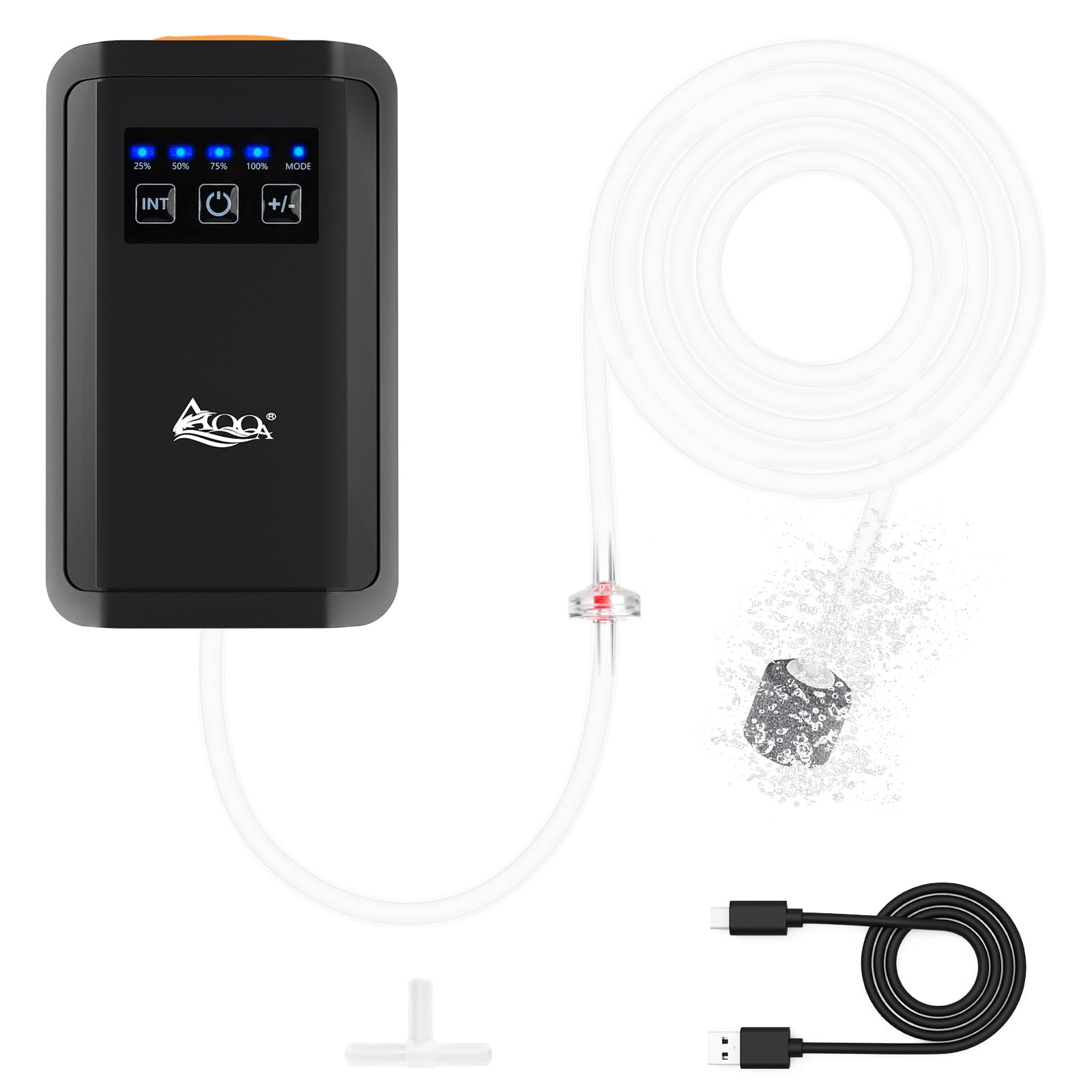
Rating: 4.2 ★ | Price: Budget | Modes: Continuous and intermittent | Airflow: 80 GPH, 4 steps | Battery: 1,500 mAh | Outlets: Single
A molded hook is a small thing to lead with, but it’s what makes the AQQA the one that leaves the house. It hangs on the rim of a bait bucket or a cooler in seconds — no shelf, no suction cups, nothing to balance — and the whole pump is light enough to live in a tackle box between trips.
The 1.5-watt version is the single-outlet model, with a 1,500 mAh battery, four airflow steps, continuous and intermittent modes, USB charging, and a complete kit: airstone, airline, check valve and cable. AQQA rates it at 80 GPH, which is a big number for 1.5 watts; treat it as a ceiling rather than a promise, and expect the useful output to sit well below it.
Where it fits is short trips. A 1,500 mAh cell is not built for a two-day outage on a stocked tank, and AQQA doesn’t publish an hour rating to argue with. We also swap the included airline for better tubing — thin-walled line has a habit of popping off the outlet and the check valve, and a replacement roll costs next to nothing.
Pros
- Hangs on a bucket or cooler rim
- Four airflow steps plus intermittent mode
- Complete kit with airstone, airline and check valve
Cons
- Small battery suits short trips, not overnight outages
We keep coming back to the hook: fishing trips and bucket duty are what this pump is built for, and it’s the easiest of the five to carry.
Best for Tight Spaces
hygger 4800mAh
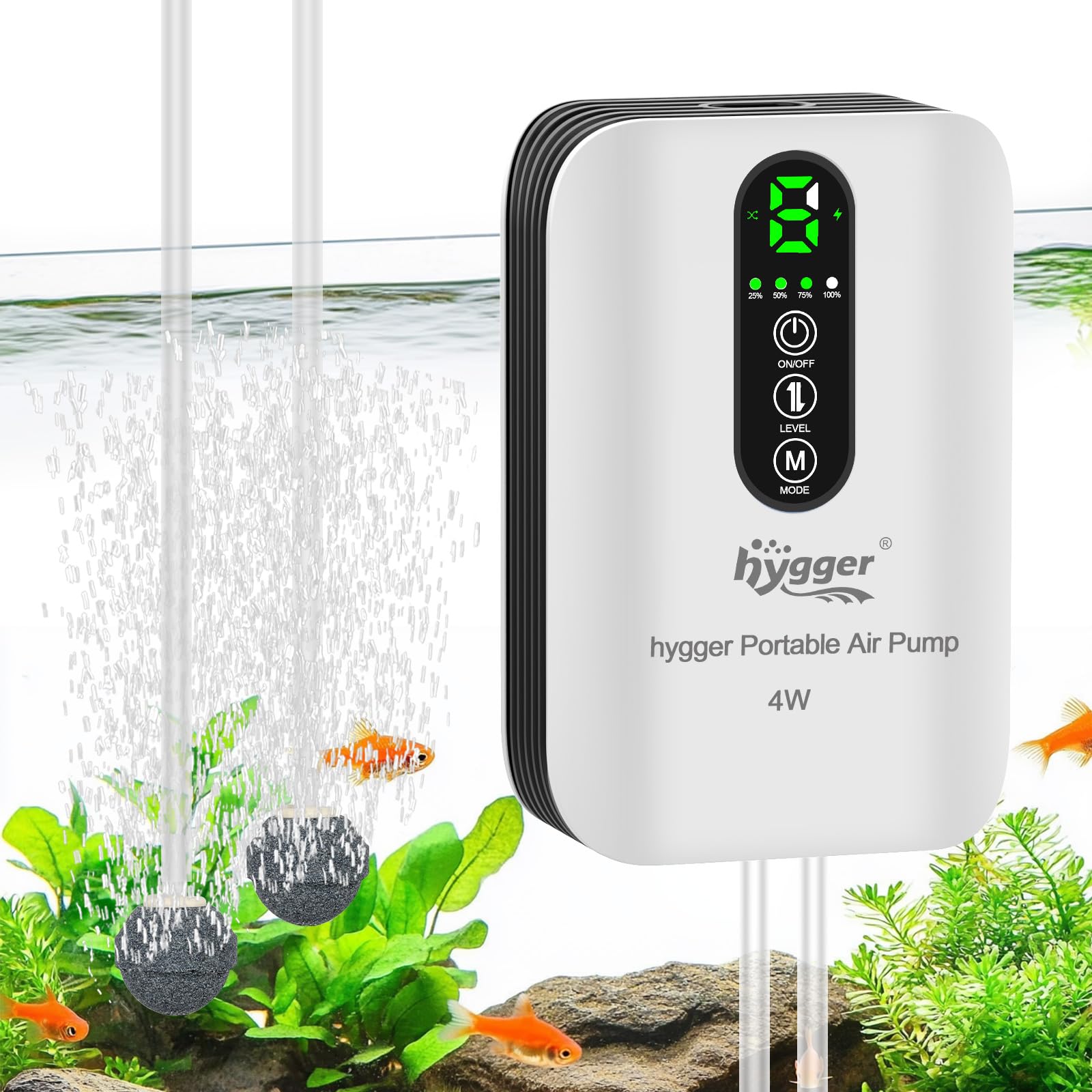
Rating: 4.0 ★ | Price: Midrange | Airflow: 64 GPH | Battery: 4,800 mAh | Charging: USB-C | Tank size: 10 to 120 gal
Slimness is the reason to look at this one: at 1.73 inches tall, it slides behind a tank or into the gap between a sump and the cabinet wall where the rounder pumps here won’t go. Inside that body there’s 4,800 mAh of battery, 64 GPH, USB-C charging and a two-year warranty — respectable numbers that stop just short of the top pick’s airflow.
The figures land between its two hygger siblings: more battery than the fishkeeper, less air than either of them. What we noticed in the box is the plumbing — a Y-connector, two 5.1-foot runs of airline, two airstones and two check valves — which is more complete than most and means a single outlet can feed a pair of airstones without a trip to the shop.
The case against it is comparative rather than absolute. The fishkeeper moves more air and the HG267 runs far longer, so what you’re paying for here is the flat body and the USB-C port. Noise is the open question: hygger quotes under 35 dB, and that’s a figure to hold them to over a few months in a cabinet, not something you can settle in the store.
Pros
- Fits behind a tank at 1.73 inches tall
- 4,800 mAh battery with USB-C charging
- Two-year warranty and full plumbing kit
Cons
- Outpaced on airflow by the cheaper top pick
When the cabinet is tight, this is the one we fit: 1.73 inches tall, USB-C charging, and a two-year warranty.
How We Tested Aquarium Battery Backups
We built the shortlist by reading through specs and owner reviews for roughly 30 battery backups, then narrowed it to 12 that covered the range of prices and designs—air pumps, power centers, and units that switch on automatically. Over nine months, I ran each one on a 10-gallon betta tank in my office and a 75-gallon community tank in the living room, plus a bedroom tank for noise checks. The first test was simple: unplug the unit and see how long it kept a sponge filter moving water. I timed each runtime until the pump stopped, then repeated the cycle after a full recharge to see if the battery held its capacity.
Noise mattered most at night, so I put each unit in a bedroom tank and listened from the pillow, then took a decibel reading from three feet away. Airflow got a more physical check: I watched how vigorously bubbles moved a sponge filter in a 24-inch-deep tank and whether the stream weakened as the battery drained. For reliability, I simulated a power cut every few weeks—flipping the breaker during a Sunday water change—and noted whether the unit kicked on by itself or needed a manual restart. I also checked build quality by handling the housing, tubing, and battery contacts after each cycle, looking for cracks, loose fittings, or corrosion.
Value came last, and it was more than the sticker price. I divided the cost by the hours of usable runtime we measured, then factored in whether the battery was replaceable and how much a replacement cost. A cheap unit that dies after two outages is not a bargain; a pricier one with a user-replaceable battery can be the better long-term buy. After nine months, the units that held up were the ones that switched on without fuss, kept a steady airflow, and stayed quiet enough to forget about.
How to Choose an Aquarium Battery Backup
The backup that saves a tank is the one that switches over while you are at work, so buy for the outage you are not home for.
Runtime is the number that decides the night
Hour ratings are the hardest thing to compare here, because only one pump in this guide publishes one: hygger’s HG267 quotes 20 hours, and its own listing ties that figure to an airflow setting, which makes it a best case at low output. The others give you battery capacity in mAh and leave the arithmetic to you. Halve whatever you are promised, then run the pump at the lowest setting that still ripples the surface. Moving water is what drives the gas exchange; a torrent isn’t required, and the quiet setting is the one still running at dawn.
Match airflow to the tank, then think in outlets
Eighty gallons per hour is plenty for most community tanks. The HG267’s 254 GPH is far more than a 40-gallon breeder needs, and the AquaMiracle’s 11 to 24 GPH is a nano-tank figure whatever its 60-gallon label says. Outlets matter as much as the total: a dual-outlet pump drives two sponge filters at once, which keeps more of your nitrifying bacteria alive through a long outage, while a single-outlet model feeds one airstone or one small sponge. If you keep a seeded sponge filter in the tank as insurance, that second outlet is the feature to pay for.
Leave it plugged in and let it switch
Four of these five list automatic AC/DC switching, and that handoff is really the product: an outage doesn’t wait until you are home to plug something in. After that it’s about modes. Continuous running is what a filter needs. Intermittent or periodical modes pulse the pump to stretch a charge, which suits an airstone in a lightly stocked tank overnight. Set the mode before the weather turns rather than fumbling with buttons in the dark, and keep the pump on a circuit you don’t switch off at the wall.
Keep it dry and stop the siphon
None of these pumps is submersible, and only the fishkeeper carries a stated water-resistance rating — IP64, which covers splashes rather than dunking. Mount the pump above the waterline, on a shelf or from its hook, and fit a check valve to every airline. Without one, water siphons back down the tube when the pump stops and ends up in the housing. Four of the five include check valves; the fishkeeper doesn’t list one, so add a pair if that’s your pick.
Frequently Asked Questions
Will a battery air pump actually keep my fish alive?
It buys time, and time is usually what you need. The pump’s job is to keep the surface moving so oxygen enters and carbon dioxide leaves; put a sponge filter on the same airline and your nitrifying bacteria stay alive too, which is what saves a tank a week after the lights come back. Don’t feed during an outage, because food raises oxygen demand and fouls water nothing is filtering. Run the pump at the lowest setting that still ripples the surface.
Do I need to test it between outages?
Yes, and more often than feels necessary. A lithium pump that sat in a cupboard for eight months may have drained itself flat, and a cell left dead for months can refuse to take a charge at all. Top it up until the indicator says full, then unplug it and let it run for twenty minutes once a month. Put it next to the filter cleaning on your calendar, because a backup you haven’t heard running is a spare part.
Can I run my air pump off a UPS instead?
You can, but a UPS is an expensive way to aerate a tank. One sized for a heater or a return pump empties in minutes under that load, while a 1- to 10-watt air pump runs for hours on a small internal cell and switches over by itself. If you already own a UPS, put the filter on it and let a battery air pump handle the surface.
Final Verdict
The fishkeeper is the one we point most people to. It switches to battery without being asked, covers anything from a nano tank to a 125-gallon community across four flow settings, and leaves room in the budget for the check valve it doesn’t include.
If your tank runs past 75 gallons, or your outages have a habit of lasting more than a day, the hygger HG267 answers that specific problem: two outlets for two sponge filters and a reserve nothing else here approaches. Buy for the outage you actually get.