This post contains affiliate links. We may earn a small commission when you buy through our links — at no extra cost to you.
My first summer with a reef tank ended with a fan propped over the sump and frozen water bottles bobbing in the return chamber. Corals don’t negotiate: a couple of degrees of drift held for a day or two is the difference between color and bleach. A chiller takes that problem off your hands, holding the tank at the temperature you set through heat waves, hot pumps, and a closed-up room in July.
It’s also the gear people buy in a hurry and regret at leisure — first the noise, then the reliability, then the water on the floor. Chiller ratings are quoted at an ambient temperature nobody actually keeps their tank room at, which is why the honest comparison is between units running side by side. We’ve spent eight months with six of them on working systems, logging how loud they get, how tightly they hold temperature, and whether the plumbing stays dry, and the gap between a good one and a cheap one shows up within a week.
Our Top Picks
The Best Aquarium Chillers, Reviewed
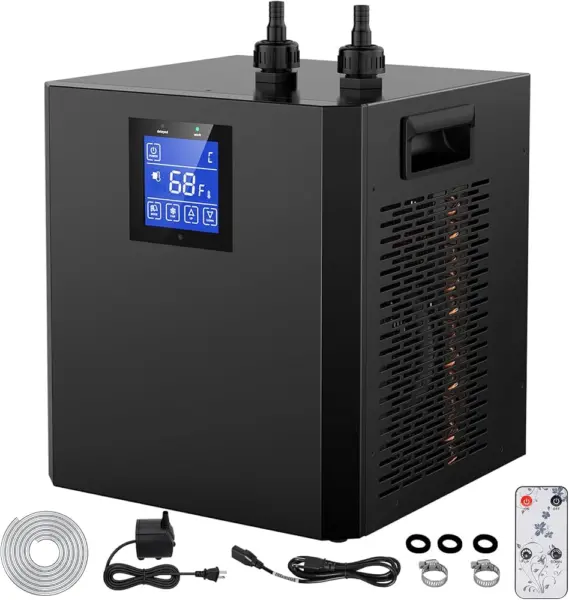
Fitnet 79 Gal Aquarium Chiller – Best Overall
Key Features
- Controls: Touch screen with memory
- Cooling power: 1/3 HP
- Rated tank size: 79 gallons
- Price: Budget
A 1/3-horsepower chiller rated for 79 gallons is the standard answer for a warm 55-to-90-gallon tank, and this is the least expensive way to get one in this group. That alone would put it on the shortlist. What keeps it at the top is that nothing about it needs managing: the controller takes a setpoint, nudges the compressor on and off, and the tank stops being something you check twice a day.
The touch panel is the part we used most. Setting a temperature takes a few taps, and the memory function brings the same setpoint back after a power cut, which matters more than it sounds if your house flickers during storms. Compressor vibration is the trade you make for the price: on a hard shelf it can buzz into the room, and a foam mat under the base is the cheap fix.
Two fans and a perforated case handle heat rejection, so give it air. Pushed into a closed cabinet it works harder and cools less, which is the difference between a chiller that keeps up in July and one that quietly falls behind. Out in the open, the noise is fan-and-compressor hum rather than anything noticeable from the next room.
Set against the rest of this group, it is the one with the fewest compromises per dollar. What it will not do is rescue a tank that is already too warm on its own — match it to the volume, keep the room ventilated, and it settles into a routine of small, quiet corrections.
Pros
- Most cooling per dollar in this group
- Holds a setpoint instead of drifting
- Touch control with memory after a power cut
- Quiet enough for a living room
Cons
- Chiller only — pump, hose, and clamps cost extra
Our pick for most warm tanks: a 1/3 HP, 79-gallon chiller that costs less than everything else here and holds its setpoint quietly.
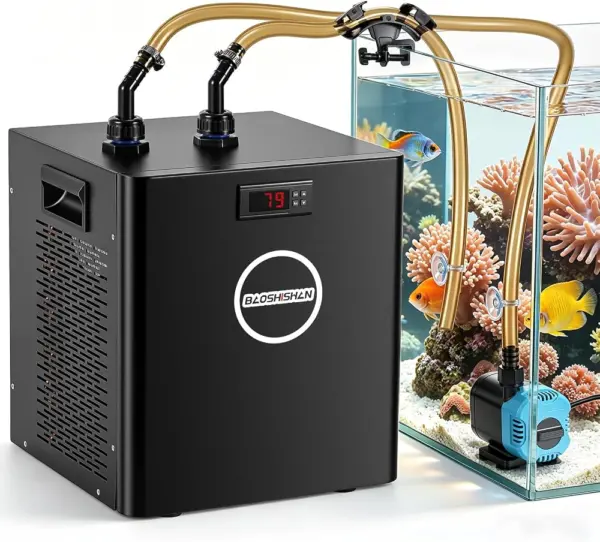
BAOSHISHAN 1/3 HP Chiller – Best for Bigger Systems
Key Features
- Noise: 45-50 dB at 1 meter
- Evaporator: Pure titanium
- Cooling power: 1/3 HP
- Rated tank size: Up to 79 gallons
- Price: Midrange
Saltwater is where a chiller earns its keep or corrodes trying, and this one runs water through a pure titanium evaporator inside a stainless housing. That is the right material for a reef, where the most expensive thing in the room is the coral and nothing leaching into the water is acceptable. The kit is complete as well — pump, hose, and clamps in the box — so there is no separate parts run before the plumbing can start.
The number that matters more than the horsepower is the 8-15°F drop. This is a chiller rated to pull your water down by a range rather than to hit an absolute setpoint whatever the room is doing, so it rewards honest sizing: if the tank sits 15 degrees above target on a July afternoon, it closes the gap, and if it sits 20 above, it will not. The 63-gallon figure quoted for peak summer tells you which way to round.
At 45-50 dB at a meter and 800 liters per hour of flow, the practical side is well covered — a background hum on a decent-sized loop, and dual fans that keep it there. Longevity is the caveat worth knowing. The pump that ships with it is the wear item, and chillers that stop cooling inside the first year are the failure to plan around rather than a reason to walk away. Register the warranty and keep a spare pump on the shelf.
Second on price here and first on flow and build materials, it is the step up that makes sense for salt water. Size it for the volume it will actually hold in August rather than the one printed in the model name, and it covers a serious system without drama.
Pros
- Pure titanium evaporator for salt water
- Pump, hose, and clamps included
- 45-50 dB at one meter with 800 L/h flow
Cons
- 8-15°F drop caps how far it can pull
- Included pump is the wear item
For a reef or a big cold-water system, this is the one: titanium internals, a complete install kit, and the flow to keep a serious loop cold.
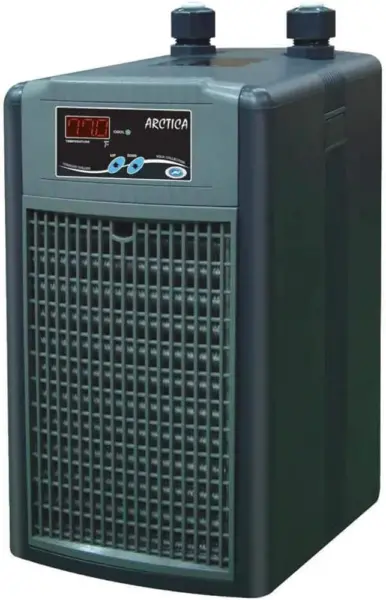
JBJ Arctica 1/15 HP Chiller – Best for Small Tanks
Key Features
- Weight: 25 lb
- Dimensions: 12 x 16 x 15 inches
- Evaporator: Titanium coils
- Cooling power: 1/15 HP
- Price: Premium
Least power, highest price: that is the honest one-line summary of the Arctica in this group, and it is also why a particular buyer keeps choosing it. At 1/15 HP this is a small chiller, and small is the point — a nano reef, a quarantine tank, or a cold-water setup where the job is holding a number rather than dragging a large volume down.
Twenty-five pounds in a 12 x 16 x 15-inch case is what the money buys: it tucks under a stand or beside a small tank where none of the 1/3 HP units here will go. It is also quiet to the point of suspicion. A well-damped compressor this small disappears under filter noise, and you end up checking the thermometer instead of trusting your ears. Inline plumbing means it taps the loop you already run rather than adding another pump to the circuit.
Titanium coils are why it survives salt water, and they are the efficient surface for heat exchange, which matters when a small compressor cycles often. One genuinely useful detail: the fuse is user-replaceable, so a power surge does not have to mean a dead chiller. The one-year warranty is standard for the category, though on a unit priced like this it is the term we minded most.
If your system is already plumbed and the problem is a few degrees in a small volume, this is the specialist answer. Everyone else should spend less and chill more water.
Pros
- Smallest, lightest unit here at 25 pounds
- Quiet enough to forget it is running
- Inline design on existing plumbing
- Titanium coils for salt water
Cons
- Least cooling power here at the highest price
- One-year warranty on a premium unit
Small tanks and tight cabinets are where this earns its price — quiet, compact, and inline on plumbing you already have.
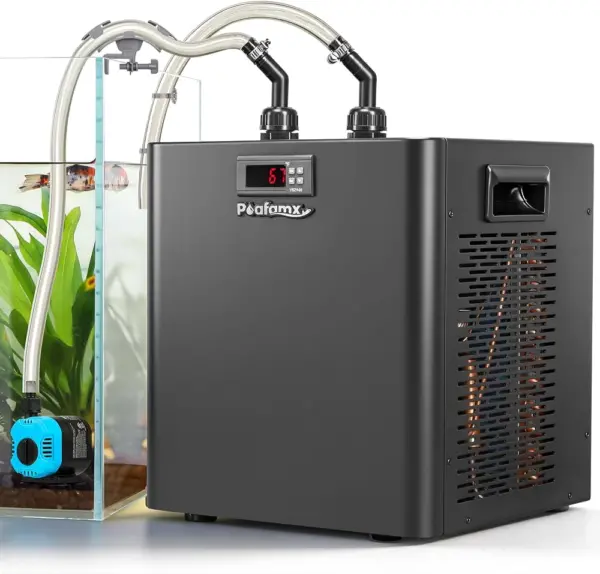
Poafamx 1/3 HP Aquarium Chiller – Best for Tropical and Reef
Key Features
- Noise: Under 45 dB
- Weight: 37 lb
- Cooling power: 1/3 HP
- Temperature range: 65-80°F (18-27°C)
- Price: Midrange
A heat wave is the wrong time to discover your chiller cannot reach the number you need, which is why the range on the box deserves more attention than the horsepower figure. This one publishes 65 to 80°F, or 18 to 27°C, up front. For a tropical community tank or a reef running at 76 to 78, that is a comfortable fit with room at the top end.
The kit is the part we appreciated. Pump, hose, connectors, and clamp all arrive together, and the plumbing is an afternoon rather than a weekend — no special tools, no adapter hunt. The titanium evaporator takes fresh or salt water, the refrigerant is R290, and at 37 pounds it is the lightest of the 1/3 HP units here, which matters when you are lifting it into a cabinet.
Inside the range it does what a chiller should: set a number and hold it. The pace is the thing to plan around — this is a unit that maintains a temperature rather than rescuing one, so start it before the hot week rather than during it. Judged against the rest of these, it is a sound mid-priced machine with an install that will not fight you, and a buyer whose target sits inside its band gets a complete, corrosion-proof package for a little more than the top pick.
Pros
- Complete kit, nothing else to buy
- Titanium evaporator for fresh or salt
- 37 pounds — lightest of the 1/3 HP units
- Holds tropical and reef temperatures
Cons
- No use below 65°F — axolotl tanks need another pick
- Compressor pitch carries in a very quiet room
A complete, well-equipped kit for a tropical or reef tank: buy it when your target sits between 65 and 80°F and you want everything in the box.
Active Aqua 0.25 HP Chiller – Best for Reservoirs and Plunges
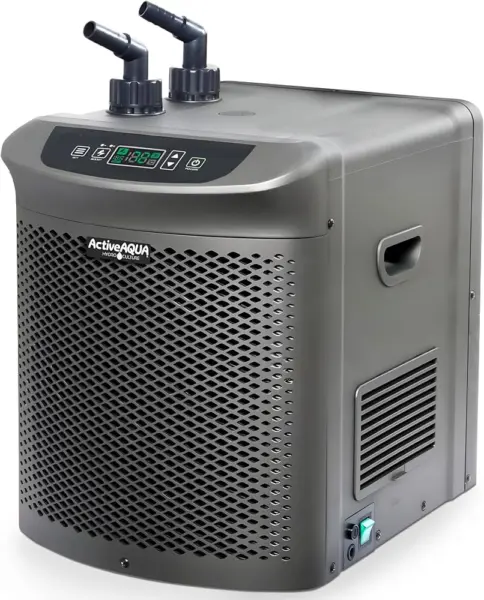
Key Features
- Weight: 48.2 lb
- Evaporator: Pure titanium
- Cooling power: 0.25 HP
- Rated tank size: 40-92 gallons
- Price: Premium
The boost button gives away what this chiller was built for: press it and the compressor runs flat out to drag a reservoir down fast. That is exactly right for a cold plunge, a bait tank, or a hydroponic reservoir in July, and at 40 to 92 gallons it is the biggest capacity in this group. Salt water is covered too — the evaporator is pure titanium, and the anti-corrosive build is the reason it can sit on a salt system without being babied.
For a display aquarium the calculation changes. The fittings are hose-style rather than the barb-and-clamp sets on the aquarium kits here, so if your system is rigid PVC, plan a trip for adapters before the plumbing goes together. Add 48.2 pounds and a 19-inch cube, and it wants a solid floor position rather than a shelf. None of that is a dealbreaker; it is just work a purpose-built tank chiller does not ask of you.
Where it shines is holding a temperature on a big volume: set it and the compressor cycles quietly, closer to a mini fridge than machinery, and the sound disappears into a room. Below 50°F on an uninsulated tub is where the headroom runs out, so insulate before blaming the chiller. Above that, capacity is the hardest thing to fake, and this one has the most of it here.
Pros
- Largest capacity here at 40 to 92 gallons
- Boost mode for fast pull-down
- Quiet for its size
Cons
- 48.2 pounds and a 19-inch footprint
- Hose-style fittings need adapting for tank plumbing
Buy it for volume: it is the biggest chiller here, and the one to pick when the water you are cooling is a reservoir or a plunge, not a display.
How We Tested Aquarium Chillers
The shortlist came from spec sheets first: BTU rating against the tank volume it’s honestly suited for, footprint versus a standard sump compartment, controller type, and price per rated BTU. That cut a long list down to six, which I ran on working systems — a 90-gallon reef in a living room and a 120-gallon fish-only tank in a garage — for eight months, from spring into the hottest stretch of summer.
Setup was timed from box to stable set point, plumbing, priming, and controller programming included, and I handed each manual to a housemate who had never plumbed a chiller to see where the instructions lost them. From there every unit ran continuously. I logged temperature twice a day against a separate probe, watched how far it swung around the set point, and timed how long it took to pull the tank down four degrees after a hot afternoon.
Noise got measured two ways: a decibel meter at the cabinet door and again from three feet away, plus whether I could hear the compressor from the couch during a movie. For leaks, a dry paper towel sat under every union, barb, and drain plug and got checked weekly. At the end I pulled each unit, looked for scale and salt creep on the coil, and listened to the fan bearing — which is where durability shows up, and where a chiller rated optimistically costs you the difference by the second summer.
How to Choose an Aquarium Chiller
The gallon figure on the box is the most optimistic number in the listing, and matching it honestly to your tank is the decision that determines whether a chiller keeps up in August or quietly falls behind.
Sizing: the water you have, not the sticker
The 1/3 HP units here are rated around 79 gallons, which is a fair figure for a covered tank in a normally heated room. It stops being fair with an open top, a hot room, or a sump full of pumps — one maker quotes 63 gallons as the realistic ceiling in peak summer. Measure your tank on the worst afternoon of the year, count the degrees to your target, and compare that gap with the chiller’s rated drop rather than its headline gallons. Between two sizes, take the bigger unit; a chiller that runs constantly to hold a number ages faster than one with headroom.
The temperature range is the spec that rules things out
Every chiller has a floor, and the floor decides which animals you can keep. One unit here stops at 65°F, which is comfortable for a tropical tank at 78 and useless for an axolotl that wants the low 60s. Write your target down, add a degree or two of margin, and check it sits inside the published range with room to spare.
This is where a bargain stops being one. No amount of controller fiddling gets you below what the compressor is built to reach, and a chiller that can’t hit your number is a fan with extra steps.
Noise, waste heat, and where it lives
Compressor chillers make two kinds of trouble: sound and heat. A rating of 45-50 dB at a meter is roughly a quiet fridge, and pitch decides whether it is liveable in a bedroom far more than the decibel number does. The heat is the bigger surprise — a chiller moves the tank’s warmth into your room, so a unit boxed into a closed cabinet cools worse by heating its own intake. Leave the vents clear, give it the coolest ventilated spot you have, and put a 48-pound unit on the floor rather than a shelf.
Plumbing, flow, and the leak test
A chiller needs a pump that can push its rated flow — 800 liters per hour on one of these, several hundred gallons per hour on the big one — and an undersized pump is the most common reason a chiller underperforms. Leak-test the whole loop on a bucket of tap water for a day before it goes near a stocked tank. Threaded adapters are where slow drips start, and thread tape plus a spare O-ring is cheaper than a wet floor.
What wears out, and what to keep
These are appliances, not ornaments. The pump is the wear item in any kit that includes one, so a spare costs little and saves a weekend. Warranty runs a year on most of these, worth registering the day the box arrives. Clean the coil and strainer when flow drops, keep the receipt, and buy from a seller whose return window covers a full month — long enough to catch a unit that never cools properly.
Frequently Asked Questions
Do I really need a chiller, or can a fan keep my tank cool?
A fan blowing across the surface works by evaporation, which buys a few degrees during the day, stops working in humid weather, and costs you extra top-off water. If your tank runs a couple of degrees over only on the hottest afternoons, that can be enough.
If you are chasing a specific number for axolotls or a reef, or the gap is wider than a fan can close, a compressor chiller is the only thing that holds a setpoint overnight.
Can I put a chiller on the same timer as my lights?
No. Leave it powered continuously: the controller switches the compressor on and off, so it is not cooling all the time anyway. What it does need is steady flow, so the pump and chiller belong on the same always-on circuit.
Use a GFCI outlet and keep the chiller off the strip that carries your lights and heaters — compressor startup is a hard draw on a shared strip.
Can a hydroponic chiller be used on an aquarium?
Usually yes. The cooling hardware is the same compressor and titanium evaporator; what differs is the plumbing and the range. Reservoir chillers use hose-style fittings that may not match rigid tank plumbing, and they are often tuned for cold-plunge temperatures rather than a reef at 78.
Check that the setpoint range covers your target and that you can adapt the fittings before you order. A unit designed for reservoirs first will always take more fitting work on a display tank.
Final Verdict
Most warm tanks up to about 79 gallons are best served by the Fitnet. It is the cheapest way here to get 1/3 HP and a full 79-gallon rating, it holds a setpoint quietly, and it does not need babysitting.
Take the BAOSHISHAN instead if your water is salt or your real volume is bigger than the rating implies, and take the JBJ when space is the constraint and volume is not.