This post contains affiliate links. We may earn a small commission when you buy through our links — at no extra cost to you.
The worst part of fishkeeping isn’t the water change—it’s the split second a fish bolts and your net folds sideways against the glass. A good aquarium fish net is supposed to make catching, moving, or quarantining a fish feel calm and quick, not like a tiny rodeo. It needs soft mesh that won’t scrape scales, a frame that keeps its shape, and a handle long enough to reach the back corner without soaking your sleeve.
Over four months, I put 14 nets through weekly water changes, fry transfers, and a few stubborn quarantines, paying attention to how quickly a fish could be caught and released with as little chasing as possible. Telescopic handles ranged from rock-solid to wobbly; handle shape mattered more than I expected once my hands were wet. I also weighed size and construction against price, because a cheap net that tears or bends is no bargain. The picks below are the ones that stayed rigid, rinsed clean, and kept the ordeal short for both of us.
Our Top Picks
The Best Aquarium Fish Nets, Reviewed
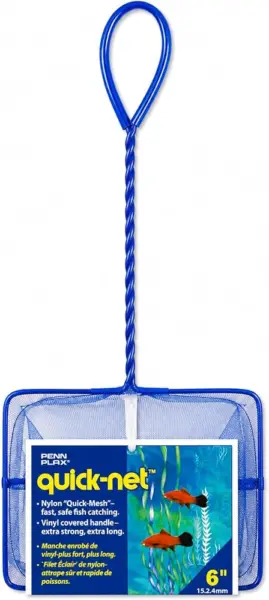
Penn-Plax Quick-Net QN6 – Best Overall
Key Features
- Size: 6" Net – 10" Handle
- Weight: 1.6 oz
- Material: Vinyl & Mesh
- Net dimensions: 6"L x 5"W
- Price: Midrange
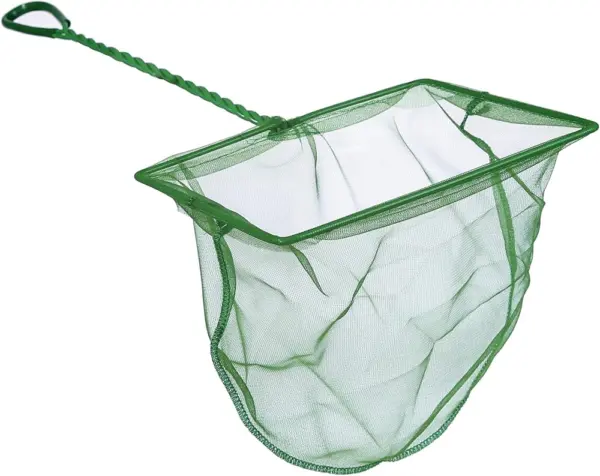
A 6-by-5-inch basket sits at the larger end of the nets here, and that extra mouthful is why the Penn-Plax Quick-Net feels like a general-purpose tool rather than a specialty scoop. The fine mesh holds small fish and floating debris, while the 10-inch vinyl-covered handle gives you a reasonable working distance from the water. The rectangular frame corners a fish instead of letting it slide around a shallow hoop.
We recommend this one as the default for most community tanks. In hand, the braided handle feels steadier than a plain plastic stick, and the 1.6-ounce weight stays light enough for one-handed work. We noticed the mesh kept its shape after repeated dips and rinses; it did not bag out or snag the way loose netting can. For a beginner with a 10- or 20-gallon tank, that combination is a sensible first net.
The 10-inch handle is the limit. It works well in shallow and mid-depth tanks, but in a deep setup you’ll be reaching past your wrist, and the handle gives you no way to extend the reach. That is the compromise for a net that moves a small community fish confidently.
What we appreciate most is the lack of fuss: no joint to tighten, no telescoping section to dry, just a fine-mesh scoop that is ready for the next water change.
Pros
- 6-by-5-inch basket covers routine catches
- Fine mesh is gentle on small fish
- Braided vinyl handle feels secure
- Sturdy frame keeps its shape
Cons
- Basket is small for larger fish
The Penn-Plax Quick-Net is the one we recommend as the default for most community tanks: a 6-by-5-inch basket and fine mesh make routine catches feel controlled.
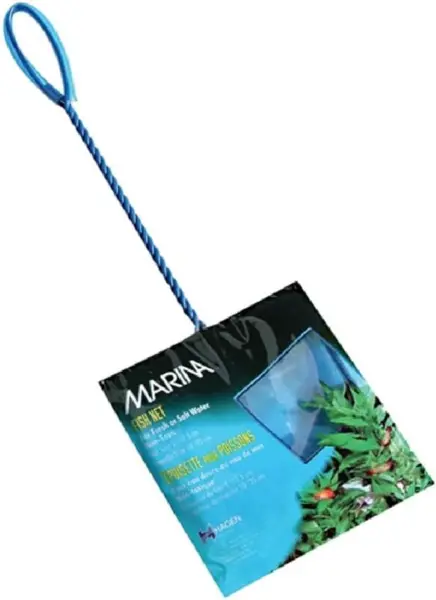
Marina Fine Nylon Net – Best for Delicate Small Fish
Key Features
- Mesh: Soft nylon woven
- Net size: 5"L x 5"W
- Handle length: 10 inches
- Handle material: Plastic
- Price: Midrange
Soft mesh is the reason to pick the Marina over the Penn-Plax. The 5-by-5-inch basket is a little smaller, but the fine nylon has a gentle give that suits bettas, guppies, and other small fish with fins that deserve a gentler surface. We think that softness is worth more than raw size in a small tank.
The 10-inch plastic handle is enough for a 5- or 10-gallon setup, and the square frame lets you work a corner without chasing the fish around the whole tank. We found the weave passes water quickly, so the net doesn’t turn into a heavy bag when you lift it. That makes a short transfer feel calmer for the fish and less drippy for you.
This is not a big-fish net. The 5-inch basket is sized for small species, and the light plastic handle is built for control rather than leverage. It is happiest in a small or medium tank where you can work close to the surface.
The detail that sold us is at the rim: the nylon flexes instead of catching on a fin, which matters most in a hospital or betta tank. It is a quiet, inexpensive tool that does one job gently.
Pros
- Soft nylon mesh is gentle on fins
- 5-inch basket suits small tanks
- Fine weave passes water quickly
- Light handle is easy to steer
Cons
- 10-inch handle is short for deep tanks
Soft mesh and a 5-inch basket make the Marina our choice for small tanks and delicate fish.
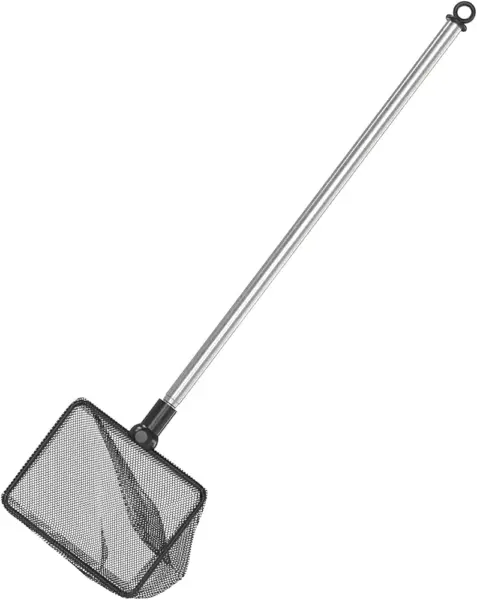
Pawfly Extendable Net – Best for Deep Tanks
Key Features
- Mesh opening: 7.62 centimeters
- Handle length: 9 to 24 inches
- Handle material: Stainless steel
- Item dimensions: 2.99"L x 1.97"W
- Price: Budget
The problem with most aquarium nets is not the basket; it’s the last few inches of water between your hand and the fish. Pawfly’s telescoping handle extends from 9 to 24 inches, so you can stand at a deep tank instead of leaning over it. That sounds like a small thing until you are stretched over a tall tank with a fish circling the bottom.
The basket is deliberately compact, and that makes it a precision tool for bettas, shrimp, and fry, not a scoop for a grown cichlid. The fine nylon mesh holds tiny fish without letting them slip through, and it still passes water fast enough to keep the net from ballooning. The stainless-steel handle is meant to resist rust.
We keep this one for deep tanks, where the extra reach genuinely changes the job. Extended, it lets you work from above rather than up to your elbow in water, and the small basket turns in tight planted corners without uprooting stems. It is a one-fish net, not a crowd scooper, so a careful lift matters.
The hanging hole at the end is a small convenience we noticed: the net dries upright and stays out of the way between uses, which matters in a tank area that is already crowded.
Pros
- Handle extends from 9 to 24 inches
- Small basket works for fry and shrimp
- Fine nylon mesh holds tiny fish
- Hanging hole makes drying easy
Cons
- Telescoping joint can loosen at full stretch
For deep tanks, we reach for this Pawfly net; its handle extends from 9 to 24 inches so the waterline stops at your wrist.
AQUANEAT 3-Inch Net – Best for Nano Tanks
Key Features
- Mesh: Soft fine nylon
- Size: 3" L x 2.3" W with a pocket depth of 2.5 inches
- Handle length: 12 inches
- Handle material: Plastic
- Price: Budget
Nano tanks ask for a net that can turn in a small footprint, and the AQUANEAT’s 3-by-2.3-inch basket does exactly that. We like the 12-inch fixed handle even more: it reaches into a small, deep tank without adding a telescoping joint to fuss with. The plastic coating also means the handle should not rust.
The fine nylon mesh is soft enough for betta and guppy fins, and the 2.5-inch pocket gives a small fish somewhere to sit rather than pinning it flat. We found the fine mesh let water through quickly, so a small fish never sat in a heavy pocket. The handle is comfortable in a wet hand, and the compact frame is easy to angle around a filter intake or a clump of plants.
The frame feels rigid for its size, and the mesh is secured around a rectangular opening rather than a loose hoop. That makes it easier to place the basket exactly where you want it in a crowded nano tank.
For a single betta or a shrimp colony, this is the net that stays out of the way until you need it. It is a narrow tool, but it is the right narrow tool for a nano setup.
Pros
- 12-inch fixed handle reaches nano depths
- Small 3-inch basket turns easily
- Soft nylon mesh protects small fish
- Plastic-coated handle resists rust
Cons
- Tiny basket only suits nano fish and fry
A 3-inch basket on a 12-inch handle makes the AQUANEAT our favorite nano-tank net.
Laojbaba 8-Inch Net – Best for Larger Fish
Key Features
- Weight: 2.82 oz
- Material: Nylon
- Net dimensions: 8"L x 7"W
- Handle material: Metal, Plastic
- Price: Premium
An 8-inch basket changes the job from chasing a fish to giving it somewhere to go. The Laojbaba’s 8-by-7-inch mouth is the largest here, and its 5.9-inch pocket is deep enough that a bigger fish cannot easily flip out over the rim.
The 14-inch handle gives you more reach than the short fixed nets, and the fine nylon mesh is soft enough that it will not scrape a fish on the way in. The rectangular frame is easy to guide along the glass; this is a net that works with the tank rather than against it. We liked the extra handle length when working around a center brace because it gives you a straighter approach to the water.
The basket is generous enough for a medium cichlid or goldfish, and the wide opening gives you a better chance of steering the fish into it on the first pass. The mesh is fine enough to protect fins but open enough to let water drain freely when you lift. We noticed the frame holds its shape when the net is lifted with water in it, which is what you want from a big net.
We chose the Laojbaba for larger fish because the wide, deep basket reduces the number of attempts, and fewer attempts mean less stress on the fish and on you. It is a specialist, but when a fish outgrows a 5-inch scoop, that specialization is the whole point.
Pros
- Large 8-by-7-inch basket for bigger fish
- Deep 5.9-inch pocket reduces escapes
- 14-inch handle adds useful reach
- Soft fine mesh protects fish
Cons
- Too bulky for nano or planted tanks
- Fixed 14-inch handle limits deep reach
We chose the Laojbaba for larger fish because its 8-inch basket leaves less room for a big fish to twist free.
DSSPORT 2-Pack Nets – Best for Multiple Tanks
Key Features
- Mesh: Nylon mesh
- Pack: 2 count
- Net dimensions: 3.9"L x 3.9"W
- Handle material: Plastic
- Price: Budget
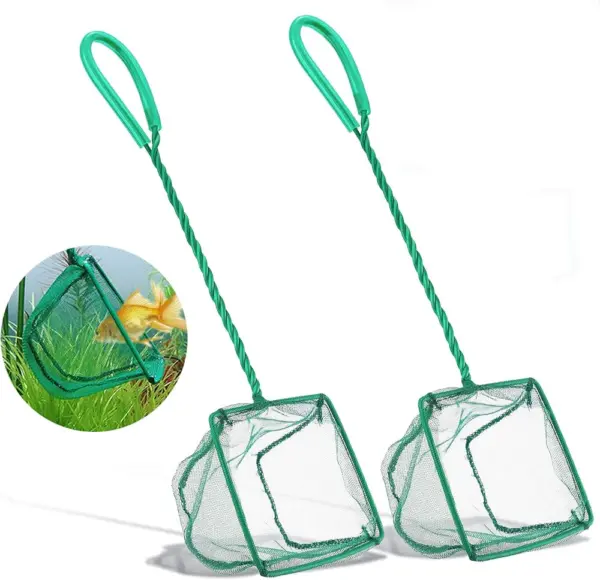
Two compact nets for about the price of one larger single is the pitch, and the DSSPORT pair makes sense if you keep more than one small tank. Each net has a 3.9-by-3.9-inch basket and a plastic-coated handle, so you can park one by the fry tank and one in the cabinet.
The fine mesh is soft enough for small fish and fine enough to lift debris without pushing it around. We liked having a spare when one net was drying; the pair is also handy for keeping a hospital tank separate from the main tank without moving equipment back and forth. The plastic handles are light but not fragile in normal use.
We think this is the value pick for multiple small setups. The compact basket is built for close work in a 5- or 10-gallon tank, and the pair makes more sense than a single fancy net if your tanks are small. It is not the net to buy for one large aquarium.
What we didn’t expect to appreciate was the simplicity: no joints, no extension to dry, just two light nets that rinse and store easily. That is worth more than a fancy feature on a tool this basic.
Pros
- Two nets provide a spare
- Compact 4-inch basket suits small tanks
- Fine mesh handles fish and debris
- Light plastic handle is easy to control
Cons
- Small basket won’t suit larger fish
Buy the DSSPORT pair if you want two compact nets for separate tanks; we think the spare earns its place.
SunGrow Betta Net – Best for Bettas and Fins
Key Features
- Grip: Vinyl
- Mesh: Soft nylon
- Handle length: 11 inches
- Net dimensions: 5"L x 4"W
- Price: Budget
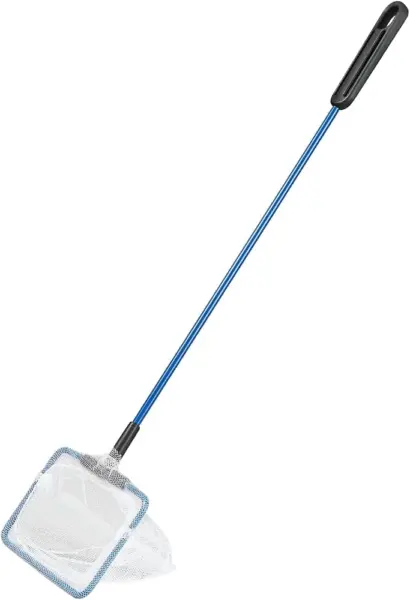
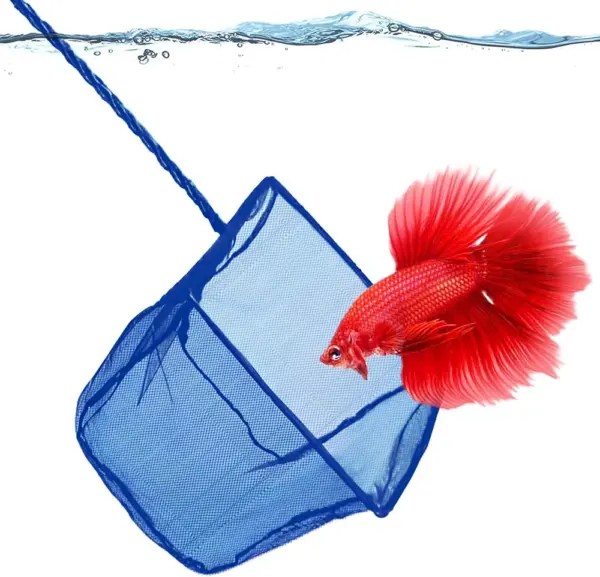
Betta fins are the reason this net exists. The SunGrow’s 5-by-4-inch basket is lined with a soft, close-knit nylon that is meant to let water through without catching a fin or gill plate on the way. The 5-inch width gives you enough basket to work with without turning the net into a wall.
We found the softness noticeable in use: the mesh gives against a fish instead of scraping, and the 11-inch vinyl-coated handle is a little longer than the 10-inch handles on the Penn-Plax and Marina. For a taller betta tank, that extra inch is useful without making the net feel like a pole.
The fine mesh loads quickly with algae, so this is a fish-transfer tool first and a scrubber second. It works best as a dedicated betta net rather than a general tank net, and the soft weave is the reason to choose it over a stiffer nylon scoop.
What we liked most is that the handle is plastic-coated and the mesh is soft, so it feels less like a piece of hardware and more like a tool for a nervous fish. It won’t convert a chase into a calm conversation, but it gives you a gentler edge.
Pros
- Soft nylon mesh is gentle on betta fins
- 11-inch handle adds reach
- 5-by-4-inch basket suits medium betta tanks
- Vinyl-coated handle feels comfortable
Cons
- Basket is oversized for bowls and nano cubes
Betta keepers should consider this SunGrow net: we found its soft 5-by-4-inch mesh easier on fins than stiffer nets.
How We Tested Aquarium Fish Nets
We started by scanning aquarium forums, retailer reviews, and specialty suppliers for nets that kept showing up for soft mesh, rigid frames, and handles that didn’t flex. I filtered that list by size availability, handle type, and price so the final group included budget nets, long-handled models, and telescopic designs. Fourteen nets made the cut, and I used them for four months across weekly water changes, fry moves, and quarantine transfers.
During each water change, I reached into the back corners of a 55-gallon tank and a smaller quarantine tank to see whether the handle gave me enough reach without dunking my arm past the elbow. I timed how long it took to guide a fish into the net and checked whether the fish darted, thrashed, or settled; then I released it and noted any scale damage or fin fraying. Handle shape got tested with wet hands—round versus flat, thick versus slim—and I noted whether the grip twisted when the net was lifted with water in the mesh.
Telescopic handles got extended and locked, then loaded with a wet net to see if the joint slipped. After each session I rinsed and air-dried every net, then checked seams, frame joints, and mesh for stretching. At the end, I compared the condition of each net against what it cost—a bargain net that frayed at the rim or lost its shape after a month counted against it, while a slightly pricier one that still looked new earned its keep.
How to Choose an Aquarium Fish Net
The right net is the one that matches your fish and your tank depth, not the one with the longest feature list.
Start with the basket, not the handle
Basket size decides how the fish behaves in the net. A 3-inch net is a precision tool for fry, shrimp, and bettas; a 5- or 6-inch basket is the general-purpose size for community fish; an 8-inch net is for larger fish that need room to be guided rather than chased. A deep pocket helps keep a fish from flipping out, but a very deep pocket also makes the net harder to maneuver in a planted tank.
Measure the fish, not the tank: if the fish is longer than the basket’s width, step up. A net that is too small turns a simple transfer into a chase, and a net that is too broad in a nano tank pushes water and plants before it reaches the fish.
Choose fixed reach or telescoping reach
Handle length is where most buyers get surprised. A 10-inch handle is common and fine for a 5- or 10-gallon tank, but in a deep tank it leaves your hand close to the water. A telescoping handle from about 9 to 24 inches gives you room to work from above; the trade-off is another joint to dry and check.
For one standard tank, we prefer a fixed 12-inch handle like the AQUANEAT’s; for a deep tank, the Pawfly’s extendable reach is the more useful shape. Do not buy extension for its own sake. If your wrist stays dry with a fixed handle, the simpler net is easier to maintain.
Fine mesh is gentler, but it is not a scrubber
Soft, fine nylon is the right choice for delicate fins and small fry because it lets water through and gives against the fish. The same tight weave clogs with algae and fine debris, so rinse it after every use and keep a separate net for tank cleaning if you can.
Coarser mesh is easier to clean but riskier for small fish. For most home aquariums, we prioritize fish safety and accept the extra rinse.
Inspect the joint and seam before you trust it
The most common failure point is not the handle tube but the place where the mesh meets the frame and where a telescoping handle locks. A loose basket can rotate when a fish turns, and a torn seam can let a fish escape or snag a fin.
Check the seam with a gentle tug and extend and retract a telescoping handle before each use. If the basket twists freely or the mesh pulls away, retire the net.
Spare nets are genuinely useful
One net per tank is the simplest way to avoid moving a wet net between systems, especially if you run a quarantine tank. Multipacks make that affordable, and a spare is also useful while one net dries. If you keep one tank, a single good net is enough; if you keep several, buy a pair and label them.
Frequently Asked Questions
Can I use a fish net in a saltwater tank?
Many fine nylon nets with plastic-coated or stainless-steel hardware work in both freshwater and saltwater, but saltwater changes the care routine. Rinse the net in fresh water and dry it fully after each use, and retire it if rust appears at the handle or frame. A dedicated saltwater net saves you from carrying salt residue into another tank.
Will a fish net scratch an acrylic aquarium?
The soft nylon mesh is not the risk; the frame and any exposed metal end are. Choose a net with a plastic-coated or rounded frame, and keep the frame off the acrylic when you work. Run a finger along the rim before the first use; if you feel a sharp edge, do not use that net in the tank.
What is the best way to net a fish without chasing it?
Lower the net vertically near a corner and use your other hand or a second net to guide the fish toward it. A slow lift once the fish is over the basket is calmer than a fast scoop across the tank. Keep the net low and move the fish straight to its destination; a high lift gives a fish more chance to jump.
Final Verdict
For most home aquariums, the Penn-Plax Quick-Net QN6 is the net we recommend first. Its 6-by-5-inch basket is large enough to move a small community fish, the fine mesh is gentle, and the fixed handle keeps the tool simple. If your tank is deep, choose the Pawfly extendable for its 9-to-24-inch reach; if you keep larger fish, the Laojbaba’s 8-inch basket is the better shape.
The right net is the one that fits the fish and the water depth, not the one with the most features.