This post contains affiliate links. We may earn a small commission when you buy through our links — at no extra cost to you.
Swing-arm hydrometers are the most common starter tool, but thousands of reef keepers have found them frustratingly inaccurate. Bubbles, sticking needles, and temperature swings can throw off readings by 0.005 SG or more — enough to stress corals during water changes.
The real solution is a refractometer. Optical models use a prism and scale to measure how light bends through saltwater, giving you consistent results in seconds. Digital refractometers add a backlit display that works in any light, but cost significantly more.
This guide breaks down the trade-offs between budget optical models, premium digital instruments, and the few hydrometers worth considering at all. Whether you’re setting up your first saltwater tank or upgrading from a plastic swing-arm, you’ll leave with the right tool for your routine.
Top Picks
Best for Serious Reef Keepers
Ade Advanced Optics Dual-Scale Refractometer

Rating: 4.5 ★ | Price: Mid-Range | ATC: Yes | Measurement Range: 0-100 PPT, 1.000-1.070 SG
The dual-scale refractometer reads specific gravity from 1.000 to 1.070 and salinity from 0–100 PPT with ±0.001 accuracy, thanks to an optical design that uses auto temperature compensation. Included accessories – hard case, pipette, cloth, and calibration screwdriver – mean no additional purchases are needed to start testing.
This tool suits reef keepers who test under good lighting and are comfortable with occasional re-zeroing. The scale requires a bright source – dim tanks or evening sessions may call for a supplemental light. Calibration can drift over weeks, but checking against distilled water before each use keeps readings precise.
Pros
- Clear markings and smooth focus adjustment make readings quick and repeatable
- Sturdy metal body holds calibration well during daily handling
- Two-year no-hassle warranty covers defects without return shipping hassle
Cons
- Scale can be hard to read in dim conditions – best used near a window or with a flashlight
- Calibration may shift after weeks of use, requiring a quick re-zero with distilled water
For hobbyists who value accuracy and simplicity, this refractometer offers a practical balance of performance and cost.
Best for Budget-Conscious Beginners
Agriculture Solutions 0-100 PPT Refractometer

Rating: 4.6 ★ | Price: Budget | ATC: Yes | Measurement Range: 0-100 PPT, 1.000-1.070 SG
The Agriculture Solutions refractometer is a popular budget choice among reef keepers, providing solid salinity testing at a low entry price. It does require a bit of discipline — calibration can drift over weeks, so re-zeroing before each session is necessary for consistent readings. This suits beginners upgrading from a hydrometer or anyone on a tight budget who doesn’t mind that extra step.
Pros
- Easy to use for saltwater testing
- Better accuracy than a hydrometer
- Great value for the cost
Cons
- Plastic case and lens can crack if dropped or handled roughly
For budget-conscious reef keepers who can handle a quick re-zero before each use, this refractometer delivers the accuracy you need without the premium price.
Best for Serious Reef Aquarists
Milwaukee MA887 Digital Refractometer
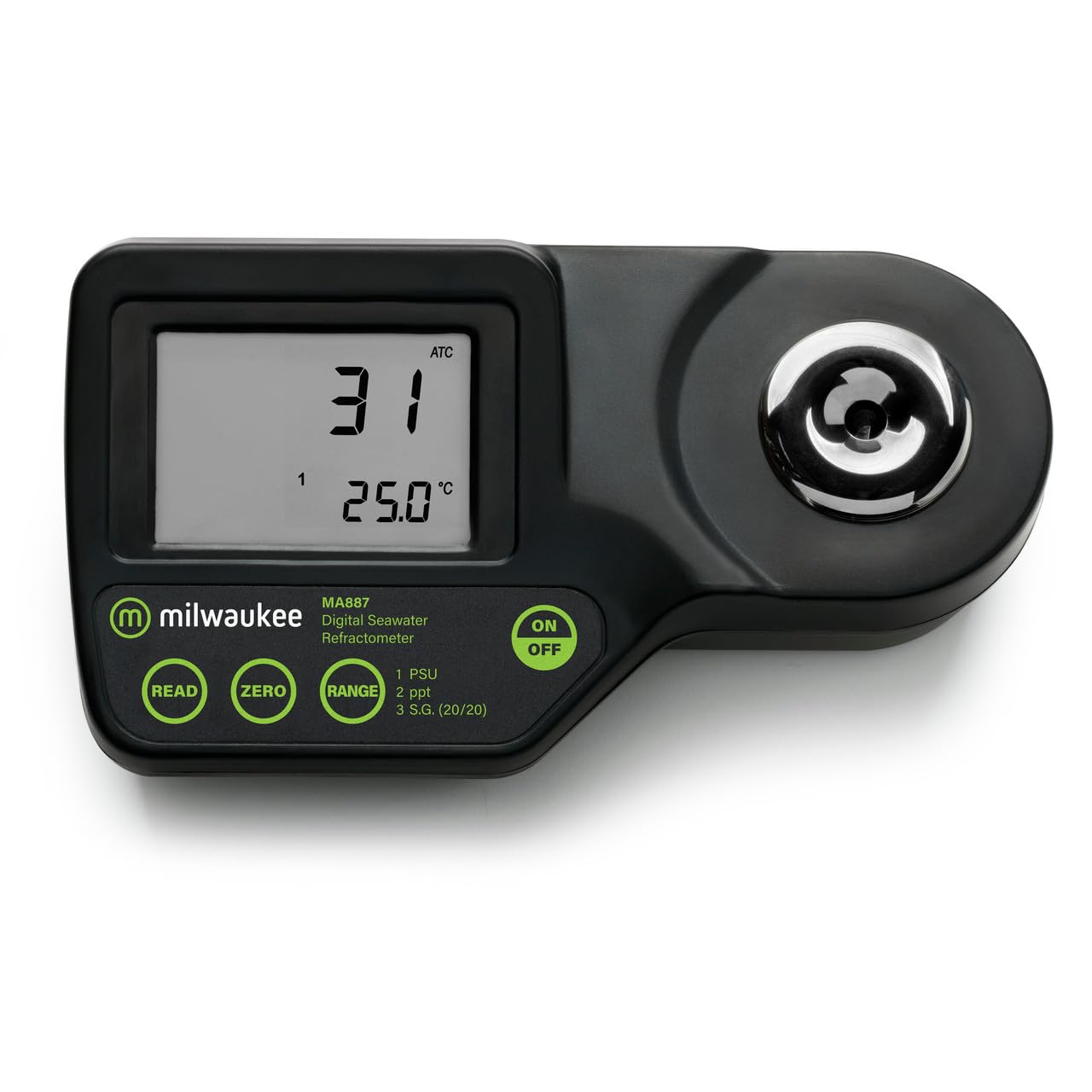
Rating: 4.5 ★ | Price: Premium | ATC: Yes
The Milwaukee MA887 provides a clear digital readout in any lighting condition, eliminating the squinting and guesswork of optical refractometers. Accuracy is consistent and repeatable, important for reef keepers monitoring sensitive systems. However, this digital convenience comes at a higher cost than the top pick, and the unit may need occasional recalibration to maintain precision. This instrument is best suited for serious hobbyists who test daily and want fast, hassle-free readings – casual users will find the expense and maintenance unnecessary.
Pros
- Digital readout works in any light – no need for bright sunlight or external lighting.
- Exceptional accuracy and repeatability – readings stay consistent session to session.
- Robust build quality with a sealed prism and stainless steel well.
Cons
- Premium price – significantly more expensive than optical alternatives.
- Occasional calibration drift may require re-zeroing weekly or monthly.
For reef keepers who test daily and prioritize speed and digital convenience, the MA887 delivers lab-grade results without the hassle of manual interpretation.
Best for Thrifty Saltwater Beginners
AUTOUTLET Dual-Scale Refractometer

Rating: 4.6 ★ | Price: Budget | ATC: Yes | Measurement Range: 0-100 PPT, 1.000-1.070 SG
A solid aluminum body with rubber grip and dual scales (0–100 PPT and 1.000–1.070 SG) for under $16 makes this an aggressive budget option. It delivers nearly identical accuracy to the top pick — both use the same optical ATC principle — but the top pick comes with a 2-year warranty and more consistent build quality. This is best for thrifty beginners or as a backup refractometer, provided you check for loose parts or defects when it arrives.
Pros
- Accurate readings with simple calibration out of the box.
- Exceptional value — more precise than hydrometers at a similar price point.
- Sturdy aluminum body with a comfortable rubber grip.
Cons
- Some units may arrive with loose parts or minor defects — worth inspecting upon delivery.
- Scale readability suffers in dim light; a bright light source is needed.
A solid budget buy if you’re willing to check for defects upon arrival; otherwise, the top pick’s warranty offers more peace of mind.
Best for Pool & Spa
Hofun 5-in-1 Digital Meter
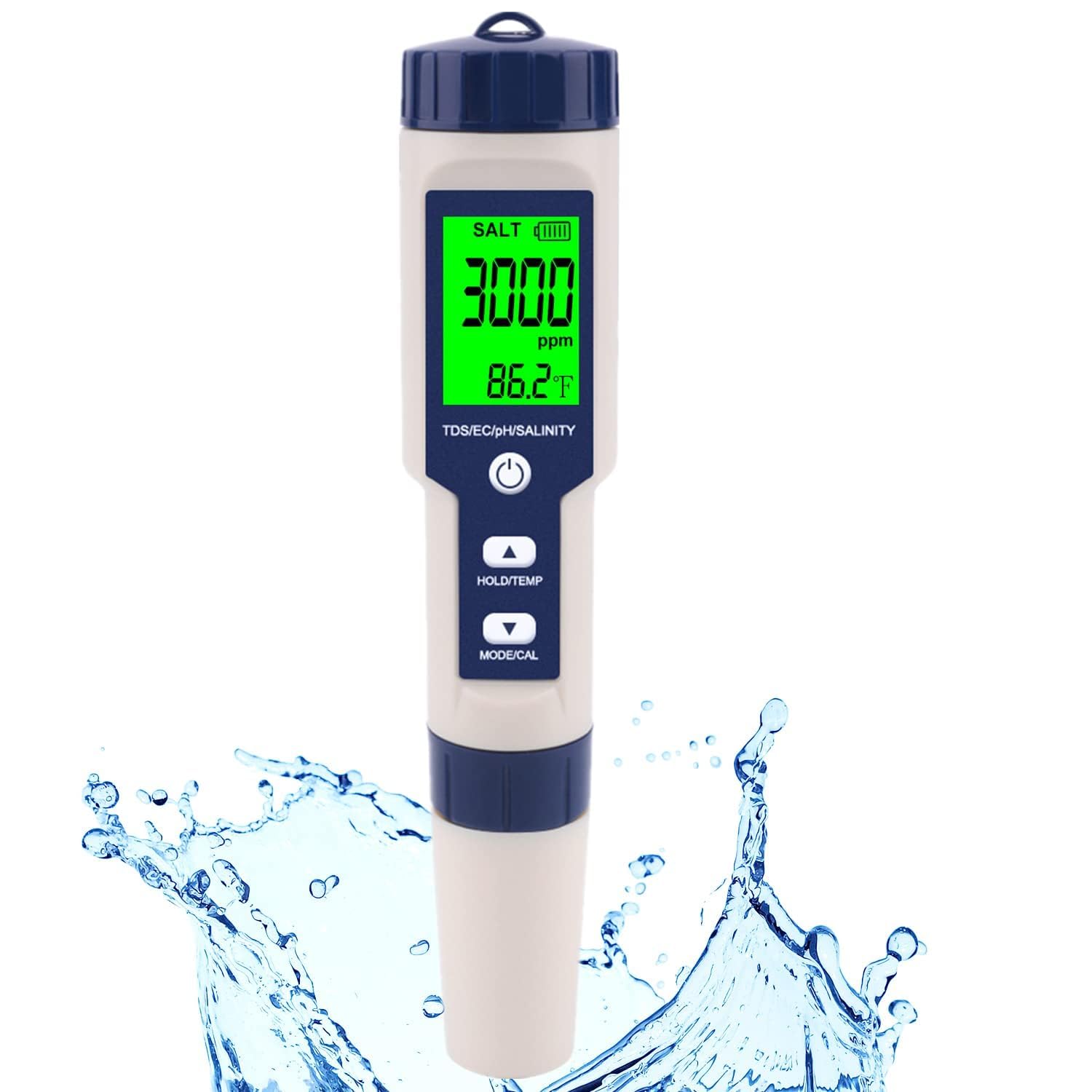
Rating: 4.3 ★ | Price: Mid-Range | Measurement Range: 0-200 ppt, pH 0-14
The Hofun 5-in-1 packs salinity, pH, TDS, EC, and temperature into a single handheld device with instant digital readouts. That’s a time-saver for pool and hot tub owners who want a quick multi-check without juggling separate tools. But accuracy trades off against convenience: salinity readings can diverge from a dedicated refractometer, and pH may be off by one unit. For freshwater aquarium keepers doing general water monitoring, these variances are acceptable. Saltwater reef aquarists who need precise salinity adjustments should stick with the top pick’s optical refractometer.
Pros
- Instant digital readout – no calibration fluid or squinting required.
- Combines five tests in one device, saving time for pool and aquarium checks.
- Solid build quality for the mid-range price point.
Cons
- Salinity and pH accuracy may diverge from reference testers – a factor when precise readings matter.
- Not suited for saltwater reef tanks where exact salinity control is critical.
This multi-meter is a practical pick for pool, hot tub, or freshwater general checks, but it’s not accurate enough for reef tank salinity management.
Best for Budget Reefers
Hallocool ATC Refractometer

Rating: 4.5 ★ | Price: Budget | ATC: Yes | Measurement Range: 0-100 PPT, 1.000-1.070 SG
Offers basic salinity measurement for budget-minded reef keepers at an entry-level price. The scale can appear blurry under some conditions, and the plastic case may crack over time – these tradeoffs suit occasional users who don’t test daily. While the review base is smaller than top picks, it functions adequately for basic needs.
Pros
- Easy to use with straightforward operation.
- Provides accurate readings consistent with local fish store references.
Cons
- Scale may appear blurry or hard to interpret in some lighting conditions.
A functional but imperfect option for budget shoppers who test infrequently and can accept minor readability tradeoffs.
Best for Buyers Willing to Inspect
SunGrow Aquarium Refractometer

Rating: 4.5 ★ | Price: Budget | ATC: Yes
For under $15, this optical refractometer delivers accurate salinity readings after a simple calibration – when the scale is printed correctly. However, some units have shipped with a 0–25 PPT scale instead of the 0–100 needed for saltwater, so immediate inspection is required. Best for budget-conscious buyers willing to verify and return a misprinted unit.
Pros
- Accurate salinity readings after simple calibration
- Very low cost makes it accessible for beginners
Cons
- Some units may ship with a 0–25 PPT scale instead of 0–100, making them unusable for saltwater aquariums
Only worth buying if you can inspect immediately upon arrival and return a misprinted unit; otherwise, a proven refractometer is safer.
How to Choose
The single most important decision is whether an optical or digital refractometer fits your testing frequency — because accuracy depends more on consistent calibration than the price tag.
Accuracy and Calibration Stability
All refractometers need periodic calibration with distilled or RO water. Optical models rely on a manual screw adjustment; digital units use a push-button zero. The physical trade-off: optical prisms can drift after repeated cleaning or temperature shifts, while digital sensors are more stable but still require re-zeroing every few weeks.
For a 20-gallon nano reef, a drift of 0.001 SG is negligible. For a 200-gallon SPS system, that same drift can affect coral polyp extension. Match your calibration discipline to your tank’s sensitivity.
Ease of Use and Readability
Optical refractometers require a bright light source — natural daylight or a white LED — to read the blue/white boundary line. In a dim fish room or during early-morning testing, you’ll need a flashlight or headlamp. Digital refractometers eliminate this entirely with a backlit LCD display.
The convenience of a digital readout comes at a cost: batteries die, and the sensor well must be kept scrupulously clean. If you test daily, the time saved adds up. If you test once a month, an optical model is faster to grab and use.
Durability and Build Quality
Optical refractometers are essentially precision instruments in a plastic or metal housing. Plastic cases crack if dropped onto a tile floor; aluminum bodies survive the same fall with minor dings. The prism itself is glass and can scratch if wiped with a rough cloth.
Digital units are more robust overall, with sealed optics and rubberized grips. But the internal electronics are sensitive to salt creep and moisture. Rinse the sensor well with fresh water after every use and store in a dry place.
Automatic Temperature Compensation (ATC)
ATC corrects for the fact that water density changes with temperature. Without it, a reading taken in a warm sump (78°F) versus a cool mixing bucket (68°F) can differ by 0.002 SG. All modern refractometers include ATC, but the compensation range matters: standard ATC works from 10°C to 30°C (50°F to 86°F).
If you mix saltwater in a cold garage or test during winter, verify that your model’s ATC range covers your typical water temperature. Most do, but cheap units may have narrower compensation.
Measurement Scales (PPT and Specific Gravity)
Specific gravity (SG) is the ratio of saltwater density to pure water. Salinity in parts per thousand (PPT) measures the actual salt content. Many refractometers show both scales on the same eyepiece. Reef tanks typically run 1.024–1.026 SG (32–35 PPT).
The scale you choose is personal: most American hobbyists use SG because it’s printed on hydrometer swing-arms. European and Asian reefers often prefer PPT. Get a dual-scale tool to future-proof your testing — you can always convert later.
FAQ
Why does my swing-arm hydrometer give different readings than my refractometer?
Swing-arm hydrometers are affected by air bubbles sticking to the needle, temperature variations, and the angle you hold the device. Even a perfectly clean unit can be off by 0.003 SG or more. Refractometers measure light refraction, which is far less sensitive to these variables. If your hydrometer and refractometer disagree, trust the refractometer.
How often should I recalibrate my aquarium refractometer?
Optical refractometers should be re-zeroed with distilled water before every use session — it takes 10 seconds. Digital models can go a week or two, but check monthly if you use it daily. Skip recalibration and a 0.001 SG drift can silently throw off your salinity over multiple water changes.
Can I use a pool salt tester for my saltwater aquarium?
Pool salt testers (like the Hofun 5-in-1) measure in a wider range (often 0–200 ppt) and are calibrated for lower accuracy. They can give a rough idea, but for reef tanks where precise salinity is critical, they are not reliable enough. Stick to a dedicated aquarium refractometer.
Is an optical refractometer accurate enough for a reef tank?
Yes. A quality optical refractometer with ATC is accurate to ±0.001 SG when properly calibrated — plenty precise for SPS corals or a mixed reef. The catch is you need good lighting to read the scale. If you test in a dark room, invest in a small LED flashlight or upgrade to a digital model.