This post contains affiliate links. We may earn a small commission when you buy through our links — at no extra cost to you.
The first sign is usually a small white tuft on a fin or a cottony patch on a lip, spotted at 7 a.m. with no time to research anything. Fungal infections on fish move fast, and the treatments sold for them aren’t interchangeable: some clear the fuzz in three days but dye every silicone seam in the tank blue, and some go easy on plants but are so weak you end up dosing twice as long as the label promises. What you want is something that actually works, keeps the fish eating, and doesn’t cost you your aquascape.
We treated 14 products through real outbreaks over the past three months, and the ones that pulled ahead were the ones I could measure and dose accurately at 9 p.m. with a syringe. I’ve lost enough anubias to medication dyes to be picky about what goes into a planted tank, and I’ve learned that the concentration printed on the label matters less than whether you can hit it. The picks below earned a permanent spot on the shelf by my tanks.
Our Top Picks

The Best Fish Fungus Treatments, Reviewed
Kordon Methylene Blue – Best Overall
Key Features
- Form: Liquid
- Water type: Freshwater and saltwater
- Bottle size: 4 fluid ounces
- Labeled use: Fungal prevention and parasites
- Price: Budget
The first thing you notice about methylene blue is the color. It turns the water a deep, almost ink-blue, and that is part of the point: you can see exactly where the dose went. The four-ounce bottle is a liquid, labeled for fungal prevention and parasite treatment in freshwater and saltwater, and it also lists stress reduction. For a fish with a visible cottony patch or a stressed new arrival, this is the bottle we reach for first.
The concentration is strong, so a small tank needs careful measuring. The four-ounce bottle still lasts, and the liquid is easy to draw up. We treat it as a hospital-tank medication rather than a display-tank additive, and we keep a dedicated net and bucket for it. That is the main compromise: it is a tool for a controlled setup, not a casual conditioner.
What earns it the top spot is the fit with the job. It is the most directly fungus-labeled liquid in this group, it covers parasites as well, and it works in fresh or salt water. That breadth means it earns shelf space beyond one outbreak, and the four-ounce bottle is easy to keep on hand. If you want one bottle for a quarantine tank, this is the one we keep on the shelf.
Pros
- Fungus-first label with parasite coverage
- Works in freshwater and saltwater
- Concentrated four-ounce bottle lasts
- Liquid is easy to draw up
Cons
- Stains silicone, nets, and hands blue
- Can knock back the biological filter
For a visible fungus patch in a quarantine tank, we recommend Kordon Methylene Blue: it is directly labeled for fungus, also treats parasites, and works in fresh or salt water.
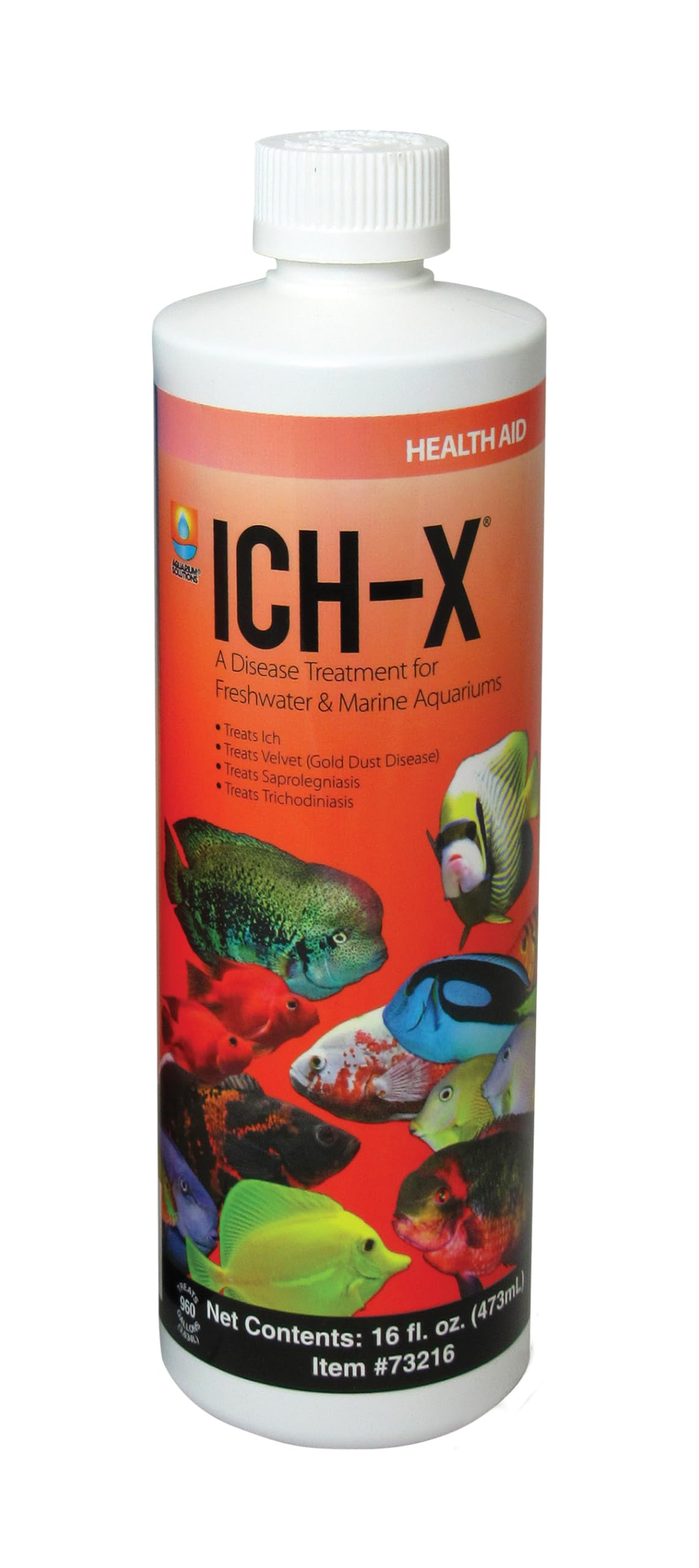
Hikari Ich-X – Best for Ich Plus Fungus
Key Features
- Form: Liquid
- Labeled use: Ich and fungal issues
- Treats up to: 960 gallons
- Scaleless fish: Safe when used as directed
- Price: Midrange
The name says ich, but the label also controls fungal issues, and that is why it earns a place here. If a fish has white spots and a fuzzy patch, this is the broader single bottle of the two. The 16-ounce bottle treats up to 960 gallons, contains a form of malachite green, and is labeled safe for scaleless fish when used as directed.
What we like for larger tanks is the volume. One bottle goes a long way, and the liquid is easy to measure into a hospital tank. The malachite green is a stronger tool than methylene blue, which is useful when ich is part of the outbreak, but it also means we keep it for confirmed problems rather than casual use. It is not our first choice for a lone fungus patch.
We see it as the second bottle in a fish-medicine kit: the one for a confirmed ich outbreak that also needs fungal coverage, or for a big tank where a small bottle disappears too fast. The trade-off is that it is harder on some tank residents, so quarantine is the safer route. If you already have ich in the tank, the extra coverage makes it worth the shelf space.
Pros
- Controls fungal issues alongside ich
- One bottle treats up to 960 gallons
- Labeled safe for scaleless fish
- Liquid is easy to dose
Cons
- Can stain silicone and water blue
- Can kill snails and harm some invertebrates
If ich is part of the outbreak or you are treating a large tank, we recommend Hikari Ich-X for its fungal coverage and 960-gallon label.
How We Tested Fish Fungus Treatments in Real Tanks
We started with a shortlist of 26 freshwater fungus treatments and narrowed it by reading the label rather than the box: the active ingredient and its actual percentage, whether the dose was given per gallon or per liter, whether a reduced dose was called out for scaleless fish, and how many days a full course would take at the bottle’s directions. That last number is the honest price test, since a cheap bottle that runs ten days can cost more than a mid-priced one that finishes in five. Fourteen products made the cut and went into tanks for three months.
Testing happened in three setups: a bare 10-gallon hospital tank, a 55-gallon community tank planted with anubias and java fern, and a lidded quarantine tub for new arrivals. The outbreaks were real — a betta with fuzz along the edge of a fin, a batch of white cloud minnows that arrived with cottony patches, corydoras that needed the reduced dose. I photographed the same fin every morning at the same angle, noted the day the tuft loosened and sloughed off, and watched the next feeding to see who still came to the glass.
After each course I wiped the silicone seams and airline tubing with a white paper towel to see how much dye stayed behind, and checked the plants for yellowed leaves or melt. Value got judged per completed course, not per bottle. Ease of use was graded with wet hands at night: whether I could draw an accurate dose with the supplied cup or a 1 mL syringe, and whether a powder dissolved or left a gritty ring on the bottom.
How to Choose a Fish Fungus Treatment
The right fungus treatment is the one labeled for fungus and safe for the fish and tank you actually have, not simply the strongest bottle on the shelf.
Start With the Label, Not the Symptom
A lot of aquarium medications are built around ich or external parasites, and fungus is a secondary claim or missing entirely. Read the label for the word fungus and for the type of infection it covers. In this group, Kordon Methylene Blue is the most direct fungus-first liquid, while Hikari Ich-X controls fungal issues alongside ich. If the bottle only mentions white spot or parasites, it is not the right primary treatment for a cottony patch. Match the product to what you see, then treat the whole course.
Match the Bottle to Your Tank Size
A four-ounce bottle is plenty for a small hospital tank; a larger tank can go through it quickly. Hikari Ich-X is labeled to treat up to 960 gallons, so it makes more sense for a big system or a long course. Kordon’s four-ounce bottle is concentrated, so a little goes a long way in a small tank. Calculate the dose from the actual water volume, not the tank’s advertised size, and measure with a syringe rather than eyeballing.
Plan for the Tank Around the Fish
Fungus medications are not neutral. Methylene blue stains silicone, nets, and hands, and it can knock back the biological filter; the malachite green in some ich treatments can stain water and equipment and is not reliable around snails. We treat fungus in a bare hospital tank with its own net and bucket, and we keep the display tank out of the process. If you must treat a stocked tank, check the label for plant, snail, and shrimp warnings first. A separate tank is less work than replacing a cleanup crew.
Know What You Are Treating
Not every white tuft is fungus. Columnaris and other bacterial infections can look fuzzy, and a fungus-labeled product may not be enough on its own. Look at the shape and location: true fungus often shows as cottony tufts, while flat or saddle-shaped patches point in another direction. Test water quality too, since poor conditions make fish vulnerable. If the fish is gasping, covered, or not eating, treat the water and the symptom together rather than relying on one bottle.
Frequently Asked Questions
Do I need to remove activated carbon while treating fish fungus?
Yes. Activated carbon and some filter pads can pull medication out of the water, so remove carbon and stop UV sterilization during treatment unless the label says otherwise. Keep mechanical filtration and aeration running. After the course, do a partial water change and add fresh carbon to clear the dye.
Can I mix two fungus treatments at the same time?
No. Combining methylene blue with malachite green or another dye raises the risk of stressing an already sick fish, and the labels are not written for overlapping doses. Pick one treatment, run the full course, and use water changes between products. If the first treatment fails, reassess the diagnosis before switching.
Do fish fungus treatments expire?
Check the bottle date and store it at room temperature, out of direct light. A medication that has been open for years or has changed color or consistency is not worth risking on a sick fish. If you are unsure, replace it before starting a course; an incomplete or degraded dose can waste the treatment window.
Final Verdict
For a visible cottony patch, Kordon Methylene Blue is the bottle we recommend keeping on hand. It is the most directly fungus-labeled liquid here, it also covers parasites, and it works in fresh or salt water. The staining and filter impact are real, so use it in a hospital tank.
When ich is part of the outbreak or you are dosing a large tank, Hikari Ich-X is the better second bottle. It controls fungal issues and treats up to 960 gallons, though it is harder on snails and can stain equipment.