This post contains affiliate links. We may earn a small commission when you buy through our links — at no extra cost to you.
A pH test kit is a deceptively simple thing: a few drops of reagent or a quick dip, then you hold the tube against a color card and make a call. Everything else follows from that call — water change, buffer, or leave a stable tank alone. The difference between a kit you trust and one you don’t is often half a shade, since 7.2 and 7.6 can look identical under kitchen lighting. My team has spent the past four months with 14 kits — strips, drops, and a couple of digital pens — and the good ones make that call obvious.
I’ve learned this the hard way: consistency beats a perfect number. A tank sitting happily at 7.6 doesn’t need rescuing, and chasing 7.0 with buffers usually causes more trouble than the reading did. What you want is a repeatable result you can get in under a minute, a chart that hasn’t faded, reagents that haven’t quietly expired a year after opening, and a cost per test that doesn’t sting. The kits below are the ones that held up on all four.
Our Top Picks
The Best Aquarium Ph Test Kits, Reviewed
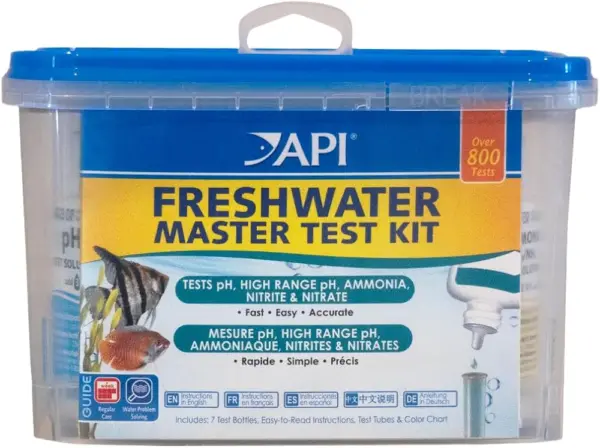
API Freshwater Master Test Kit – Best Overall
Key Features
- Parameters: pH, high range pH, ammonia, nitrite, nitrate
- Water type: Freshwater
- Kit contents: 7 solutions, color card, 4 tubes
- Tests per kit: 800
- Price: Midrange
A pH reading on its own is a thin slice of what’s going on in a tank. The Freshwater Master tests pH and high-range pH, ammonia, nitrite and nitrate out of one box — seven dropper bottles, a color card and four capped tubes — and that breadth is the whole argument for it.
It’s the kit we reach for first, and the reason is scope rather than precision. The same session that gives you a pH number also tells you whether that number is being pushed around by fish waste, uneaten food or a filter that hasn’t caught up. A pH-only kit leaves you looking at 6.4 with no idea whether it means anything.
The routine is drops in a tube: fill to the line, add reagent, shake, wait, match against the card. Two habits decide whether the reading is worth having. Shake the nitrate bottle harder and longer than feels necessary, because a half-shaken bottle won’t give you a result you can act on. And hold the tube against the white of the card in daylight — tank lighting tints everything and makes the shades harder to separate than they really are.
Four tubes cover five tests, so rinsing between them is part of the job, and it’s the step that gets skipped. The booklet is the other piece first-timers undervalue: it gives the ideal range for each parameter and a next step when one comes back off. Eight hundred tests is a lot of Sundays, and the solutions keep as long as the caps go back on tight.
Pros
- pH plus three nitrogen compounds
- 800 tests per kit
- Booklet explains results and next steps
- Color card covers both pH ranges
Cons
- Freshwater aquariums only
- Tubes are fragile and easy to knock over
We recommend it for any freshwater tank: it reads pH alongside ammonia, nitrite and nitrate, so the number comes with a reason behind it.
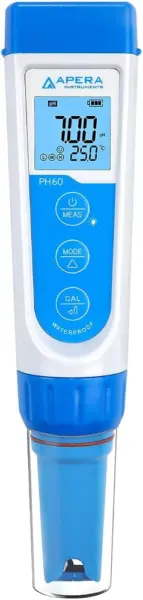
Apera PH60 pH Tester – Best Ph Meter
Key Features
- Probe: Replaceable glass
- Accuracy: ±0.01 pH
- pH range: -2.00 to 16.00
- Calibration: 1 to 3 point auto
- Price: Premium
The PH60’s probe unscrews and can be replaced, and that one detail separates it from every sealed pH pen in this group. When the electrode ages out, you buy a probe instead of a whole meter — the difference between a tool you keep and a tool you replace.
The specification behind it is ±0.01 pH across a range of −2.00 to 16.00, far more resolution than a community tank needs. Reef keepers and planted-tank people chasing a shift of a tenth or two are the ones who’ll use it: at that resolution a change shows up long before the livestock reacts. Calibration runs one to three points with automatic recognition of five buffer standards, and the backlit display shows pH and temperature together — the dual readout is a small thing we came to rely on.
Two things are worth planning for. Calibration isn’t a one-time setup, it’s a routine, and buffer solution is a consumable you’ll reorder. The glass bulb also needs to stay wet between uses; a probe left dry in a drawer comes back slow and drifts, and no amount of calibrating fixes that. Cared for properly this is the most precise instrument here by a wide margin, and the replaceable probe is what makes the running cost easier to justify than replacing a whole pen when its electrode goes.
Pros
- Reads to ±0.01 pH
- Replaceable glass probe
- One to three point auto calibration
- Backlit display shows pH and temperature
Cons
- Needs regular calibration and buffer refills
For reef and planted tanks we recommend the PH60: it resolves a hundredth of a pH unit, its probe can be replaced, and it calibrates itself against five buffers.
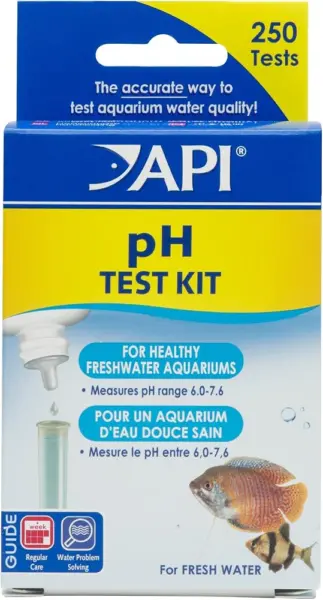
API pH Test Kit – Best Budget Ph Kit
Key Features
- pH range: 6.0 to 7.6
- Water type: Freshwater
- Kit contents: 1 solution, color card, 1 tube
- Tests per kit: 250
- Price: Budget
Some tanks only need one number. If pH is the only thing you monitor — a mature setup with an established filter where you’re watching for drift — a bottle of indicator and one tube is a better tool than a five-parameter kit, and this is the least expensive way into that here.
The kit is one dropper bottle, one color card and one capped tube, and it reads 6.0 to 7.6. Fill to the line, add drops, shake, match. That’s the whole procedure, and with 250 tests in the bottle you can check after every water change instead of rationing it out to Sundays. If your fish sit above that range — African cichlids, livebearers, goldfish, marine fish or invertebrates — buy the high-range test instead, because this one will sit at the top of its card and tell you nothing useful.
What we like is the economics of testing often. pH is the number that moves after a water change or a new piece of driftwood, and a kit whose per-test cost is close to nothing removes the excuse to skip a check. The card itself is the caveat: adjacent shades are close enough that you’ll want daylight and a white background, and a result sitting between two squares is an estimate rather than a value.
Pros
- 250 tests from one bottle
- Lowest cost per test here
- Reads in well under a minute
Cons
- The single tube is delicate
We recommend it as the pH-only workhorse: one bottle, one tube, and 250 tests that make checking after every water change an easy habit.
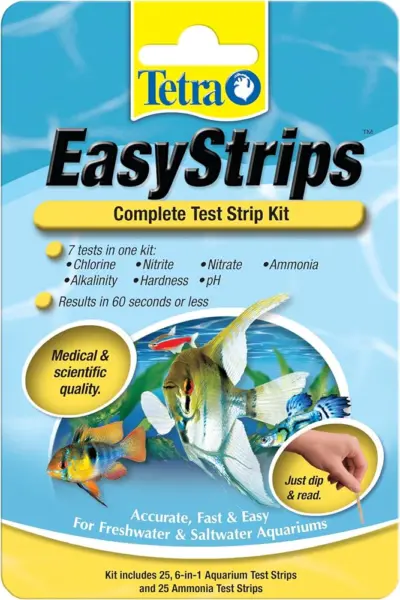
Tetra EasyStrips Complete – Best for a Fast Check
Key Features
- Read time: 60 seconds
- Parameters: Ammonia, nitrate, nitrite, hardness, chlorine, alkalinity, pH
- Water type: Freshwater and saltwater
- Strips included: 25 six-in-one, 25 ammonia
- Price: Budget
Dip a strip, wait a minute, compare the pads against a chart printed on the bottle. The EasyStrips Complete kit does that six ways at once and adds a separate ammonia strip, so there’s no glassware to rinse, no drops to count and nothing to break.
We treat it as a screening tool rather than an instrument, and it’s a good one. On a tank that’s already dialed in, a strip tells you within a minute whether anything has moved, which is all you need to decide whether to get the liquid kit out of the cupboard. It won’t tell you that your pH is 7.2 — it’ll tell you whether you need to care today.
The case for it is frequency. The barrier to testing is one minute instead of ten, and a kit you’ll actually use twice a week beats a better kit you avoid. Keep the bottle sealed and upright, because the chart lives on the label — a damp bottle ruins the strips and your reference at the same time.
Pros
- Seven parameters in about a minute
- Separate ammonia strips included
- No tubes to rinse or break
- Chart printed on the bottle
Cons
- Shades are approximate, not precise readings
We recommend it for the tank that’s already stable: a minute’s dip tells you whether anything has moved, without tubes or counting.
Apera PH20 pH Tester – Best for Budget Digital Readings
Key Features
- Accuracy: ±0.1 pH
- Calibration: Automatic, buffer recognition
- Battery life: Up to 2,000 hours
- Temperature compensation: 32 to 122 °F
- Price: Midrange
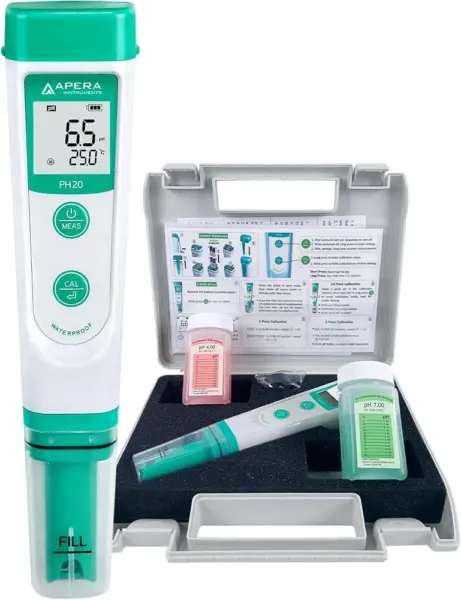
The PH20 gives up two things against the PH60: a decimal place and a replaceable probe. It reads to ±0.1 pH with automatic temperature compensation from 32 to 122 °F, and for a freshwater community tank we think that’s the right resolution — you’re asking whether you’re near 7.0, not whether you’re at 6.84.
What you keep is the routine. Calibration is automatic with buffer recognition, the reading settles and holds so you’re not guessing when to write it down, and the body is waterproof with a lanyard and a case that holds the pH 4 and 7 buffers it ships with. Apera rates it for up to 2,000 hours on AAA batteries, so battery life isn’t what ends this meter’s life.
The electrode is. Store it wet, calibrate on a schedule, and it’s a steady instrument that returns a reading in about five seconds; let it dry out and the numbers drift, with no probe to swap. That’s the trade against the PH60 — you get the same calibration routine for less money, on the understanding that when the sensor goes, the meter goes with it.
Pros
- ±0.1 pH with automatic temperature compensation
- Automatic calibration with buffer recognition
- Buffers and a carrying case included
Cons
- Probe cannot be replaced when it wears out
We recommend the PH20 for freshwater keepers who want a number instead of a shade: ±0.1 accuracy and a calibration routine that takes minutes.
SJ WAVE 11-in-1 Strips – Wide Screening Panel
Key Features
- Extras: Color chart, eBook, test tubes
- Ammonia strips: 50
- Strips included: 150
- Parameters tested: 11
- Price: Midrange
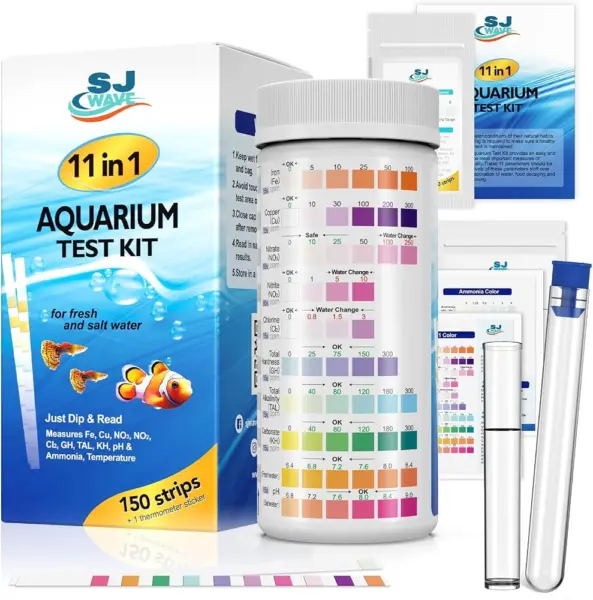
Strips die from moisture long before they run out, which makes the packaging part of the product. SJ WAVE splits its 150 strips between a bottle and a resealable bag, so the ones you aren’t using aren’t breathing damp tank-room air every time you open the lid.
Eleven pads is the headline, and the extras are the interesting part: free chlorine, copper and iron alongside the familiar pH, hardness, nitrite and nitrate, with 50 dedicated ammonia strips in the box. If you’re on well water, or topping a reef off from the tap, copper and chlorine are worth a look before they turn into a problem.
What a wide panel can’t fix is shading. Eleven results crowded onto one strip means some colors sit a shade apart, and the pH pad — the one this whole search is about — is the one we trust least here. On a reading that matters, the strip is where the check starts, not where it ends.
So we file this as a broad screening kit rather than a pH reference. It earns its place if you’re sweeping several tanks a week and want an early warning on metals and chlorine; for the single tank where pH drives your decisions, drops or a meter will serve you better.
Pros
- Eleven parameters including copper and chlorine
- 50 dedicated ammonia strips included
- Spare strips stay sealed against moisture
Cons
- Colors are hard to tell apart on crowded pads
We recommend it for keepers running several tanks who want a broad, cheap sweep — not as the pH reference you dose against.
AAwipes 8-in-1 Strips – Best for Bulk Strip Screening
Key Features
- Water type: Freshwater and saltwater
- Ammonia test: Separate eighth pad
- Strips included: 150
- Parameters tested: 8
- Price: Budget
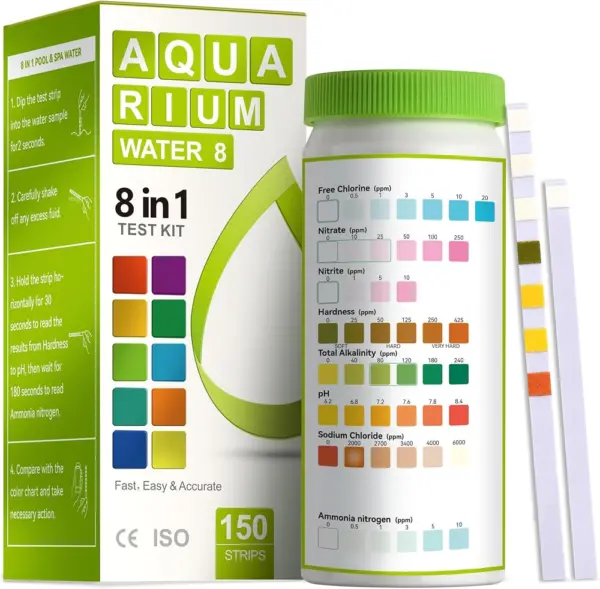
The first thing we noticed is that the eighth pad is an ammonia test you dip separately from the other seven, so the ammonia result gets its own few seconds rather than riding along with everything else.
Eight parameters, 150 strips, a sealed bottle and a chart on the side. That’s the whole offer, and for bulk screening it holds up — there’s enough here to check several tanks a week without rationing. Ammonia is the test people skip and then wish they hadn’t, and having it in the box rather than as a separate purchase is worth something.
Where it fits is volume: a quarantine tank, a shelf of grow-out tanks, a pond you check quickly and confirm with something better. For the tank whose pH actually drives decisions we still reach for drops or a meter; for everything else, a strip that reads ammonia in the cupboard beats a trip to the store when a fish looks off.
Pros
- Eight parameters including ammonia
- 150 strips in a sealed bottle
- Ammonia has its own pad
Cons
- Small pads make the shades hard to separate
We recommend it as a bulk screening kit for multiple tanks: eight parameters, ammonia included, and enough strips to check everything weekly.
How We Tested the pH Kits
We started by gathering every kit we could find at big-box pet stores and the hobbyist retailers — dip strips, bromothymol blue and phenol red drop kits, and a few digital pens — then filtered the pile by resolution (kits that read in 0.2 increments rather than 0.4), whether replacement reagents are sold separately, and how much each individual test costs. That left 14 kits, which we ran for four months.
Testing happened where these kits actually live: beside a 55-gallon community tank, a 20-gallon planted tank, and a bare quarantine tank, plus a jug of tap water and three reference buffers of known pH. Each week we sampled the same water with every kit in the lineup, then compared the readings against each other and against a calibrated meter to see which ones drifted over time and which stayed steady.
We timed every test from dip to reading, then read strips a second time 30 seconds late to see how fast the color moved — a couple shifted almost a full shade, which is the difference between leaving the tank alone and panicking. Each sample was read independently by two people under warm kitchen light, cool daylight, and a tank LED, and we wrote down exactly where the chart got ambiguous or where a shade was too close to call. We also checked whether charts were printed on waterproof card or paper that curled the first time it got splashed, and left strip containers open in a humid cabinet for a week to see if the pads clumped.
For value, we divided the price by the number of tests a kit actually delivers, not the number promised on the box, and marked down anything that needed a fresh chart or a proprietary refill after a month. The survivors are still in weekly rotation, and we’ll update if a reagent expires early or a chart starts reading differently.
How to Choose an Aquarium Ph Test Kit
The best pH kit isn’t the most precise one you can buy — it’s the one whose routine you’ll repeat every week without resenting it.
Decide whether you need pH or the whole tank
A pH test answers one question, and it isn’t always the urgent one. In a tank that’s still settling, a fish that’s gasping or a filter that’s new, ammonia and nitrite are what you need to see, and a kit that reads them alongside pH saves you a second purchase and a second wait for shipping. In a tank that’s been running for years, pH plus a quick strip covers most weeks.
The API Freshwater Master is the broad choice here; the API pH Test Kit is the deliberately narrow one. Neither is wasted money — just be honest about which tank you actually have.
Match the color card to the water you keep
The standard pH test runs from 6.0 to about 7.6, which covers most South American and Southeast Asian community fish. It does not cover African cichlids, goldfish, livebearers, marine tanks or invertebrates, which sit at or above the top of that scale.
The trap is buying the low-range kit because it’s the one on the shelf, then reading 7.6 every week for a year and assuming everything is fine — a test pegged at the top of its card isn’t a measurement. Check where your fish sit first; the API pH Test Kit’s own directions send cichlid and marine keepers to the high-range version for exactly this reason.
Choose your precision: drops, strips or a meter
Drops and strips both work by matching a shade, and both depend on your eye. Drops give a tighter set of steps and a more controlled reaction; strips trade that for speed and no glassware to rinse. A meter takes your eye out of it entirely and hands you a number, but it needs calibrating and its electrode has a working life.
Our order of use: strips to screen, drops to confirm, a meter when you’re tracking a small shift over weeks. Reef keepers and high-tech planted tanks are where the meter earns its keep; a community tank rarely needs more than a tenth of a pH unit of resolution.
Budget for refills, not just the box
The figure that matters is cost per test, not the shelf price. A bottle that runs 250 tests and a box of 150 strips can look like similar money and last wildly different lengths of time depending on how many tanks you keep and how often you test.
Meter owners carry a second budget: buffer solutions for calibration, and eventually a replacement probe. Work out your tests per month before you commit, because the running cost is what you live with after the unboxing.
The reading is only as good as the technique
Three habits do more for accuracy than the kit you choose. Read against a white background in daylight — a tank light turns a blue-green result into a guess. Time the read, because a strip left sitting keeps developing and drops read too early haven’t finished reacting.
And rinse the tube with tank water between tests. A trace of the last reagent is enough to skew the next one, and where a result matters, run it twice before you change anything in the tank.
Frequently Asked Questions
How often should I test my aquarium’s pH?
Once a week is the usual rhythm, plus a check after any water change, new fish or new piece of hardscape. Test at roughly the same time of day each time — pH drifts over a day as plants and algae use up carbon dioxide, and a morning reading compared against an evening one looks like a swing that isn’t really there.
In a new tank, check every couple of days until the readings settle into a pattern you recognize.
Do aquarium test strips go bad?
Yes, and moisture is what kills them. Once a bottle is opened, damp air and a wet cap degrade the pads and the results fade toward useless. Keep the bottle sealed and upright, away from the cabinet directly above the tank where condensation collects, and check the expiry date before you trust a strange reading.
A strip that shows no color change at all is a dead strip, not perfect water.
Can I use a hydroponics pH pen in my fish tank?
A water pH meter will read tank water, and the Apera pens here are general-purpose instruments that work fine in an aquarium. Two conditions apply: calibrate against fresh buffer before you trust the number, and rinse the probe in tank water rather than tap between uses.
Store the electrode wet. A pen left dry in a drawer drifts, and no amount of calibrating brings it back.
Is a pH of 7.0 the goal?
No — matching your fish is the goal, and stability matters more than the number itself. Tetras and discus keepers usually work below 7, livebearers and goldfish above it, and African cichlids well above.
Chasing a target with pH-up and pH-down products causes more harm than a steady reading slightly off the ideal. Find your species’ range, keep it there, and test often enough to catch a drift before it becomes a swing.
Final Verdict
For a freshwater tank, we point people to the API Freshwater Master Test Kit: five parameters, 800 tests, and a routine that takes a few minutes once a week. It’s the pick that turns a pH number into something you can act on, which is the whole point of testing.
If your fish sit above 7.6, add a high-range pH test to whatever you buy. If you’re running a reef or a high-tech planted tank where a tenth of a unit is the story, the Apera PH60 is the instrument that earns its price. And if you know you won’t stand at a counter with a tube, the Tetra EasyStrips Complete is the kit that actually gets used.