This post contains affiliate links. We may earn a small commission when you buy through our links — at no extra cost to you.
Many aquarists discover the hard way that ammonia test strips often show zero even when levels are dangerous. The real difference isn’t price—it’s the testing method.
Liquid reagent kits use chemical reactions that produce clear color changes, while strips rely on a tiny, often inconsistent pad. For cycling a new tank or checking on sensitive fish, that accuracy matters.
This guide focuses on the kits that actually detect ammonia at the levels that affect fish health—and the ones that don’t.
Top Picks
Best for Complete Freshwater Kit
API Master Test Kit 800

Rating: 4.8 ★ | Price: $$ | Test Type: Liquid reagent | Parameters: pH, ammonia, nitrite, nitrate | Tests per Kit: 800 tests total | Reading Ease: Color chart comparison | Water Type: Freshwater only
Liquid reagent tests deliver precision that strips can’t match, especially for ammonia readings critical during tank cycling. The kit includes separate reagents for each parameter; the ammonia test uses a simple color comparison that users find consistent across typical household lighting. Nitrate color matching can be trickier in some lights, and only four test tubes are included for five tests, meaning you’ll wash tubes between procedures.
This kit is for freshwater owners who want one complete set to track the full nitrogen cycle without buying separate ammonia, nitrite, and nitrate kits – it covers pH as a bonus. Saltwater or reef keepers will miss calcium and alkalinity tests, so this stays in freshwater territory. The included color charts and instructions are clear enough for first-time hobbyists, though the small print may need a magnifier.
Pros
- Accurate liquid tests for all four cycling parameters – ammonia, nitrite, nitrate, and pH – in one box
- Exceptional value per test – the 800-test count lasts months to years, outlasting strip refills
- Clear instructions and color charts make the process intuitive even for first-time hobbyists
Cons
- Only four test tubes included for five tests – expect to wash tubes between procedures
- Nitrate color chart shades can be hard to distinguish under certain lighting, leading to subjective readings
For freshwater aquarium owners, this kit delivers accurate liquid tests for the four parameters that matter most during cycling and maintenance – the most practical single kit on the market.
Best for Dedicated Ammonia Tracking
API Ammonia Liquid Kit

Rating: 4.7 ★ | Price: $ | Test Type: Liquid reagent | Parameters: Ammonia only | Tests per Kit: 130 tests | Reading Ease: Color chart comparison | Water Type: Freshwater & saltwater
The API Ammonia Liquid Kit delivers the same lab-grade chemistry as the popular master kit for a fraction of the cost – a practical choice for aquarists who already own a multi-parameter test set or are cycling a new tank. It measures ammonia from 0–8 ppm in both freshwater and saltwater, with results in under five minutes. The glass test tube is fragile – handling over a soft surface or swapping for a plastic tube makes this a non-issue for most setups.
Pros
- Highly accurate ammonia-specific testing
- Excellent value for dedicated ammonia monitoring
- Easy to use with clear color card
Cons
- Glass test tube can break if dropped; no spare included
- Occasional packaging mix-up with wrong color card – returns resolve easily
For aquarists who already own a multi-parameter kit or are cycling a new tank, this is the cost-effective way to track ammonia without paying for tests you don’t need.
Best for Quick Multi-Parameter Checks
SJ WAVE 11-in-1 Strips
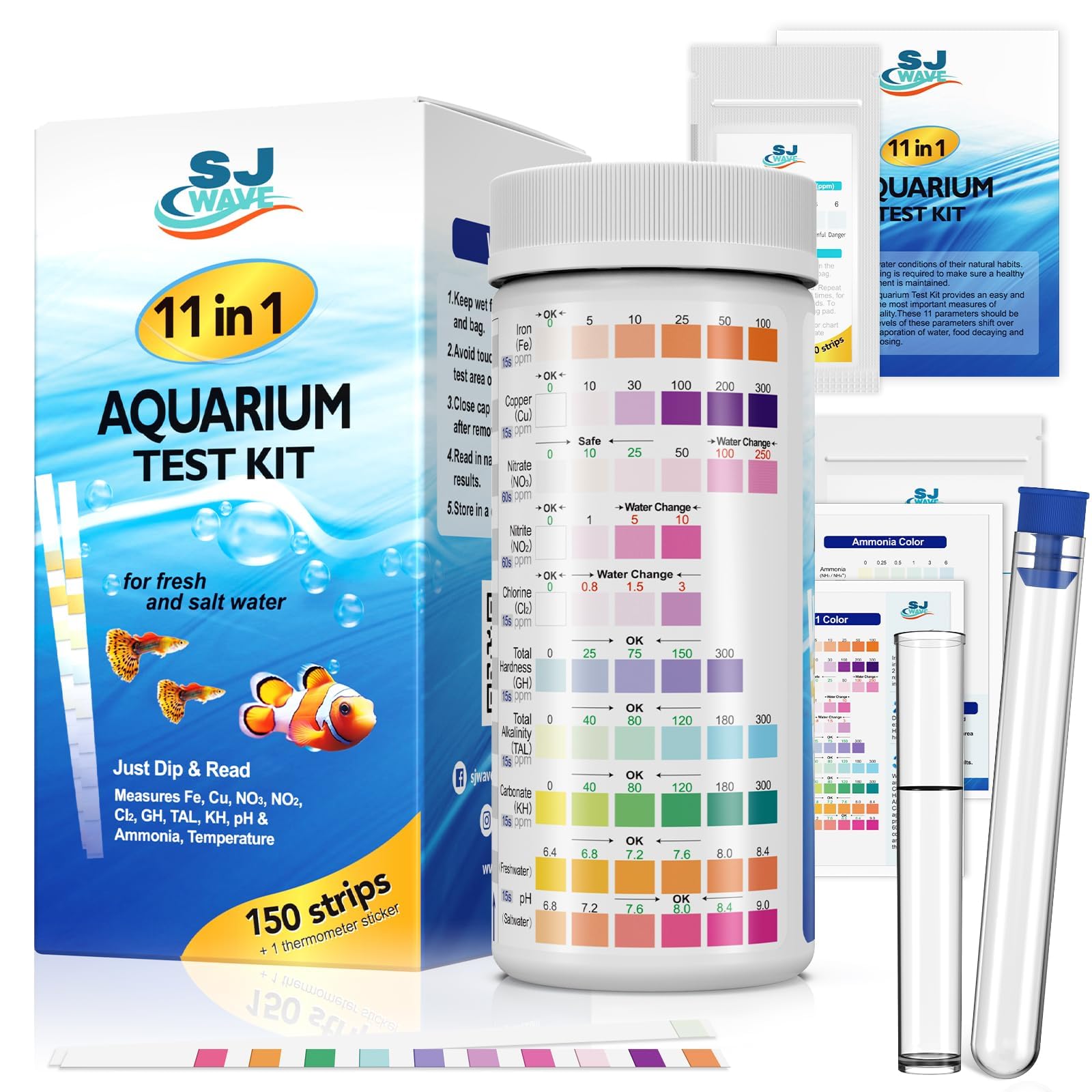
Rating: 4.5 ★ | Price: $ | Test Type: Test strips | Parameters: 11 parameters | Tests per Kit: 150 strips total | Reading Ease: Dip-and-read strips | Water Type: Freshwater & saltwater
These strips deliver quick readings for 11 water parameters at a budget-friendly per-strip cost — ideal for weekly check-ups in established tanks. Where liquid tests like the API Master Kit demand mixing and waiting, these offer a 30-second dip-and-read approach. The ammonia pad, however, shows inconsistent color changes; some batches may read zero even when harmful levels are present.
Best suited for hobbyists maintaining stable tanks who value speed over pinpoint accuracy. The included ebook helps beginners learn about multiple parameters, but a liquid ammonia kit should remain the go-to for cycling or suspected spikes. The subjective color matching on pH and GH pads requires decent lighting to interpret correctly.
Pros
- Extremely convenient – quick dip-and-read for 11 parameters
- Excellent value per strip – large quantity at a low price
- Includes separate ammonia strips and a thermometer for extra utility
Cons
- Color matching on multi-pad strips can be subjective, especially for pH and GH
- Ammonia testing accuracy is inconsistent – the pad may read zero when harmful levels are present
Good for general water quality snapshots in stable tanks, but keep a liquid ammonia kit on hand for cycling or suspected spikes.
Best for Reef & Saltwater
Red Sea Marine Care Kit

Rating: 4.5 ★ | Price: $$$ | Test Type: Liquid reagent | Parameters: 5 marine parameters | Tests per Kit: 100+ per parameter | Reading Ease: Color wheel system | Water Type: Saltwater only
The Red Sea Marine Care Kit uses a color wheel and white background for more consistent reading of saltwater ammonia tests compared to generic strips. It includes all essential marine parameters in one kit, covering ammonia, nitrite, nitrate, pH, and alkalinity. However, shipping is a risk: bottles can leak and ruin the color charts. This kit is for saltwater and reef owners who value accuracy over convenience and already know they won’t be using it in freshwater.
Pros
- Color wheel with white background reduces ambiguity in matching saltwater ammonia levels.
- All essential marine tests in one box — no need to buy separate kits for ammonia, nitrite, nitrate, pH, and alkalinity.
Cons
- Bottles can leak during transit, potentially damaging the color charts and reagents.
Best for marine aquarium keepers who want precise ammonia readings and don’t mind the risk of shipping damage — consider ordering with extra packaging protection.
Best for Quick Ammonia Checks
Tetra Ammonia Strips 100

Rating: 4.5 ★ | Price: $$ | Test Type: Test strips | Parameters: Ammonia only | Tests per Kit: 100 strips | Reading Ease: Dip-and-read strips | Water Type: Freshwater & saltwater
The Tetra EasyStrips offer a quick 30-second dip-and-read ammonia check that suits established tanks where the goal is confirming ammonia stays near zero. The 100-strip pack provides good value for these routine screenings. However, the color scale is too subtle to reliably distinguish 0 from 0.5 ppm, making it easy to miss low-level spikes during cycling. Additionally, some strips may arrive with detached test pads.
Pros
- Convenient dip-and-read in 30 seconds for routine ammonia screening.
- Good value at 100 tests per container for ammonia-only checks.
Cons
- Hard to tell 0 ppm from 0.5 ppm – easy to miss small ammonia rises.
Keep these strips for quick checks in stable tanks, but rely on a liquid ammonia kit for cycling or when you suspect a spike.
Best for Routine Ammonia Check
FUNSWTM Ammonia Strips 100

Rating: 4.5 ★ | Price: $$ | Test Type: Test strips | Parameters: Ammonia only | Tests per Kit: 100 strips | Reading Ease: Dip-and-read strips | Water Type: Freshwater & saltwater
These strips offer a dip-and-read ammonia check for established tanks where occasional pass/fail is enough. The included thermometer is a bonus. However, the 0 vs 0.5 ppm color pads look almost identical – easy to miss low-level ammonia. For cycling or sensitive livestock, a liquid test is more dependable.
Pros
- Affordable per-test cost with 100 ammonia-specific strips plus a thermometer.
- Clear color chart makes results easy to read in under a minute.
Cons
- Accuracy may vary between batches – some strips give readings that differ from liquid ammonia tests.
Best for routine checks on cycled tanks where a quick pass/fail is enough – use liquid for cycling or precise management.
Best for Basic Parameter Checks
AAwipes 8-in-1 Strips 50
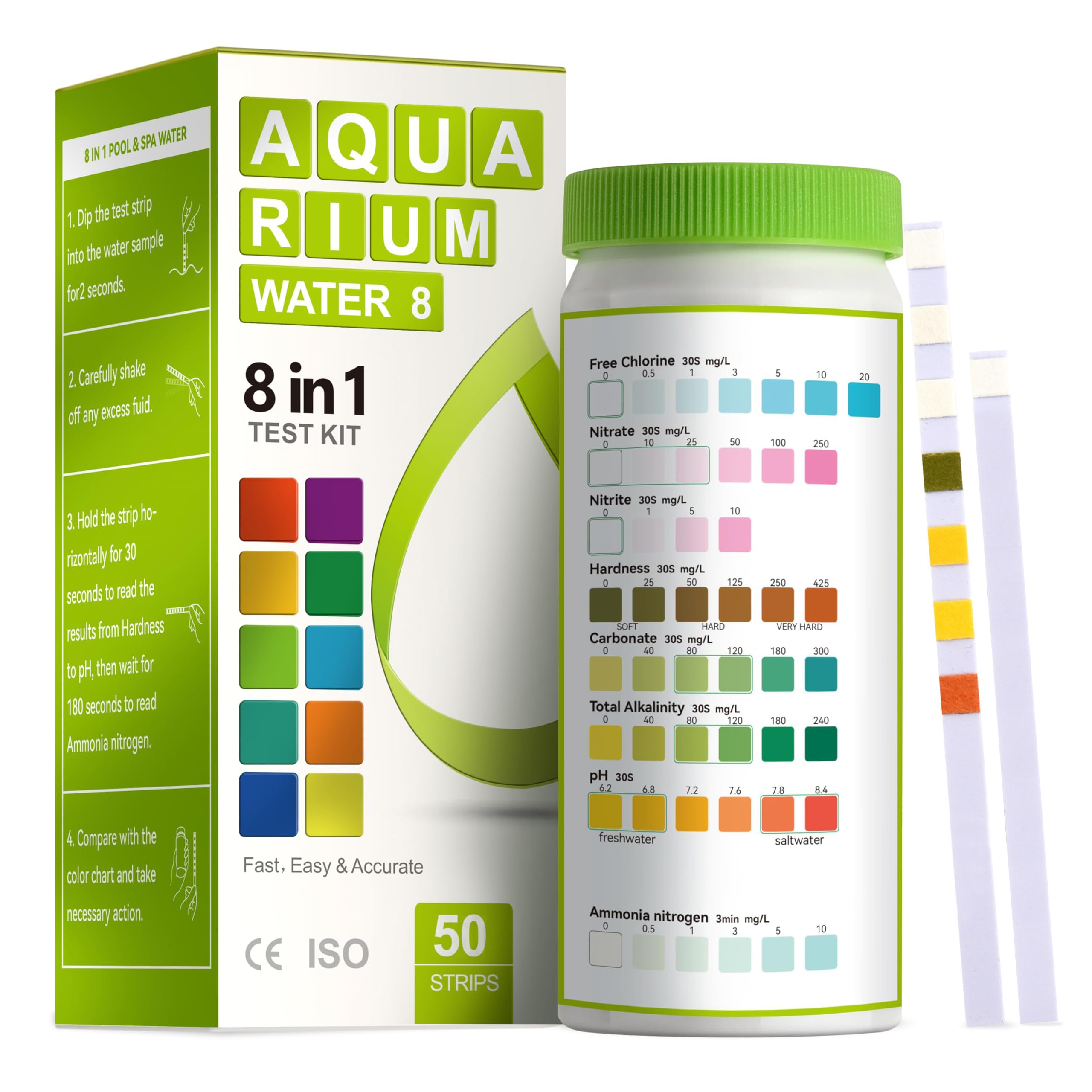
Rating: 4.4 ★ | Price: $ | Test Type: Test strips | Parameters: 8 parameters | Tests per Kit: 50 strips | Reading Ease: Dip-and-read strips | Water Type: Freshwater & saltwater
The AAwipes 8-in-1 strips deliver the lowest price for eight water parameters, covering pH, alkalinity, and hardness. The ammonia pad can be unresponsive in some batches, so this kit is best reserved for non-ammonia parameter checks only.
Pros
- Budget-friendly price for testing eight water parameters
- Simple dip-and-read process with clear instructions
Cons
- Some pads can show little to no color change, making reading difficult
Good for emergency non-ammonia checks when budget is the priority, but pair with a liquid ammonia test for cycling and any tank with live fish.
Best for Casual Ammonia Glance
DIPSTIK Ammonia Strips 50
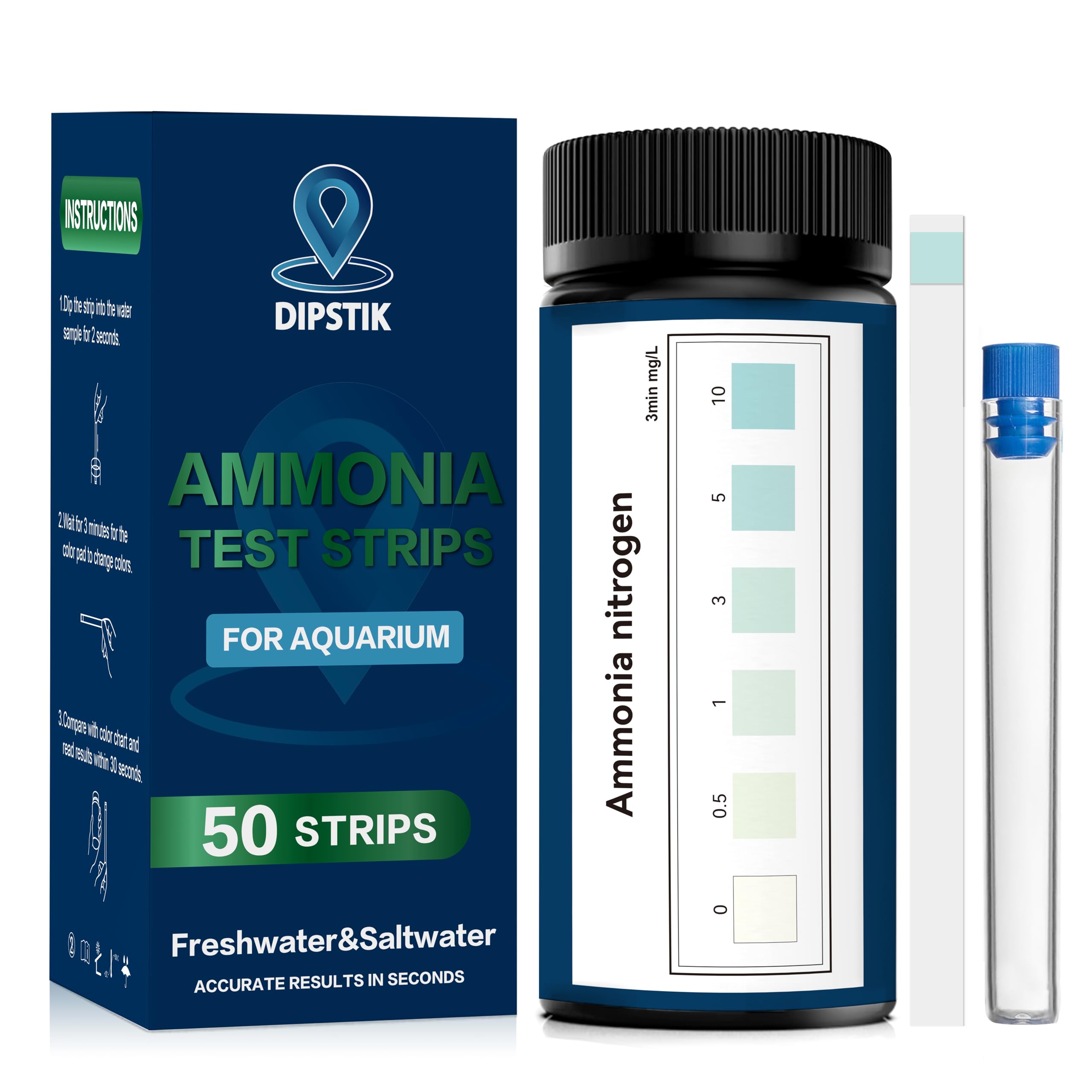
Rating: 4.5 ★ | Price: $ | Test Type: Test strips | Parameters: Ammonia only | Tests per Kit: 50 strips | Reading Ease: Dip-and-read strips | Water Type: Freshwater & saltwater
At a low price, these strips provide a quick and easy read for ammonia. The tradeoff: some strips may not show a color change when ammonia is present, making them ill-suited for cycling or any situation needing accuracy. Best for very casual aquarists or as a backup when liquid reagents run out.
Pros
- One of the cheapest ammonia-only test strip options available.
- Simple dip-and-compare design gives results in seconds.
Cons
- Colors may bleed on the pad, making chart matching harder.
Only for the most casual tank checks where a rough idea is enough, or as a backup when your liquid test is empty.
Best for Ultra-Budget Multi-Check
DaToo 8-in-1 Strips 100

Rating: 4.2 ★ | Price: $ | Test Type: Test strips | Parameters: 8 parameters | Tests per Kit: 100 strips | Reading Ease: Dip-and-read strips | Water Type: Freshwater & saltwater
For casual monitoring of parameters other than ammonia, these strips offer an incredibly low per-test cost and include a temperature sticker. However, the ammonia pad rarely changes color, making it unsuitable for any ammonia detection needs. This kit works best as a supplement for non-ammonia checks in established tanks.
Pros
- Lowest-priced multi-parameter strips for basic water quality checks
- Includes a temperature sticker for quick reference
Cons
- Ammonia pad can fail to show any color change, making the ammonia test unusable for detecting spikes
Best used as a budget supplement for non-ammonia parameters in tanks where ammonia is already monitored separately.
Best for Copper & Basic Check
SaySummer 9-in-1 Strips 125

Rating: 4.4 ★ | Price: $ | Test Type: Test strips | Parameters: 9 parameters | Tests per Kit: 125 strips | Reading Ease: Dip-and-read strips | Water Type: Freshwater & saltwater
These strips include a copper pad for shrimp and snail keepers. The low cost per test is a plus. But ammonia readings can vary between strips — use a liquid ammonia kit for critical checks. This set works best as a supplement for invert keepers who already have an accurate ammonia test.
Pros
- Copper detection useful for invertebrate tank monitoring
- Low per-test cost with 125 strips per pack
Cons
- Strip colors may bleed into adjacent pads, making some readings harder to interpret
Worth considering for invertebrate keepers who need copper monitoring at a low per-test cost.
How to Choose
The most important buying decision is choosing between liquid reagent tests and test strips, because strips often fail to detect ammonia until levels are lethal.
Test Type: Liquid vs Strips
Liquid reagent kits use a chemical reaction that produces a distinct color proportional to ammonia concentration. Test strips rely on a thin pad that can dry out, lose sensitivity, or fail to react altogether.
For fishless cycling or diagnosing spikes, a liquid kit gives you a reliable number. Strips may show zero when ammonia is above 1 ppm, leading to false confidence and dead fish.
Number of Parameters
Multi-parameter strips test 8 to 11 parameters on one pad, but the ammonia pad is often the smallest and least reliable. In many brands, this pad fails to change color even in high ammonia.
An ammonia-only liquid kit dedicates its chemistry to that one parameter, giving far more dependable results. If you need multiple parameters, a master liquid kit covers them all without sacrificing accuracy.
Tests per Kit
Liquid kits list total tests (e.g., 800 for the API master kit) but spread across multiple parameters. Strips list number of strips, each used once. The hidden trade-off: liquid kits cost more upfront but can last over a year of weekly testing.
Budget strips seem cheap per pack, but if you have to re-test with a liquid kit after getting a questionable reading, you lose both time and accuracy. For frequent testing, liquid is more economical in the long run.
Ease of Reading
Liquid tests require mixing a water sample with reagents and waiting 5 minutes, then matching to a color chart. Strips are fast—dip and read in 30 seconds. The trade-off: strips rely on very subtle color shifts that are tough to distinguish, especially between 0 and 0.5 ppm.
Liquid kits produce more vivid, easier-to-read colors. Some even use titration (drop count) instead of color matching, eliminating subjectivity. If speed is your priority, accept the accuracy risk and cross-check occasionally.
Water Type
Many kits work for both freshwater and saltwater, but marine-specific kits adjust color charts and chemistry for saltwater pH and alkalinity. Using a freshwater kit in saltwater may give off readings for parameters like pH.
For reef tanks, choose a kit designed for saltwater—it will have the correct range and reference colors. For freshwater-only tanks, a dedicated freshwater kit is simpler and often cheaper.
FAQ
Why do my ammonia test strips always show zero even when fish are dying?
Most multi-parameter strips have a tiny ammonia pad that often fails to react. Liquid kits detect ammonia down to 0.25 ppm, while strips may not change color until levels exceed 1 or 2 ppm—by then fish are already stressed. Always use a liquid reagent kit for critical ammonia monitoring.
How accurate is the API Master Test Kit for ammonia compared to test strips?
The API Master Test Kit uses the same Nessler reagent chemistry as lab tests, giving repeatable results within 0.25 ppm. Strips from any brand are less sensitive and often produce false zeros. For cycling a new tank, the liquid kit is the only trusted choice.
Can I use a saltwater ammonia test kit in a freshwater tank?
Yes—most ammonia liquid kits work in both fresh and saltwater because the ammonia test chemistry (Nessler or salicylate) isn’t affected by salinity. However, check the color chart; some kits include separate cards for each water type. Strips labeled for both are fine, but accuracy is the same (low).
How many tests do I get from the API Freshwater Master Test Kit before I need a refill?
The kit contains approximately 800 tests total—about 160 per parameter (ammonia, nitrite, nitrate, pH, high-range pH). With weekly testing, that lasts about 3 years for ammonia alone. Refill bottles are available separately for each parameter.