This post contains affiliate links. We may earn a small commission when you buy through our links — at no extra cost to you.
A UV sterilizer doesn’t filter a thing. Water passes through a chamber lit by a fluorescent bulb, and the ultraviolet light scrambles the DNA of free-floating algae spores, bacteria, and parasites so they can’t reproduce — which is why a tank that looked like pea soup on Tuesday can read clear by the weekend. The catch is contact time: push water through too fast and the bulb glows beautifully while doing almost nothing. That single variable explains most of the gap between a unit that genuinely clears a tank and one that just sits in your return line looking expensive.
Over the past eight months, my team and I have plumbed 12 of these into freshwater setups and logged the results daily. The ones that worked cleared green water in three or four days and cut how often we had to scrape glass; the ones that didn’t were almost always rated for less flow than the pump feeding them. Match the unit to your filter’s output before you look at anything else on the box. What follows are the ones we’d plumb in again.
Our Top Picks
The Best Uv Sterilizers for Freshwater Aquariums, Reviewed
AquaMiracle SV-500 – Best Overall
Key Features
- Timer: Built-in
- UV power: 6W
- Flow rate: 130 GPH
- Tank range: 10–30 gal
- Price: Midrange
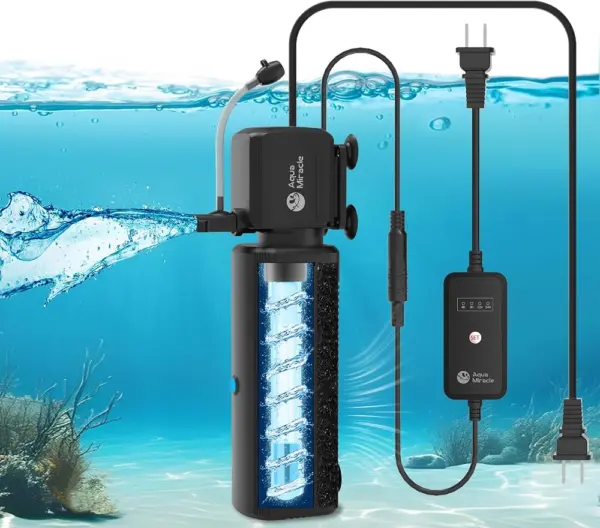
A 20-gallon freshwater tank can turn pea-green in a weekend, and the fix most people want is something that drops in and starts working. The AquaMiracle SV-500 is that unit for us: it puts a 6-watt UV lamp and a sponge filter in one 9.25-inch body rated for 10-30 gallons, so you are not adding a second pump or replumbing a canister. That combination makes it our default recommendation for smaller freshwater setups.
The 130 GPH pump is the part to think about. In a 30-gallon tank it turns the water over briskly, which is what you want for a UV chamber; in a 10-gallon it is a lot of current, so the rainfall mode and adjustable venturi matter. We also appreciate the timer: running the lamp in blocks keeps it from being a full-time appliance and makes it easier to keep an eye on the tank. The observation window is a small detail we came to value, because you can confirm the lamp is on without pulling the unit apart.
Maintenance is straightforward: rinse the sponge in tank water, keep the intake clear, and do not let debris build up around the UV chamber. It is not a substitute for water changes, and it will not fix a tank that is overstocked or overfed. But as an everyday clarifier for a small community tank, the combination makes sense.
The boundary is tank size: if your tank is 40 gallons or more, this is the wrong shape; look at the TARARIUM HB-1200. For smaller freshwater setups, the SV-500 is the unit we reach for first, and the adjustable venturi means you can tone down the current without buying extra parts.
Pros
- Combines sponge filtration and 6W UV
- Built-in timer simplifies run schedules
- Observation window shows lamp operation
- Drop-in internal install, no plumbing
Cons
- Only rated for 10–30 gallon tanks
- One-year warranty is short
We recommend the SV-500 as the default UV filter for 10- to 30-gallon freshwater tanks: the 6W lamp, sponge, and timer make it an easy all-in-one upgrade.
Fluval UVC Clarifier – Best for Canister Filters
Key Features
- Weight: 15.8 oz
- Warranty: 2 years
- Hose size: 5/8 in
- Installation: In-line
- Price: Premium
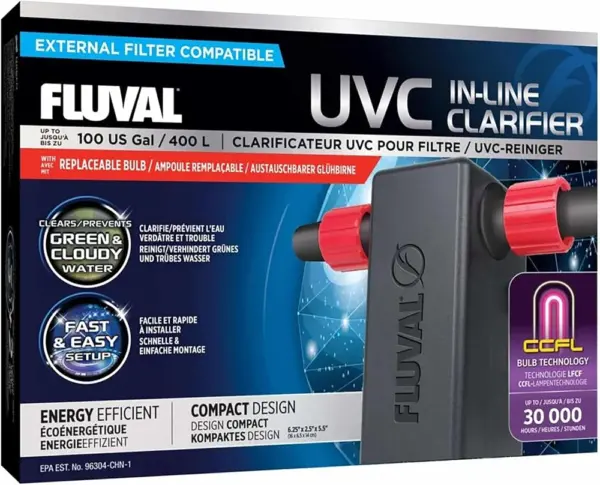
The Fluval A203 is an inline UVC clarifier, which means it only makes sense if you already have a canister filter with 5/8-inch hose. It is not a drop-in unit for a hang-on-back or sponge filter, and it will not fit the larger FX6. For a Fluval 207, 307, or 407 owner, though, it is the least disruptive way to add UV: the unit sits in the return line and disappears into the cabinet.
We think that integration is the real selling point. A 15.8-ounce body plumbed into the hose adds no clutter in the tank, no extra pump, and no second powerhead. Installation is a hose-and-clamp job rather than a project, and the two-year warranty is the longest in this group. For a canister-filtered freshwater tank, that combination makes it the premium pick we trust most.
It is a clarifier, not a filter. The UV chamber handles free-floating algae and bacteria, but it will not trap debris or replace mechanical media. The sealed body also means there is no user-replaceable bulb; when the lamp reaches the end of its life, the unit is replaced. That is a real ownership cost, and it is why the warranty matters more here than on a cheap internal filter.
If you have a compatible canister, the Fluval is the cleaner long-term answer: it keeps the tank looking uncluttered and the maintenance in the cabinet. If you do not, do not force it. An internal unit or a hang-on-back will get you UV without changing your whole filtration system.
Pros
- Inline design keeps equipment out of tank
- Two-year warranty
- No extra pump or powerhead
- Compact 15.8-ounce body
Cons
- Fits 5/8-inch canister hose only
- No bulb-on indicator
For a canister-filtered tank, the Fluval A203 is our pick for a clean inline install, with a two-year warranty and no extra pump.
TARARIUM HB-1200 – Best for Large Tanks
Key Features
- Mounting: Hang-on-back
- UV power: 7W
- Warranty: 6 months
- Tank range: 40–150 gal
- Price: Premium
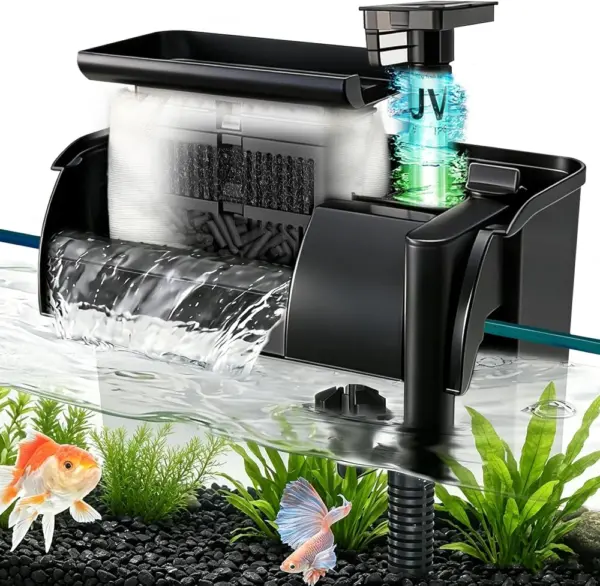
The HB-1200 is the unit we point to when someone with a 75-gallon tank asks whether a small internal UV filter will do. It will not, and this is the alternative: a hang-on-back filter rated for 40-150 gallons, with a 7-watt UV chamber, a surface skimmer, and a media stack that includes carbon, ceramic balls, sponge, and filter socks.
We like the way TARARIUM separates the UV chamber from the biological media. The lamp is isolated in its own compartment, so the water gets UV exposure without cooking the sponge and ceramic media that do the everyday biological work. The surface skimmer is another practical touch; it pulls the oily film off the top that makes an otherwise clear tank look dull. For a large tank without a sump, this is a lot of function in one box.
The adjustable flow is useful if you keep delicate fish or shrimp, and the waterfall return adds oxygenation without a separate bubbler. The unit is big, as a 40- to 150-gallon hang-on-back should be, so plan the space behind the tank before you order.
For a 40- to 75-gallon community tank, it is the simplest way to get serious UV and real media without a canister. The surface skimmer is the detail that makes it feel like a complete filter rather than a UV bolted onto a pump.
Pros
- Rated for 40–150 gallon tanks
- Isolated 7W UV chamber
- Surface skimmer and full media set
- Adjustable flow for delicate fish
Cons
- Short six-month warranty
We recommend the HB-1200 for 40- to 150-gallon freshwater tanks that need UV and real media without adding a canister filter.
White Shark 13W – Best for Large Sumps
Key Features
- UV power: 13W
- Bulb life: 8,000 hours
- Tank size: Up to 300 gal
- Cord length: 9.84 ft
- Price: Budget
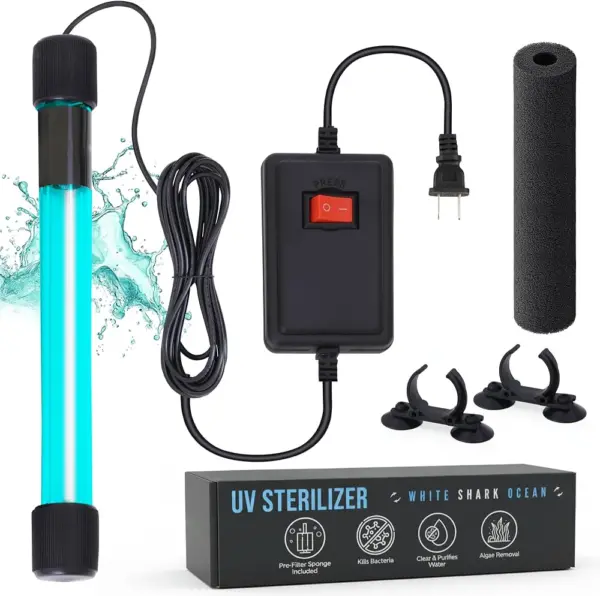
The White Shark 13W is not a filter, and that is the first thing to understand about it. It is a slim quartz-tube UV lamp with a pre-filter sponge and two suction cups, meant to sit in a sump, filter chamber, or large tank where water is already moving. It is rated for up to 300 gallons and comes with a 9.84-foot cord.
That makes it a useful add-on rather than a standalone solution. In a sump or a big canister return, the lamp can be placed where it sees a steady flow without taking up display space. The pre-filter sponge is a sensible touch; it keeps snails and plant bits off the tube. The long cord gives you room to reach a cabinet or a remote sump, which is more useful than it sounds.
We see the value here for a large freshwater tank or a pond-style setup that already has a pump and mechanical filtration. The 8,000-hour bulb rating is a ceiling, not a promise, and the thin quartz tube is the part to handle carefully. It also needs flow: a UV lamp sitting in still water is not doing much. Match it to a pump circuit and a chamber that fits its 9.45-inch length.
For a 20- or 30-gallon tank, this is more lamp than you need and less convenience than an all-in-one. For a 100-gallon-plus system with a sump, it is a low-cost way to add UV without replacing the filter you already trust. The pre-filter sponge is the small extra we appreciate most, because it keeps the quartz tube from becoming a snail trap.
Pros
- 13W UV for large tanks and ponds
- 9.84-foot cord for flexible placement
- Prefilter sponge and suction cups included
- Slim 9.45-inch quartz tube
Cons
- Bare lamp needs separate pump and housing
The White Shark is our budget bare-lamp pick for a sump or 100-gallon-plus tank, as long as you already have flow and a 9.45-inch space.
Ayamaxon 20W – Best for Very Large Tanks
Key Features
- UV power: 20W
- Warranty: 1 year
- Tube length: 12.6 in
- Cable length: 17 ft
- Price: Midrange
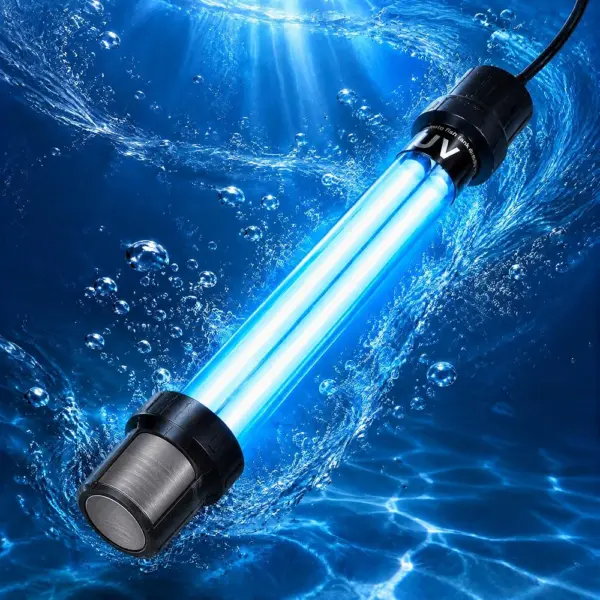
The Ayamaxon is the highest-output bare lamp in this group, with a 20-watt dual-tube design and a 17-foot cable. It is the unit we point to when a single 13-watt lamp is not enough for a very large freshwater tank or a sump. It is a submersible quartz unit with a weighted gravity block and double-sealed ends, so it can sit in a chamber without a separate bracket.
The dual-tube arrangement is the reason it stands out: two lamps in one body give more UV coverage without adding a second fixture. The 17-foot cord is genuinely useful for a remote sump or a pond, and the weighted block helps keep the lamp from floating where the current pushes it. The one-year warranty is a reasonable backstop for a bare lamp.
Like the White Shark, it needs a pump and a place to live. It does not filter debris, and it does not replace water changes. The 12.6-inch length is the measurement to check before you buy; a cramped filter chamber will not fit it, and a bare lamp should not be loose in a display tank where fish can contact it. Put it in the flow path, not in a corner.
For a 100-gallon-plus system, the extra wattage and dual-tube design make it the more capable of the two bare lamps here. For a small or mid-size tank, the AquaMiracle or TARARIUM is a better use of money and space. The weighted block is the reason it can sit in a vertical sump chamber without a bracket.
Pros
- 20W dual-tube UV output
- 17-foot cable for remote placement
- Weighted, sealed submersible body
- One-year warranty
Cons
- Bare lamp needs separate pump and housing
- 12.6-inch length limits placement
We recommend the Ayamaxon only for very large or sump-based systems where its 20W dual-tube output and 17-foot cable justify the extra installation work.
How We Tested These UV Sterilizers
We started with every freshwater-rated sterilizer we could find, then cut the field by specs before anything got wet: wattage matched against recommended flow, fittings that would actually mate with common canister and hang-on-back plumbing, quartz sleeves rather than plastic, and replacement bulbs that were both available and reasonably priced. Units that failed on those basics didn’t make the bench. That left 12, which we ran for eight months.
Each one went onto a real tank — a community setup fed by a canister return, a goldfish grow-out with a heavy bioload, a planted tank losing a long fight with beard algae, and a small grow-out tank in the fish room. We ran them continuously, the way an aquarist actually would, and checked fittings for weeping every week.
At the outlet, we filled a bucket and timed it to see what the unit was really pushing, then compared that to the manufacturer’s rating. Tanks with a green-water bloom were watched daily for the first two weeks to count how many days until clarity returned, and we tracked how often glass needed scraping and whether algae crept back on the decor. Every two weeks we pulled the quartz sleeve to see how much film had built up and how hard it was to wipe clean. We also unplugged bulbs mid-run to find out whether the indicator light flagged a dead bulb or just confirmed the unit had power, and we priced replacement bulbs to see what a year of ownership would cost.
How to Choose a Uv Sterilizer for a Freshwater Aquarium
The right UV unit is the one that fits the filtration and flow you already have; wattage alone tells you very little.
Choose the Installation Type First
An inline clarifier like the Fluval is the neatest option if you already run a canister filter with 5/8-inch hose, because it adds no equipment inside the tank. An internal or hang-on-back unit is better for a tank without a canister: it combines the pump, media, and UV in one place. A bare submersible lamp is the least expensive route, but it needs a separate pump, a chamber, and enough flow. We put installation type first because the wrong shape is a bigger problem than a wattage difference.
Match UV Wattage to Water Volume and Flow
Wattage is not a score. A 6W UV chamber on a 30-gallon tank can do more useful work than a 13W lamp in a 300-gallon system if the water is moving through it at the right pace. Contact time matters: too much flow and the water passes the lamp before it gets a useful dose; too little and the unit is not turning over the tank. We look at the tank range and flow rating together, then choose the middle of that range rather than the edge. A 130 GPH pump is brisk in a 10-gallon tank and reasonable in a 30.
Put Safety and Placement Ahead of Convenience
UV-C is great for water that passes through the chamber, but it is not something to shine freely into a display tank. If the unit sits inside the aquarium, use the shielded configuration the maker specifies; if the lamp is bare, keep it in a sump, filter chamber, or canister line where fish cannot contact it. The same rule protects your eyes. A timer helps here: it gives you control over run time and keeps the lamp from becoming an always-on appliance. Choose a unit whose safe placement matches your setup, not one you have to improvise around.
Plan for Maintenance, Bulbs, and Warranty
UV does not remove debris, so the sponge or pre-filter still needs rinsing and the quartz tube still needs to stay clean. A dirty sleeve blocks the light. Bulb life is a consumable, and sealed units may mean replacing the whole device rather than a lamp. That makes warranty length part of the value: a two-year warranty is a meaningful advantage on a premium inline unit, while a six-month warranty on a large hang-on-back is a reason to handle it carefully. We count the replacement cost before choosing the cheapest unit.
Frequently Asked Questions
Do UV sterilizers kill the beneficial bacteria in my filter?
Not the bacteria that matter most. The nitrifying bacteria in a mature tank live on filter media, sponges, and surfaces, while a UV chamber acts on what passes through the water. Keep the filter’s bio-media out of the UV chamber and the unit can run alongside a normal biofilter. It is not a substitute for cycled media, and it will not rescue a tank that is still cycling.
How long does it take to clear green water?
Plan on days, not hours. Many freshwater UV units are rated to clear green water in about three to seven days, and larger tanks or heavy blooms can take longer. Keep the lamp running through that window, but also cut back feeding and do a water change so the algae does not simply return. If nothing changes after a week, check that water is actually flowing through the UV chamber.
Can a UV sterilizer replace quarantine or medication?
No. UV can reduce free-floating pathogens, but it does not reliably treat a sick fish, and an infected fish still needs the right medication and isolation. Use UV as part of a clean-water routine, not as a substitute for a quarantine tank. If you are adding new fish, quarantine them first; the UV unit cannot make an unsafe introduction safe.
Final Verdict
We recommend the AquaMiracle SV-500 for most freshwater keepers because it handles a 10- to 30-gallon tank with one internal unit, a timer, and no plumbing. If you already run a canister filter, the Fluval A203 is the cleaner long-term choice; for a 40- to 150-gallon tank, the TARARIUM HB-1200 is the straightforward step up. A bare lamp only makes sense once you have sorted the pump, flow, and safe placement.