This post contains affiliate links. We may earn a small commission when you buy through our links — at no extra cost to you.
The worst kind of aquarium thermometer is the one that never looks broken. It sticks to the glass, the numbers look crisp, and your fish are sitting in water two degrees cooler than you think they are. The cheap version and the reliable version look nearly identical on the shelf, and a thermometer is one of the few pieces of gear whose entire job is to be trusted. What a good one buys you is boring and invaluable: a number you don’t have to second-guess.
In my own tanks, failure usually shows up in small ways — a suction cup that lets go at 2 a.m., a display I have to squint at from six inches away, a probe that lags ten minutes behind a water change. My team and I have spent the past four months with 14 thermometers stuck to glass, dunked in buckets, and running nonstop, and the standouts separated themselves within a week. Below are the ones worth sticking in your tank, from nano setups to 75-gallon community tanks.
Our Top Picks
The Best Aquarium Thermometers, Reviewed
Zacro Digital 2-Pack – Best Overall
Key Features
- Sensor: Submersible probe
- Accuracy: ±1 °C
- Pack size: 2 thermometers
- Temperature range: -50 to 70 °C
- Price: Midrange
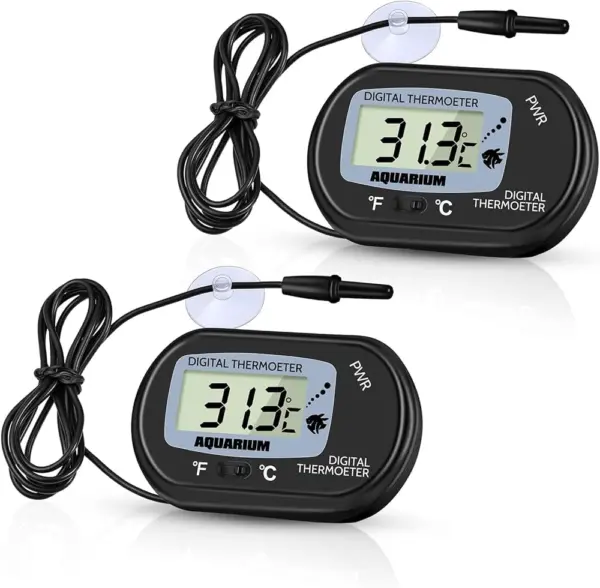
Two thermometers in one box looks like padding until you have tried to trust a single budget digital. The Zacro pair puts the sensing probe in the water and the LCD on the outside of the glass, and the second unit is what makes the set useful: one at each end of a long tank, or one on the glass and one kept dry as a reference, and you can see in a few seconds whether the two agree. That comparison is the only accuracy test most of us can run at home.
We made this the default because it reads the water itself. A stick-on unit infers the tank temperature through the glass; this one puts a probe in the flow, so a cold pocket at the far end shows up as a number instead of a guess. The display is genuinely readable, with large digits you can check from across the room, and the reading settles in a couple of seconds. The listed accuracy is within 1 °C with roughly 0.1-degree resolution, and the range runs from -50 to 70 °C, which covers any freshwater or saltwater tank we can think of.
What you are buying into is inexpensive hardware, and it shows over time. Units in this family have been known to go quiet within weeks, and the button cell is a consumable you will be buying again. The pair is the answer to both: when one dies you already have the other on the glass, and you are never left guessing about a tank because a single thermometer failed. Treat these as tools rather than heirlooms and they earn their place.
Pros
- Probe reads the water, not the glass
- Two units to compare and fall back on
- Large digits readable across the room
- Settles on a reading in about two seconds
Cons
- Suction cups slip, especially the one holding the probe
We recommend the Zacro pair to almost every keeper: two probe units let you read both ends of the tank and check them against each other, which matters more than any accuracy claim.
PAIZOO ATVH-1 Wireless – Best Cordless
Key Features
- Battery: Replaceable CR2032
- Display: Touch-activated LED
- Mounting: Adhesive, outside glass
- Temperature range: Up to 140 °F
- Price: Budget
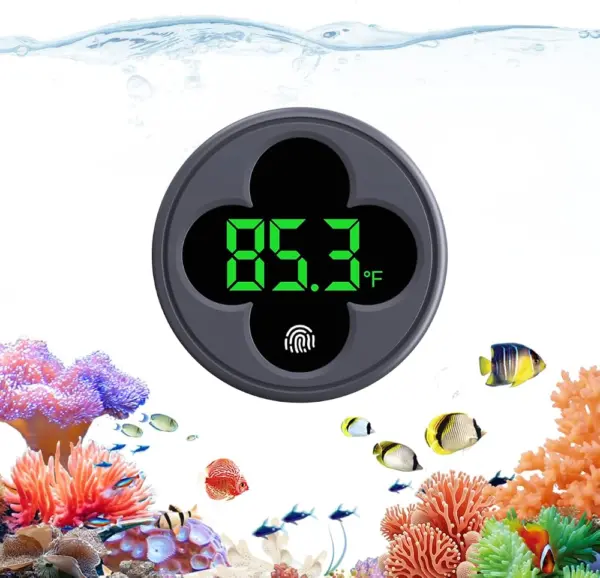
Twist the back counterclockwise and a fresh CR2032 drops in. That single detail is why we chose this PAIZOO over the cordless units that cost about the same and seal their cells inside. A thermometer whose battery cannot be changed has a fixed expiry date, and in a hobby built on checking things regularly, that is a bad trade. The rest is what you expect: a small puck that sticks below the water line on the outside of the glass, no wires, and nothing in the tank for a fish to bump.
A touch on the front wakes a backlit display, and the numbers are big enough to read from a step back; it goes dark again on its own, which is how the cell lasts. The listed figure is ±0.9 °F, and readings are taken through the glass, so give it a spot away from a window or an air vent. A stick-on that is being cooled by the room is reading the room.
The place it falls down is curved glass. A flat adhesive pad will not wrap around a round betta bowl, and this is not the thermometer for one. On flat-sided or rimless tanks it sits flush and disappears, which is exactly what you want from a piece of monitoring kit in a living room.
Pros
- Replaceable CR2032 battery
- Nothing in the water and no wires
- Backlit digits readable in a dim room
- Compact and discreet on the glass
Cons
- Display sleeps between checks, so every reading is a tap
We point anyone who wants nothing inside the tank to this one — it sticks to the glass, reads through it, and is the only cordless unit here whose battery you can replace.
QZQ Touch 2-Pack – Best for Two Tanks
Key Features
- Battery: CR2032, up to 12 months
- Accuracy: ±1 °C
- Pack size: 2 thermometers
- Temperature range: 32 to 140 °F
- Price: Midrange
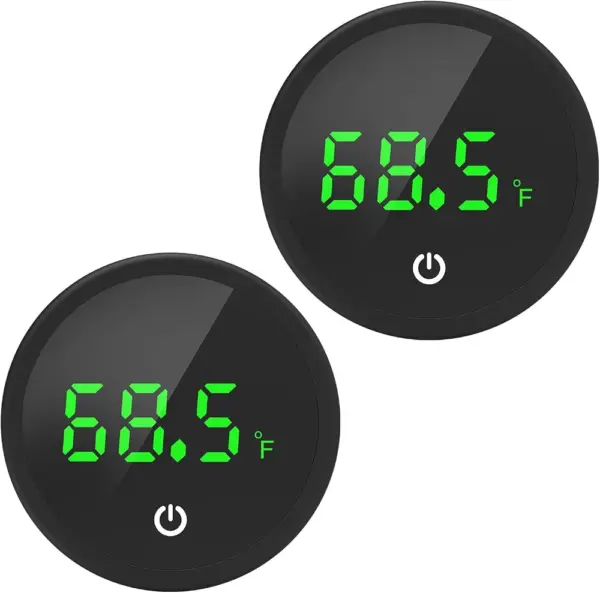
There is no always-on readout here. You tap the front, the LED lights with the temperature for a few seconds, then it sleeps again, so every check is a small deliberate act. We came around to it: that is exactly how the maker can claim a year from one CR2032, and a display you have to wake is not quietly draining itself in a dark room.
Two of them come in the box, which is the real argument. One on the quarantine tub and one on the main tank, or one at each end of a long tank, and you get the cross-check that turns a lone number into something you can believe. The three-second response and the ℃/℉ switch on the back are nice to have, and the 32 to 140 °F range covers a coldwater tank through a heat treatment.
It mounts with a peel-and-press pad, and on a rimless tank it reads as a small dark square rather than an aquarium accessory — we did not mind it in the living room. Keep it below the water line, though; mounted above it the number is meaningless, which is true of every stick-on we have handled.
Pros
- Two complete cordless units in the pack
- Sleep mode protects the claimed 12-month cell life
- Fast three-second response, ℃/℉ switching
- Clean look on a rimless tank
Cons
- Tap-to-wake for every reading
- Readings through glass can sit a few degrees off true
Buy this pair if you keep two tanks and want a cordless readout on each; we treat its number as a trend rather than a reference, and it does that job well.
LCR Hallcrest Crystal Strip – Best No-Battery Pick
Key Features
- Length: 6.75 in
- Mounting: Adhesive, outside glass
- Graduations: 2 °F
- Temperature range: 66 to 84 °F
- Price: Budget
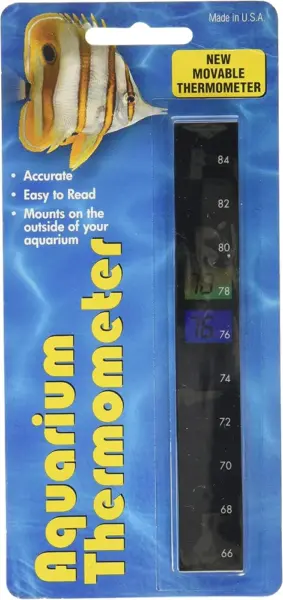
Nothing to power, nothing to wake, nothing to corrode. This is a strip of liquid crystal film you stick to the outside of the glass, and the section that lights up tells you the temperature. Ours has sat on the same pane for months without being touched, which is more than we can say for anything in this guide with a button cell in it.
For a tropical community tank in the high seventies, that is all most people need, and the accuracy record of this strip is quietly better than the digitals here: no sensor to drift, no battery to sag. You are reading a band rather than a decimal, though. The scale moves in 2 °F steps, so you will know the tank is at 78 rather than 78.4 — and 78 is the number you act on anyway.
The limit is the range. From 66 to 84 °F it covers tropical fish and not much else: a goldfish or axolotl tank in the sixties falls off the bottom of the scale, and pushing the heat up to treat something runs past the top. Keep a light handy as well; the colors show up best with a phone torch or a lamp shining on them.
Pros
- No battery and no electronics to fail
- Best accuracy record of the products here
- Sticks and repositions without residue
- Readable from a few feet away
Cons
- Only shows 2 °F steps
We keep this on any tropical tank we do not want to fuss over: no battery, no wire, and a color band that shows the heater is still working every time you walk past.
WEIMELTOY LED 2-Pack – Best for Multi-Tank Checks
Key Features
- Battery: CR2032 plus spare
- Pack size: 2 thermometers
- Sensitivity: 0.1 °F
- Temperature range: Up to 140 °F
- Price: Midrange
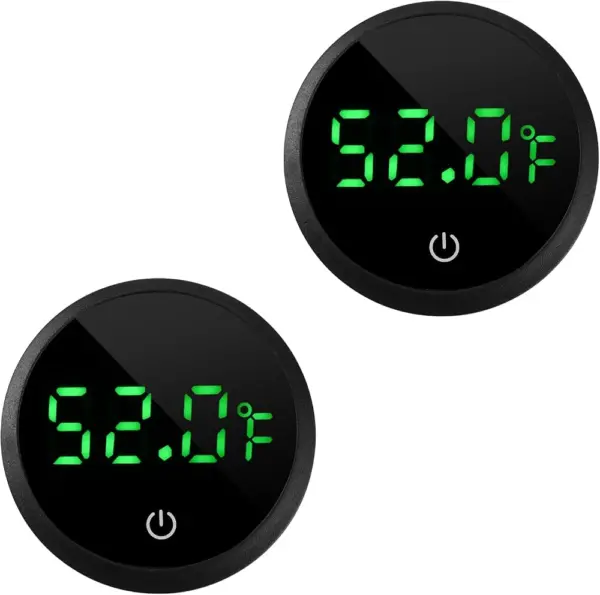
Two button cells come in the box, one already in the unit and one spare, which is the sort of detail you appreciate three months later when a display starts to dim. The instruction we nearly skipped is the useful one: press the pad onto the outside of the glass, then give it a few minutes to settle before you believe the number.
The unit itself is a small puck with a bright LED behind a touch panel — tap it, read it, and it sleeps after five seconds. Setup takes a minute and there is nothing to install. On a small tank or a betta setup it nearly disappears against the glass, which is what you want from monitoring kit.
What we noticed is that these read steadily rather than perfectly. A thermometer that returns the same number every time is still a useful monitor: you learn where it sits against a reference and then watch for movement. It is not the one to trust for a precise figure, but as a quick check on two small tanks it does everything asked of it.
Pros
- Spare CR2032 included in the pack
- Bright digits that read in a dim room
- Sleeps after five seconds to save the cell
- Two units for two tanks
Cons
- Reads steadily but a little off true
A nicely finished cordless pair with a spare battery in the box; we like it for two small tanks, provided you accept a reading that is steady rather than exact.
JANSAMN Strip 4-Pack – Best for Quarantine Tanks
Key Features
- Accuracy: ±1 °C
- Pack size: 4 strips
- Strip size: 5 × 0.5 in
- Temperature range: 39 to 97 °F
- Price: Budget
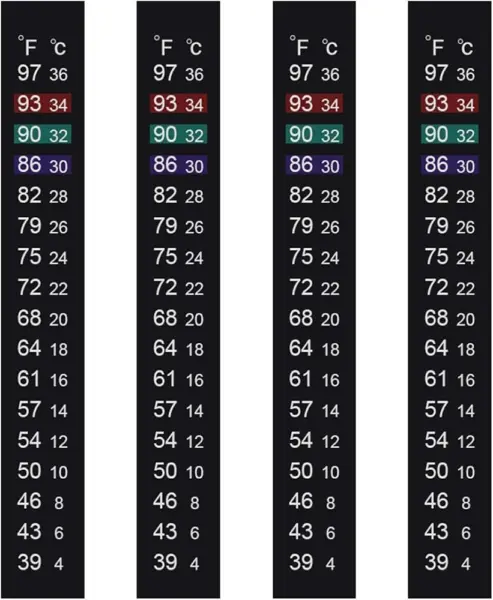
Four thin strips of temperature-sensitive film, each about five inches long and printed from 39 to 97 °F. That is the widest range of the stick-on strips here, and wide enough to cover a coldwater tank at one end and a warm treatment at the other — which is not true of every strip on this page.
You peel the backing, press it to the outside of the glass below the water line, and read whichever color lights up. The claim is ±1 °C, and in practice a strip is a band rather than a figure: you will see that the tank is in the high seventies, not that it is 78.6. Leave it a few minutes after sticking it down before you judge the reading.
Where we come down is that this is a quantity purchase. One for the display tank, one for the quarantine tub, one for the fry tank and one for the bucket you mix water in — none of them needing a battery or a wire. What it is not is a precision instrument. If you are treating a disease or breeding something delicate, buy a digital for that tank and keep these for the ones you only glance at.
Pros
- Four strips for four tanks
- 39 to 97 °F covers cold and warm setups
- Nothing in the water and no battery
Cons
- Shows a color band, not a number
Four inexpensive strips that put a thermometer on every tank and tub you own; we recommend them for glancing, not for chasing a two-degree swing.
How We Tested Aquarium Thermometers
To build the shortlist, I read through spec sheets and customer reviews for glass, probe-style digital, and stick-on strip thermometers, then cut anything with a vague accuracy claim, a non-replaceable battery, or a mount that looked likely to give out. That left 14 units, which we ran for four months in a 55-gallon community tank, a small quarantine tank for new arrivals, a nano tank on a desk, and a five-gallon bucket used for water changes — the places a thermometer actually lives during a normal fish-keeping week.
Accuracy came first. I mixed an ice-slurry bath and compared every unit against a reference thermometer, noting which ones landed within a degree and which drifted, then re-checked the worst offenders two weeks later to see whether the gap widened. For responsiveness, I moved each probe from a warm tank into a cool bucket and timed how long the reading took to settle, which separated the near-instant readers from the ones that stalled for minutes.
Mounting got its own test: each thermometer went onto the inside glass of an active tank, and I checked weekly to see what slid, what floated, and what held through algae growth and a scrub-down. Digital models ran on fresh batteries for the full four months so I could see which displays dimmed first. I also read every unit from about six feet back, the distance you actually stand when you’re feeding, rinsed each one to check for fogging inside the glass, and weighed the price against what the thing actually delivered.
How to Choose an Aquarium Thermometer
The decision that matters most is not brand or price — it is whether you want a sensor in the water or a reading taken through the glass.
Sensor in the water, or through the glass
A probe thermometer drops a small sensor into the tank and keeps the display outside on a suction cup, so the number comes from the water itself. That is what you want when a heater is suspect or a big tank has a cold corner. A stick-on unit reads through the pane instead: nothing in the tank, nothing for a fish to knock, but the glass and the room behind it sit between you and the reading, so keep it off a window or a drafty wall.
If you run a sump with the display in a cabinet, check the probe cable length before buying. Cables in this category range from a few inches to a couple of meters, and a short one will not reach.
Match the range to your tank
A thermometer only has to cover the temperatures your tank actually reaches, but that is a wider spread than most strips allow. The common adhesive strips start around 66 to 68 °F and stop at 84 °F, which is the tropical band and nothing else: a goldfish or axolotl tank in the sixties reads blank at the bottom, and raising the heat to treat a disease runs past the top. Check the printed range against your target before you stick anything down.
Mount it where it can read the water
Every stick-on and strip here has to sit on the outside of the glass below the water line; put one above it and you are reading the air in the room, which is exactly the mistake that makes people distrust a perfectly good thermometer. Choose a spot away from the heater outlet so you see the tank rather than the warmest inch of it, and avoid plastic frames and braces, which block the reading.
Round bowls are the case nobody mentions. A flat adhesive pad will not wrap around the curve, which is where a probe unit or a floating thermometer earns its place.
Batteries, and how long the thing lasts
Most units here run on a button cell, either a CR2032 or an LR44, and the type matters less than whether you can change it. A replaceable cell turns a thermometer into a tool you keep; a sealed one makes it disposable, and that is the real difference between two otherwise similar cordless models. Buy cells in a card rather than one at a time.
Expect the cheap end of this category to last a season or two rather than years. That is the argument for packs of two: you get a cross-check while both work and a spare when one goes quiet.
Frequently Asked Questions
My heater has a dial — do I still need a thermometer?
Yes. The dial sets how much heat the heater tries to deliver; it does not tell you what the water is doing. Put a thermometer at the opposite end of the tank from the heater, leave it there, and check it a day after any adjustment. A tank that sits below the dial is telling you the heater is undersized or the flow around it is poor, and that is worth knowing before the fish tell you.
How accurate does an aquarium thermometer need to be?
Closer than a degree is rarely useful, and a whole degree is usually fine. What you are watching for is drift and swings — a heater that has quietly moved, a water change that went in cold — not the second decimal place. A unit that is consistently off by the same amount stays usable once you know its offset; a unit that gives a different answer every day is not.
Can I check a thermometer at home?
If it has a probe, yes. Fill a glass with crushed ice and a little water, stir for a minute, then lower the probe in without letting it rest against the ice. It should settle at 32 °F; note how far off it reads and remember that offset. Stick-on and strip units cannot be checked this way — compare one against a probe or a second strip and see whether the two agree.
Final Verdict
The Zacro two-pack is the pick we stand behind. Two probe thermometers read the water itself rather than the glass, let you compare both ends of the tank, and leave you a spare the day one goes quiet — which, at this end of the market, is a question of when.
If you want the simplest thing that works, the LCR Hallcrest crystal strip is the alternative: no battery, no wire, and a glance from across the room, provided your tank lives between 66 and 84 °F and you are content reading a band rather than a number.