This post contains affiliate links. We may earn a small commission when you buy through our links — at no extra cost to you.
Soft water makes lovely coffee and miserable shrimp. When your tap comes out with almost no calcium or magnesium, molts stick halfway, snail shells pit and thin, and pH swings overnight while you sleep. A water hardness increaser puts those minerals back — calcium and magnesium for growth and molting, carbonate buffer to hold pH steady — so the tank stops running on luck. It’s a small adjustment with outsized consequences if you dose it wrong.
I’ve kept neo shrimp and a planted community tank long enough to learn that hardness isn’t one number. Much of the confusion — mine included at first — comes from not knowing whether a product raises general hardness, carbonate hardness, or both, so test your tap water before you buy anything. Over four months, our team ran 14 powders and liquids through working tanks, tracking dissolve time, dosing fuss, and how long the readings actually held. The picks below are the ones that behaved predictably, which is the whole job.
Top Picks
Best for Planted Community Tanks
Seachem Equilibrium

Rating: 4.7 ★ | Price: Midrange | Dose: 16 g per 20 US gal for 3 dH | Form: Powder | Raises: GH | Container: 300 g (10.6 oz)
Sixteen grams is a level tablespoon. Put one in 20 US gallons and general hardness rises by about 3 dH, which makes the 300 g tub worth roughly 1,500 litres of new water at that target. Run that against your own routine and it stops looking like a small container: a 40-gallon tank swapping 10 gallons a week is using half a tablespoon a week, so one tub covers most of a year of changes.
That predictability is the reason Equilibrium is our default. It is a dry mineral salt built for water that has had everything stripped out of it, RO, DI and rainwater included, and it lifts GH without the sodium and chloride that salt-based boosters leave behind. In a planted tank that difference compounds, because sodium accumulates and nothing in the tank consumes it. It is also the product here with the longest record behind it, and the one we trust to do the same thing twice.
We mix ours into a jug of replacement water rather than sprinkling it over the tank. Stirred into a bucket it goes in slightly milky and clears as it disperses; dumped dry onto the substrate it leaves a chalky dusting that hangs around longer. A level tablespoon is easy to eyeball for a 20-gallon change, though a cheap gram scale is more repeatable if you are chasing an exact number.
Pros
- Raises GH without sodium or chloride
- One tub treats roughly 1,500 L at 3 dH
- Built for RO, DI and mineral-poor water
- Dosing you can calculate and repeat
Cons
- Raises GH only; carbonate hardness is separate
Equilibrium is the GH booster we reach for first: predictable dosing, no sodium or chloride, and a tub that lasts a planted community tank most of a year.
Best for Soft-Water Top-Ups
Seachem Replenish

Rating: 4.8 ★ | Price: Midrange | Form: Liquid | Size: 500 mL (17 fl oz) | Raises: GH
This one is for the person who already knows the number they are aiming for and wants to hit it without a mixing bowl. Replenish is a liquid GH restorer: draw the dose, add it to the bucket or straight to the tank, move on. No grit, no stirring, no waiting for powder to disappear. Of everything here it is the least fussy to live with, and after a water change that is most of what we ask of a product.
What it puts back is the mineral content that RO membranes and demineralisers strip out. That is not cosmetic. A fish sitting in water too low in calcium and magnesium spends energy managing the gradient across its gills instead of growing, and moving fish between very soft replacement water and harder tank water is what produces osmotic shock. Replenish keeps new water closer to the water it is joining, which is the whole job.
It is a maintenance tool rather than a builder. For a 20-gallon community tank doing a 5-gallon change a week it is exactly the right shape: a bottle on the shelf, a syringe, thirty seconds of work. For filling a rack of tanks from an RO unit every Sunday, a dry mineral goes further per container, which is why we keep Replenish for adjustments and reach for Equilibrium when we are building water from scratch.
Pros
- No mixing, no residue, no waiting
- Restores minerals stripped by RO and DI
- Softens the shock of very soft change water
Cons
- No carbonate hardness in the bottle
If you want to raise GH with a syringe instead of a spoon, Replenish is the easiest product here, and a natural fit for soft-water community tanks.
Best for Caridina and Neocaridina
SaltyShrimp Shrimp Mineral GH/KH+
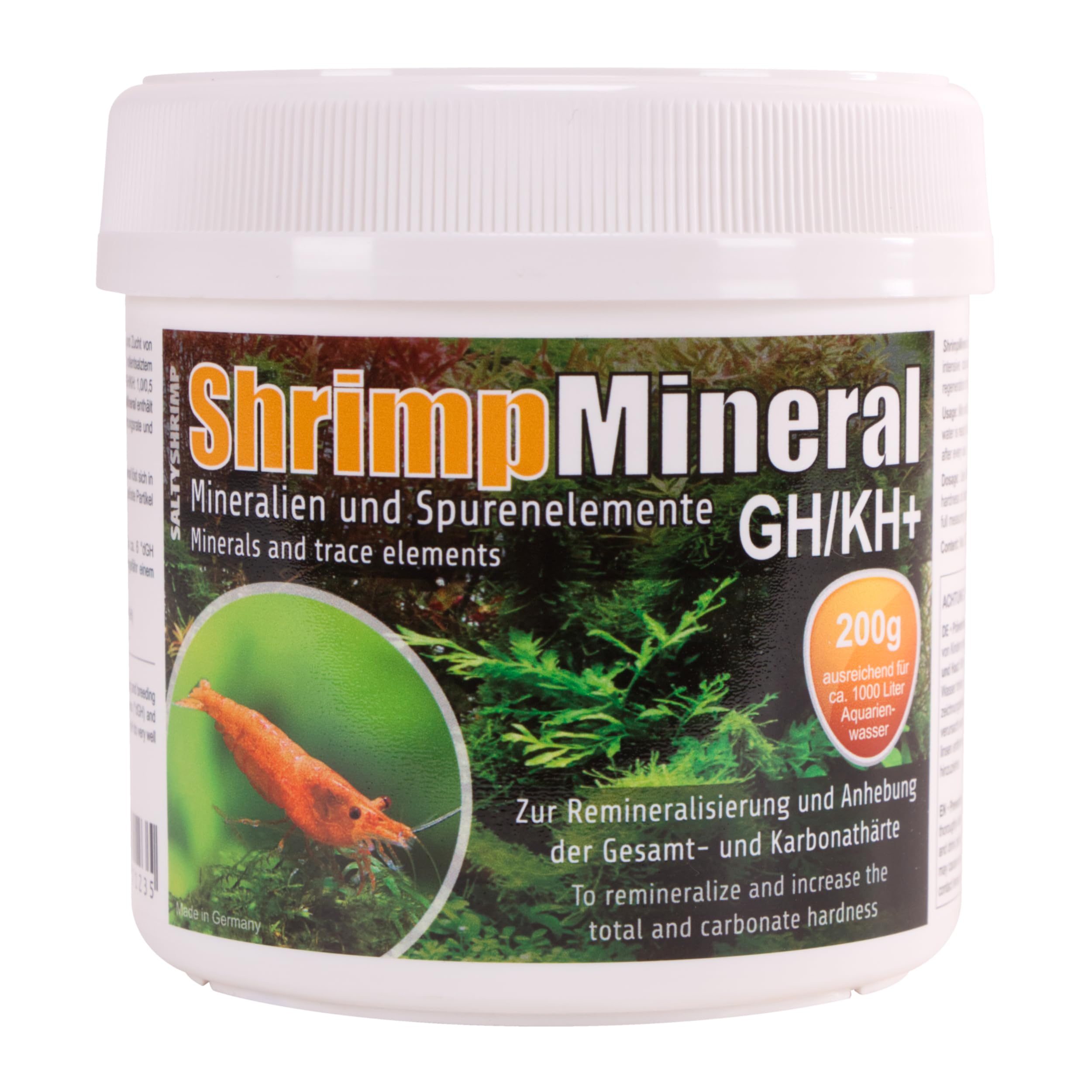
Rating: 4.8 ★ | Price: Premium | Form: Powder | Ratio: GH/KH 1.0/0.5 | Yield: Up to 1,000 L per 200 g | Raises: GH and KH
You do not pour this into the tank. The mineral salt goes into a bucket of fresh water first, one measuring spoon to 10 litres, and gets stirred until it dissolves. That remineralised water is what goes in at the water change. It is an extra step every week, and it is the step that lets the product do something the GH-only liquids here cannot.
The ratio is the point: it raises general hardness and carbonate hardness together at roughly 1.0 to 0.5. A molting shrimp is working with both, because GH supplies the calcium and magnesium for the new shell while KH holds pH steady as that shell hardens. Push GH on its own and you can end up with the minerals present and no buffering behind them. A 200 g can makes up to 1,000 litres, so the high outlay buys a long run of water changes rather than a single season.
For a Caridina or Neocaridina colony built on RO or rainwater, this is the pick, and the one we trust when KH is as much of a question as GH. Because the ratio is fixed, you cannot tune one without the other. That is fine from a clean RO start and awkward if your tap water already carries carbonate hardness, which is a good reason to mix this with RO rather than straight from the tap. Undissolved particles are safe to add, but close the can properly, because the salt cakes fast once air gets to it.
Pros
- Raises GH and KH together at a set ratio
- Up to 1,000 L of water per 200 g can
- Made specifically for keeping and breeding shrimp
- Produces neutral water for water changes
Cons
- Highest outlay of the products here
- Absorbs moisture fast once opened
For shrimp keepers mixing RO water, this salt gets both hardness numbers right at once, and one can covers a long run of water changes.
Best for Nano Shrimp Tanks
Crystalpro Shrimp Minerals

Rating: 4.7 ★ | Price: Budget | For: Shrimp and invertebrates | Form: Liquid | Size: 125 mL (4.2 fl oz) | Targets: GH, TDS, pH
Liquid trace elements are the easy answer for a nano shrimp tank. There is no spoon to calibrate, no bucket to stir, no cloud drifting through the tank afterwards; you draw what you need and put it in. In a small tank, where a couple of litres of evaporation can move the numbers before you notice, that convenience is not a small thing.
This is the Crystalpro bottle aimed at invertebrates, and it is our pick for a small Neocaridina colony on a budget. It targets GH, TDS and pH stability, which is the right trio for shrimp, since they care more about consistency than about any single number being ideal. Shrimp keepers judge a mineral on one thing, whether the colony keeps molting and breeding, and on that measure this bottle has the best record of anything here aimed at invertebrates.
The habit worth forming is to test GH before you dose and again a day later. It is a concentrated liquid, and two small additions a day apart can add up to a bigger step than you intended. For one nano tank it is the sensible buy; the moment you are remineralising six tanks from an RO unit, the powder wins on both effort and yield.
Pros
- Liquid dosing with no powder to mix
- Targets GH, TDS and pH stability
- Strong record on shrimp molting and breeding
- Built for Caridina and Neocaridina tanks
Cons
- Cap can cross-thread and leak
For a nano shrimp colony, this is the simplest way to hold GH, TDS and pH steady, and the cheapest shrimp-specific option here.
Best for Betta Tanks
Crystalpro Betta Minerals

Rating: 4.7 ★ | Price: Budget | Dose: 1–2 drops per 1 L weekly | Form: Liquid | Size: 125 mL (4.2 fl oz) | Minerals: Calcium, magnesium, potassium, sodium
The Betta bottle and the shrimp bottle beside it are the same size, the same money, and the same idea: a liquid trace-mineral top-up for water that is too clean. What separates them is the mix and the dose. This one lists calcium, magnesium, potassium and sodium, and it goes in by the drop, one or two per litre a week.
That is aimed at a particular fish. Bettas come from soft, mineral-poor water, and one kept in straight RO or very soft tap is living in something closer to distilled than to a rice paddy. The bottle puts trace minerals and electrolytes back into water that has none, without asking you to build an entire water-chemistry routine around a single fish.
We kept coming back to the drop cap, because it is what makes this workable in a small tank where a millilitre is already a large dose. Test GH before the first drops go in, since it does raise hardness and the useful range is narrow. Sodium is on the ingredient list, which is fine in a bare betta tank and one more thing accumulating in a planted one, where Equilibrium adds its minerals without it.
Pros
- Drop dosing built for small tanks
- Restores minerals in soft and RO water
- Includes calcium, magnesium and potassium
Cons
- Sodium in the mix, which planted tanks do not need
For a betta in soft or RO water, this is the least fussy way to put trace minerals back, at a dose measured in drops.
Best for Snail and Shrimp Tanks
Weco Wonder Shell

Rating: 4.5 ★ | Price: Budget | Form: Dissolving shell | Pack: 3 small shells | Size: Small
A shell that dissolves is the oldest answer to soft water in this group, and the least precise. Drop one in and it releases calcium and other minerals as it breaks down, then it is gone in days or weeks depending on the water. As a hands-off mineral source for a snail or shrimp tank it is genuinely convenient. As a hardness increaser, it is the one product here where the dose is not in your hands.
Where it earns its place is in tanks nobody wants to fuss over: a snail tub, a low-tech shrimp tank, a quarantine setup being brought up to hardness before livestock go in. There is nothing to measure and nothing to store, and we understand why people drop a shell in the filter and forget about it. That is a maintenance block, though, not a way to hit a number.
If you use one, use one. Add a single small shell, test GH and pH the next morning and again a few days later, and lift it out once you are where you want to be. The label also claims it removes chlorine and clears water; we still run a conditioner and treat the shell as a calcium source, because that is the job it is doing.
Pros
- Nothing to measure or mix
- Releases calcium gradually for snails and shrimp
- Useful for quarantine and grow-out tubs
Cons
- Release rate varies; GH can jump fast
- Clouds the water in some tanks
Wonder Shell suits a snail or shrimp tank that wants a slow calcium source and no dosing routine; for hitting a target GH, use a powder or liquid.
How We Tested Water Hardness Increasers in Real Tanks
We started with every hardness increaser we could get our hands on and narrowed to 14 based on what they actually contain: straight calcium chloride, calcium sulfate, magnesium sulfate blends, and products that buffer carbonate hardness alongside general hardness. Anything without a clear dosing chart or a listed mineral ratio got set aside early. Format mattered too, since a scoop, a pump, and a liquid ask something different of you at water-change time.
Testing happened in tanks, not beakers: a 10-gallon neo shrimp colony, a 20-gallon planted community tank, and a bucket on the kitchen counter every Saturday morning for water changes. Each product was stirred into a cup of tank water first so we could time how long it took to go from gritty to clear and note whether grit settled at the bottom. Then we dosed the tanks, watched the glass for cloudiness over the next hour, and ran drop tests for general and carbonate hardness at 24 hours and again just before the next water change to see how far the numbers had drifted.
In the shrimp tank we logged molts, berried females, and any losses, because a product can hit the right number on a test kit and still stress animals if it swings too fast. We also weighed out the dose each one needed for a 20-gallon change and counted how many changes a container covered — the cheap tub that takes three scoops is not the bargain it looks like. Fish behavior, snail shell condition, and whether the water stayed clear enough to see the back glass rounded out the picture. The products that made the list dissolved cleanly, held their readings through the week, and never pushed a shrimp into a molt it couldn’t finish.
How to Choose an Aquarium Water Hardness Increaser
The right product depends less on the brand than on two numbers you already have: the hardness of your source water and the hardness you are trying to reach.
Test before you buy anything
General hardness is reported in dH or ppm, and the conversion is simple enough to do in your head: 1 dH is roughly 18 ppm. Test your tap water and your tank water and write both numbers down. If the source already sits at the hardness your fish want, a GH increaser has nothing to do and your money belongs on a conditioner instead.
The keepers who genuinely need one are usually the ones who switched to RO or rainwater. A membrane strips nearly everything out, so remineralising stops being optional. Buy only when there is a real gap between the two numbers.
GH and KH are not the same number
General hardness is calcium and magnesium. Carbonate hardness is the buffering that keeps pH from moving. Plenty of products raise the first and leave the second alone: Equilibrium and Replenish are GH-only by design, and the Crystalpro liquids target GH, TDS and pH stability rather than KH itself. In a planted community tank with reasonable tap water, that is usually all you need.
A shrimp colony is the case where it is not. Molting needs minerals and stable pH at the same time, so a keeper building water from RO is better served by one salt that raises both in a set ratio than by two bottles pulling in different directions.
Powder, liquid or dissolving shell
Form decides how precisely you can hit a target. Powder measured on a scale or by the spoon is the most repeatable, which is what you want if you are building water for several tanks at once. A liquid is faster and tidier for one small tank or a single weekly change.
A dissolving shell is not a dosing tool at all, and treating it as one is the mistake. It suits a snail or grow-out tub where nobody is chasing a number; it does not suit a shrimp tank you are trying to hold at a specific GH.
Read the mineral list for what it leaves out
If the tank has plants you care about, look for sodium and chloride on the label. Plants take up neither, so salt-based boosters add to the tank’s dissolved solids without feeding anything, and the effect accumulates week after week. Equilibrium’s pitch is built entirely around leaving those two out.
Shrimp and betta formulas are mixed for different animals, which is why the two Crystalpro bottles sit side by side with different contents. A betta formula that lists sodium is a reasonable choice for a bare tank and a poorer one for a heavily planted tank.
Dose the replacement water, not the display
Where the product allows it, mix the minerals into the bucket of new water and let it clear before it goes in. The livestock never sits in a cloud of undissolved powder, and the change water arrives already matched to the tank it is joining.
It also gives you a chance to test the bucket before you commit. That is one extra minute against a panicked water change later, and it is the single habit that separates keepers who hold a stable GH from keepers who chase it.
Frequently Asked Questions
Can I raise GH with Epsom salt or crushed coral instead?
Epsom salt supplies magnesium and nothing else, so it treats half of hardness and is easy to overdo. Crushed coral dissolves slowly and pushes KH and pH up along with GH, which helps in some setups and works against you in others.
Both are cheaper than a dedicated product and both are harder to repeat precisely. Whichever route you take, test GH before and after, and change one thing at a time.
How long will one container actually last?
Longer than the price suggests, because these are concentrates. A 300 g tub of Equilibrium treats roughly 1,500 litres of new water at a 3 dH lift, and a 200 g can of the SaltyShrimp salt makes up to 1,000 litres.
Work out your weekly change volume, divide, and a container usually covers months. The 125 mL liquids are the ones that run down quickly if you are dosing several tanks.
Do I still need a water conditioner with a mineral additive?
Yes. None of these products dechlorinates, and hardness minerals do nothing about chlorine, chloramine or heavy metals in tap water. Condition first, mineralise second, and give the two a few minutes between them.
If you are starting from RO water there is nothing to condition, so the mineral step is the only one you need. The Wonder Shell label claims it removes chlorine; we still run a conditioner alongside it.
Final Verdict
Equilibrium is the one we point most people to. It raises GH by an amount you can calculate before you pour, it leaves sodium and chloride out, and one tub covers the best part of a year of water changes in a normal community tank.
If mixing powder is a step too far, Replenish does the same job from a bottle. And if the tank is a shrimp colony built on RO water, skip both and buy the SaltyShrimp salt, because GH without KH is only half of what a molting shrimp is working with.