This post contains affiliate links. We may earn a small commission when you buy through our links — at no extra cost to you.
A shrimp stuck mid-molt or a snail with a shell that looks too thin is the kind of thing that sends you searching for calcium. Supplements are supposed to solve that, but plenty of them cloud the water, sink into the substrate, or disappear before anything can use them. I’ve kept tanks where the water looked fine and the invertebrates still struggled, so I started watching how these products behave instead of trusting the label. Over the past four months, my team and I put 12 calcium supplements through real tank routines.
The first thing I look for now is whether the shrimp and snails actually go after it, because a supplement nobody eats is just decoration. I tracked water clarity, dissolution time, and how long a container lasted at the label dose; value only counts if water quality stays steady and fish stay healthy. A calcium boost shouldn’t come at the cost of a cloudy tank or a spike that stresses everything else. The picks below held up across nano shrimp tanks and community setups with snails and fish.
Our Top Picks
The Best Aquarium Calcium Supplements, Reviewed
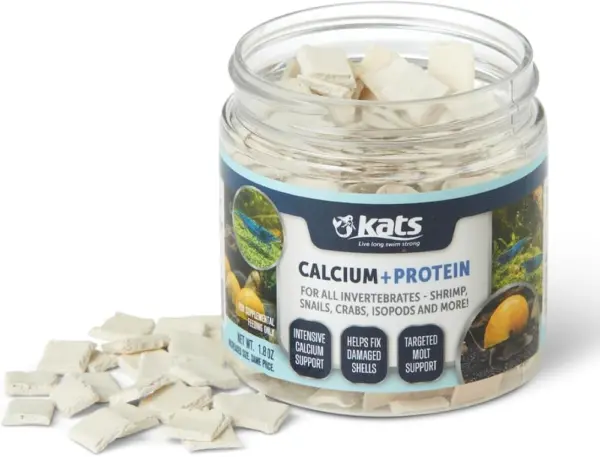
KatsAquatics Calcium + Protein Tablets – Best Overall
Key Features
- Form: Sinking calcium tablets
- Package size: 1.7 oz jar
- Key ingredients: Calcium carbonate and egg protein
- Dissolves in water: No
- Price: Midrange
Calcium usually goes into a tank as chemistry: measure, pour, measure again. These tablets are the other approach. Calcium carbonate and egg protein are pressed into a sinking tablet that an animal eats, so the calcium arrives with the shrimp and snails that need it rather than floating around the water column. That’s why this is the first jar we point a shrimp or snail keeper toward — there’s no per-gallon dose to work out, nothing to test before breakfast, and no haze in the tank afterwards.
We fed a lot of these out over the weeks, and the pattern held. Snails find a tablet quickly, shrimp work at the edges of it, and the pieces snap in half cleanly, which matters when you’re feeding one mystery snail rather than a colony. Very little was left sitting on the substrate at the end of a day, and the water stayed as clear as it was before the tablet went in.
What to know before you buy: a tablet only works if it’s eaten, and the animals first in line get it. Plecos and ordinary community fish will happily take a shrimp tablet off the substrate, so in a mixed tank you’re partly feeding the fish. In a dedicated invert tank, that’s a non-issue.
Pros
- Calcium the animals eat, not a dose to measure
- Doesn’t dissolve or cloud the water
- Tablets snap in half for a single snail
- Carries protein and vitamins alongside calcium
Cons
- Won’t lift calcium in the water column
Buy these if you keep shrimp or snails and want to add calcium without dosing the water — it’s the simplest, cleanest route here.
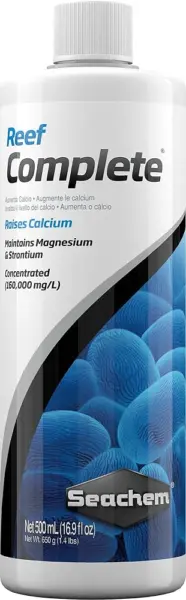
Seachem Reef Complete – Best for Reef Tanks
Key Features
- For: Marine reef tanks
- Form: Liquid ionic calcium
- Size: 500 mL / 17 fl. oz.
- Stated concentration: 160,000 mg/L
- Price: Midrange
The number on the label is 160,000 mg/L, and it’s the reason a 500 mL bottle goes as far as it does. Seachem prints that against the 100,000 mg/L figure typical calcium solutions quote, and the practical difference is that you pour less to move the same reading. It’s a liquid ionic calcium source, fully soluble, and it goes into salt water clear rather than milky.
For a marine tank, a clear liquid beats anything we have to mix, and this is the reef calcium we reach for out of this group. Coralline algae spreading across the rock and new growth on hard and soft corals are what we watch in the weeks after dosing, and they’re the reason to own the bottle at all.
Reef dosing is a test-and-add routine, not a set-and-forget one. Keep a calcium kit on the shelf and check daily while you work out how much the tank draws in a day, then settle into a weekly check. Skipping a day once you know the draw is harmless; guessing at it isn’t.
Pros
- High stated concentration stretches a small bottle
- Fully soluble, so it goes in clear
- Targets coral and coralline growth directly
Cons
- Marine tanks only, not freshwater inverts
The reef calcium we recommend for a marine tank: concentrated, fully soluble, and dosed against a test rather than a guess.
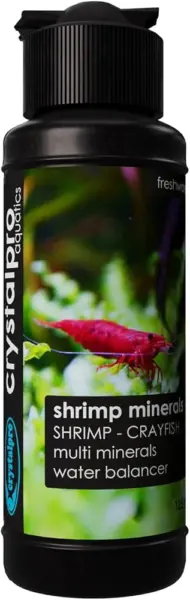
Crystalpro Shrimp Minerals – Best Liquid for Shrimp Tanks
Key Features
- For: Freshwater shrimp
- Form: Liquid mineral concentrate
- Size: 4.22 fl oz / 125 mL
- Maintains: GH, TDS and pH
- Price: Budget
Dosing a liquid into the water is the least fiddly way to hold a shrimp tank steady, and it’s what Crystalpro is built for: a 4.22-ounce bottle of mineral and trace-element concentrate that goes in at water changes.
The job it does is replacement. Every siphon pulls minerals out of the tank, and shrimp draw calcium and trace elements out of the water to build a shell, so a tank running on soft tap water drifts slowly toward molting trouble. This puts minerals, GH, TDS and pH stability back in the same pour, and the dose is small enough that one bottle keeps going for months rather than weeks.
Of the liquids here, this is the one we keep on a breeding tank. Clean molts are what keep a colony producing, and a colony that stops molting stops growing, which is the whole reason to dose minerals in the first place. The correction is gradual, spread across water changes, and that suits an established tank better than a rescue.
What it isn’t is a buffer. This is a mineral product, not a KH builder, so a tank sitting near zero carbonate hardness still has a separate problem to solve, and no amount of shrimp minerals fixes that one.
Pros
- Concentrated, so a small bottle lasts months
- Supports molting and breeding in a settled colony
- Liquid goes in without powder clouding
Cons
- Has to be redosed at every water change
Our pick for a settled shrimp colony: a concentrated liquid that replaces what each water change takes out, poured rather than measured by the spoonful.
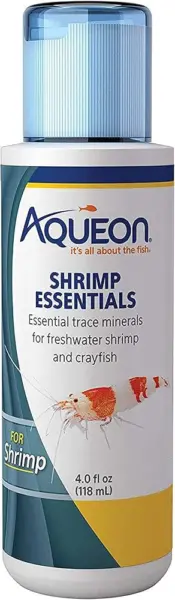
Aqueon Shrimp Essentials – Best Budget Shrimp Mineral
Key Features
- For: Freshwater shrimp and crayfish
- Dose: 5 mL per 1 gallon
- Form: Liquid trace minerals
- Size: 4 fl oz
- Price: Budget
Four fluid ounces doesn’t sound like much until you run the label’s arithmetic: at 5 mL per gallon, one bottle treats a bit under 24 gallons. That makes Shrimp Essentials a per-water-change purchase rather than a shelf ornament, and since it’s the cheapest of the liquids here, that’s exactly how to think about it.
It’s a freshwater liquid for shrimp and crayfish, aimed at molting and osmoregulation rather than at moving a number on a test kit. We treat it as a top-up, not a rebuild: it replaces trace elements without setting out to change your hardness, so it doesn’t rescue soft water and isn’t meant to. For a routine change on an established colony, that’s the right amount of intervention.
One practical note worth taping to the bottle. The label asks you to pull chemical filtration, carbon in most tanks, for a while when you dose. Leave it running and the media strips much of what you just poured in, which is the most common way this product ends up blamed for doing nothing.
Pros
- Cheapest liquid here for routine dosing
- Easy dose with the included cap
- Doesn’t cloud the water
Cons
- Small bottle empties fast on larger tanks
The cheap, easy-to-find liquid for routine shrimp water changes — best on a nano tank, where a small bottle actually lasts.
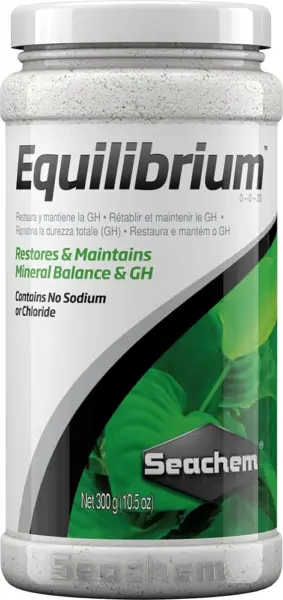
Seachem Equilibrium – Best for Ro/di and Soft Water
Key Features
- Dose: 16 g raises 20 US gal by 3 dH
- Form: Powder
- Size: 300 g / 10.6 oz
- Contains: No sodium or chloride
- Price: Midrange
The first thing to get straight about Equilibrium is that it isn’t a calcium bottle. It’s a general hardness builder: a powder that puts calcium and the other minerals back into water that has almost none, which in practice means RO/DI, distilled, or tap water so soft it barely reads on a test.
For that job it’s the one we pick here. Sixteen grams raises 20 US gallons by 3 dH, there’s no sodium or chloride in it, and it lifts general hardness without hauling pH or KH up alongside — which is exactly what you want when you’re building water for a planted tank or a shrimp colony from scratch.
Mix it into the change water rather than dropping it into the tank. In a bucket it hazes for a while and then clears, and that haze is much easier to deal with before it’s in with the livestock. A 300-gram jar is a mixing-water budget, not a display-tank budget; big RO changes go through it faster than you expect.
Pros
- Lifts GH without dragging pH or KH along
- No sodium or chloride in the formula
- Clear dosing: 16 g per 20 gallons for 3 dH
Cons
- Not a calcium-specific supplement
Buy this when you start with RO/DI or very soft water and need to build hardness from nothing — not as a calcium fix.
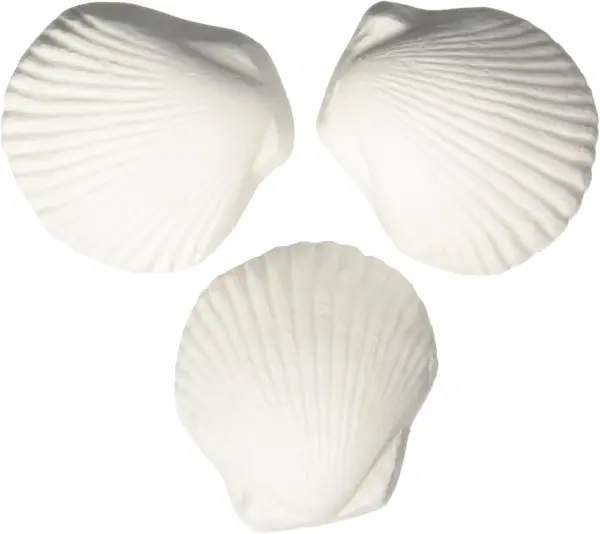
Weco Wonder Shell – Best Set-And-Forget Option
Key Features
- Form: Dissolving mineral shells
- Pack: 3 shells
- Size: Small
- Price: Budget
Drop a shell in and walk away. After a run of liquids and powders, that’s a genuinely pleasant change: three small shells in a pack, each one sitting on the substrate and slowly giving up minerals into the water.
The appeal is the shape of the thing rather than the numbers. A shell is a visual dose — when it’s gone, it’s used — so there’s nothing to measure and nothing to remember at a water change. In a small tank, where every bottle feels oversized, that simplicity counts for a lot.
The catch is control. How fast a shell goes depends on the water around it: soft, acidic water eats one faster than hard water does, so the same shell that lasts a month in one tank can be half gone in a week in another. In a nano tank, start with half and watch your GH rather than dropping a whole one in and hoping.
Pros
- Nothing to measure or dose
- Three shells per pack, so a small tank is covered
- Effectiveness well regarded for snails and bottom feeders
Cons
- Can cloud a small tank
The set-and-forget choice for a small tank: drop a shell in, watch it disappear, and keep an eye on GH while it does.
API Marine Calcium – Best for Marine Calcium Dosing
Key Features
- For: Marine reef tanks
- Form: Liquid calcium solution
- Size: 16 fl oz
- Dosing guide: When calcium is below 400 ppm
- Price: Midrange
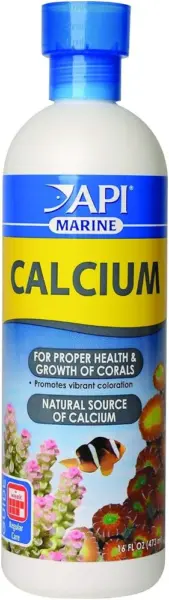
The most useful line on this bottle isn’t a specification at all — it’s an instruction: dose whenever a test shows calcium below 400 ppm. That’s a real number to work against, and it tells you plainly that the product expects you to own a test kit before you own the bottle.
It’s a liquid calcium solution for marine tanks in a 16-ounce bottle, with a lid that measures out a dose without a funnel or a syringe. Small thing, but you notice it every week.
Set it beside Seachem’s Reef Complete and the difference is information. Reef Complete prints its concentration; this one doesn’t, so you’re dosing to the reading rather than to a stated strength. A reef keeper who tests anyway can work with that happily. Someone who wants to know exactly what a capful adds is better served by the Seachem bottle.
Where it earns its place here is that plainness: a generous bottle, a stated target, and a lid that measures. It’s the calcium we hand to someone with their first coral tank, who wants one clear instruction and no ionic chemistry.
Pros
- Gives a clear target of 400 ppm
- Dispensing lid makes measuring simple
- Large bottle for regular reef dosing
Cons
- No stated calcium concentration
A straightforward reef calcium for someone who tests weekly and wants one clear instruction instead of an ionic chemistry lesson.
JOR Calcium Rocks – Best for Nano Shrimp Tanks
Key Features
- Form: White mineral rocks
- Weight: 3.5 oz
- Also provides: Hideouts and grazing surfaces
- Price: Budget
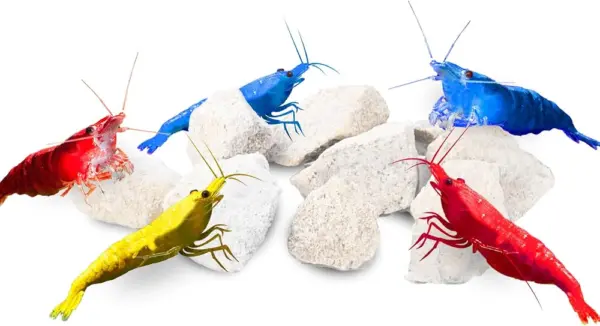
These are sold as a calcium source, but the first thing you notice when they go in is the aquascaping: a handful of small white rocks that give shrimp somewhere to stand, graze and hide.
That’s not a small thing in a shrimp tank. Baby shrimp spend their first weeks looking for cover, and a rock that also happens to be mineral-rich gives them a reason to settle somewhere you can actually see them. Crayfish and isopods use them the same way, and the white stands out well against a dark substrate.
The mineral side is slower and less exact. A rock gives up calcium into the water as it sits there, which is useful as a background source and useless as a fix for a tank that’s genuinely low, because you can’t dial a rock. Pieces run small and vary in the bag, and a handful in a nano tank is plenty — the whole bag in five gallons is asking for trouble.
What we ended up valuing them for is the combination: a hideout, a grazing surface and a slow mineral feed in one cheap addition. Two or three rocks do more for a small tank than a bagful.
Pros
- Doubles as hideout and grazing surface
- Shrimp and snails are drawn to them
- Inexpensive way to add cover and minerals
Cons
- Piece size and count vary in the bag
Buy these for the hideouts and grazing surfaces first and the slow mineral release second — a cheap addition to a nano shrimp tank.
How We Tested Aquarium Calcium Supplements
We began by gathering every calcium supplement sold for freshwater tanks — powders, liquids, blocks, and calcium-rich foods — and filtering out anything with vague dosing, no ingredient breakdown, or a price that only made sense for large systems. That left 12 products, which we ran for four months in three live setups: a nano shrimp tank, a planted snail tank, and a community tank with fish. Each supplement went into the routine it was meant for, dosed after water changes and at feeding time, so we could compare how it acted around shrimp, snails, and fish rather than in an empty jar.
At feeding time, I watched whether shrimp and snails moved toward the supplement or ignored it, and whether fish picked at it — that was our read on taste and effectiveness. I mixed each dose exactly as directed, timed how long powders floated before dissolving, and checked the water an hour later for haze or film on the glass. Anything that clouded the tank or left grit on the substrate got marked down, no matter how strong the calcium content looked on paper.
Before and after each dose, we checked calcium, hardness, and clarity, then tracked molts, shell growth, and fish behavior over the following days. Duration and value came down to how many doses a container actually delivered at the label amount, not the price on the shelf. Quality showed up in small things: whether the scoop was accurate, the powder stayed dry, and the directions matched what happened in the tank. The ones still running in our tanks are the ones that made the least work for the keeper.
How to Choose an Aquarium Calcium Supplement
The right calcium product depends less on how much calcium it carries than on where you want that calcium to end up: in the water, or in the animal.
Feed It, Dissolve It, or Dose It
Calcium reaches an aquarium by three routes, and they behave differently. An eaten tablet or mineral rock goes into the animal that takes it, so the water barely changes. A dissolving shell sits in the tank and releases minerals at whatever rate your water allows. A liquid or powder goes straight into the water column, which is precise but only as good as the test you dose against.
Choose by how much attention you’ll give and what lives in the tank. Corals pull calcium from the water, so they need the dissolved route; a shrimp or snail benefits from both. The trap is assuming a tablet can dose a reef tank. It can’t, because a coral never eats it.
Freshwater Inverts or a Reef Tank
Marine systems are dosed against a calcium reading, and the label on a reef product usually names its target — API’s instruction to dose below 400 ppm is a good example of the format. Freshwater shrimp and snails need minerals for molting, which is measured as general hardness rather than calcium alone.
That mismatch is where most money gets wasted. A reef calcium bottle in a ten-gallon cherry shrimp tank is being dosed against a number no freshwater kit will show you, and a jar of tablets does nothing for a coral. Match the product to the water before you match it to the price.
Know Which Number You’re Raising
General hardness, carbonate hardness, calcium and TDS are four different readings, and most disappointing products were bought to fix the wrong one. Equilibrium raises general hardness and leaves KH and pH where they are. A shrimp trace-mineral liquid tops up minerals without rebuilding hardness. A dissolving shell nudges all of it.
At minimum, own a GH test before you buy a supplement. If your carbonate hardness sits near zero, that’s a separate problem, and no calcium product on this page fixes it — solve the buffer first, then worry about calcium.
Small Tanks and Soft Water Punish Guesswork
In five or ten gallons, a single shell or a full-strength dose moves the numbers quickly, and soft or acidic water dissolves shells faster than hard water does. Start at half the label dose, wait a day, and re-test rather than adding more because nothing looked different after an hour.
Dose the water you’re actually changing, not the tank volume, when the product is designed for change water. And don’t run two calcium products at once to speed things up: you lose track of which one moved the reading, and the animals absorb the mistake.
Frequently Asked Questions
Do shrimp and snails actually need a calcium supplement?
If your water is soft or you start with RO/DI, yes. Molting invertebrates pull minerals out of the water to build a shell, and very soft water doesn’t supply enough of them. The signs to look for are failed molts, a white ring across a shrimp’s back, and thin or peeling new growth on a snail’s shell.
Test general hardness before you buy anything. If GH is already high, adding more calcium is not the fix, and you’ll be spending money to make the water harder than your animals want.
Does my filter remove the minerals I dose?
Chemical media can. Carbon and similar resins pull minerals out of the water, which is why liquid products tell you to switch them off around a dose; leave carbon running and you’re partly filtering out what you just paid for. Sponges, ceramic media and filter floss do nothing to calcium.
Tablets and mineral rocks aren’t affected, because they’re eaten or they dissolve in the tank rather than passing through the filter.
Should I top off evaporation with tap water?
Top off with RO/DI or distilled water. When water evaporates, the minerals stay behind, so replacing the lost volume with tap water adds another load of hardness every time — and in a small tank that creep shows up within weeks.
Save treated tap water for actual water changes, where you’re removing water and the minerals in it at the same time.
Final Verdict
For a shrimp or snail tank, the KatsAquatics tablets are the easy answer: calcium the animal takes in directly, no dosing, no cloudy water, and no test kit needed just to get started. A reef tank changes the calculation completely, and there Seachem’s Reef Complete is the bottle we reach for, dosed against a calcium test rather than a guess.
And if you’re building water from RO/DI, buy Equilibrium first. Hardness has to exist before any of the rest of it means anything.