This post contains affiliate links. We may earn a small commission when you buy through our links — at no extra cost to you.
Shrimp molting keeps a lot of shrimp keepers up at night. A mineral supplement is meant to make that process easier by putting calcium, magnesium, and trace minerals back into the water or food, but the wrong one can cloud a tank, foul the water, or sit untouched while your shrimp go about their day. I’ve kept Neocaridina and Caridina colonies for years, and the label matters less than what happens in the tank over the next few weeks. What you’re paying for is steadier molts, cleaner water, and a supplement your shrimp and snails will actually use.
Over five months, my team and I tested 14 shrimp mineral supplements in our home tanks, from powders mixed into water-change buckets to mineral bites and blocks. We watched shrimp activity, counted molts, tracked snail interest, and logged losses against water parameters. We also compared bottle sizes and cost per dose, and noted which were easy to dose, consistent from scoop to scoop, and didn’t turn a clear tank into a snow globe.
Our Top Picks
The Best Shrimp Mineral Supplements, Reviewed
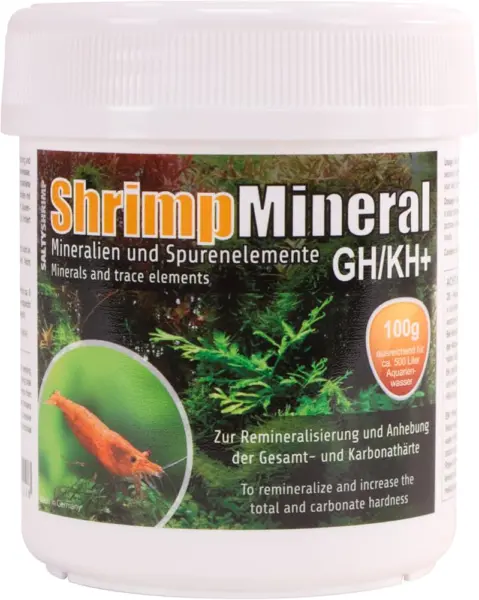
SaltyShrimp Mineral GH/KH+ – Best Overall
Key Features
- Dose: 2 g per 10 liters
- Form: Powder
- Target GH: 6 dGH
- Water type: RO, rain, or desalinated
- Price: Premium
Six dGH is the number this powder is built around, and it’s the reason we put it first. One level spoon — roughly 2 g — per 10 liters of water brings total hardness up to that figure, which is where a lot of neocaridina and many caridina keepers want their tanks to sit. What we appreciate most is that it converts ‘add some minerals’ into a repeatable measurement: dose, test, and the reading lands where the label says it will.
It’s designed for water with almost nothing in it — RO, rain, or desalinated. That’s the whole point, and it’s also the boundary. If your tap water already carries hardness, this isn’t your product; adding it pushes you higher instead of solving a shortage. The powder dissolves rather than settling out in a film, it doesn’t leave the tank cloudy, and the same dose is claimed to feed plants and filter bacteria, which we count as a pleasant bonus rather than a reason to buy.
Two things temper the recommendation. The ratio of GH to KH doesn’t land identically from one tub to the next, so check both readings instead of trusting the spoon — a GH and KH test kit belongs in the same order. And the label stops short of listing the full mineral blend, which is irritating when the whole appeal is precision. Neither is a reason to walk away. For someone putting together shrimp water for the first time, this is what we reach for.
Pros
- Doses to a stated 6 dGH target
- Dissolves cleanly without clouding the tank
- A tub lasts at 2 g per 10 liters
Cons
- Label doesn’t list the full mineral blend
Buy it if you’re building shrimp water from scratch: this is the one pick here that turns mineral dosing into a number you can actually hit.
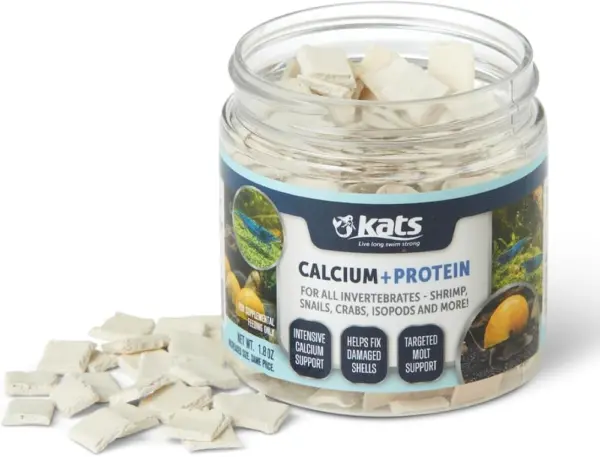
KatsAquatics Calcium + Protein – Best Calcium Food
Key Features
- Form: Sinking tablet
- Container: 1.7 ounce jar
- Also eaten by: Snails and plecos
- Key ingredients: Calcium carbonate, egg protein
- Price: Midrange
The first thing to understand about these tablets is that they’re food, not chemistry. They will not move your GH by a single degree, and if soft water is your problem, no amount of them solves it. What they are is a direct calcium source — calcium carbonate plus egg protein, with vitamins A, C, K1, and B6 in the mix — that a shrimp eats rather than absorbs. In a tank where the water is already dialed in, that’s the most useful thing we tested.
They’re hard little squares that sink fast and sit on the substrate instead of dissolving into soup, and that’s why they work: shrimp and snails can find them, work on them for a while, and there’s nothing left to siphon out. Neocaridina and caridina both go at them, and so do the snails, which makes this the one product here that earns its place in a mixed invert tank as well as a shrimp-only one.
Just don’t treat the jar as a mineral plan. Feed a tablet or two alongside whatever you use for GH, not instead of it, and go easy — a tablet that sits uneaten is a water-quality problem in a small tank, not a slow-release bonus.
Pros
- Eaten eagerly by shrimp and snails
- Calcium carbonate plus egg protein
- Sinks and holds together, no cloudy water
Cons
- Does not change GH, KH, or TDS
We keep these on hand for tanks whose water is already in range — they put calcium in the shrimp without pretending to fix your GH.
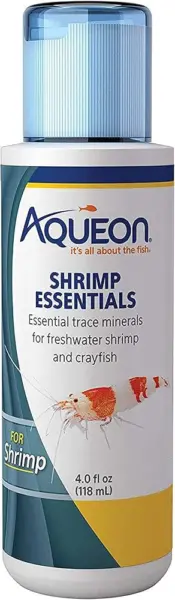
Aqueon Shrimp Essentials – Best Budget Liquid
Key Features
- Dose: 5 mL per gallon
- Form: Liquid
- Also for: Crayfish and lobsters
- Bottle size: 4 fluid ounces
- Price: Budget
Do the math before you judge this one by the bottle. The dose is 5 mL — one teaspoon — for every gallon of new water, and there’s a cap in the box that measures it. The bottle holds 4 fluid ounces, so it treats just under 24 gallons of change water in total. In a 10-gallon tank with weekly 3-gallon changes, that works out to roughly two months.
That math is the reason we hand it to a beginner. There’s no spoon to level and no dust cloud over the tank; you fill the cap, tip it into the bucket of new water, and you’re finished. What it isn’t is a hardness builder. The listing promises minerals and trace elements for molting and osmoregulation and makes no claim about hitting a GH target, so on genuinely soft water it’s a maintenance top-up rather than a fix.
One line on the label is worth taking seriously: pull chemical filtration, carbon included, while you dose. Carbon does exactly the job of removing the minerals you just added. Buy two bottles if you keep anything larger than a nano, and use this as the gentle weekly habit rather than the thing that rescues a tank in trouble.
Pros
- Teaspoon dose with a measuring cap
- Low entry price for a first supplement
- Also labeled for crayfish and lobsters
Cons
- Bottle is small for anything past a nano
- No stated GH target — it’s a tonic
We hand this to the beginner with a nano tank: a teaspoon, a measuring cap, and no powder to weigh on water-change day.
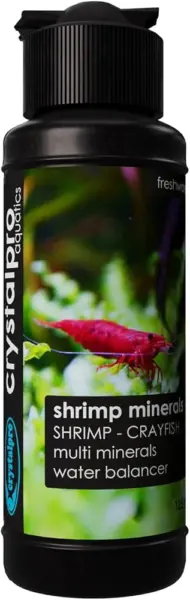
Crystalpro Shrimp Minerals – Best for Nano Tanks
Key Features
- For: Caridina and Neocaridina
- Form: Liquid
- Volume: 4.22 fluid ounces
- Supports: GH, TDS, and pH
- Price: Budget
This is the bottle that lived by the sink on water-change day. The claim on the label is broad — consistent GH, TDS, and pH for both caridina and neocaridina, delivered as trace elements in liquid form — and the format is the reason it stayed there rather than going back in the cupboard.
A few milliliters into a gallon jug beats leveling 2 grams of powder on a scale for a 5-gallon bucket, and it disperses without a snowstorm of undissolved grains. That matters more than it sounds in a nano tank, where a small over-dose is a big proportional swing.
Where it separates from the other liquids in this group is on results: the molting and colony-thriving side of the picture is the most convincing here, and it’s the one we’d hand someone whose shrimp keep dying after a molt. Be clear about what it is, though — a trace-element top-up, not a hardness builder with a target number. A small dose can still leave KH close to zero, so test rather than assume, and read the pH claim as stability rather than correction.
Pros
- Squeeze-and-dose liquid, no weighing
- Most convincing molting results of the liquids here
- A little covers a nano tank
Cons
- Cap doesn’t seat evenly and can leak
- GH and KH can still test low after dosing
The liquid we reach for in a small colony: squeeze dosing with a marked measure, and the strongest molting results of the liquids here.
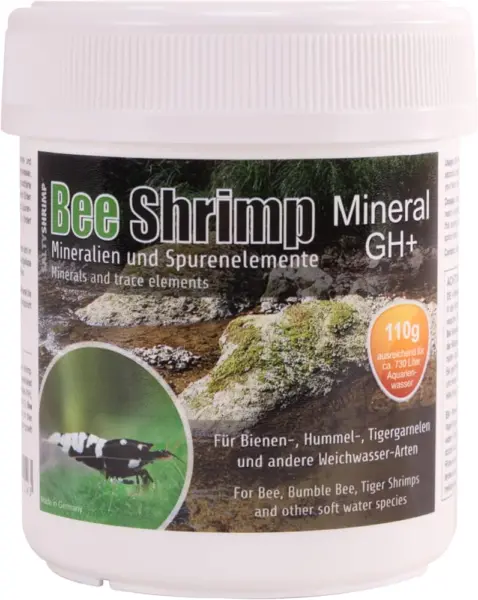
SaltyShrimp Bee Shrimp GH+ – Best for Caridina Tanks
Key Features
- For: Bee shrimp (Caridina)
- Form: Powder
- Size: 3.88 oz
- Raises: GH only
- Price: Midrange
There’s one situation where our top pick is the wrong thing to put in the tank: a caridina setup running on buffered aquasoil. Those substrates pull pH down and hold it there, and KH works against them — it consumes the acidity and lets pH creep up. A product that raises GH and KH together spends its time undoing your substrate. This one raises GH and leaves KH alone.
Otherwise it’s the same clean-dissolving powder from the same maker, in a smaller tub, dosed by the spoon. The 110 g container goes further than you’d guess at shrimp-tank volumes, and it mixes into RO water without leaving grit on the surface.
For a bee shrimp tank on active soil, this is the purchase, and the only real decision is between it and its GH/KH sibling — a difference that settles itself once you know what’s under your gravel. What we like is that it does the one job without dragging KH along, so the parameters you built the tank around stay where you set them.
Pros
- Raises GH without touching KH
- Dissolves cleanly at shrimp-tank volumes
- Leaves buffered soil’s pH alone
Cons
- No KH, so it can’t buffer soft water
For caridina on buffered soil, this is the purchase — hardness without the KH that fights the substrate.
JOR Calcium Rocks – Best for Decor and Cover
Key Features
- Adds: Hiding and breeding spots
- Form: Rocks
- Weight: 3.5 oz
- Price: Budget
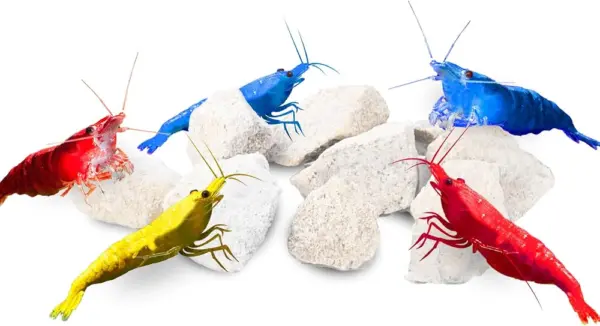
Search this category long enough and you’ll run into these: a bag of small white rocks, shelved with the water treatments and described as a calcium source for shrimp and crayfish. What arrives is hardscape. That’s not a criticism exactly, but it is the honest way to judge them.
As decor they’re genuinely good. Shrimp graze the surface, pick at the film that grows on it, and use the gaps as cover and resting spots; the white rock reads naturally against a dark substrate and it doesn’t break down into the water column. As a supplement there’s nothing to work with — no stated calcium content, no dose, no way to know what one rock puts into the tank over a month. We treat them as a bonus in a tank that’s already mineralized, not as the plan.
The caution is the same one that applies to any rock that slowly dissolves: it can move GH and KH, and it does so on its own schedule. Test after they go in, add a couple at a time rather than the whole bag, and don’t stack them on top of a remineralizer you’re already dosing to a target.
Pros
- Gives shrimp cover and a grazing surface
- Natural-looking hardscape for nano tanks
- Durable — it doesn’t dissolve away
Cons
- No stated mineral content or dose
These earn their place as hardscape that shrimp graze on; for actual calcium, we point you to something that states what it adds.
How We Tested Shrimp Mineral Supplements
We started by reading ingredient panels and dosing directions for more than 40 powders, bites, blocks, and liquids, then narrowed the field by what each product claimed to add—calcium, magnesium, trace minerals, or buffering—and by how clearly it explained a dose for a small tank. Anything with vague directions or a scoop that made a five-gallon tank nearly impossible to dose was set aside. The final 14 products went into our home shrimp tanks for five months, alongside the snails that share those tanks.
We used each supplement on its normal schedule: powders mixed into water-change buckets on Saturday mornings, mineral bites dropped in after lights-out, and blocks left on the substrate for days. At every water change, we checked whether the tank stayed clear or went cloudy, whether powder looked uniform or separated in the scoop, and whether the bottle or pouch was easy to open, reseal, and store without a mess. We also noted how many doses each container held and whether the bottle size fit a small tank’s realistic use.
We counted molts, watched for failed molts, and logged shrimp activity and any deaths, then compared those notes with ammonia, nitrite, nitrate, GH, and KH readings. We watched whether shrimp actually ate the food-like supplements and whether snails grazed on the mineral bits, because a product nobody touches is no bargain. We judged durability in the tank—how long a block held its shape and whether a powder stayed dry and scoopable—and calculated cost per dose, not just the number on the bottle. The winners stayed consistent from one dose to the next and kept tanks steady without extra fuss.
How to Choose a Shrimp Mineral Supplement
The first decision in this category isn’t a brand — it’s whether your tank needs minerals in the water or calcium inside the shrimp, because those are two different products wearing the same label.
Water minerals and food calcium do different jobs
Shrimp harden a new shell by pulling calcium and magnesium out of the water, and GH is the reading that tells you how much is available to them. A tablet does something else entirely: the shrimp eats it, and the calcium arrives through the gut. Both help a molting shrimp, but only one fixes genuinely soft water.
Our top pick sets hardness to a stated figure. The calcium tablets here never move GH at all, which is exactly why we treat them as a companion to a mineral routine rather than a replacement for one.
Start with your source water
Almost every remineralizer worth buying is formulated for water with nothing in it — RO, rain, or desalinated. That’s not a marketing detail, it’s the design brief. Tap water usually already carries calcium and magnesium, and adding a remineralizer on top pushes GH higher instead of solving a shortage.
The trap is buying the strongest product in the category for a tank that never needed it. Test GH first. If it already sits where you want it, spend the money on a calcium food and leave your water alone.
Match the powder to your substrate
GH and KH are separate readings, and the powders here treat them separately: one raises both, the other raises hardness alone. Which you want is decided by your substrate, not by the color of your shrimp.
Buffered aquasoil works by acidifying the water and holding pH down, and KH consumes that acidity, so a KH-raising product fights the soil. On active soil, choose GH only. On inert gravel or tap water, the combined product is the more useful of the two.
Liquids: convenience has a cost per gallon
A liquid is dosed against the water you’re adding, not against the tank, which makes bottle math easy to get wrong. One of the liquids here treats just under 24 gallons of change water in total. Divide that by how much you swap each week and you have the real running cost.
Do the multiplication before you decide a liquid is the cheap option. For a nano tank it often is; for anything past 20 gallons, a powder usually wins on cost per water change.
Dose to a number, then test
Every product here is easier to live with alongside two inexpensive tools: a GH and KH test kit, and for liquids a TDS meter. Dosing by feel is how tanks end up soft enough to cause molting trouble, or hard enough to stress shrimp that were doing fine.
Mix to your target in the change water, add it, then test the tank rather than the bucket. If you buy one extra thing with your supplement, make it the test kit.
Frequently Asked Questions
Can I use a shrimp mineral supplement in a tank with snails and fish?
Yes, with one distinction worth knowing. The calcium tablets get eaten by snails, plecos, and corys as readily as by shrimp, and snails need the same calcium for shell growth, so sharing is fine.
A remineralizer changes the water for every animal in it. If you keep soft-water fish, raise GH in steps across several water changes and watch how they behave rather than dosing the whole target at once.
Does a mineral supplement mean I can skip water changes?
No, and the two interact in a way that catches people out. Minerals stay in the tank when water evaporates, so topping off with mineralized water concentrates them week after week.
Top off evaporation with plain RO or distilled water, and add minerals only to the water going in during a change. That keeps your GH stable instead of creeping upward.
Can I run a remineralizer and a liquid tonic at the same time?
Pick one product for the water and, if you want one, one for food. Stacking a GH/KH powder with a liquid that also claims GH support gives you two doses you aren’t measuring separately.
GH drifting upward is harder on shrimp than a reading that sits slightly low but steady. If you already dose a powder to a target, make the second product a calcium food rather than a second liquid.
Final Verdict
Buy the SaltyShrimp GH/KH+ if you’re building shrimp water from RO, rain, or desalinated water. It’s the only product here that turns mineral dosing into a number you can hit, and the results behind it are the most consistent in this group.
If your water already has hardness, don’t buy it. Get the KatsAquatics tablets and feed the calcium instead. And if your caridina live on buffered soil, take the GH+ so you don’t undo the substrate every time you dose.