This post contains affiliate links. We may earn a small commission when you buy through our links — at no extra cost to you.
The worst thing an auto top off can do isn’t miss a top-off — it’s top off when it shouldn’t. A stuck sensor or a siphon that won’t break can dump fresh water into a tank, drop the salinity, and turn a stable system into a cloudy mess before you notice. A good ATO earns its place by doing one boring thing well: replacing evaporated water in small, reliable doses so your salinity stays put. I’ve come back from a weekend away to a sump that was two inches low and a refractometer reading that made my stomach drop; that’s the problem these units solve.
Over the past eight months, we’ve run 12 auto top offs on everything from a 10-gallon nano to a 75-gallon mixed reef with a sump. The differences aren’t in the spec sheet — they’re in whether the sensor stays clean, whether the pump moves water without a fight, and whether setup takes ten minutes or an afternoon. Price matters, but a cheap unit that overshoots or leaks isn’t a value; it’s a weekend project. The picks below are the ones that kept the water line where I set it, day after day.
Our Top Picks
The Best Auto Top off Systems for Aquariums, Reviewed
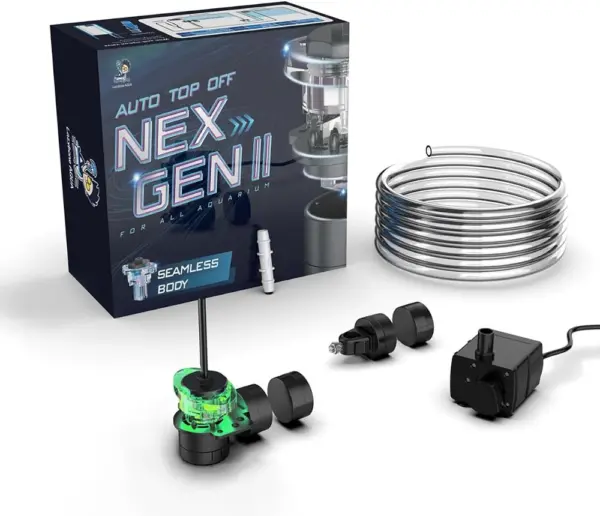
LAZYBONE NG11 – Best Overall
Key Features
- Mount: Magnetic, up to 19 mm
- Sensors: Three optical, in one probe
- Warranty: 2 years probe, 1 year pump
- Overfill protection: High-level cut-off plus run-dry shutoff
- Price: Midrange
The NG11 puts the whole controller inside the probe. There’s no box to screw to a cabinet and no separate controller with a cable entry where salt air gets in — just a sealed one-piece unit on a magnet, three optical sensors looking down at the water, and a pump on the end of a single lead.
That’s what earns it the top spot. On most of the optical kits here the electronics live in their own enclosure, and the seam where a cable enters that enclosure is exactly where salt creep does its damage. Folding the controller into a sealed probe removes a failure point rather than adding a feature, and the sensors are arranged as a primary, a backup and a high-level cut-off, with the pump shutting off if the reservoir runs dry.
The pump draws from close to the bottom of the reservoir, which sounds minor until you’re topping off from a shallow container and the last inch of water is unusable. The magnet slides to set the level, so adjusting it takes a moment rather than a screwdriver, and the probe is small enough to sit behind a rim or in a rear chamber without announcing itself.
Two things to know before you order. LAZYBONE doesn’t publish a lift or flow figure, so if your reservoir sits on the floor under a tall stand, ask before you buy or take the MagTool, which is rated to 8.2 feet. And the adaptive refill timing sold as AI is the one claim we can’t evaluate — what you get is a pump that starts when the level drops and stops when it’s back, which is the whole job.
Pros
- Controller sealed inside the probe
- Three optical sensors plus dry-run shutoff
- Pump draws from low in the reservoir
- Two years on the probe, one on the pump
Cons
- Magnet mount stops at 19 mm glass
We recommend the NG11 to anyone setting up a first ATO: the controller is sealed inside the probe, three optical sensors guard the level, and the pump shuts down dry.
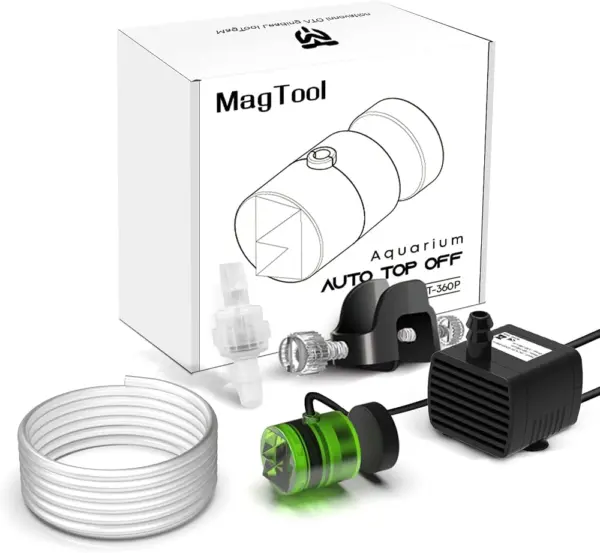
MagTool HF-ATOLITE – Best for Larger Tanks
Key Features
- Sensor: Dual optical, 0.7 in
- Max lift: 8.2 ft
- Pump flow: 74 GPH
- In the box: Pump, sensor, power adapter
- Price: Midrange
Eight feet of lift is the number that matters here. MagTool rates the 12-volt pump at 8.2 feet of head and 74 gallons per hour, enough to pull from a bucket sitting on the floor of a stand and deliver it to a display above. Most of the kits here will top off from a reservoir beside the tank; this is the one we trust to reach up from underneath.
The rest is a complete optical kit done properly: a 0.7-inch sensor on the glass, a second sensor as a high-level cut-off, and everything in the box down to the adapter. The pump measures 1.5 by 2 inches, small enough to tuck into a sump compartment out of the way, and it runs quietly enough that noise never becomes part of the conversation.
For a large system with the sump in the cabinet, this is the pick we point to, and a ten-minute setup is part of why. The one caution is the trigger point: the level can fall a noticeable distance before the pump kicks in. In a wide sump that’s nothing at all; on a nano, where a drop that size already moves salinity, it’s the wrong tool.
Pros
- 8.2 ft of lift from a 12 V pump
- 74 GPH moves top-off water briskly
- Complete kit, about 10 minutes to install
- Quiet pump in a compact body
Cons
- Some units stop working within weeks
Buy it if your top-off water lives on the floor: the 8.2-foot lift and 74 GPH pump reach a sump that most of these kits cannot.
Clscea Auto Top Off – Best Budget
Key Features
- Fits: Flat, rimless glass
- Mount: Adhesive gasket, no screws
- Power: None, uses differential pressure
- Tank wall: 3-10 mm / 0.12-0.39 in
- Price: Budget
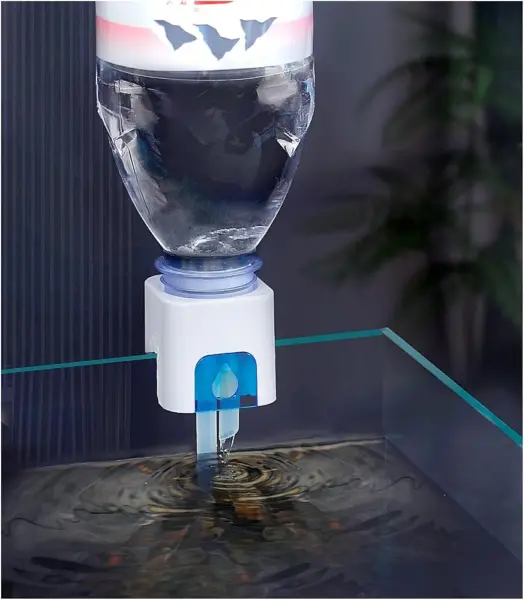
No pump, no sensor, no cord. The Clscea clips to the glass with a silicone gasket, screws onto a bottle of water, and lets physics finish the job: as the tank level drops, air enters the bottle and water trickles out until the two are level again. It’s the cheapest thing on this page and it has been the hobby’s answer to evaporation for decades.
For a nano, a quarantine tank or a week away, we think it’s hard to beat. There’s nothing to plug in, nothing to burn out overnight, and no pump that can run itself dry into an empty reservoir. When a seal finally gives up it drips rather than emptying a container onto your floor, and that’s the sort of failure we can live with.
The limits are about where it goes and what hangs off it. It needs a rigid bottle, since a soft one collapses under the pressure, and the tubing has to be cut to length so the base sits at the level you want to hold. If you keep a rimless nano on a desk, a water bottle clipped to the side is exactly as subtle as it sounds — which is the trade for having no electronics to fail at two in the morning.
Pros
- No electricity, so nothing fails overnight
- Clips on without screws or glue
- Cut-to-length tube sets the level
- Works with an ordinary screw-top bottle
Cons
- Won’t fit rimmed or curved tanks
The pick we recommend for nano tanks and vacations: no power, no sensor, no pump, and a failure that drips instead of flooding.
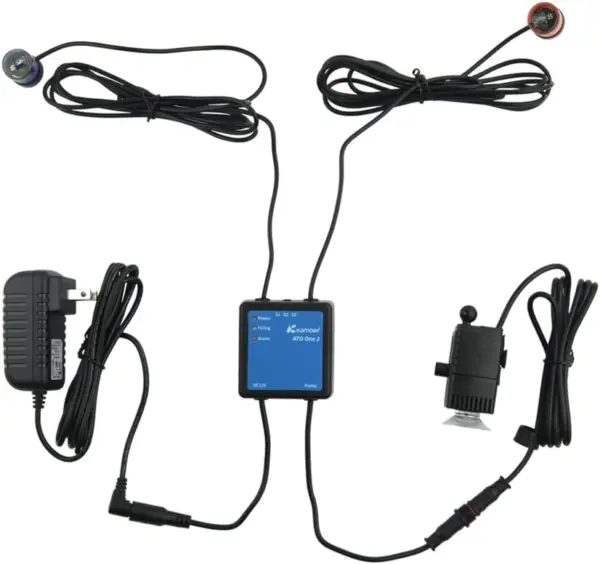
Kamoer ATO One 2 SE – Best Midrange
Key Features
- Pump: Anti-dry submersible
- Alerts: Refill timeout alarm
- Height limit: 1.5 m reservoir drop
- Sensor ports: Two optical, one optional reservoir
- Price: Premium
The cheap optical kits here will top off your tank. This is the one that can tell you the bucket is empty. Kamoer builds the ATO One 2 SE around three sensor ports: one optical sensor to trigger a fill, a second mounted high as an overflow cut-off, and a third for a reservoir-level sensor you add yourself.
The pump is the anti-dry version rather than the standard submersible, and a refill timeout alarm shuts the unit down when a fill runs longer than it should. That’s the exact scenario where a fouled sensor turns a top-off into a flood, and between the timer, the high-level cut-off and the run-dry pump it has the most convincing safety story of any pump kit in this group.
Two installation rules carry more weight than they look. Kamoer wants the reservoir within 1.5 meters of the tank and, ideally, not sitting above it — get that wrong and the unit siphons or refuses to fill. The sensor also has to go in the right way up; mounted upside down it simply doesn’t work. Neither is difficult, but both are easy to rush.
It costs more than the entry-level optical kits here, and what that buys is a better-protected pump, a real alarm, and room to grow into a reservoir sensor. On a reef you leave for a week at a time, that’s money well spent. On a nano you look at every day, the LAZYBONE does the same core job for less.
Pros
- Refill timeout alarm stops a runaway fill
- Anti-dry pump built for an empty reservoir
- Third port takes an optional reservoir sensor
- High-level cut-off as a separate safeguard
Cons
- Reservoir sensor sold separately
The pick for a reef you travel from: a timeout alarm and a run-dry pump end a fill that won’t quit, and a third port takes a reservoir sensor.
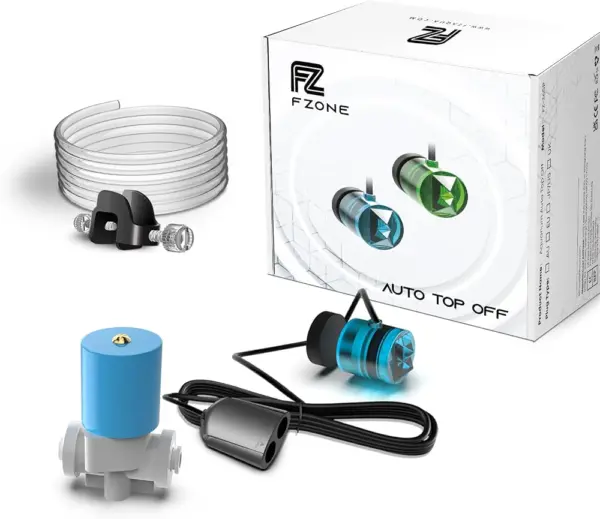
FZONE Nano ATO – Best for Ro/di Hookups
Key Features
- Valve: Solenoid for RO/DI line
- Sensors: Dual optical, 0.7 in
- Included: PU tubing and connector
- Warranty: 2 years
- Price: Midrange
There’s no reservoir in this kit’s story. FZONE replaces the pump with a solenoid valve that tees straight into a home RO/DI line, so top-off water comes from the same purified supply you fill the tank with. No bucket to haul, no bucket to refill, and nothing taking up floor space in the stand.
If RO/DI already runs under the cabinet, that’s a neater install than any pump kit here, and on a nano it frees up space a container would eat. The dual optical sensors and QST3.0 overfill logic carry over from the pump-driven kits, and the AFT feature is designed to ignore the momentary level rise from a return pump or a wave maker rather than reading it as a call for water — the sort of thing that makes a valve chatter all afternoon.
The safety thinking has to change with the design. A pump that sticks on empties a finite reservoir; a valve stuck open has your water supply behind it for as long as it stays stuck, so the second sensor and the overfill logic are the only things standing between you and a wet floor. We’re comfortable with that, because FZONE builds two independent triggers into the head — but anyone running a plumbed valve should know where the supply shut-off is.
The honest gap is history. There’s less of it behind this kit than behind the budget optical ones, so we’re recommending it on design and on a positive showing for function and quality rather than on years of service. If you’re plumbing RO/DI to the tank anyway, this is the tidiest way to use it.
Pros
- No reservoir to refill or haul
- Tees directly into an RO/DI line
- Dual optical sensors with AFT overfill logic
- Two-year warranty on the kit
Cons
- Only works where an RO/DI line is already plumbed
Buy it when RO/DI already reaches the tank: a solenoid replaces the pump and the bucket, with dual optical sensors doing the stopping.
Qwakay Smart ATO – Best for Hands-On Keepers
Key Features
- Pump: Submersible, included
- Sensor: Electromagnetic level sensor
- Controls: Alarm and pause button
- Price: Budget
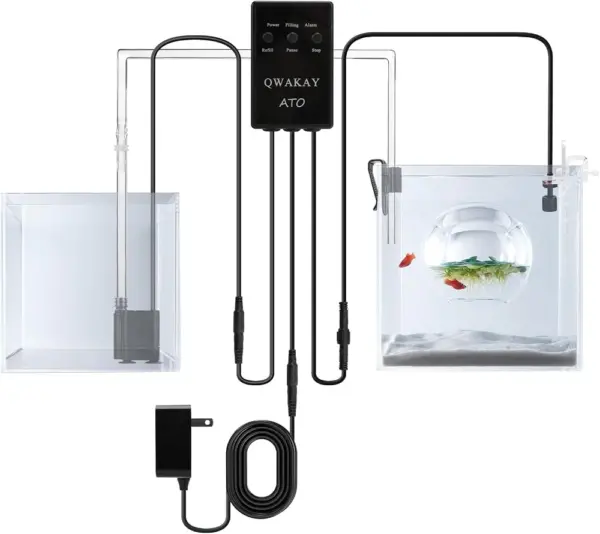
A pause button is a small thing that turns out to matter. Water change, target feeding, moving a frag — on most of the kits here you lift the sensor clear of the water or pull the plug, and on the Qwakay you press a button and the pump stays off until you press it again. That’s the feature that earns it a place on this page.
It’s also the cheapest electronic kit here, and one of the few with an alarm that sounds when the reservoir runs dry, so you find out before the pump does. The box includes the submersible pump and everything else you need, and the level sensor is a solid-state electromagnetic design rather than an optical eye. On a tank in a back room, or one you leave for long weekends, the alarm is worth more than a flow rating.
Pros
- Pause button stops the pump for maintenance
- Alarm sounds when the reservoir empties
- Everything included, pump and controller
Cons
- Controller box and cables take space beside the tank
We recommend it for hands-on keepers: the pause button stops the pump during water changes, and the alarm sounds when the reservoir runs dry.
DIGITEN ATO-19U-3 – Best for Budget Sump Tanks
Key Features
- Sensor: Dual float switch
- Max lift: 78.74 in
- Level range: 0-17 cm / 0-6.7 in
- Power adapter: ETL listed
- Price: Budget
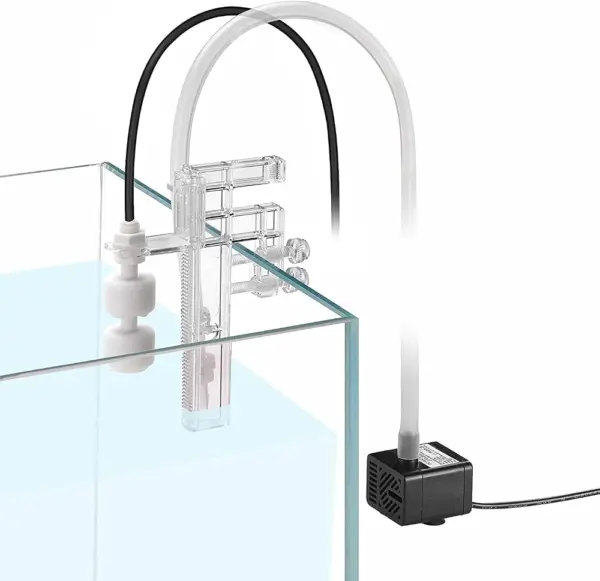
Floats are the oldest water-level switch in the hobby, and they have one advantage an optical eye can’t match: they don’t care what’s growing on a lens. This DIGITEN hangs two of them on a bracket — the lower one switches the pump on as the level drops, the upper one cuts power if it keeps rising.
There’s an ETL-listed power adapter in the box and a siphon break, and the operating band covers 0 to 17 cm of level drop, which suits a sump with a wide fill range better than a nano display. The 12-volt pump is rated to lift about six and a half feet.
Fit the siphon break. It’s listed as optional and it isn’t: without it, a line left sitting under the water level can keep pulling after the pump stops and drain the tank back into the reservoir. Keep the reservoir below the tank outlet too, which is DIGITEN’s own recommendation.
What floats give you in tolerance they take back in upkeep. One gummed up with salt, algae or a stray snail shell sticks — sometimes shut, which means a tank that quietly stops getting topped off, sometimes open, which means water until somebody notices. A few minutes with a soft brush every couple of months is the routine this design asks for. If you want a switch you can see and clean, that’s a fair trade on a budget sump.
Pros
- Dual floats give a mechanical backup
- ETL-listed power adapter included
- Siphon break and full kit in the box
- 0 to 17 cm level range suits a sump
Cons
- Some units fail early
- Bulkier than a stick-on optical sensor
A sensible budget choice for a sump with a wide level range: two floats, an ETL-listed adapter, and a switch you can clean by hand.
XP Aqua Duetto 2 – Best for Display Tanks
Key Features
- Body: Stainless steel
- Mount: Magnetic coupling
- Sensors: Dual optical
- Overfill protection: Two-stage with QST
- Price: Premium
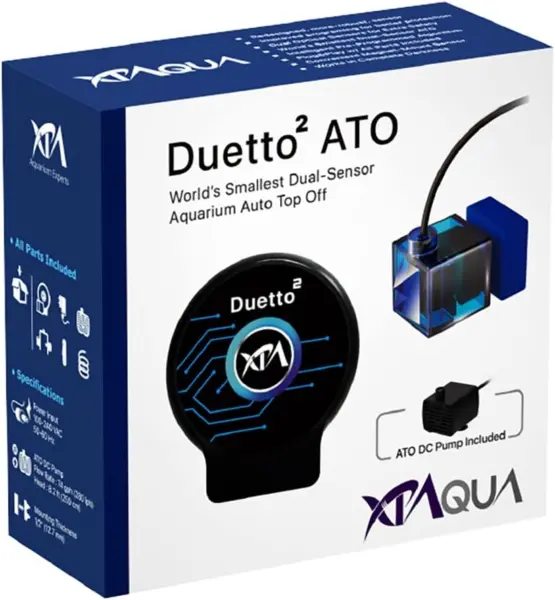
The Duetto 2 is the premium kit here, and it makes you ask what the extra money actually buys. The answer is compactness and materials: a dual-sensor head on a magnetic coupling that slides to adjust without tools, and a body in stainless steel rather than plastic. If the hardware is going to sit in view on a rimless display, that’s not nothing.
The dual optical sensor is XP Aqua’s own design, backed by two layers of overfill protection and QST programming that cuts the pump if a fill runs long. Between a mount that adjusts in seconds and a head built to stay out of the way, it’s the ATO you notice least once it’s in place.
We recommend it for a display tank where the equipment is part of the look and the budget isn’t the deciding factor — and not as a first ATO, or for a sump nobody sees. In those spots the LAZYBONE tops off the same water for less, and the MagTool reaches places the Duetto’s pump cannot.
Pros
- Compact dual-sensor head for a display tank
- Magnetic coupling adjusts without tools
- Two layers of overfill protection
- Stainless steel body rather than plastic
Cons
- Some units fail early for the money
Buy it for a display tank where the hardware shows: a compact dual-sensor head on a magnetic coupling, in stainless steel, with two layers of overfill protection.
How We Tested Auto Top Off Systems
We started with a list of more than 30 auto top offs sold for home aquariums, then narrowed it by tank size, sensor type (float, optical, and pressure), pump style, mounting hardware, and price. We eliminated units with unclear replacement-part availability and models that only worked with one reservoir shape. That left 12 units, which we tested over eight months on a 75-gallon mixed reef with a 20-gallon sump, a 10-gallon nano, and two team members’ home systems.
Each unit got the same first test: I installed it solo and timed how long it took from unboxing to a stable water line, noting whether the controller menus made sense without the manual. We timed how long each pump took to move a quart of water into a measuring cup, then watched how often the unit cycled during normal evaporation. Water level accuracy was checked with a ruler against the sump return chamber and a refractometer for salinity; we noted whether the unit overshot, short-cycled, or let the level drift between top-offs.
Reliability came from living with them. We let each unit run unattended for a week, simulated a stuck sensor by lifting float switches and blocking optical eyes, and pulled the plug mid-cycle to see what happened on restart. Leak-proofing was checked at every connection under pressure, and after eight months we opened pumps and sensor housings to look for salt creep, cracked tubing, and film on the sensors. We also compared replacement pump and sensor costs against the purchase price — a unit that saves $30 upfront but needs a $40 sensor in a year isn’t cost-effective.
How to Choose an Aquarium Auto Top-Off System
The best auto top-off is not the one with the most sensors; it’s the one whose worst day is a pump that stops rather than a reservoir that ends up on your floor.
Count the independent shut-offs
Every kit here promises overfill protection, and the useful question is how many separate things have to fail before water keeps coming. A high-level sensor that cuts power is one. A pump that stops when the reservoir runs dry is another. A timer that ends a fill that has gone on too long is a third. Two is the minimum we look for; three is what separates the kits we trust from the ones we tolerate.
This is also where a plumbed solenoid deserves more caution than a pump. A pump can only empty the container it sits in. A valve on a live water line can keep feeding until something upstream notices, so on an RO/DI setup the high-level sensor is doing the real work. Prove it before you leave the system alone.
Match the pump to where the water lives
Lift rating, not flow rating, decides whether a kit works in your cabinet. Measure from the bottom of the reservoir to the outlet, add a foot for bends and fittings, and compare that with the maximum head height. A pump rated at 74 GPH and eight feet of head handles a bucket on the floor of a stand; a small pump rated for two feet will not, however fast it moves water at zero height.
Reservoir placement matters just as much. Keep the reservoir’s water level below the tank outlet, or fit the siphon break most kits include, otherwise a line left submerged keeps draining after the pump stops. If you already run RO/DI to the tank, a solenoid kit like the FZONE skips the reservoir question entirely.
Pick a sensor you will actually clean
Optical sensors are precise and they foul. A film of salt creep or algae on the eye can hold it in the wrong state, which is why the better kits pair a primary sensor with a high-level backup. Keeping one honest is easy: a wipe with a soft cloth, or a vinegar soak during a water change, is the entire routine.
Floats tolerate growth better and judge the level less precisely, and they stick rather than drift, so a float setup wants a second float above the first. A mechanical refiller has no sensor at all — differential pressure stops the flow when the levels equalize — which means nothing to foul and a coarser, fixed water line in exchange.
Check the fit before the features
Glass thickness and rim style disqualify more ATOs than anything else. These magnets are rated for a maximum pane thickness — the LAZYBONE’s tops out at 19 mm — and the Clscea’s clip needs flat glass between 3 and 10 mm with no rim or brace in the way. Check your tank’s spec sheet or measure the pane before ordering.
The head itself is the other fit question. Optical sensors run roughly 0.7 to 0.8 inches across, small enough to hide behind a rim or in a rear chamber, while a float bracket and a separate controller need visible real estate and a cable route. On a rimless display you notice all of it; inside a cabinet sump you notice none of it.
Frequently Asked Questions
Where should the ATO sensor go?
In a sump, put it in the return-pump chamber — the last section before water goes back to the tank. That’s the only place where evaporation shows up as a falling level, because the return pump fixes the height everywhere else. In an all-in-one tank, use the rear chamber that pumps to the display.
Set the sensor at the level you normally run, mark that level with a piece of tape, and watch one complete fill cycle before you leave it unattended.
Does an auto top-off replace water changes?
No. An ATO adds fresh water to replace what evaporated, and the salt stays behind, so salinity returns to where it was. It does nothing about nitrate, phosphate or depleted minerals, which is what a water change removes.
Keep the same volume on the same schedule. The ATO only spares you from chasing the water line in between.
What does an auto top-off cost to run?
Very little in electricity. Several of these pumps are rated around 5 watts and run for a few minutes at a time, so the power is negligible beside the tank’s lights and heater. The real ongoing cost is the pump or sensor that eventually fails.
That is why the warranty split matters: look for coverage on the probe or sensor, not just the pump, since the sensor is the part that decides when to stop.
Final Verdict
The LAZYBONE NG11 is the one we recommend to most people. It seals the controller inside the probe instead of leaving an enclosure and a cable entry for salt creep to find, guards the level with three optical sensors and a dry-run shut-off, and asks nothing of you after setup except a wipe of the sensor now and then.
Change the pick for a specific reason. A reservoir on the floor of a stand wants the MagTool’s 8.2 feet of lift. A plumbed RO/DI line wants the FZONE’s solenoid and no bucket at all. A nano, a quarantine tank or a tank you leave for a week is well served by the Clscea, which has nothing to plug in.