This post contains affiliate links. We may earn a small commission when you buy through our links — at no extra cost to you.
A saltwater aquarium heater is a simple piece of equipment—plug it in, set the temperature, and forget it. But many hobbyists find their heater drifting, failing, or even shattering within months. The real cost isn’t the purchase price but the stress of a sudden temperature crash in your reef or fish tank.
This guide cuts through the noise of digital displays and safety claims to focus on what actually matters: which heaters hold temperature consistently over years of use. We’ve sorted through dozens of models to find the ones that balance features with proven durability. Whether you have a 10-gallon nano or a 75-gallon display, there’s a heater here that won’t let you down.
Top Picks
Best for Medium to Large Tanks
HiTauing 300W AP02

Rating: 4.5 ★ | Price: $$ | Wattage vs. Tank: 300W, 40-75 gal | Thermostat Type: Adjustable digital | Reliability: 91% positive reliability
The HiTauing AP02 holds temperature within a degree of the set point and warms up quickly even in 75‑gallon tanks, distributing heat evenly across the aquarium. The external digital controller makes adjustments simple, and the safety features — automatic power‑off when the unit leaves water and overheat shutdown — work as described without fuss. That combination of precision and protection is rare at this price.
This heater fits keepers running 40‑ to 75‑gallon tanks who want adjustable temperature control plus backup safety. Saltwater or freshwater, it handles both. Some units can develop condensation inside or stop heating after months of use, so buying from a retailer with a flexible return policy is sensible — but for most owners the AP02 delivers steady, uneventful operation year after year.
Pros
- Digital control holds within 1°F of the set temperature.
- Heats quickly and distributes warmth evenly in larger tanks.
- Safety features (low‑water shut‑off, overheat protection) trigger reliably.
Cons
- Some units can develop condensation inside or stop heating after several months — worth buying with a flexible return window in mind.
- Temperature sensor may read 2–3°F off; calibration using the digital controller resolves it.
For medium to large tanks where accuracy and safety matter, the AP02 is the most dependable digital heater in its class.
Best for Nano Tanks
hygger 50W Mini
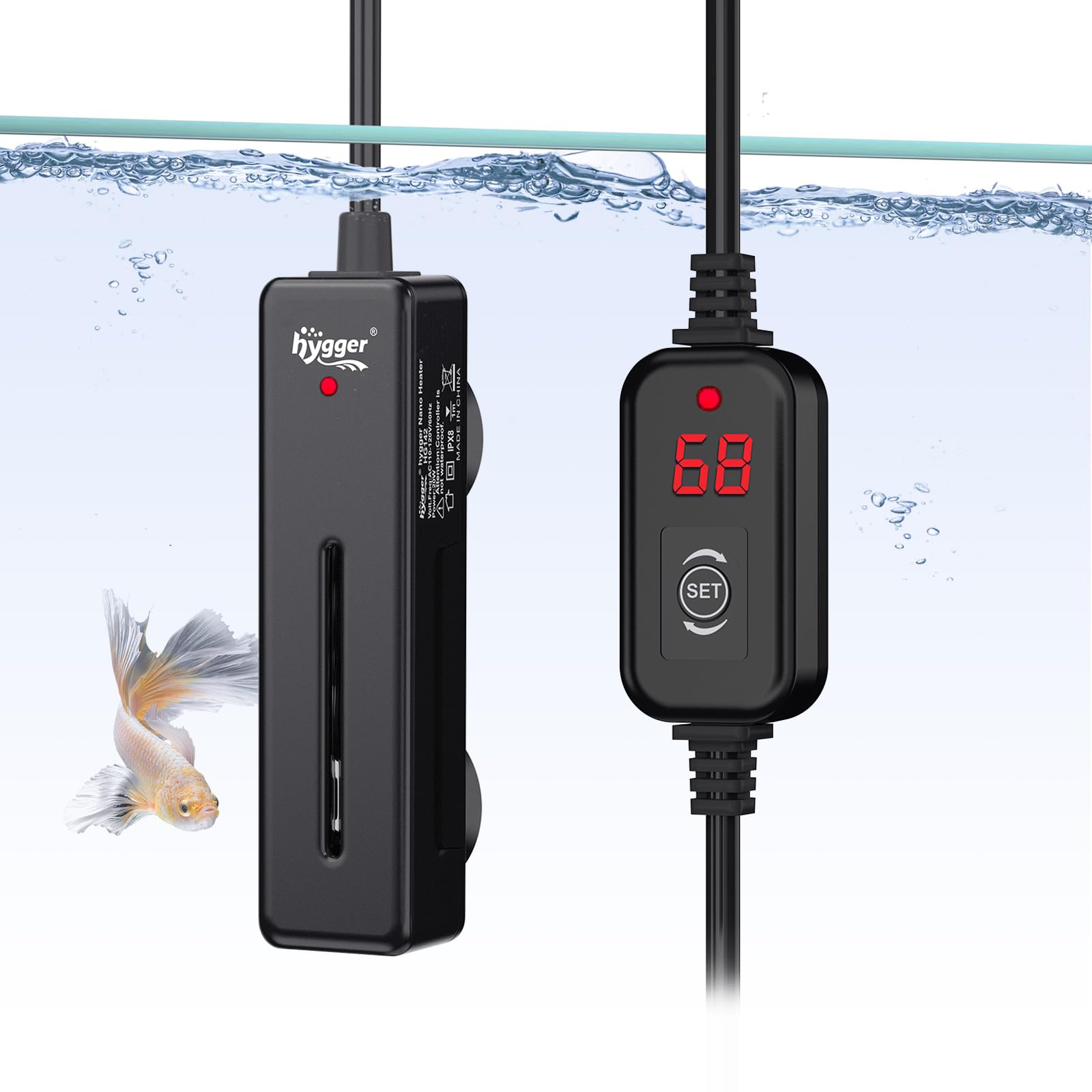
Rating: 4.5 ★ | Price: $ | Wattage vs. Tank: 50W, 5-10 gal | Thermostat Type: Adjustable digital | Reliability: 82% positive, limited long-term
The hygger 50W Mini brings digital display and low-water alarm to nano tanks — features usually reserved for larger, pricier heaters. For saltwater nano setups (5–10 gallons), this heater offers precise adjustability and a shatterproof casing that adds peace of mind. The tradeoff: its track record is still building, so hobbyists who want extensive long-term assurance may prefer a more established option. Occasional temperature drift in cooler rooms makes this best for aquarists who monitor their tank closely.
Pros
- Digital display and low-water alarm provide clear status and safety alerts.
- Shatterproof casing reduces breakage risk in tight nano tank spaces.
- Compact footprint fits easily in 5–10 gallon tanks without crowding.
Cons
- Temperature consistency can drift in cooler rooms, requiring occasional manual adjustment.
For the nano reef keeper who wants digital control and safety features in a small package, the hygger 50W Mini delivers — just keep an eye on the thermometer in colder months.
Best for Turtle Tanks
HITOP 200W PTC

Rating: 4.3 ★ | Price: $$ | Wattage vs. Tank: 200W, 25-60 gal | Thermostat Type: Adjustable digital | Reliability: 86% positive, some failures
The HITOP PTC heater removes the worry of glass shattering in tanks with active inhabitants, using a ceramic element and protective cover. Compared to quartz heaters, it trades tighter temperature control for this durability — consistency can drift and may need occasional recalibration. This suits saltwater fish-only systems where ±1°F precision isn’t required, though some units may have shorter lifespan, making it a pick for breakage-prone tanks over long-term reliability.
Pros
- No glass – shatterproof for active tanks
- Heats well and maintains stable temperature for most setups
Cons
- Temperature accuracy can drift between units, requiring occasional recalibration — less precise than quartz heaters
- Some units may cease heating after a few months, so a flexible return window is worth having
Choose this when shatterproof construction is a priority for a saltwater fish-only tank where precision isn’t critical; for reef systems or longer-term use, the top pick is a better fit.
Best for Small to Medium Tanks
HITOP 100W Digital

Rating: 4.6 ★ | Price: $ | Wattage vs. Tank: 100W, 12-30 gal | Thermostat Type: Adjustable digital | Reliability: 83% positive, few reviews
With digital temperature control at a price that undercuts many competitors for 12–30 gallon tanks, the HITOP 100W offers solid value for budget-minded keepers. Long-term durability is still building a track record — some units may develop a temperature offset or stop heating after months. That makes it a better fit for temporary setups or secondary tanks where replacement cost is low.
Pros
- Digital temperature adjustability at a price that fits a tight budget.
- Simple setup with an external controller and clear display.
- Compact glass housing fits neatly in smaller tanks without crowding.
Cons
- Temperature reading can be slightly off from actual water temp — worth verifying with a separate thermometer.
For budget-focused keepers of small to medium tanks who can accept some risk on longevity, the HITOP delivers digital control and easy setup at a low cost.
Best for Tech Enthusiasts
Fluval E 300W

Rating: 4.3 ★ | Price: $$$ | Wattage vs. Tank: 300W, up to 100 gal | Thermostat Type: Adjustable digital | Reliability: 82% positive, but many fail
The Fluval E 300W differentiates itself with a color-coded digital display that changes from blue (cold) to green (at set point) to red (overheating), making temperature status visible from across the room. The external controller allows adjustments without reaching into the water—a clear upgrade over the top pick’s less visual approach. However, this feature set requires strong water flow to avoid the ‘LF’ low-flow error, narrowing placement options. This makes the Fluval best suited for tech-savvy hobbyists running high-flow filtration who value real-time feedback and are willing to accept a premium price.
Pros
- Color-coded temperature display gives instant visual status (blue/cold, green/ok, red/hot).
- External controller allows temperature adjustments without immersing hands.
- Maintains temperature within 0.5°F of target when positioned in sufficient flow.
Cons
- Some units may experience temperature drift or stop heating within the first year.
If you value real-time visual feedback and run a high-flow setup, the Fluval E 300W offers a unique display – but its inconsistent longevity makes it a gamble worth taking only with a flexible return window.
Best for Budget Large Tanks
Orlushy 300W

Rating: 4.4 ★ | Price: $ | Wattage vs. Tank: 300W, 40-75 gal | Thermostat Type: Adjustable analogue | Reliability: 83% positive, poor durability
Priced well below most 300W adjustable heaters, this Orlushy unit heats water quickly for tanks up to 75 gallons – a tempting budget option. Where the top pick (HiTauing AP02) offers digital precision and more consistent build, this model uses a glass tube with an external dial, and durability has been a concern: the glass may crack or the plastic guard can warp under extended use. That makes it a fit for quarantine tanks or emergency backups rather than permanent installations with valuable livestock.
Pros
- Budget-friendly 300W adjustable heater for tanks up to 75 gallons.
- Warms water quickly and holds set temperature for many aquarium owners.
Cons
- Glass tube may crack or plastic guard may warp with ongoing use – worth monitoring closely.
- Temperature accuracy can drift; some units overheat or cool more than the dial suggests.
A low-cost heater that works when it works – best for tanks where a sudden failure won’t mean losing prized fish.
Best for Small Budget Tanks
Tetra HT 100W

Rating: 4.4 ★ | Price: $ | Wattage vs. Tank: 100W, 10-30 gal | Thermostat Type: Preset fixed | Reliability: 75% positive, variable
Tetra’s HT 100W is a compact, budget-friendly heater that holds steady at 78°F in small freshwater tanks. However, the non-adjustable temperature prevents use for saltwater species or disease treatment, and unit longevity can vary – making it a better fit as a backup or for low-maintenance freshwater than for any saltwater application.
Pros
- Compact size fits unobtrusively in tanks up to 30 gallons.
- Consistent temperature at 78°F in normal room conditions.
Cons
- Fixed 78°F temperature cannot be adjusted – limits its use for saltwater species or disease treatment.
Best suited as a low-cost backup or for small freshwater tanks where temperature flexibility isn’t needed.
Best for Aquascapers
Fluval M 200W

Rating: 4.4 ★ | Price: $$$ | Wattage vs. Tank: 200W, up to 65 gal | Thermostat Type: Adjustable analogue | Reliability: 77% positive, good build
The Fluval M 200W offers solid build quality and a reflective finish that blends into planted tanks, with heating performance that holds temperature for many owners. Its main limitation is the top cap that must stay above the waterline, which restricts installation options, and the glass tube can break if bumped during cleaning or by active fish.
Pros
- Good build quality with attractive mirror finish
- Reliable temperature maintenance over time
Cons
- Top must remain above water – not fully submersible, limiting tank placement
Best for aquascapers who prioritize aesthetics and can work around the top-above-water requirement, but less suited if full submersibility or shatter resistance is needed.
Best for Early Adopters
HiTauing Upgraded 300W

Rating: 4.7 ★ | Price: $$ | Wattage vs. Tank: 300W, 40-75 gal | Thermostat Type: Adjustable digital | Reliability: 94% positive, early failures
The HiTauing 300W maintains temperature within 1°F of the set point and stops heating automatically when exposed to air – a practical safety feature for saltwater tanks. Glass breakage or internal melting has been noted in a small number of units, so this heater suits attentive owners who monitor their equipment closely and are comfortable with less established long-term track records.
Pros
- Digital control holds temperature within 1°F of the set point – precise for sensitive setups.
- Low-water shut-off and overheat protection work reliably, reducing risk during water changes.
Cons
- Glass breakage or melting may occur in a small number of units over time – best for owners who keep a close watch.
Worth considering if you want the latest safety features and are willing to accept unproven durability in exchange for advanced protection.
Best for Noisy Environments
FREESEA 50W

Rating: 4.3 ★ | Price: $ | Wattage vs. Tank: 50W, 1-10 gal | Thermostat Type: Adjustable digital | Reliability: 90% positive, inconsistent
Easy to use with a clear digital display and compact size that fits well in nano aquariums. Temperature accuracy can vary – the built-in reading may be 2–5°F off, so keeping a separate thermometer handy is a good idea.
Pros
- Clear digital display and simple temperature setting via external controller.
- Compact footprint suits small tanks (1–10 gallons) without taking up much space.
Cons
- High-pitched whine may be audible in quiet rooms – better suited for garages, basements, or temporary use.
Worth considering only for temporary setups or tanks in already-noisy locations where the whine won’t be a bother.
Best for Small Tanks, Safety
HANLESHUKA 100W

Rating: 4.4 ★ | Price: $$ | Wattage vs. Tank: 100W, 10-20 gal | Thermostat Type: Adjustable digital | Reliability: 78% positive, limited data
This heater’s auto shut-off on air exposure is a standout safety feature for small tanks. Short-term performance is consistent. It serves a specific need rather than being an all-rounder — a sensible pick for keepers who value that tradeoff.
Pros
- Auto shut-off when water level drops reduces risk of overheating.
- Stable heating in the short term for typical 10–20 gallon setups.
Cons
- Temperature display can differ from actual tank water temperature.
A reasonable fit when safety features outweigh the need for pin-point temperature control.
Best for Early Adopters
ZazaFi 300W
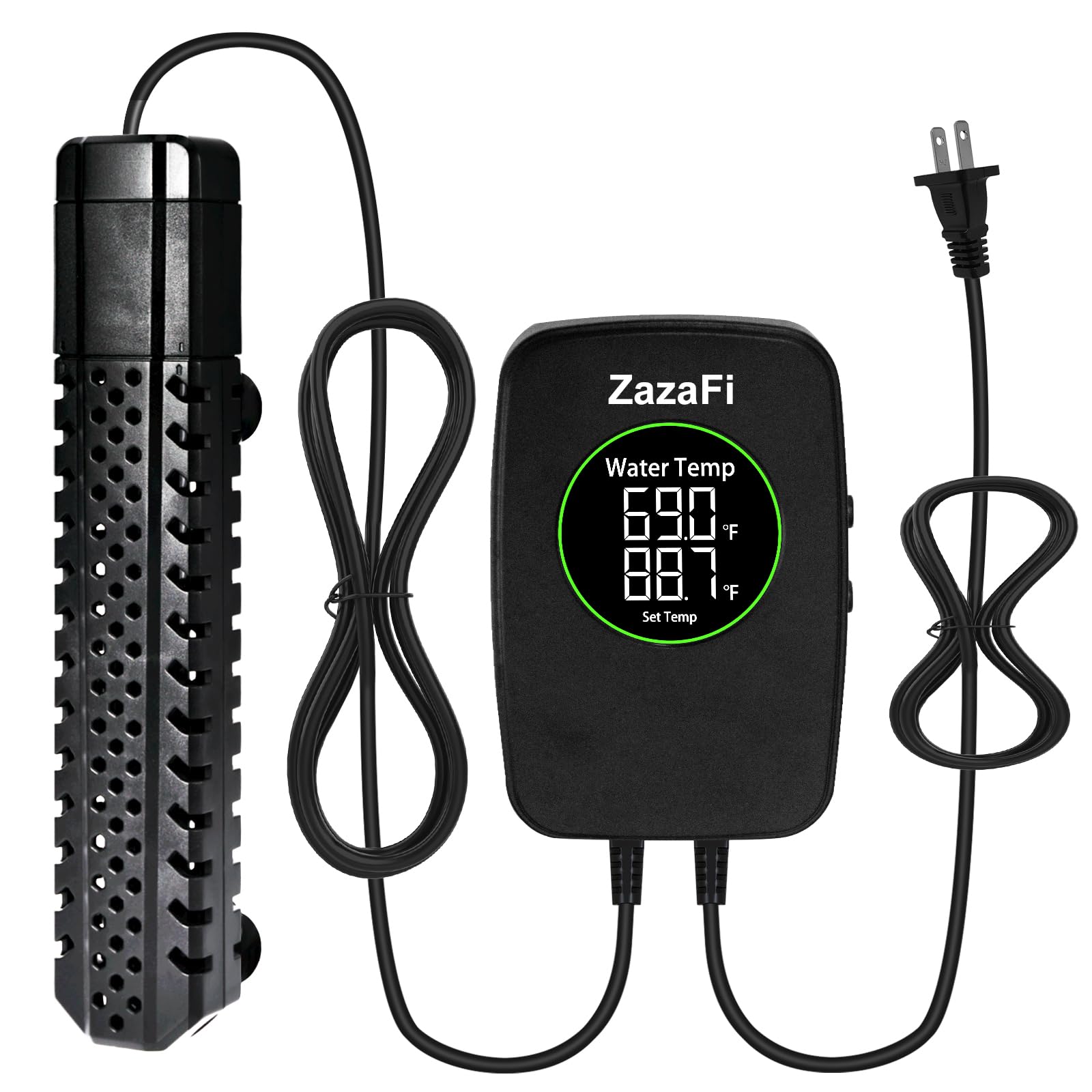
Rating: 4.6 ★ | Price: $$ | Wattage vs. Tank: 300W, 40-75 gal | Thermostat Type: Adjustable digital | Reliability: 86% positive, insufficient data
The ZazaFi 300W heater maintains temperature within 1°F of the set point and has a clear digital readout. Because it comes from a newer brand with limited long-term feedback, it is a good fit as a secondary heater or for hobbyists who want to try a new product rather than for primary use in a main tank.
Pros
- Holds water temperature within 1°F of the set point.
- Digital display is easy to read from across the room.
Cons
A sensible pick for a backup heater or for those willing to monitor a newer brand’s performance.
How to Choose
The most important factor in choosing a saltwater heater is long-term reliability, not just features or price.
Wattage vs. Tank Volume
The general rule is 3–5 watts per gallon of tank volume. A 200W heater works for a 40-gallon tank, but a 300W heater gives more headroom in cold rooms or if the tank is in a drafty area. Oversizing slightly (e.g., 300W on a 55-gallon) helps the heater keep up with heat loss without constantly cycling on and off.
Using a heater that’s too large for a small tank can cause rapid temperature swings when it clicks on, stressing fish. Conversely, an undersized heater will run continuously and may never reach the set temperature in a cold environment.
Adjustable vs. Preset Thermostat
Preset 78°F heaters are simple but lock you into a single temperature. That becomes a problem when you need to raise the tank to 82–86°F for treating ich or other diseases—you simply can’t. An adjustable thermostat gives you control over the entire safe range for tropical fish.
Digital adjustable heaters offer more precise settings, often within 1°F, while analog dials tend to drift and require repeated tweaking. For saltwater reefs, digital adjustability is nearly essential for stability.
Safety Features
Look for auto shut-off when the water level drops, overheat protection, and shatterproof materials. A heater that keeps running when exposed to air can overheat and crack, potentially electrocuting the tank. Low-water alarms add another layer of safety by alerting you before the heater is fully exposed.
Glass heaters are vulnerable to thermal shock—moving them from cold water to hot or vice versa can cause them to shatter. PTC ceramic heaters eliminate that risk entirely and are a safer choice for active fish or turtles.
Reliability Track Record
Customer review patterns reveal that many budget heaters work well for a few months then fail or drift. A heater that holds temperature for six months isn’t enough—you want one that lasts years. Pay attention to the ratio of positive vs. negative reliability mentions, not just the star rating.
A product with thousands of reviews and a high percentage of positive long-term feedback is a safer bet than a new model with glowing initial ratings but no track record. Red flags include frequent reports of early failures, condensation inside the tube, or sudden overheating.
FAQ
Why is my aquarium heater not reaching the set temperature?
The most common cause is insufficient wattage for the tank size or a room that’s too cold. Check that your heater is rated for at least 3–5 watts per gallon. If the room temperature drops below 65°F, even a correctly sized heater may struggle—consider insulating the tank or using two smaller heaters instead of one large one.
Can I use a higher wattage heater than recommended for my tank?
Yes, within reason. Using a 300W heater on a 40-gallon tank is fine—it will heat up faster and handle cold rooms better. The heater cycles on and off as needed, so it won’t overheat the tank as long as the thermostat works correctly. Avoid using a heater so powerful that it creates rapid temperature jumps of more than 2°F per hour.
How do I prevent a glass aquarium heater from shattering?
Always unplug and let the heater cool down completely before removing it from water. Never place a hot glass heater into cold water or vice versa. Use a heater guard or choose a shatterproof PTC ceramic model if you have active fish or turtles that might bump the glass.
Why does my heater make a humming or clicking noise?
A low hum is normal as the thermostat clicks on and off. A loud clicking or high-pitched whine often indicates a cheap internal relay or vibration from the heating element. Some budget models like the FREESEA are notorious for this. If the noise bothers you, look for a heater with a reputation for quiet operation, such as the HiTauing AP02 or Fluval E.