This post contains affiliate links. We may earn a small commission when you buy through our links — at no extra cost to you.
A protein skimmer does one job: it makes fine bubbles, lets dissolved waste stick to them, and pushes the resulting foam into a cup you empty. Everything that separates a good one from a frustrating one happens around that job — a pump that pulls real air, a body that doesn’t rattle, a valve you can nudge without the cup flooding. I’ve come home to a skimmer that overflowed down the side of the sump, and I’ve also owned one so quiet I forgot it was running. The difference is worth shopping for.
We’ve run nine skimmers on our own tanks over the past seven months, from compact in-sump models to hang-on units that hold on with magnets, and the pattern held — the ones that pulled the most skimmate were also the easiest to live with. One thing nobody tells a first-time buyer: sizing up slightly and dialing back beats an undersized skimmer running wide open, and adjustability matters more than the air-draw number on the box. Here’s what earned a permanent spot under the cabinet.
Our Top Picks
The Best Aquarium Protein Skimmers for Reef Tanks, Reviewed
IOAOI DC Protein Skimmer – Best Overall
Key Features
- Pump: DC pinwheel with controller
- Mounting: Hang-on or in-sump
- Dimensions: 17"L x 3.4"W x 17"H
- Tank Rating: Up to 80 gallons
- Price: Budget
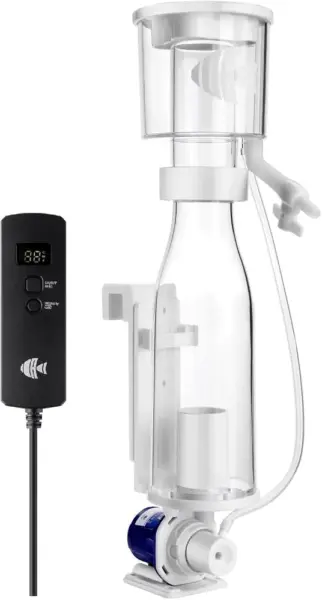
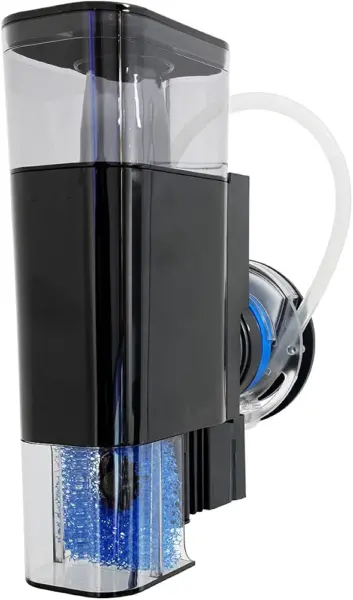
Two things make this the skimmer we recommend first. One is the mounting: it hangs on the back of the tank or sits in a sump chamber, so it works on a system that has no proper sump yet. The other is the body, 3.4 inches wide and 17 inches tall, which slides into the rear compartment of an all-in-one tank where a conventional cone will not go. Rated to 80 gallons with a DC pinwheel pump and a controller, it covers the most common reef size without asking for a filter room.
The controller is the part we care about most. It lets you slow the pump and set the foam where you want it, and you can rotate the body to adjust the outlet height instead of shimming the unit up on egg crate. In a rear chamber or hung on the back, that is what keeps it from skimming wet one week and dry the next. It also runs quietly enough for a living room, which is not a given at this size.
The cup asks for a little patience. Getting it off means disconnecting the airline and drain hose first, and the valve is stiff enough that you will want to leave the drain line running into a jug rather than lifting the cup every few days. Once it is plumbed that way, the routine is a glance at the jug instead of a job. The rest is ordinary: a couple of weeks of break-in, and a water level that stays put.
Pros
- Hangs on the back or sits in a sump
- 3.4-inch body fits AIO rear chambers
- DC controller for fine tuning
- Quiet enough for a living room
Cons
- Hang-on bracket won’t fit rimmed tanks
Our pick for most reef keepers: it hangs on the back or drops into a rear chamber, and the DC pump lets you tune the foam without touching the plumbing.
Reef Octopus Classic 110-INT – Best Classic In-Sump
Key Features
- Mounting: In-sump
- Tank Rating: Up to 100 gallons
- Skimmer Type: 4-inch needle wheel
- Price: Premium
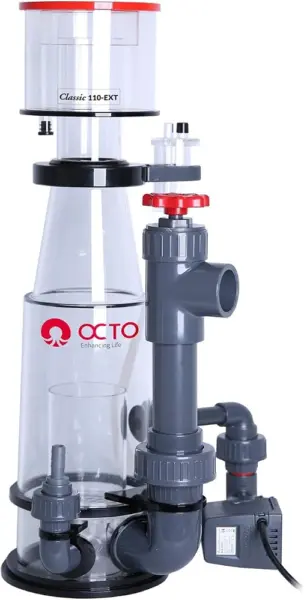
The Classic 110-INT has one non-negotiable requirement: a sump that holds its water level within a fraction of an inch. Foam depends on the depth in the chamber it stands in, so evaporation, a big water change, or a heavy feed pushes it from dry to overflowing unless you keep up with top-off. An auto top-off and a stand that sets the unit at the right depth solve it. Nothing else does.
Get that right and it is the in-sump skimmer we point a 100-gallon reef at. The 4-inch needle wheel pulls dark, dry skimmate once it settles, and taking the cup off is a lift rather than a wrestle — an O-ring collar instead of a screw thread, which sounds like a small thing until you are holding a full cup over the carpet. It drops into a 13-inch baffle, so a 20-gallon long sump is enough to house it.
The first weeks are the fiddly part. It breaks in slowly and responds to small adjustments rather than one big one, and the foam you see in week one is not the foam you will live with. Judge it on a month.
Pros
- Pulls dark, dry skimmate once settled
- Cup lifts off an O-ring collar
- Fits a 13-inch sump baffle
Cons
- Fiddly to dial in during break-in
For a 100-gallon reef with a proper sump and a steady baffle, this is the in-sump skimmer we point people to first.
Simplicity 240DC – Best for Big Tanks
Key Features
- Pump: Variable-speed DC
- Height: 19.5 in
- Footprint: 8.3 x 7.9 in
- Tank Rating: Up to 240 gallons
- Price: Premium
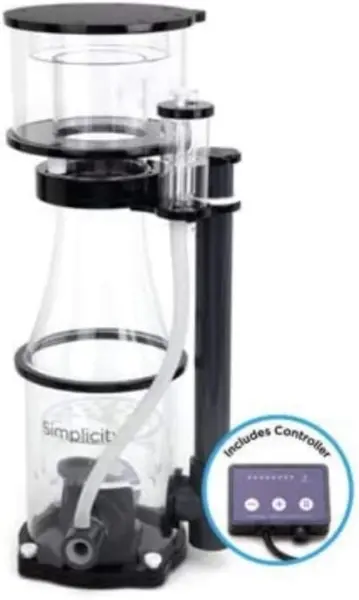
A 240-gallon rating on a footprint under nine inches on each side is the whole case for this skimmer, and it is a good one. Plenty of big tanks are plumbed to sumps that were laid out for the equipment of a decade ago, and the 240DC stands 19.5 inches tall while taking up less floor space than most return pumps. It is the skimmer that makes a small sump work with a big tank.
The variable-speed DC pump is what makes the rating flexible: run it low on a lightly stocked 120 and turn it up as the fish load grows, which is cheaper than buying twice. The cup carries a drain with a cap, so you can run a line to a jug and stop lifting it every few days. Assembly is straightforward and it runs quietly, which matters when the sump sits under the living room.
Pros
- 240-gallon rating on an eight-inch footprint
- Variable-speed DC pump
- Collection cup drain with cap
Cons
- Thin instructions for the controller
- Tall body needs cabinet headroom
We reach for this when the tank is big and the sump isn’t: 240 gallons of rated capacity on an eight-inch footprint.
MagTool N130 Plus – Best Value for 100-Plus Gallons
Key Features
- Pump: 400 GPH DC pinwheel
- Footprint: 7.9 x 7.4 in
- Tank Rating: 105–135 gallons
- Overflow Shutoff: Cup sensor stops the pump
- Price: Midrange
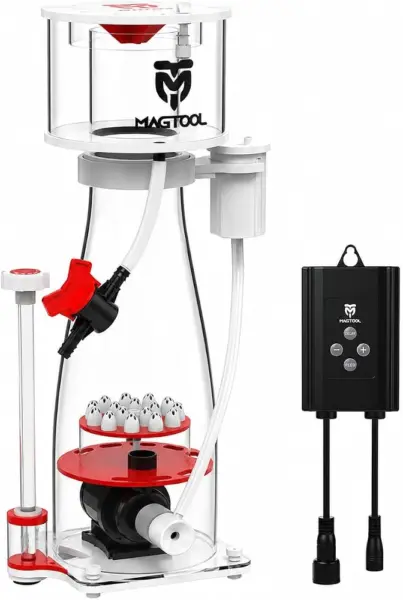
The feature that sells this skimmer is the sensor in the collection cup. When the cup fills, the pump cuts out instead of pushing wet foam into a cup that is already full. Anyone who has come back to a sump full of skimmed tank water will see why that matters, and it is the only unit here with that protection.
The rest is a well-judged package for a 105-to-135-gallon reef: a 400 GPH DC sine-wave pump with a needle wheel, a hybrid cone with a diffuser above it, and a 7.9-by-7.4-inch footprint that tucks into the corner of a modest sump. The controller lets you run it well below full power, which is what you want if your bioload sits nearer 105 gallons than 135.
We rate it the value pick of the big in-sump skimmers here. It costs less than the other units rated above 100 gallons, it runs quietly, and the cut-off means a forgotten cup costs you a minute instead of an afternoon with a towel. Below about 100 gallons it is more skimmer than you need, and a smaller body with a gentler pump will be easier to keep stable.
Pros
- Cup sensor shuts the pump off when full
- Controllable 400 GPH DC pump
- Compact 7.9 x 7.4 inch footprint
- Cheapest big in-sump skimmer here
Cons
- More skimmer than a sub-100-gallon system needs
We recommend this for a 105–135-gallon reef: a controllable DC pump, a cup that shuts the pump off, and the cheapest way into a big in-sump skimmer here.
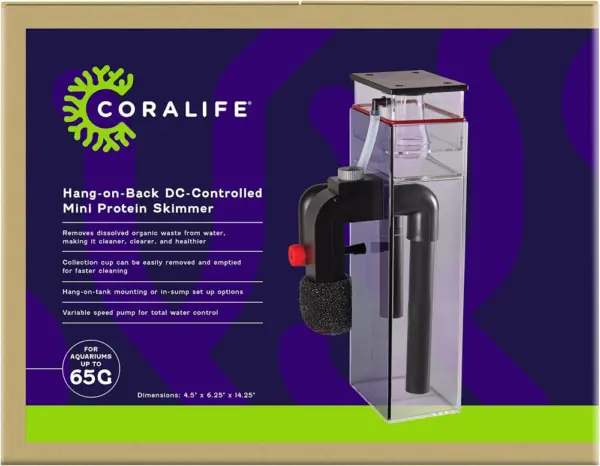
Coralife Hang-On DC Mini – Best Hang-On
Key Features
- Pump: DC with remote control
- Mounting: Hang-on or in-sump
- Dimensions: 4.49 x 6.26 x 14.28 in
- Tank Rating: Up to 65 gallons
- Price: Midrange
If there is no sump under the tank, this is the skimmer we point people to. It hangs on the back or sits in a sump if you add one later, and it is rated to 65 gallons in a body 4.5 inches wide — slim enough to sit behind the tank rather than hang off it.
What we appreciate most is the titanium mesh wheel. It breaks bubbles finer than a plastic needle wheel does, and finer bubbles mean more surface area for dissolved waste to cling to, which is the entire mechanism. The DC pump has an inline remote for speed and flow, so you can dial the foam in from the front of the cabinet instead of reaching behind the tank.
Setup is quick and the motor is quiet enough that you forget it is running. The one thing to watch is the body: lift the cup and the whole unit can shift on its mount, so steady it with one hand or give it a small platform to sit on. Do that and the weekly routine is a lift, a rinse, and nothing else.
Pros
- Hangs on the back or sits in a sump
- Titanium mesh makes finer bubbles
- Remote DC speed and flow control
Cons
- Priced like skimmers rated for larger tanks
The one we point to when there’s no sump to work with: a slim hang-on body, a titanium mesh wheel, and remote DC control.
Tunze Comline DOC 9001 – Best for Nano Tanks
Key Features
- Weight: 1.85 lb
- Mounting: Internal, magnet mount
- Dimensions: 4.3 x 2.5 x 8.5 in
- Price: Budget
The 9001 goes inside the tank rather than under it, and the magnet is how. There is no bracket to hang over a rim and no plumbing to run, so it drops into a rear chamber or onto the back wall of a nano and stays there. At 2.5 inches wide and 8.5 inches tall it fits chambers that will not take anything wider, which is the whole reason to own one.
Performance is what you hope for from a small internal unit: it pulls a consistent, dark skim once it settles, and the pump is quiet enough to run in a bedroom. It is not as tunable as the DC units here — you set the height and let it work — so setup is more about finding the right spot in the chamber than about adjusting a controller.
We recommend it for a nano or an all-in-one where nothing wider will fit, with one caveat: the magnet. On thin glass it holds; on thicker walls, a rim, or with the extender fitted, it can let go, so check the grip before you trust it with a full cup. And because it works off the water line, an automatic top-off is close to essential.
Pros
- 2.5-inch body fits narrow rear chambers
- Magnet mount needs no bracket or plumbing
- Quiet, consistent skim in nano tanks
Cons
- Weak magnet on thick or rimmed glass
For a nano tank with a rear chamber, this is the skimmer we trust to keep pulling — just check the magnet’s grip first.
Reef Octopus eSsence S-130 – Best for Tight Sump Spaces
Key Features
- Height: 20.5 in
- Footprint: 8.3 x 6.9 in
- Sump Depth: 7–8 in
- Bioload Rating: 75 gal heavy / 120 gal medium / 160 gal light
- Price: Premium
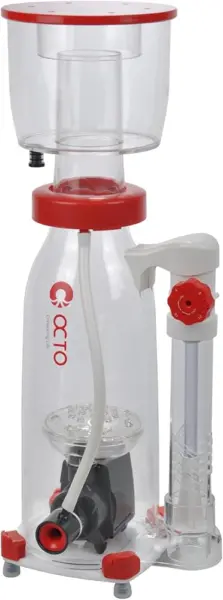
The gallon rating on this skimmer is three ratings, and the distinction matters. Reef Octopus rates the S-130 for a heavily stocked 75 gallons, a medium-load 120, or a light-load 160. Read the middle number rather than the last one: on a 160-gallon tank full of tangs and heavy feeding, this is not the skimmer you want.
What it is good at is fitting. A 6-inch body on an 8.3-by-6.9-inch footprint, 20.5 inches tall, with a specified sump depth of 7 to 8 inches — that is a package for a sump with height but not floor space. If your return chamber is a narrow slot, this is one of the few serious skimmers that will sit in it.
The Aquatrance pinwheel pump draws 11 watts and runs quietly, and the acrylic has the solid feel you want at this level. The 2.4-inch neck is the detail we noticed when cleaning it: wide enough to hold a head of foam without the cup needing constant attention.
It stays an also-consider rather than a top pick because the case for it is dimensional rather than universal. The S-130 earns its place when a narrow, deep sump rules out a wider cone; if your sump has floor space to spare, buy on capacity instead.
Pros
- 6-inch body fits narrow sumps
- Specified 7–8 inch sump depth
- Quiet 11-watt pinwheel pump
Cons
- Premium price for the capacity
We like this one for a heavily stocked 75-gallon reef with a narrow sump slot; the headline 160-gallon figure is a light-load number.
How We Tested Nine Skimmers Over Seven Months
We started with roughly 30 skimmers rated for tanks between 30 and 150 gallons and cut the list using spec sheets — rated volume, footprint, pump type, cup capacity, mounting style — then cross-checked each one against long-term owner threads to see which models actually held their rating after a year. Price counted, but a bargain skimmer that needs a pump upgrade to perform isn’t a bargain.
Each of the nine finalists ran on one of our own tanks for at least six weeks, installed the way a hobbyist would install it. We left every unit alone for the first week to break in and then measured how much dark skimmate collected in the cup over the following seven days. For noise, we stood a foot from the closed cabinet and listened for hum, rattle, or pump whine, then did it again at night with the house quiet. Build quality got handled, not read: we lifted each cup full of water to see if the body flexed, and watched how the cup seal and drain fitting held up through weekly emptying.
Adjustability got its own run — we turned each gate valve and pump controller through its full range, timed how long the foam took to settle after every change, and noted whether we could do it without reaching blind into a tight sump. Microbubbles were easy to spot: we checked the display glass for haze after each adjustment and after feeding. On hang-on models we confirmed the magnets held on 3/8-inch acrylic with the pump running and the cup full. And we pulled the plug on every skimmer mid-skim to see where the water went, because an overflowing cup can dump a week of waste back into the tank or onto the floor.
How to Choose a Protein Skimmer
The gallon rating on the box is a ceiling, not a target, and a skimmer that fits your chamber at the right water depth will beat a bigger one that doesn’t.
Size to Your Bioload, Not the Number on the Box
Every rating assumes a load, and makers assume different loads. Reef Octopus spells it out on the eSsence S-130: 75 gallons heavily stocked, 120 medium, 160 light. Others print one figure and leave the assumption to you. If you feed heavily, keep messy eaters, or run the tank near its limit, buy against the heaviest-stocking number rather than the headline one.
A skimmer a little oversized for the tank is easier to live with than one that spends the week between water changes catching up. It also runs at a lower setting, which keeps the foam drier and the cup emptier.
Mounting: Where the Thing Physically Goes
Hang-on skimmers avoid the sump question, but they need clear space behind the tank and a mounting surface the bracket can actually grip; check yours against the rim and any center brace before you order. In-sump units need a chamber with a stable depth and enough room above to lift the cup. Internal units are for rear chambers in all-in-one tanks.
Decide which of those three your system can take before you compare anything else. A skimmer that does not physically fit is not a bargain at any capacity.
Measure the Chamber and the Water Depth
Footprints here run from 7.9 by 7.4 inches on the MagTool to 8.3 by 6.9 on the S-130, and heights from 14.3 inches on the Coralife hang-on to 20.5 on the S-130. Height is what catches people out, because the cup comes off upward — leave several inches of clearance above the unit as well as around it.
Water depth matters just as much. The S-130 specifies 7 to 8 inches; sit a skimmer too deep or too shallow and it either floods the cup or produces nothing at all. Measure the chamber and the running depth before the box arrives, not after.
Fixed Pump or DC Controller
A DC pump with a controller lets you slow the flow and set the foam without touching plumbing, and it lets one skimmer cover a range of tank sizes — the Simplicity 240DC can idle at half speed on a lighter load and be turned up later. A fixed AC pump is simpler, has one less thing to fail, and usually costs less.
Pay for the controller if you are sizing up, want to run a big body gently, or plan to grow the bioload. If none of that applies, put the money into capacity instead.
The First Two Weeks
New skimmers need a break-in, and during it the foam is unstable and microbubbles can escape into the display. That is normal rather than a fault: give it a fortnight before you judge the setting, and route the return away from a pump intake in the meantime.
Sort the water level early. An automatic top-off is close to mandatory for in-sump and internal units, because a skimmer set for a stable depth misbehaves the moment evaporation pulls that depth down.
Frequently Asked Questions
Can I use one of these on a freshwater tank?
No. Foam fractionation depends on saltwater’s chemistry — the bubbles need the dissolved organics in marine water to form a stable, waste-carrying foam, and in freshwater the same device mostly makes bubbles that pop. Keep a skimmer on saltwater and reef systems, and put the money into mechanical and biological filtration for a freshwater tank.
Do I still need water changes with a skimmer running?
Yes. A skimmer pulls dissolved organic compounds out before they break down, which is genuinely useful, but it does not remove nitrate or phosphate the way a water change does and it does not replace the trace elements you are exporting. Keep your normal schedule and test nitrate to see whether the skimmer is keeping up.
How often will I have to empty the collection cup?
It depends on how wet you run it. A dry setting can last a week or more on a lightly stocked tank; wet skimming can fill a cup in days. Check daily for the first week to learn your rate, then settle into a routine.
If the model has a drain on the cup, like the Simplicity 240DC or the IOAOI, run a line to a jug and check that instead — it turns a weekly lift into a glance.
Final Verdict
For most reef keepers, the IOAOI is the pick: hang it on the back or drop it into a rear chamber, set the pump with the controller, and it covers an 80-gallon mixed reef without demanding a filter room. If you have a proper sump with a steady 13-inch baffle and a 100-gallon tank, the Reef Octopus Classic 110-INT is the better skimmer and worth the step up. Running 200 gallons or more, the Simplicity 240DC is the one that fits.