This post contains affiliate links. We may earn a small commission when you buy through our links — at no extra cost to you.
The worst thing a canister filter can do isn’t under-filter — it’s let go at 2 a.m. and turn a hardwood floor into a wading pool. That worry is exactly why so many people stick with a hang-on-back on a 55-gallon tank that deserves better. A canister holds far more media, pulls water from the bottom, returns it across the surface, and can stretch weeks between cleanings, but only if the seals, latches, and hose connections are built to last. What you’re actually buying is clear water with nothing puddling underneath it.
I’ve kept 55-gallon tanks long enough to know the gallons-per-hour figure on the box is close to fiction once the baskets are loaded and a few weeks of mulm have settled in. Over the past eight months, my team and I ran nine canister filters across two 55-gallon setups — one in a busy living room, one in a quiet bedroom — and the gaps in noise, flow, and how miserable cleaning day felt showed up within the first month. The picks below are the ones that held up.
Our Top Picks
The Best Canister Filter for a 55 Gallon Tank, Reviewed
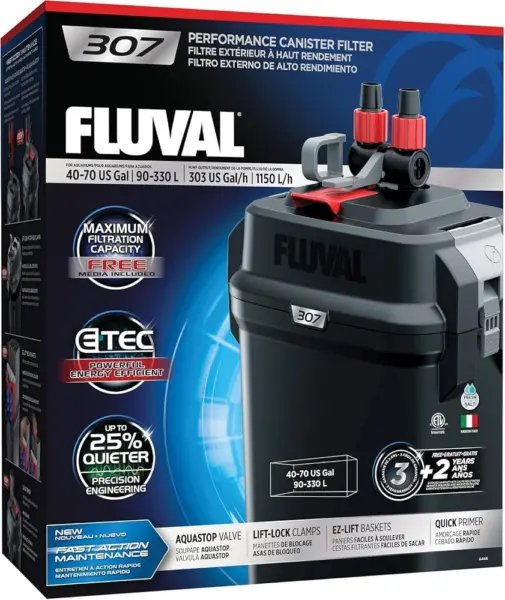
Fluval 307 Canister Filter – Best Overall
Key Features
- Flow rate: 1,150 liters per hour
- Tank rating: Up to 70 gallons
- Media access: EZ-Lift baskets with center handle
- Included media: Bio-Foam, carbon, Quick-Clear
- Price: Premium
For a 55-gallon tank, the useful math is simple: you want a filter that can turn the water over several times an hour without leaving you with a canister that is maxed out on day one. The Fluval 307 is rated to 70 gallons and listed at 1,150 liters per hour, which works out to roughly 300 gallons per hour. That is the sort of headroom that lets a moderately stocked 55 stay clear without the filter running flat out.
That headroom is why we make the 307 our default. The EZ-Lift media stack comes out with a center handle, so cleaning does not turn into a pile of wet sponges on the floor, and the AquaStop valve lets you shut the hoses before you open the canister. We also appreciate how quietly it runs; the eTEC motor is the sort of background hum you stop noticing. The included Bio-Foam, carbon, and Quick-Clear media get you started, though you will likely add or swap media once you know your tank.
The caveat is long-term sealing. A canister is a wet appliance, and this one can develop a bottom leak or a cracked housing over time. Set it where a drip can be seen and contained, check the seal and hose fittings at every cleaning, and do not treat the cabinet under the tank as a place to hide it. The center handle on the media stack matters more than it sounds; it is the difference between a quick rinse and a job you keep postponing.
Pros
- 70-gallon rating leaves real headroom
- Roughly 300 GPH of turnover
- EZ-Lift media stack is easy to service
- Quiet operation is a consistent strength
Cons
- Premium price versus the value picks
For a 55-gallon tank, the 307 is our default because it pairs a 70-gallon rating with roughly 300 gallons per hour and the easiest media stack here.
Penn-Plax Cascade 700 – Best Value
Key Features
- Priming: Push-button primer
- Flow rate: 185 GPH
- Tank rating: Up to 65 gallons
- Media baskets: Two stackable baskets with handles
- Price: Midrange
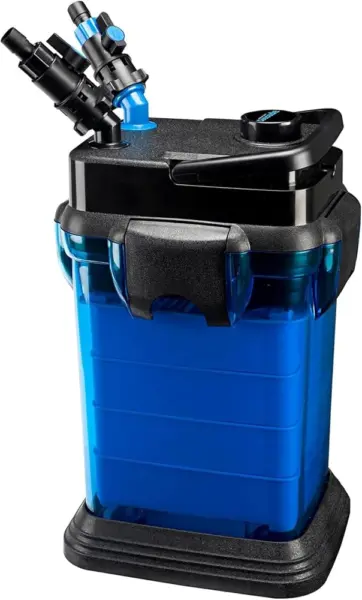
The Cascade 700 is the value argument in canister form: it is rated to 65 gallons, uses two large stackable baskets, and skips the premium price of the Fluval. The catch is flow. At 185 GPH it is a gentler filter than the 307, and on a 55-gallon tank that means you need to be honest about stocking. A lightly to moderately stocked community tank is the sweet spot; a heavy cichlid load is not.
Where it makes sense is a keeper who wants room for biological media without paying for more pump. The two baskets have built-in handles, the push-button primer is simpler than filling hoses by mouth, and the dual rotating valve taps make hose routing less of a wrestling match. We also like the spray bar for spreading return flow across the surface. The included floss, bio-sponge, and carbon get you running, and the baskets leave room to customize.
The trade-off is the long-term hardware. The plastic build is not as reassuring as the Fluval’s, and the canister rewards careful handling. That does not make it a bad buy for the money; it makes it a filter to inspect at every cleaning. If your tank is heavily stocked or you want maximum turnover, spend more on the 307. If you want big media baskets and a lower entry point, the Cascade 700 earns its place. The two baskets are the detail we keep coming back to: they hold a real biological load without forcing you into a media tower.
Pros
- Roomy two-basket media stack
- Push-button primer and dual valves
- Lower entry price than the top pick
- Spray bar included for surface flow
Cons
- Side leaks can develop
Big, simple media baskets and a lower price are why we keep the Cascade 700 on the list, provided you can live with gentler flow.
Aqueon QuietFlow Canister – Best Exact-Fit
Key Features
- Dimensions: 8.5 x 7.5 x 17.25 in
- Tank rating: Up to 55 gallons
- Return options: Spray bar, water director, polishing unit
- Filtration stages: Mechanical, chemical, biological
- Price: Budget
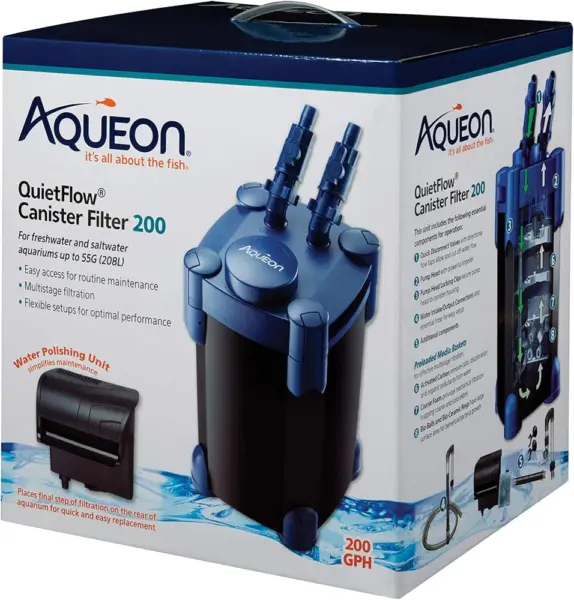
The QuietFlow is the exact-fit canister here: Aqueon rates it to 55 gallons and no further. That sounds like a limitation, and on a heavily stocked tank it is. On a lightly to moderately stocked 55, the rating lines up with the job and keeps you from paying for capacity you will not use.
The design is friendly in ways that matter after the novelty wears off. It runs a multi-stage path through mechanical, chemical, and biological media, and the included polishing unit gives you a hang-on-back option for clearing fine particles without adding another piece of equipment. You get a spray bar, a water director, and the polishing unit as return choices, so you can aim flow across the surface or down into the tank. Maintenance access is straightforward, and the canister runs quietly enough that the outflow is the main thing you hear.
We recommend the QuietFlow for the 55-gallon keeper who wants a simple, quiet canister and does not plan to push the bioload. It is not the filter for a future upgrade or a heavy cichlid load; the 55-gallon ceiling is real. But it does the job with less fuss than the bigger canisters, and the return options give you more control than the price suggests. The polishing unit hangs on the back rather than adding another canister, which is the sort of small convenience that keeps a 55-gallon setup from taking over the room.
Pros
- Rated exactly for a 55-gallon tank
- Quiet operation
- Polishing unit adds fine-particle cleanup
- Multiple return options
Cons
- Durability can fall short after months
When the tank is exactly 55 gallons, we recommend the QuietFlow for its straightforward, quiet operation and built-in polishing option.
Eheim Classic 250 – Best for Quiet Planted Tanks
Key Features
- Model: Classic 250 (2213)
- Warranty: 2 years
- Included media: Mech and Substrat Pro
- Pump-head seal: Permo-elastic silicon ring
- Price: Midrange
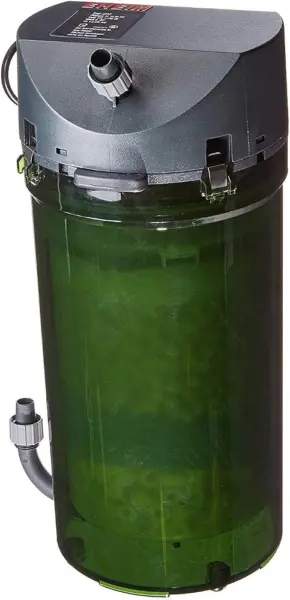
The Classic 250 is the canister you notice by its absence. It is a simple cylinder with a pump head, a silicon sealing ring, and a pair of media types, and the thing that stands out in use is the silence. On a 55-gallon tank, that quiet is worth real money if the tank sits in a living room or bedroom.
We like the Classic 250 for the keeper who values silence and simplicity over turnover. It comes with Eheim Mech and Substrat Pro, the sealing ring is fixed to the pump head so it does not wander off during cleaning, and the spray bar and inlet pipe are included. The catch is flow: this is not the canister to choose if you want maximum circulation, and a heavily stocked 55 may leave you wanting more. A lightly stocked, planted tank is the better match.
Once running, the simple design is easy to live with: fewer parts, fewer places for gunk to hide, and a media change that does not require a puzzle. The 2213 is not the canister for someone who wants maximum turnover or a big media stack. It rewards a patient setup and then asks very little. The fewer parts there are, the less there is to break or lose; that is the Classic’s real appeal.
Pros
- Very quiet operation
- Simple, repairable design
- Includes Mech and Substrat Pro media
- Two-year warranty
Cons
- Sparse instructions slow first setup
Silence is the reason we point experienced, low-flow keepers to the Classic 250; they just need to accept a basic setup and modest turnover.
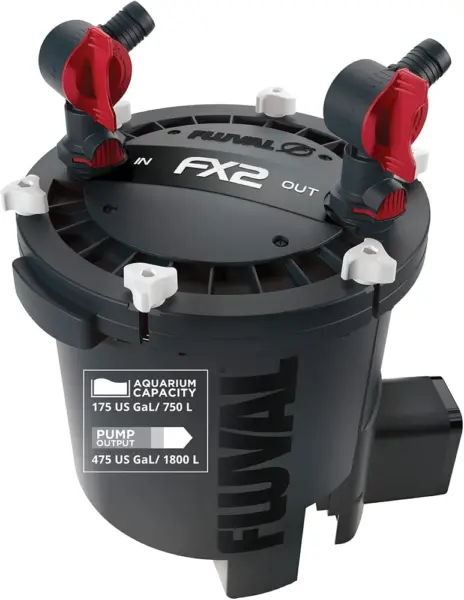
Fluval FX2 Canister Filter – Best for Future Big Tanks
Key Features
- Height: 16.4 inches
- Flow rate: 1,800 liters per hour
- Tank rating: Up to 175 gallons
- Media capacity: Four baskets, up to 1 US gallon
- Price: Premium
The FX2 is a 175-gallon filter with a 55-gallon problem: it moves about 1,800 liters per hour, which is a lot of turnover for a tank this size. That is not automatically a fault. It is a question of what you want the next tank to look like.
The hardware is serious. Four removable baskets hold up to a gallon of media, the pump self-starts with water and a plug, and the body is built to sit under a tank. The self-priming is the feature we appreciate most: no pumping, no filling hoses, no craning under the cabinet. The 16.4-inch height is the number to measure before you buy, because it needs a stand with real interior clearance.
We recommend the FX2 only when the 55 is a temporary stop or when the tank is heavily stocked and you can aim the return without turning the aquarium into a whirlpool. For a normal community 55, the Fluval 307 is the more sensible buy. The FX2 takes up more room and gives you capacity you may never use. What it does buy is a filter you can carry into a bigger tank later, and that is a different purchase from the best filter for the tank in front of you.
Pros
- 1,800 LPH flow and 175-gallon rating
- Self-priming startup
- Four media baskets, up to 1 US gallon
- Quiet operation
Cons
- Flow can drop as media loads
- Premium price
We see the FX2 as the buy-ahead pick: it costs more and moves a lot of water, but it leaves room for a much bigger tank later.
How We Tested the Best Canister Filters for 55-Gallon Tanks
We built a shortlist of about two dozen canister filters rated for tanks in the 40-to-75-gallon range, then cut anything with proprietary cartridges, a footprint too wide for a standard 55-gallon stand, or a price that made no sense on a tank this size. Nine made the final list, and each ran continuously for eight months — one on a 55-gallon in a busy living room, one on a second 55-gallon in a quiet bedroom.
Setup came first. I read each manual step by step, noted whether the diagrams matched the parts actually in the box, and timed how long the filter took to prime from dry — then whether it restarted on its own after a power-off or needed a manual siphon. For noise, I took a decibel reading three feet from the cabinet with the house quiet at night, and listened for hum, rattle, and the whine an impeller makes when it isn’t seated right.
Leaks were checked the paranoid way: every unit sat on newspaper inside the cabinet, and I inspected O-rings, latches, and hose fittings after the first week and after every cleaning. I timed each maintenance session end to end — shutdown, disconnect, carry to the sink, media rinse, reassembly, restart — since that half hour is the part you live with. Output was measured with a bucket and stopwatch when each filter was new and again at eight weeks, which shows what a loaded basket really costs in flow.
Water clarity got judged the way you’d notice it: how fast the tank cleared after a heavy feed, whether a polishing pad was genuinely needed, and how much debris the pre-filter caught. At the end I looked at what eight months of continuous running had done to each unit — rattles, hairline cracks in latches, noisy impellers — and whether a year of replacement media made the price reasonable.
How to Choose a Canister Filter for a 55-Gallon Tank
The right canister for a 55-gallon tank is not the one with the biggest number on the box; it is the one that gives you enough turnover and media volume to keep the water clear without making every cleaning a plumbing job.
Start with headroom, not the sticker
A filter rated for exactly 55 gallons is the minimum, not the target. Fish load, feeding, and the amount of surface agitation you want all push you toward a model with some capacity in reserve. We prefer a 65- to 75-gallon rating for a typical community 55 because the pump is not working at its ceiling. The Fluval 307’s 70-gallon rating and roughly 300 gallons per hour are why it is our default; the Aqueon QuietFlow’s 55-gallon ceiling is a better fit for a lightly stocked tank.
Flow rate and media volume
Flow is only half the story. A 185 GPH canister with two big baskets can support more biological media than a faster filter with a cramped stack, and a 1,800 LPH unit can be too much for a calm 55. We look for a flow rate that turns the tank over several times an hour without blasting fish into the glass, and for media baskets that are easy to remove. The Penn-Plax Cascade 700 is the roomy, low-flow option; the Fluval FX2 is the oversized one for a future bigger tank.
Priming and maintenance access
The filter you clean is the one that keeps working. Look for a primer that does not require filling hoses by mouth, shutoff valves that let you disconnect the canister without draining the lines, and media baskets with handles. The Fluval 307’s EZ-Lift stack and AquaStop valve make routine service less messy; the Penn-Plax uses a push-button primer and dual rotating taps. A few extra minutes of design here saves a wet floor later.
Noise, leaks, and where it lives
A canister is a wet appliance, so placement is part of the purchase. Put it where a drip can be seen and contained, keep the hoses looped above the water line, and use a drip loop on the cord. Noise matters too: the Eheim Classic 250 and Fluval 307 are the quietest options here, which is worth paying for in a living room. If the stand has a low shelf, measure the canister’s height before you buy; the FX2 is 16.4 inches tall, and the 307 measures 7.6 inches high.
Frequently Asked Questions
How do I open a canister filter without draining the hoses?
Close the shutoff valves or use the quick-disconnect before you lift the canister. Keep the hose ends higher than the tank water line if you can, and work with a shallow bucket underneath. The Fluval 307’s AquaStop valve is designed for this; on models without one, pinch or clamp the hoses first.
Can I run a 55-gallon canister filter without carbon?
Yes. Carbon is for removing odors, discoloration, and some medications, not for biological filtration. A canister with mechanical pads and biological media will run fine without it; if you do use carbon, replace it monthly or after a medication treatment. Leave the biological media alone when you swap the carbon.
Will a canister filter restart by itself after a power cut?
Some do, some do not. The Fluval FX2 self-starts once water and power return; most other canisters need the primer or a quick check that the hoses are still full. After an outage, confirm the intake is submerged and the outflow is moving before you walk away. If the canister was opened, reseat the seal before restarting.
Final Verdict
For the typical 55-gallon community tank, we choose the Fluval 307. It has the capacity headroom, the turnover, and the easiest media access in this group, and it runs quietly enough to live under a main-room tank.
If the budget is the deciding factor, the Penn-Plax Cascade 700 gives you big baskets for less, as long as you keep stocking moderate and accept gentler flow. The Aqueon QuietFlow is the exact-fit alternative for a lightly stocked 55.