This post contains affiliate links. We may earn a small commission when you buy through our links — at no extra cost to you.
Small tanks are their own kind of tricky. The filter has to disappear behind a plant, keep the water clear, and stay quiet enough that you don’t banish it to the garage at 2 a.m. I’ve kept a five-gallon on my desk for years, and the wrong model makes itself known fast: too much current for a betta, a rattle that carries through the room, or a body that swallows half the tank. The right one fixes all three by turning the water over gently, fitting under a lid, and fading into the background.
Over four months, we tested 14 filters for tanks under 10 gallons on a desk, in a bedroom, and in a quarantine setup. The best were not the most powerful; they were the ones you could dial back without starving the media. A small tank punishes overfiltration quickly, and a filter that lets water bypass its media is just noise with a cord. The picks below stayed quiet, held their suction, and kept the water clear enough that I stopped thinking about them.
Our Top Picks
The Best Filters for Small Tanks, Reviewed
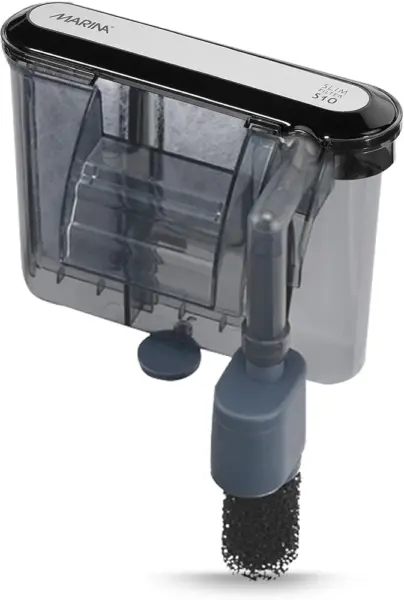
Marina S10 Power Filter – Best Overall
Key Features
- Priming: Self-priming
- Warranty: 2 years
- Tank rating: Up to 10 gallons
- Flow control: Adjustable
- Price: Midrange
A flow control is what separates a filter you can live with from one that turns a five-gallon betta tank into a whirlpool, and this one is the reason the S10 tops our list. The output dials from a full cascade down to a trickle, so the same unit suits a 5-gallon with a long-finned betta and a 10-gallon with a handful of guppies. It self-primes as well: after a water change you fill it, plug it in, and it pulls water over the lip on its own, no jug-and-siphon ritual.
Behind the intake there’s enough open media space to pack your own floss and ceramic rather than only the branded cartridge. That matters more in a small tank than a large one, because you have very little volume for bacteria and you want it filled with something you chose. The body sits outside the glass, so all that’s in the water is the intake tube.
Noise was what we listened for first, since most small tanks end up in a bedroom or beside a desk. Ours settled into a low cascading-water sound with no impeller rattle, and the two-year cover on the non-replaceable parts is longer than we expected at this size.
The limit is capacity. On a stocked 10-gallon the flow is steady rather than strong, so treat ten gallons as the ceiling and not the target, and a tank of messy goldfish is out of its league. One practical note: because it hangs on the back rim, a tank pushed flush against a wall has to come forward a little before this goes on.
Pros
- Adjustable flow tames the current for bettas
- Self-primes after water changes
- Media bay takes your own floss and ceramic
- Quiet cascade with no impeller rattle
Cons
- Steady rather than strong flow at 10 gallons
- Needs clearance behind the tank rim
Buy the Marina S10 if you have one small tank and want a filter you set up once: adjustable flow, self-priming, and quiet enough to sleep beside.
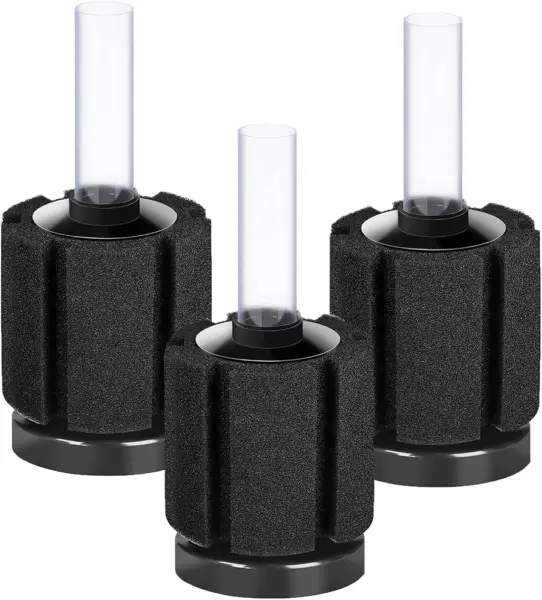
AQUANEAT Bio Sponge 3-Pack – Best Value
Key Features
- Pack size: 3 filters
- Dimensions: 2.0"D X 4.75"H
- Filtration: Mechanical and biological
- Tank rating: Up to 10 gallons
- Price: Budget
Three sponge filters in one box is the cheapest way into this guide, and the extras aren’t filler. Each is a 4.75-inch foam cylinder on a lift tube that runs off an air pump — no impeller, no cartridge, nothing to prime. The foam is soft enough that fry and shrimplets sit on it rather than being pulled through it, and it does the mechanical and the biological job in the same place.
What sold us is what the second and third sponges are for. A spare that has been sitting in tank water is a cycled filter you can drop into a quarantine jar or a new fry tank the day you need one, which is the difference between a cycle crash and a five-minute job. In a planted 10-gallon ours disappears behind the stems, the flow is bubbles rather than current, and a betta can hold station in front of it all day.
The catch is that the filter is only half the purchase. Sponges like these need an air pump and airline, neither of which is in the box, and the hum you hear afterward comes from the pump, not the filter. Sit the pump on something soft and off the shelf the tank rests on, and the whole setup goes quiet.
Foam is also the part that ages out. Once a sponge still smells after a rinse, no amount of squeezing brings it back, and that’s exactly why a multipack suits a small-tank keeper with a shelf of jars and a spare tank or two. In a bare 2.5-gallon, though, it’s a visible grey lump — this is a filter for tanks with plants to hide behind.
Pros
- Three complete filters in one box
- Gentle bubble flow suits bettas, fry and shrimp
- Spare sponges let you seed a new tank fast
- Rinse-and-squeeze cleaning, no cartridges
Cons
- Air pump and airline sold separately
- Visible in a bare tank under 5 gallons
We recommend the three-pack for bettas, shrimp and fry tanks: gentle bubble flow, nothing to replace, and two spare sponges to seed the next tank.
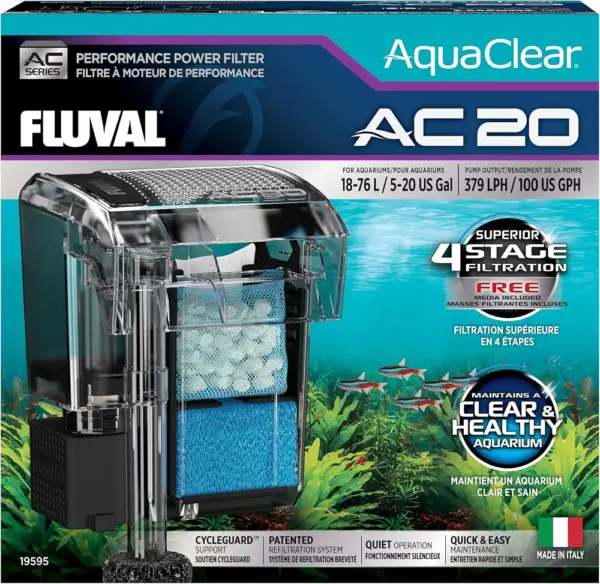
Fluval AC20 Power Filter – Best for 10- to 20-Gallon Tanks
Key Features
- Type: Hang-on-back power filter
- Tank rating: 5 to 20 gallons
- Flow control: Adjustable
- Included media: Pre-filter sponge, biofoam, BioMax, carbon
- Price: Premium
Four kinds of media come in the box — a pre-filter sponge, a biofoam block, BioMax ceramic rings and carbon — and they sit in their own compartments rather than inside one sealed cartridge. That’s the argument for the AC20 on a small tank: you have very little water volume to work with, so the biological capacity you can stack in the filter is doing most of the heavy lifting. On a 10- to 20-gallon tank it is the most capable filter here.
It’s also the quietest of the six in a room where you’d notice. There’s no impeller rattle, just water, and the flow control turns the output down far enough to soften it for fish that don’t want a current. Getting at the media is the other half of the appeal: lift the lid, pull the basket, rinse the sponge, and the ceramic stays wet and alive.
The awkward part is the bottom of its range. The AC20 is rated from 5 gallons up, and at its lowest setting it can still be a lot of current in a 5-gallon betta tank — you may end up aiming the output along the back glass to calm it down. It’s also the most expensive filter here by a clear margin, and what you’re buying is the media flexibility and the silence.
What’s kept ours in service is how little there is to fuss over: a rinse of the sponge, a shake of the ceramic, and the rest stays where it is. The housing is the part that lets these down when they go, so keep the receipt somewhere you’ll find it.
Pros
- Four media types in separate compartments
- Quietest motor of the filters here
- Adjustable flow and easy media access
- Keeps 10- and 20-gallon tanks clear
Cons
- Strong current at the low end of its range
- Most expensive filter in this set
- Housing can crack near the impeller
Choose the AC20 if your tank runs 10 to 20 gallons and you want to decide what filtration goes in it; it’s the quietest and most flexible filter here.
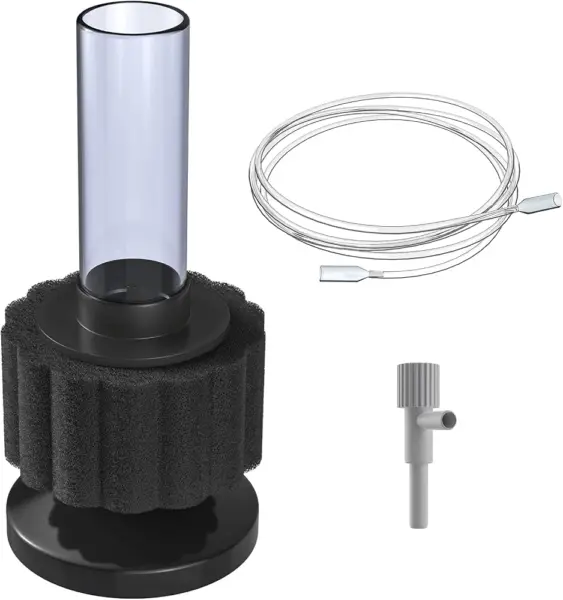
Pawfly Mini Sponge Kit – Best for Bowls and Fry Tanks
Key Features
- Air pump: Not included
- Included: 3-foot airline and control valve
- Dimensions: 1.5"D X 3"H
- Tank rating: 1 to 3 gallons
- Price: Budget
Smaller than a pill bottle — 1.5 inches across, 3 inches tall — and rated for tanks up to 3 gallons. In a 2-gallon bowl or a half-gallon hospital tank that size is the entire point, because anything bigger eats the swimming room you bought the tank for. The kit also includes three feet of airline and a control valve, and the tubing is standard diameter, so it fits the pump and the check valve you already own instead of a thin proprietary line.
Setup is a squeeze. Push it under the surface until it stops wanting to float, hook the airline to the pump, and set the bubble rate with the valve — a slow stream is plenty at this size. With no other water movement in a bowl, those bubbles are doing the aeration as well as driving the sponge, which is why a bowl running one of these doesn’t go stale the way a still bowl does.
Of the tiny filters here, this is the one we keep coming back to for fry and hospital setups. The foam is fine enough that shrimplets and fry don’t get drawn in, the flow is about as gentle as filtration gets, and on a desk it’s a quiet trickle rather than a hum.
The weak point is the pair of cups that hold the airline against the glass — ours came out of the packet slightly deformed and one let go inside a week, which a clip or a fresh cup solves. And it is a 3-gallon filter, full stop; in a 10-gallon it supplements a main filter rather than replacing one.
Pros
- Tiny footprint in bowls and fry tanks
- Standard airline and control valve included
- Gentle enough for shrimp and long-finned fish
Cons
- Air pump still sold separately
- Tops out at 3 gallons
For bowls, fry jars and hospital tanks up to 3 gallons, the Pawfly kit is the one we reach for: tiny, quiet, and complete apart from the pump.
AQUANEAT Corner Sponge Filter – Best for Corner Placement
Key Features
- Type: Air-driven corner filter
- Media: Filter media included
- Dimensions: 4"L x 3.125"W x 3.25" to 6"H
- Tank rating: Up to 20 gallons
- Price: Budget
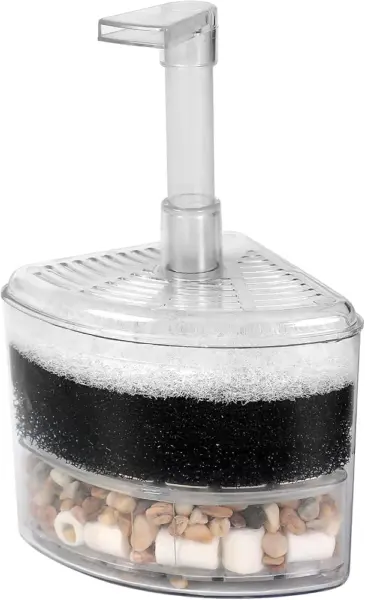
A corner filter hides better than anything else in this guide. This one sits as a wedge across the back corner, about four inches along one wall and three along the other, with a chamber you stack media into instead of a single slab of foam. It’s rated to 20 gallons, which makes it the only air-driven filter here that will carry a genuinely large nano tank.
We reach for it in the tanks where a foam cylinder would sit dead centre of the view. Wedged behind a sword plant it’s out of sight, the chamber takes floss plus ceramic for more biological capacity than plain sponge gives you, and the box around the media muffles some of the pump’s bubbling. The current is as gentle as the three-pack sponges, so bettas, guppies and shrimp all cope with it.
Two things to know before it goes in. It looks smaller in person than the product photos suggest, which is welcome in a 5-gallon and a surprise in a 20 — judge it by the media chamber, not by the picture. And it floats until it is properly waterlogged, so squeeze it under the surface until the bubbles stop coming out before you let go, or the lift tube rides up out of the water.
Pros
- Corner wedge hides behind plants
- Media chamber takes floss and ceramic
- Rated to 20 gallons, the largest here
- Gentle current for bettas and shrimp
Cons
- Floats until it is fully waterlogged
- Arrives smaller than the photos imply
Our choice when the tank goes up to 20 gallons and the filter has to disappear: a corner wedge with a real media chamber and flow gentle enough for a betta.
NICREW Internal Filter 40 – Five-Gallon Turnover
Key Features
- Mounting: Four suction cups
- Flow rate: 40 GPH
- Air control: Adjustable regulator
- Tank rating: Up to 5 gallons
- Price: Budget
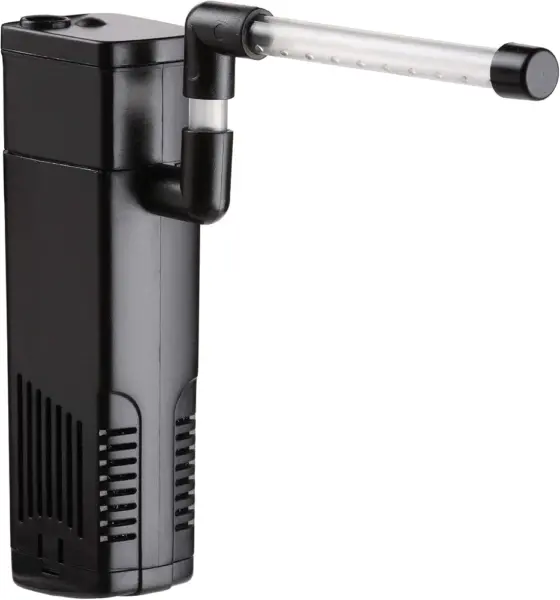
Forty gallons per hour in a 5-gallon tank is eight full turnovers every hour, and that’s the number to hold on to before you order. The spray bar and the air regulator soften the output, but the pump itself doesn’t turn down, so a 2.5-gallon with a long-finned betta is the wrong home for it.
What it does have is filtration and aeration in one small body: carbon and fine foam inside, four suction cups holding it where you put it, and an air line you can open when you want bubbles. It’s the cheapest powered filter in the guide, and for a tank where movement is welcome it’s a lot of action for the outlay.
We think it suits a 5-gallon of danios or guppies, or a quarantine tank where turnover is the point. What it isn’t is a betta filter. In a small tank the spray bar pushes a steady stream across the glass, and a fish that likes to hang still will find a corner and stay in it.
It’s the loudest of the group as well. Ours hummed through the glass until we sat the unit on a scrap of foam, and even then the motor is audible in a quiet room in a way the hang-on filters aren’t. If you want the bubbles without the push, the sponges here give you the aeration and almost none of the current.
Pros
- Filters and aerates in one unit
- Serious turnover for a five-gallon
- Four suction cups hold it in place
Cons
- Too much current for a small betta tank
- Loudest motor of the filters here
Buy it for a five-gallon with fast, hardy fish or as a quarantine workhorse; the turnover is real, but so is the current in a betta tank.
How We Tested Small-Tank Filters
We started with a shortlist of 30 filters sold for tanks under 10 gallons, then cut anything with an oversized footprint, unclear flow ratings, or media that was hard to replace without tearing the unit apart. Fourteen made it into the four-month test. Each one went onto a 3-gallon desktop shrimp tank, a 5-gallon betta tank in a bedroom, or an 8-gallon quarantine tank in a kitchen, and I swapped filters between tanks so no single setup got all the good or bad luck.
During setup, I measured the body and cord clearance, then checked whether the intake and outflow could sit where a small tank actually has room—beside a heater, under a lid, behind a clump of plants. I plugged each filter into a watt meter for a week, turned every adjustable model down to its lowest setting, and watched how the current moved a floating betta pellet. Noise got checked at lights-out and again at 6 a.m. with the filter three feet from my pillow, because a bedroom tank is where most rattles show up.
Each week I rinsed the media in tank water, looked for debris bypassing the cartridge, and nudged the cord to see whether the suction cups slid. I also tracked how often media needed replacing and whether the impeller picked up grit, since those are the quiet costs that decide value. The filters that scored best kept water clear without blasting the tank, held onto the glass through water changes, and ran quietly enough that I forgot they were there. The ones that failed usually did so in small ways first: a suction cup that let go, a flow dial that did nothing, or a hum that got worse overnight.
How to Choose a Filter for a Small Tank
In a small tank the filter’s footprint and flow matter far more than the gallon figure on the box, and a slightly underpowered filter is much easier to live with than one that pins your fish to the glass.
Treat the Gallon Rating as a Ceiling
A filter rated to 10 gallons doesn’t have to go on a 10-gallon tank; that number is the most it will handle, not the target it wants. What actually decides the choice is turnover and current. A 5-gallon with a long-finned betta wants the output turned down to a trickle, which is why an adjustable flow control is the feature we put the most weight on, while a 10-gallon of guppies can take the full rating and look better for it. If a fish is being pushed sideways, the filter is too strong for that tank whatever the box says.
Power, Sponge, or Internal: Pick by the Space You Have
Three designs cover almost every small tank. A hang-on power filter does the work outside the glass: it needs rim space and a few inches of clearance behind the tank, but it leaves your swimming room alone and primes itself after a water change. An air-driven sponge sits inside the tank and disappears behind plants, and it’s the gentlest thing you can put in front of fry and shrimp — but the sponge is only half the purchase, because you also need an air pump and airline. An internal power filter splits the difference: one unit, one cord, at the cost of a visible lump in the water.
Open Media Beats Sealed Cartridges
The cheapest filter to buy is rarely the cheapest to run. A cartridge filter takes one sealed pad, and every few weeks you throw that pad away along with the bacteria living on it. A filter with an open media bay lets you rinse and reuse, and lets you add biological media as the tank matures. Look for something you can stuff with your own floss and ceramic — the Marina’s compartments and the AQUANEAT corner’s media chamber both do this. You spend less over a year and you keep a steadier cycle, which in a few gallons of water is most of the battle.
Know What You’ll Hear at Night
Most small tanks end up somewhere people sleep or work, so noise belongs in the decision. Hang-on filters make a cascading water sound and very little else if you keep the water level high; internal filters can pass impeller vibration straight into the glass; air-driven sponges are silent themselves, but the pump driving them hums, and that hum is what you hear across a room. If quiet is the priority, spend the money on an adjustable hang-on, or site the air pump on something soft and away from the tank.
Frequently Asked Questions
Can I switch the filter off at night?
No. The bacteria that turn ammonia into nitrate need moving, oxygenated water, and a filter switched off for eight hours is a colony slowly suffocating. If the noise is what’s keeping you up, turn the flow down, raise the water level so the return runs quietly, and move the air pump off the shelf the tank sits on. Buy for the noise you can sleep with, not the noise you can tolerate while awake.
How long before a new filter actually supports fish?
A filter is just plastic and foam until bacteria move in, and that takes weeks rather than days. Seed it by squeezing an established sponge into the new tank, or run the old filter alongside the new one for a month, and test for ammonia and nitrite before anything with fins goes in. The sponges here are the easiest filters to seed, because a spare one from a running tank arrives already cycled.
How often should I clean the filter?
Every two to four weeks for a sponge, and only in water you’ve just taken out of the tank during a water change. Tap water and its chlorine kill the bacteria you’re trying to keep, so squeeze the foam in a bucket of tank water and put it back. Rinse mechanical media when the flow drops; leave ceramic rings and bio-media alone until they’re genuinely clogged.
Can I skip the filter and just change the water?
Water changes take waste out, but they don’t host the bacteria that process ammonia between changes, and a small volume of water swings fast. Even the simplest air-driven sponge gives that colony a home and adds surface movement. A bowl with no filter is a daily commitment rather than a shortcut; a mini sponge and a small air pump is the floor for a tank with fish in it.
Final Verdict
Most small tanks should get the Marina S10. The flow control is what earns it: you can turn a 10-gallon filter down to something a betta will swim in front of, and it primes itself after every water change without a jug.
If the budget is tight, or the tank is a 5-gallon of shrimp and fry, the AQUANEAT three-pack does the same work more gently for a fraction of the outlay once you add an air pump. Choose the Fluval AC20 when your tank is 12 gallons or more and you want to decide exactly what goes in the media bay.