This post contains affiliate links. We may earn a small commission when you buy through our links — at no extra cost to you.
Corals don’t care how sleek a light looks. They care about getting the right intensity and spectrum for the right number of hours, and a fixture that quits or drifts off schedule can undo months of growth. A good reef light delivers bright, even output you can adjust, then runs reliably.
After eight months with seven fixtures across my mixed reef and a couple of local tanks, the pattern is clear: brightness is easy to claim and harder to live with. The lights that earned a spot were adjustable enough to dial in spectrum and spread, programmable enough to set a timer and walk away, and reliable enough that I stopped checking the app. Mounting mattered, too—a clumsy bracket is a daily annoyance, and a remote or timer that fights you is worse—while build quality and value came down to what was in the box, not just the sticker. The picks below cover different tanks and budgets, but they all got the basics right.
Our Top Picks
The Best Lights for Saltwater Aquariums, Reviewed
SMATFARM G5 95W – Best Overall
Key Features
- Power: 95 watts
- Mounting: Aluminum bracket
- Beam angle: 120 degrees
- Color temperature: 14000 K
- Price: Premium
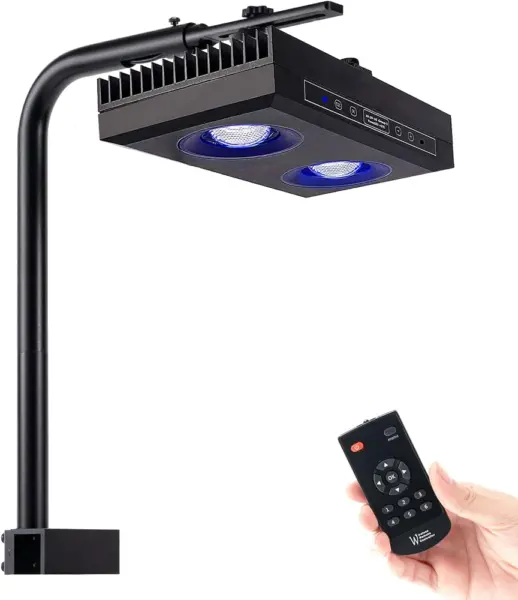
What put the SMATFARM G5 on top is a pair of unglamorous things: it comes with a bracket, and it runs its own schedule. The fixture fades up from a blue-heavy dawn to full output, holds through the middle of the day, then drops through sunset into a moonlight setting you can leave running. Set it once with the touch panel or the remote and the tank has a day cycle without you touching a switch. That is the difference between a light you own and a light you operate.
The output is better than the 95-watt rating suggests. At 14000 K through a 120-degree lens it colored up a mixed tank for us — fish blues first, then the fluorescence in the softies — and the fans stayed under their 44.7 dB rating, disappearing beneath the sound of a return pump. What SMATFARM does not publish is a PAR figure or a recommended footprint, so treat the first two weeks as the test: start low and watch how the corals at the bottom of the tank respond before you turn anything up.
The bracket is the part we argue about. It is a single aluminum arm with an offset base, and at full extension with the fixture out over the water it can sag; on a narrow tank you may not get it centered at all. If you need the light over the middle of a wide tank, plan to hang it instead. On a two- or three-foot tank the arm does the job as delivered, and needing no ceiling hooks means you can be running the same afternoon.
Programming takes an evening. Six schedule points, each with its own intensity, navigated with two buttons and no screen — we got there, but not on the first pass. The payoff beyond the schedule is joint control: set a second G5 as part of the same group and one controller runs both, which is how a four-foot tank gets one sunrise instead of two.
Pros
- Sunrise-to-moonlight schedule runs itself
- Bracket mount means no ceiling work
- Quiet fan cooling under 44.7 dB
- Group control links multiple fixtures
Cons
- Menu tree takes an evening to learn
This is the light we tell most reef keepers to buy first: a schedule that runs itself, a bracket that means no ceiling hooks, and enough output for a mixed tank.
VIPARSPECTRA V165 – Best for Deep Tanks
Key Features
- LEDs: 55
- Dimming: Two channels, 0-100%
- Coverage: 24 x 24 in per unit
- Dimensions: 16 x 8.5 x 2.4 in
- Price: Midrange
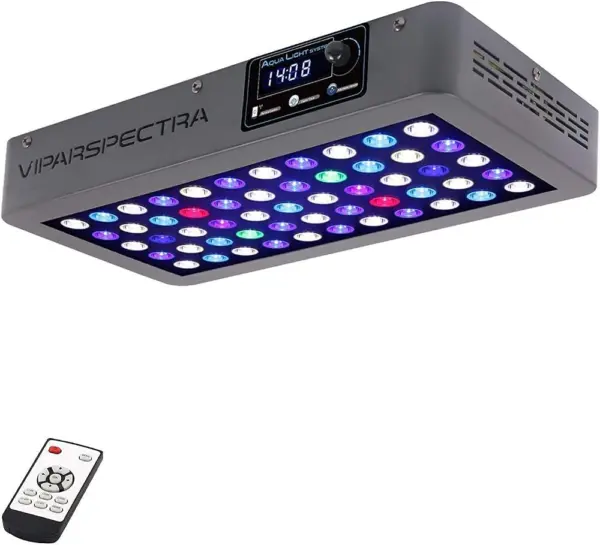
Coverage is the reason to buy this one. Each V165 throws a 24-by-24-inch footprint, so a four-foot tank gets a module over each half instead of one fixture stretched thin across the middle, and a two-foot-deep tank gets enough punch that SPS on the rockwork is a realistic proposition rather than a hopeful one. Fifty-five LEDs across a 16-inch body, and it is a genuinely bright light: start the dimmers low and bring them up over a couple of weeks.
We like it most for tanks where you were going to hang a light anyway. There is no bracket in the box — two hanging kits, a 6-foot cord and 7.6 pounds of fixture — so a ceiling hook or a wall arm is part of the plan, and something that heavy deserves a fixing that is actually in a stud. Once it is up, the two channels dim independently from 0 to 100 percent, which is all the control a soft coral and LPS tank needs.
The internal timer is where it loses ground. Scheduling through the remote is a run of button presses with nothing on the fixture to confirm what you entered, and after a power blip it can come back out of step. An outlet timer on the cord fixes that, and the remote stays useful for brightness. The failure worth knowing before you buy is a blue channel that quits; the warranty covers a year, so keep the receipt and buy where returns are straightforward.
One more thing: this is the only fixture here that makes no water-resistance claim at all, so it belongs high, with a lid or canopy between it and the splash. That is a placement decision rather than a reason to walk away — the light itself does the one thing that matters, which is grow coral.
Pros
- 24 by 24 inches of coverage per unit
- Strong enough for SPS depth
- Hanging kits and 6-foot cord included
Cons
- No bracket included; hanging only
- Not rated for water resistance
Buy this one when the tank is deep or wide — 24 inches of coverage per unit and enough output to carry SPS toward the sandbed, provided you can hang it.
Fluval Sea Marine Nano – Best for Nano Tanks
Key Features
- Power: 20 watts
- Control: Bluetooth app
- Mounting: Over-the-glass clamp
- Beam angle: 120 degrees
- Price: Midrange
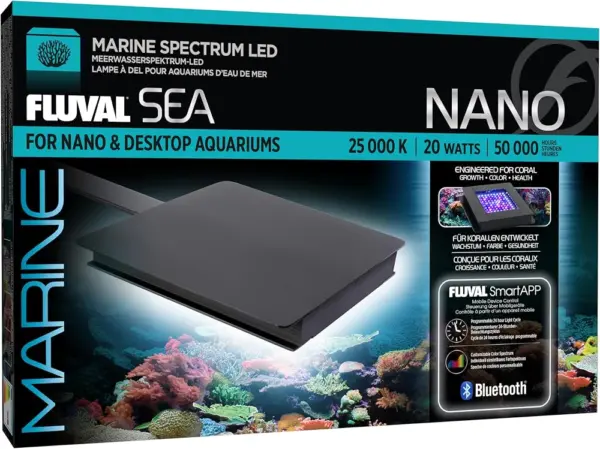
The Sea Marine Nano is a 20-watt bar about seven inches long that weighs a pound and a half. It is not trying to light a 75-gallon tank. It is trying to make a 10-gallon cube on a desk look like a slice of reef, and at that it has no competition in this group.
We like the mount as much as the light. The over-the-glass clamp slides up and down, side to side and front to back, so you can push the beam toward the front glass where the coral sits instead of leaving a hot spot at the back of the tank. The aluminum shell is fully encased, which is the thing that decides whether a small fixture survives a year over an open-top nano in a small room.
Programming runs through the Bluetooth app, and the app is the good part. Pick sunrise, midday, sunset and night once and the fixture handles the rest, with seven band waves and enough independent color control to run a blue-heavy evening without turning the room into a nightclub. We had a schedule running in a few minutes, and changing it later takes less.
Check your rim before you order. The clamp is happiest on rimless glass, and a thick or braced rim is the one thing that can stop the mount fitting at all. Everything else about it — the sealed shell, the aim, that 24-hour cycle — is exactly what a small tank wants.
Pros
- Full 24-hour cycle from a Bluetooth app
- Mount adjusts in three directions
- Sealed aluminum shell resists humidity
Cons
- 20 watts leaves SPS tanks short
For a rimless nano, nothing here is easier to live with: a sealed 20-watt bar, an app you learn in minutes, and a mount you can aim.
PopBloom RL60 – Best Value
Key Features
- Power: 65 watts
- Tank fit: 20-36 in long
- Beam angle: 110 degrees
- PAR at depth: >130 at 20 in, >100 at 24 in
- Price: Budget
Above 130 PAR at 20 inches of depth, above 100 at 24, through a 110-degree glass lens — PopBloom publishes the figures most fixtures in this group leave off the box. That matters more than wattage, because it tells you what the light does at the bottom of the tank rather than what it draws at the wall. For a beginner’s 36-inch LPS tank, that is the difference between a light that keeps corals alive and one that grows them.
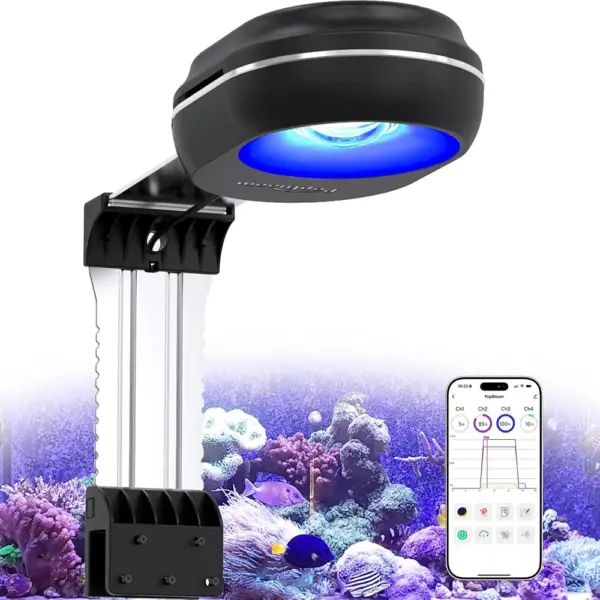
It is built around a 20- to 36-inch tank, 24 inches wide and deep, with arms that slide rearward so the fixture sits back over the water instead of in front of a rear filter chamber. That rearward slide is the detail we appreciate most on an all-in-one, where the back compartment eats the space a normal bracket needs.
Control is entirely in the app over Wi-Fi: presets for a 24-hour cycle, a lunar cycle and seasonal shifts, plus four channels you can dial yourself. We found the presets the fast route and the custom schedule the slower one — the app is capable but it does not hold your hand, and a walkthrough video saves an hour of tapping.
The fan runs continuously and you can hear it: a soft whir that disappears in a living room and might not suit a bedroom. Sixty-five watts in a body this small has to go somewhere. With a two-year warranty behind it, that is a trade we take at this end of the price range.
Pros
- PAR above 130 at 20 inches
- Two-year warranty
- App handles the full light cycle
Cons
- Arms are wide for narrow all-in-one tanks
We recommend it as a first reef light without qualification — published PAR, a two-year warranty, and an app that runs the whole schedule.
SMATFARM G6 140W – Best for Wide 4-Foot Tanks
Key Features
- Power: 140 watts
- Channels: Six
- Mounting: Bracket or hanging
- Dimensions: 13.9 x 5.7 x 1.7 in
- Price: Premium
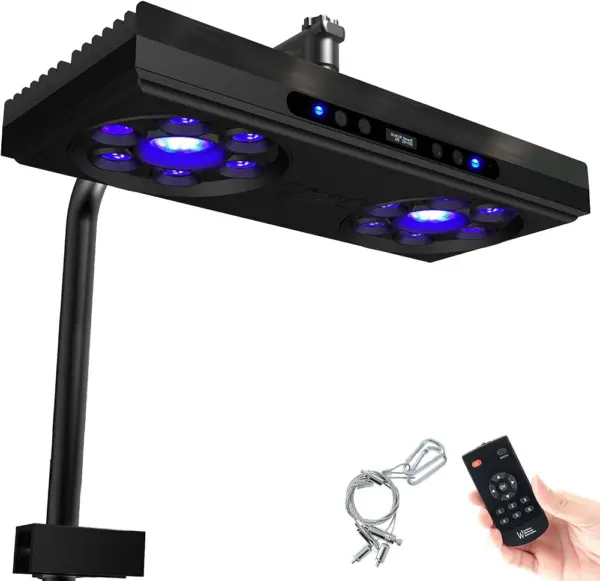
Stretch the G5’s control platform to nearly 14 inches, add four channels and 45 watts, and you have the G6. It is the widest single fixture in this group, and the only one that dims white, blue, violet, ultraviolet, green and red separately.
One hundred and forty watts across 52 LEDs, an aluminum heatsink with a fan SMATFARM calls silent, and a bracket rated for glass from 0.2 to 1.5 inches — or you can hang it. The feature that earns its money on a four-foot tank is master-slave group control: set one unit and both run the same schedule, no second controller involved.
Our reservation is straightforward. It is the most expensive fixture here, and for most tanks the G5 does the same work for less. The G6 earns the step up where coverage is the problem — two of them over four feet give an even footprint from end to end — and where you want violet and ultraviolet on their own sliders, which is the sort of control SPS keepers use and the rest of us mostly leave alone.
Two units set as master and slave are the tidiest answer in this group for a big mixed reef: one schedule, one remote, no matching of two apps by hand. Below that size, buy the smaller light.
Pros
- 140 watts across six channels
- Group control pairs two fixtures
- Widest single fixture in this group
Cons
- Most expensive fixture here
- Bracket tops out at 1.5-inch glass
Spend the most here only if you are lighting four feet: six channels and group control earn it, and anything smaller does not need it.
How We Tested Reef Lights
We started by narrowing a long list of reef fixtures to seven that covered the range of tank sizes and budgets, filtering first by spectrum and claimed output, then by whether the mounting hardware and app or remote controls suited real installations—rimmed tanks, canopies, and hanging kits. Over eight months, those seven lights ran on my 75-gallon mixed reef and two smaller local setups, with daily schedules set to mimic sunrise and sunset.
Each morning I checked that the timer had fired and the schedule hadn’t drifted; in the evening I adjusted intensity and spread over different coral placements, noting whether the app responded quickly or made me dig through menus. I also programmed each light from scratch without the manual, used the remote where one existed, and watched how easy it was to change spectrum, ramp time, and moonlight settings—that is where everyday functionality lived or died. For brightness, I compared visual spread and coral response at several depths rather than trusting the box.
Mounting got its own pass: I installed each fixture on a rimmed tank, under a canopy, and with a hanging kit where possible, looking for wobble, clearance, and whether the bracket blocked access to the tank. Reliability checks came weekly—fan noise, moisture near the housing, app dropouts, and whether settings survived a power blink. Value came down to included hardware, build quality, and how much fiddling a light demanded.
How to Choose a Saltwater Aquarium Light
Most lighting mistakes in a saltwater tank are fit mistakes: the fixture is fine, but its coverage, its mount or its schedule does not match the tank it went over.
Coverage and depth come before wattage
Watts describe what a fixture draws, not what reaches the sandbed — two 95-watt lights can behave completely differently depending on lens angle and how high they sit. What you can actually compare is footprint and depth. A module with a 24-by-24-inch footprint covers roughly two feet of tank length, so a four-foot tank wants two of them rather than one stretched fixture.
Depth cuts intensity as well. The PopBloom’s published figures fall from above 130 PAR at 20 inches to above 100 at 24, which is comfortable for LPS and marginal for SPS on the bottom. Measure your tank’s length and depth first, then decide how many units you need.
Choose the schedule before the spectrum
A reef light you switch on yourself will eventually be switched on at the wrong time. Decide how the fixture keeps time: an internal timer driven by a remote, a Bluetooth or Wi-Fi app, or nothing at all beyond a dimmer. The trap is the middle ground — a built-in timer that takes a sequence of button presses to change and can lose its settings after a power cut. If the fixture you want lands in that group, put it on an outlet timer and use its own controls only for brightness.
A sunrise and sunset ramp is worth having. It lets the tank wake gradually and gives you a dim blue window in the evening without running full output until bedtime.
Bracket, clamp or ceiling
Three mounts cover almost everything. A tank bracket rests on the rim and is the easiest to live with, but brackets are rated for a range of glass thicknesses — the SMATFARM fixtures list 0.2 to 1.5 inches — and an arm reaching far out over the water can sag under the fixture’s weight. An over-the-glass clamp, like the one on the Fluval, suits rimless nanos and slides to aim the beam.
A ceiling hang puts the light exactly where you want it and keeps heat off the water, at the cost of a drill, a stud and visible cable. Check your rim and any center brace before ordering: a braced tank rules out most clamps.
How many channels you actually need
Blue does most of the work in a reef tank. The 445 and 460 nm wavelengths drive photosynthesis and set off coral fluorescence, which is why a marine fixture is blue-heavy where a planted-tank light is white and red. Independent channel control lets you keep the blues where the coral wants them while dialing white up or down for viewing.
Two channels, white and blue, are plenty for soft corals and LPS. Six, as on the G6, split out violet and ultraviolet so SPS keepers can tune color and growth — and give everyone else a menu with more ways to get it wrong.
The second year: fans, heat and water
An LED fixture is a heatsink with a light bolted to it, and how it handles heat decides how long it lasts in a humid room. Fan cooling keeps the LEDs happier but adds a noise floor: the PopBloom’s fan is rated at 32 dB and runs continuously, and the SMATFARM G5 claims under 44.7 dB. Where a figure is published, compare it; where none is, expect to hear something in a quiet room.
Water is the other half. Some of these housings are sealed against humidity and the V165 makes no water-resistance claim at all, so it wants height and a lid between it and the splash. Wipe salt creep off the housing and lens monthly, and check the warranty before you mount anything: one year on the SMATFARM and VIPARSPECTRA fixtures, two on the PopBloom.
Frequently Asked Questions
How many hours a day should a saltwater aquarium light run?
Eight to ten hours of total light is the usual range for a reef tank, and a fish-only tank does fine at eight. The ramp counts: if the fixture spends an hour fading up and another fading down, that is part of the photoperiod, not extra on top.
Pick a window when you are actually home to see the tank, keep it fixed, and shorten the day by an hour before you change anything else if algae starts filming the glass.
Why did algae take off after I upgraded my light?
Almost always because the new fixture delivers more light than the old one did, and the algae respond faster than the corals. Run the new light low for the first week or two, then raise it in small steps while keeping the photoperiod short.
If nitrate and phosphate were already high, extra light simply makes them visible. Test both before you blame the fixture.
How high above the water should the fixture sit?
A bracket light sits where the arm puts it, a few inches over the rim, which is close enough that the housing needs wiping for salt creep. A hanging fixture is adjustable: raise it and the beam spreads wider and lands softer, lower it and the center of the tank gets brighter.
Use the corals as the gauge. Pale sandbed with healthy rock tops means lower it or add a second unit; a bleached middle means raise it.
Final Verdict
The SMATFARM G5 is the fixture we point most people to, and the reason is fit rather than raw power: a bracket that sits on the tank, a schedule that runs itself, and enough output for a mixed reef. If your tank is deep or unusually wide, the VIPARSPECTRA V165 covers more water per unit and hangs out of the way — plan on an outlet timer for it.
For a rimless 10-gallon cube, the Fluval Sea Marine Nano is the easiest thing here to live with. For a first 36-inch tank, the PopBloom RL60 asks the least and tells you the most about what it does at depth.