This post contains affiliate links. We may earn a small commission when you buy through our links — at no extra cost to you.
The last time my filter intake clogged, it was 9 p.m. on a Sunday, and the nearest shop that stocks replacement floss was closed until Tuesday. That’s the moment online aquarium shopping stops being a convenience and becomes the whole hobby — most of us now buy media, food, test kits, and even livestock from a screen. The catch is you can’t squeeze the plant, shake the bag of substrate, or check the date stamp on a bottle of food before you pay.
A good retailer solves most of that with accurate listings, honest stock counts, careful packing, and a return policy that doesn’t punish you when a plant arrives as mush. I’ve kept tanks for years and lost my share of shipped plants, and my team has spent eight months ordering from 12 online aquarium retailers to find the ones that hold up. Ordering livestock early in the week helps, but packing and a real live-arrival guarantee are what decide it — and the picks below reflect that, because no single retailer wins on everything.
Our Top Picks
The Best Place to Buy Aquarium Supplies Online, Reviewed
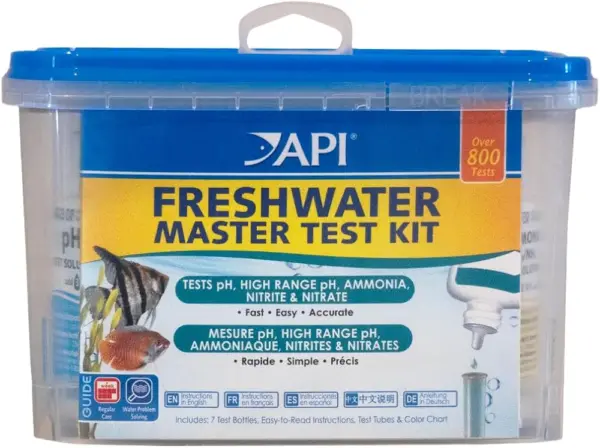
API Freshwater Master Test Kit – Best Overall
Key Features
- In the box: 7 solutions, color card, 4 tubes with caps
- Aquarium type: Freshwater
- Tests per kit: 800
- Parameters tested: pH, high range pH, ammonia, nitrite, nitrate
- Price: Premium
Ammonia and nitrite are colorless. A tank can look clean, the fish can be swimming normally, and both can be climbing toward a crash you will not see until it has already happened. That is the gap this kit fills, and the reason we put it first: five liquid tests, four tubes, and a color card that turn ‘the water looks fine’ into a number you can write down and compare next week.
You get 800 tests across pH, high range pH, ammonia, nitrite, and nitrate, which works out to roughly three years of weekly checks on a single tank. The booklet walks through each test in order and the tubes are marked, so nothing depends on a steady hand. One thing we learned the hard way: the nitrate test wants the second bottle shaken hard, not politely. A half-hearted shake gives you a low reading that means nothing at all.
The difference from a dip strip is resolution. A strip gives you a color to squint at; this gives you a number, which is what you need to tell whether a water change actually moved anything. In a new tank that is the difference between patience and panic, and in an established one it is how you catch a filter that is quietly losing ground.
Know the limits before you order. It is built for freshwater only, so a marine tank needs a different kit, and there is no general or carbonate hardness test here — planted and shrimp keepers usually add those separately.
Pros
- Five parameters from a single kit
- 800 tests, so years of weekly checks
- Booklet clear enough for a first tank
- Readings you can log and compare
Cons
- No GH or KH test included
We tell every freshwater keeper to buy this before anything else: it turns invisible water problems into numbers you can act on.
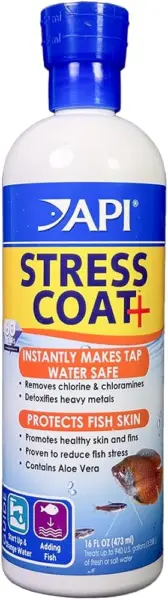
API Stress Coat 16 oz – Best Everyday Conditioner
Key Features
- Form: Liquid
- Use when: Water changes, new fish, injury
- Bottle size: 16 fl oz
- Key ingredient: Aloe vera extract
- Price: Budget
Every bucket of tap water that goes into a tank has to be made safe first, and this is the bottle we keep next to the bucket. Dose it for the volume you are replacing, give it a stir, and the chlorine and chloramine in municipal water are handled before the water ever reaches a fish.
What makes Stress Coat the one we reach for, rather than a plain dechlorinator, is the aloe vera. It is aimed at the fish rather than the water: netting, bagging, a move to a new tank, a nip from a tankmate, and the slime coat is what takes the damage. We use it on ordinary water-change days, and we make a point of it whenever a new fish goes in.
Sixteen ounces is the sensible size for a household with one or two tanks: big enough that you are not reordering every month, small enough to live under the stand next to the food. The liquid pours and measures easily, and there is nothing to assemble or rinse, which is exactly what you want at the end of a water change.
Pros
- Makes tap water safe at every change
- Aloe vera aimed at slime coat repair
- 16-ounce bottle suits a routine
- Pour, dose, done — nothing to assemble
Cons
- Won’t fix an existing ammonia or nitrite problem
If your water changes start at a tap, this is the conditioner we point people to: it makes new water safe and gives damaged fins a hand at the same time.
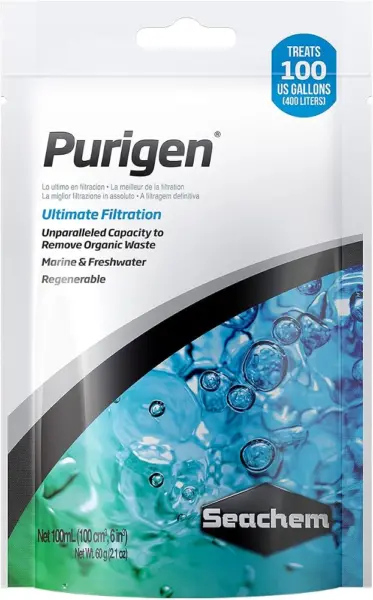
Seachem Purigen 100 ml – Best Water Polisher
Key Features
- Size: 100 ml
- Controls: Ammonia, nitrite, nitrate
- Media type: Synthetic polymer
- Rechargeable: Yes
- Price: Midrange
A tank can be perfectly healthy and still look like weak tea. Driftwood, almond leaves, and some substrates release tannins that tint the water brown, and no amount of water changing clears it for long.
Purigen is what we drop in the filter when the water is clean but the color is wrong. It is a synthetic polymer rather than a carbon pad, and it does two jobs at once: it pulls the yellow out of the water and takes ammonia, nitrite, and nitrate out of circulation. Rinse the beads before they go anywhere near the tank. They arrive dusty, and skipping the rinse trades brown water for cloudy water for a day.
In a canister filter with steady flow, the change on a tannin-stained tank is the most dramatic of anything in this group — water that has been amber for months comes back clear. What it does not do is fix the cause. A tank that is overstocked or overfed keeps producing the waste this resin removes, and you end up recharging it constantly instead of occasionally.
Recharging is the part people put off. It is a multi-step soak and a careful rinse, and it eats an evening. Do it properly, or buy a second pouch and rotate them so there is always one working while the other is soaking.
Pros
- Clears tannin-stained water fast
- Pulls ammonia, nitrite, and nitrate
- Rechargeable instead of disposable
Cons
- Recharge is a multi-step chore
- 100 ml suits one filter at a time
Buy it when your water is yellow from driftwood or your nitrates keep creeping up; the beads work, as long as you don’t mind the recharge ritual.
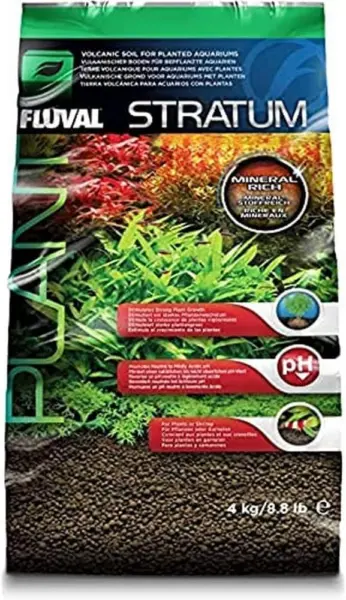
Fluval Plant and Shrimp Stratum – Best Substrate for Planted Tanks
Key Features
- Bag size: 8.8 lb
- Structure: Light porous granules
- Tank type: Freshwater planted
- pH effect: Neutral to slightly acidic
- Price: Midrange
Stratum comes with a chore attached. You rinse it, then you rinse it again, and the runoff still runs cloudy for longer than seems reasonable. Better to hear that before you start than to find out with a tank full of milky water and nowhere to put the fish.
What you get for the effort is a substrate plants actually root into. The granules are light and porous, so roots push through instead of circling on top, the surface gives nitrifying bacteria somewhere to live, and newborn shrimp vanish into the gaps. It also holds a neutral to slightly acidic pH, which is what most tropical plants and shrimp keepers are already aiming for.
The same lightness that lets roots spread lets the granules shift. Replanting a stem sends up a puff of dust and leaves a small landslide behind, so place the hardscape and plant once, before you fill. Once it settles, the cloudiness clears on its own with the filter running, usually within a day or two.
It is also the wrong substrate for a tank that needs hard, alkaline water. Livebearers and African cichlids want the opposite of what this does, and no amount of rinsing changes that.
Pros
- Porous granules roots push through
- Slightly acidic pH suits plants and shrimp
- Refuge for newborn shrimp
Cons
- Light granules shift when you replant
- One bag covers only a small footprint
For a planted tank with neutral-to-acidic water, Stratum is the substrate we start with; set aside an afternoon for rinsing and buy two bags.
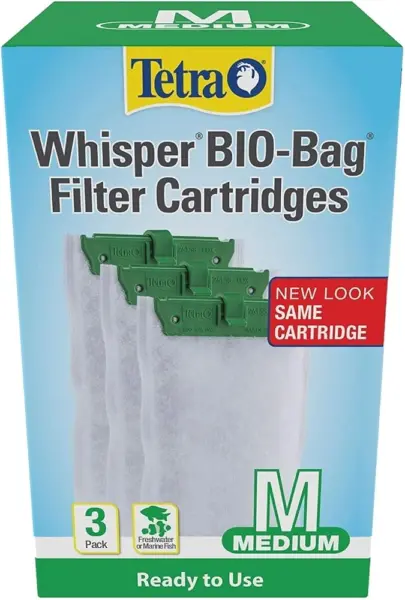
Tetra Whisper Bio-Bag 3-Pack – Best Refill for Whisper Filters
Key Features
- Fits: Whisper 5-10 gal, PF-10, IQ 10
- Pack size: 3 cartridges
- Filtration: Carbon with dual-sided mesh
- Replacement: Monthly
- Price: Budget
Cartridges are where online aquarium shopping goes wrong. The bag that fits one Whisper filter will not fit the next size up, and the word medium means nothing once you are outside the brand. These fit the Whisper 5-10 gallon, the PF-10, and the IQ 10, and the color coding on the package exists so you can match it to the filter already hanging on your tank without measuring anything.
For those three filters they are hard to fault. The bags come assembled, so a change takes about as long as washing your hands, and the carbon does the visible work, clearing odor and discoloration while the dual-sided mesh catches what the intake misses. Three to a pack means there is always a dry one on the shelf when the flow slows.
The catch is the system, not the bag. A cartridge filter asks you to throw the pad away every month, and the bacteria you have spent weeks growing go with it, which is why some keepers eventually change designs rather than brands.
For a Whisper you already own, none of that matters much: buy the refills and keep the tank running. For a small tank you have not set up yet, the sponge filter on this list is the simpler long game, because you clean it instead of replacing it.
Pros
- Color-coded fit for three Whisper models
- Comes pre-assembled, ready to drop in
- Carbon clears odor and discoloration
Cons
- Fits only Whisper 5-10, PF-10, and IQ 10 filters
If a Whisper 5-10, PF-10, or IQ 10 is already running on your tank, these are the refills to keep on the shelf: assembled, color-coded, quick to swap.
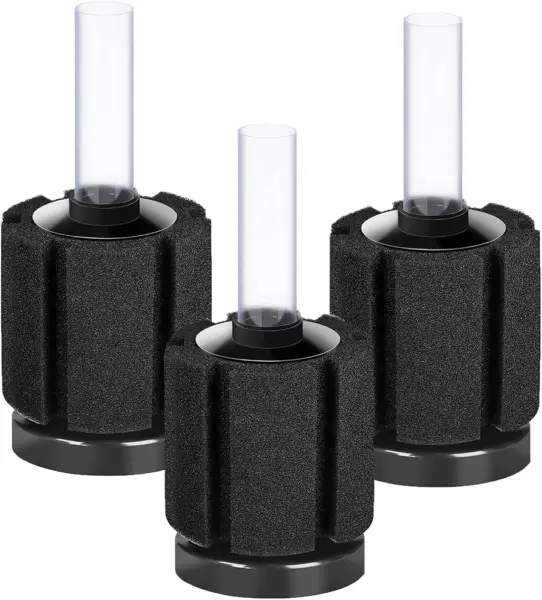
AQUANEAT Sponge Filter 3-Pack – Best Budget Filter for Nano Tanks
Key Features
- Requires: Air pump and airline
- Pack size: 3 filters
- Rated for: Up to 10 gallons
- Dimensions: 2.0"D x 4.75"H
- Price: Budget
Three sponge filters arrive in one order, and the job they do is one a cartridge filter cannot manage: nothing gets thrown away. The sponge holds the bacteria, air rising through the middle pulls water through it, and the flow is gentle enough that a betta can sit in front of it without being pushed around.
We point people to these for the tanks they actually start with: a ten-gallon on a desk, a betta tank, a shrimp or fry grow-out. At 2 inches across and under 5 tall, one hides behind a plant, and cleaning is a squeeze in a bucket of tank water rather than a trip to the store for refills. That squeeze is also how you seed a new tank — the bacteria you wring out can start the next filter.
Plan for the rest of the setup. These are air-driven, so they need an air pump and airline tubing, and if neither is in the cupboard that is a second purchase in the same order. Small also means small: they are rated to ten gallons, and anything larger needs a bigger sponge or two of these running together.
Pros
- Three filters, no refills to buy
- Gentle flow for bettas, fry, and shrimp
- Cleans with a squeeze in tank water
Cons
- Needs an air pump and tubing to run
- Rated only up to 10 gallons
For a betta, shrimp, or fry tank up to ten gallons, this is the filter we point people to first: cheap to run and rinsed in a bucket in a minute.
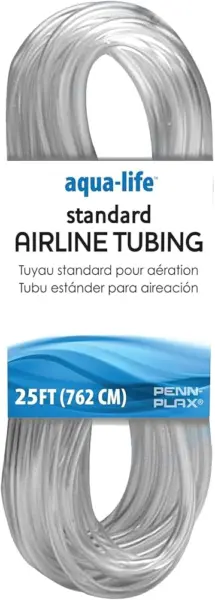
Penn-Plax Airline Tubing 25 ft – Best for Air Pump Setups
Key Features
- Length: 25 ft
- Material: Clear plastic
- Inner diameter: 4 mm
- Outer diameter: 6 mm
- Price: Budget
A kinked airline stops everything downstream of it, and twenty-five feet of clear 3/16-inch tubing is what stands between an air pump and a working sponge filter or air stone.
Penn-Plax’s roll is the one that lives in our supply bin. The 4 mm inner diameter and 6 mm outer diameter are the standard fittings for aquarium air gear, the plastic stays flexible enough to bend a corner without collapsing, and the clear tubing lets you see bubbles moving, which is the quickest way to know the pump is still doing its job.
Buy the long roll rather than a short length. Runs get re-routed, ends get trimmed when they harden, and a second tank usually wants a second line, so 25 feet covers the job with room to spare.
It is also the item most likely to be left out of the cart. If you are ordering a sponge filter, an air stone, or a new pump, put a roll in with it — nothing air-driven runs without tubing, and a second order for a forgotten length is a poor way to spend a weekend.
Pros
- Standard 4 mm inner, 6 mm outer fittings
- Flexible enough to route around corners
- 25 feet leaves room to re-cut
- Clear tubing shows flow at a glance
Cons
- 4 mm inner diameter suits standard air fittings only
Add a roll whenever you buy an air pump or a sponge filter; nothing air-driven runs without it, and you will use more than you expect.
How We Tested 12 Online Aquarium Retailers
We started with a list of about 30 online sellers — big-box pet chains, dedicated aquarium specialists, hobbyist-run shops, and the major marketplaces — and cut any retailer with a pattern of complaints about dead-on-arrival livestock, listings that didn’t match what shipped, or no live-arrival guarantee. That left 12, and over eight months we placed repeat orders with each so a first impression could be checked against a third. We paid for every order ourselves.
Each order was built the same way: filter media, food, a test kit, and either live plants or a bag of substrate. On arrival we photographed everything before opening, noted how the box was packed — insulation, cold or heat packs, whether bags were double-knotted — and compared the delivery date against what the site promised. Plants were judged on melt, snails, and algae; bottles and bags on date stamps and whether the size matched the listing.
Then the supplies went to work in a 20-gallon community tank and a nano planted tank. New gravel and sand got rinsed in a bucket in small handfuls, and we counted how many rounds it took before the water ran clear, then watched whether the tank stayed hazy or picked up a tint afterward. Floss and sponges were judged on how fast they loaded up, how easily they rinsed clean in a bucket of tank water, and whether they held their shape.
We ran ammonia, nitrite, and nitrate tests before and after each change and watched clarity for a week, so a product that quietly fouled the water didn’t get credit for looking fine on day one. We also tracked what the whole order actually cost once shipping was added, how easy the site made it to reorder a staple, and what happened when something arrived wrong — a cracked jar, a plant three inches shorter than advertised.
How to Choose Aquarium Supplies to Order Online
Buy the things that tell you what the water is doing before you buy the things that treat it, and you will spend less and lose fewer fish.
Test before you treat
Water problems start invisible. Ammonia and nitrite have no color and no smell, so the only way to know where a tank sits in its cycle, or whether last week’s water change helped, is a liquid kit that reads all five core parameters. Strips are faster and cheaper, and we keep a few around, but they are a smoke alarm; the liquid kit is the thermometer. Buy the tests first and the treatments only when a test tells you which one you need.
Match refills to the model numbers on your gear
The most common ordering mistake in this hobby is buying a refill for the wrong model. Cartridge sizes are brand- and model-specific: a Tetra Whisper medium bag fits the 5-10 gallon, PF-10, and IQ 10 filters and nothing else, even though it looks like it should. Tubing works the same way, where 4 mm inner diameter is the standard for air gear and a wider hose will not seal. Write down your filter and pump model numbers before you shop, not after.
Choose filtration you will actually clean
There are two honest paths. A cartridge filter is plug-and-play but asks you to throw the pad away, and the bacteria on it, every month; rinse the old pad in water you have just siphoned out and it keeps working longer. A sponge filter holds its bacteria indefinitely if you squeeze it in tank water rather than under the tap, and it costs less to run, at the price of needing an air pump. A chemical resin such as Purigen is a third tool that polishes color without replacing either.
Know what the substrate does to your pH
Substrate is not decoration. A buffering planted substrate such as Fluval Stratum holds a neutral to slightly acidic pH, which suits most tropical fish, plants, and shrimp and works against livebearers and cichlids that need hard, alkaline water. It also arrives dusty: rinse it in small batches until the runoff is mostly clear, and expect a cloudy day or two anyway. Buy by planting depth rather than tank volume, and expect to need more than one bag.
What to order online and what to buy locally
Consumables are the easy yes. Conditioner, test refills, cartridges, tubing, and chemical media are light, keep well, and make more sense in larger sizes, so they belong in one order. Substrate is the arguable one, since a bag is heavy and shipping is often priced by weight; compare the delivered total against a local store. Livestock is the clear no, because you want to see the fish you are buying and have it home in minutes rather than days.
Frequently Asked Questions
Can I let tap water sit out instead of using a conditioner?
Standing water for a day lets chlorine gas off, which is why the old advice still circulates. It does nothing for chloramine, the blend many municipal supplies now use, and nothing for metals in the pipes. If your supplier uses chloramine, untreated water still damages gills.
Use a conditioner dosed for the volume you are replacing, every time, and check your water supplier’s annual report to see which disinfectant they use.
Is it cheaper to buy aquarium supplies online?
Usually, if you compare the right number. Conditioner, cartridges, and test kits all get cheaper per dose or per test in the larger size, and ordering refills together saves a second trip. Compare cost per test or per water change rather than sticker price.
The exception is weight. Bags of substrate are heavy, so price the delivered total against a local store before you commit.
Can I use these supplies on a saltwater tank?
Some of them. Purigen and the airline tubing are labeled for fresh and salt water. The Freshwater Master Kit is not, so a marine tank needs a saltwater kit that reads alkalinity and calcium. Sponge filters and Whisper cartridges are freshwater hardware, and a reef build needs different filtration entirely.
Final Verdict
Buy the test kit first. Everything else here is a refill or an upgrade; the API Freshwater Master Kit changes how you keep fish, because it tells you when to change water instead of leaving you to guess, and it keeps telling you for years.
Add Stress Coat to the same order and every water change is covered. If a Whisper filter is already hanging on your tank, the Bio-Bag refills ride along in the same box, and if you are planting the tank, start with the Stratum and a second bag.