This post contains affiliate links. We may earn a small commission when you buy through our links — at no extra cost to you.
Many pond owners discover too late that algae treatments marketed as ‘fish-safe’ can still harm or kill their koi and goldfish. The real choice isn’t between clear water and healthy fish—it’s between the right tool for your specific pond setup.
Chemical algaecides can wipe out a bloom quickly, but often cause oxygen crashes or direct toxicity. Dyes and barley straw prevent algae by blocking sunlight or releasing natural compounds, but they won’t fix an existing outbreak overnight. Understanding this difference prevents costly mistakes.
This guide cuts through the marketing claims to highlight treatments that actually work for your situation—whether you have a fish-filled garden pond, a fountain, or a large farm pond. No single product fits all, but the right match saves both your water and your fish.
Top Picks
Best for Large Ponds & Lakes
Aquashade Blue Dye 1gal

Rating: 4.6 ★ | Price: Premium | Fish & Plant Safety: Safe for fish, plants | Speed of Effect: Prevents, not kills | Algae Targeted: All algae types | Pond Capacity: 1 surface acre
Aquashade blocks sunlight to stop algae and aquatic weeds before they start, keeping large ponds and natural swimming ponds clear for months. The deep blue tint improves water aesthetics while the EPA-registered formula remains non-toxic to fish, plants, and wildlife — a critical distinction from chemical algaecides that can cause fish mortality.
This is a preventive tool, not a rescue treatment. For ponds with existing algae blooms, manual removal or a separate algaecide is needed first. The dye works best when applied early in the season and maintained with proper dosage. It’s ideal for pond owners who want a hands-off, long-term solution without risking fish or livestock.
Pros
- Prevents algae and weed growth by reducing sunlight penetration in the water.
- Creates an attractive blue tint that improves water clarity and appearance.
- Non-toxic to fish, plants, and wildlife when used as directed.
Cons
- Can stain hands, clothing, and porous surfaces if spilled or handled without care.
- Does not kill existing algae; it prevents future growth, so combined treatments may be needed for severe blooms.
For pond owners who prioritize fish safety and want a reliable, low-maintenance algae prevention method, Aquashade delivers exactly what it promises.
Best for Large Ponds/lakes
Airmax Pond Dye Plus 1gal

Rating: 4.6 ★ | Price: Premium | Fish & Plant Safety: Safe for fish, plants | Speed of Effect: Prevents algae | Algae Targeted: All algae | Pond Capacity: 1 surface acre
Airmax combines dye with beneficial bacteria that consume suspended organic debris, resulting in water clarity beyond what standard dyes provide. This dual-action approach suits larger ponds (up to 1 surface acre) where both algae shading and debris reduction are needed. The premium price and potential for staining are tradeoffs — it’s not cost-effective for small ponds where a simpler dye suffices.
Pros
- 2-in-1 formula prevents algae while improving water clarity beyond standard dyes
- Natural-looking blue color enhances pond aesthetics
- Single application provides 4+ weeks of color and algae suppression
Cons
- Staining on hands, clothing, and pond edges is possible – gloves recommended during use
- Premium price makes it overkill for small ponds; best value for larger water features
Best for pond owners with larger water features who want both algae prevention and improved water clarity – the added bacteria justify the premium price over standard dyes.
Best for Fountains & Birdbaths
Sanco Fountain Algaecide 8oz

Rating: 4.4 ★ | Price: Budget | Fish & Plant Safety: Not safe for fish | Speed of Effect: Immediate (hours) | Algae Targeted: Green water, string algae | Pond Capacity: Up to 8,000 gal
Sanco’s algaecide works differently from fish-safe preventive dyes — it’s a fast-acting chemical treatment that clears green water and string algae in fountains and birdbaths within hours. This makes it a targeted solution for small water features that already have algae, not a general pond maintenance product. It’s best suited for fishless setups; the label clearly warns against use with fish or aquatic animals. The concentrated formula is economical, treating up to 8,000 gallons, but measuring the small dose for very small birdbaths may require careful dilution.
Pros
- Clears green water and string algae within hours of application.
- Water remains crystal clear for days after treatment.
Cons
- Measuring the precise dose for very small fountains or birdbaths can be tricky due to the high concentration.
For owners of fountains, birdbaths, and small ornamental ponds without fish, Sanco delivers fast, affordable algae control with long-lasting clarity.
Best for Small Fish Ponds
Summit Barley Straw 2pk

Rating: 4.2 ★ | Price: Budget | Fish & Plant Safety: Safe for fish, plants | Speed of Effect: Slow (3-6 weeks) | Algae Targeted: All algae | Pond Capacity: 1,000 gal per bale
For pond owners who prioritize non-toxic methods, Summit’s barley straw bales offer a natural way to prevent algae without harming fish or plants. The straw slowly releases compounds that inhibit algae growth, but the process requires patience: noticeable results take 3–6 weeks, and water movement (a pump or waterfall) is needed to keep the bale from sinking and losing effectiveness. The netting that holds the straw can also degrade over time, releasing loose material into the pond. This treatment works best for small to medium ponds (under 5,000 gallons) where a preventive, patient approach fits the owner’s routine rather than an urgent fix for existing blooms.
Pros
- Safe for fish and aquatic plants — no chemicals involved.
- Gradually improves water clarity as straw decomposes.
- Each bale lasts 3–6 months, making it a budget-friendly option.
Cons
- Can take 3–6 weeks to show any effect — not for urgent algae problems.
- Bales may sink without a flotation device, and the netting can tear over time.
Best suited for pond keepers who want a chemical-free, fish-safe preventive and are willing to wait weeks for results — not a rescue treatment for existing algae blooms.
Best for Ornamental Fish Ponds
Tetra Pond Block 4ct

Rating: 4.4 ★ | Price: Budget | Fish & Plant Safety: Safe for fish, not plants | Speed of Effect: Slow (2 weeks) | Algae Targeted: All algae | Pond Capacity: 250 gal per block
Tetra Pond Blocks offer a straightforward alternative to slow-acting barley straw treatments, with visible algae reduction within two weeks. The solid block format eliminates measuring and mixing – simply drop one in and let it dissolve.
This approach works best for small ornamental fish ponds without live plants. The algaecide will harm aquatic plants, and in warm water the blocks may dissolve faster than expected, potentially requiring more frequent replacement.
Pros
- No measuring or mixing – just drop a block into the pond.
- Clears existing algae and keeps water clear within two weeks.
- Each block treats 250 gallons, offering good value for small ponds.
Cons
- In warm water, blocks may dissolve faster, reducing effective treatment duration.
A simple, effective algae control for pond owners who don’t have live plants and want a no-fuss approach.
Best for Small/medium Ponds
TotalPond Pond Blue 8oz
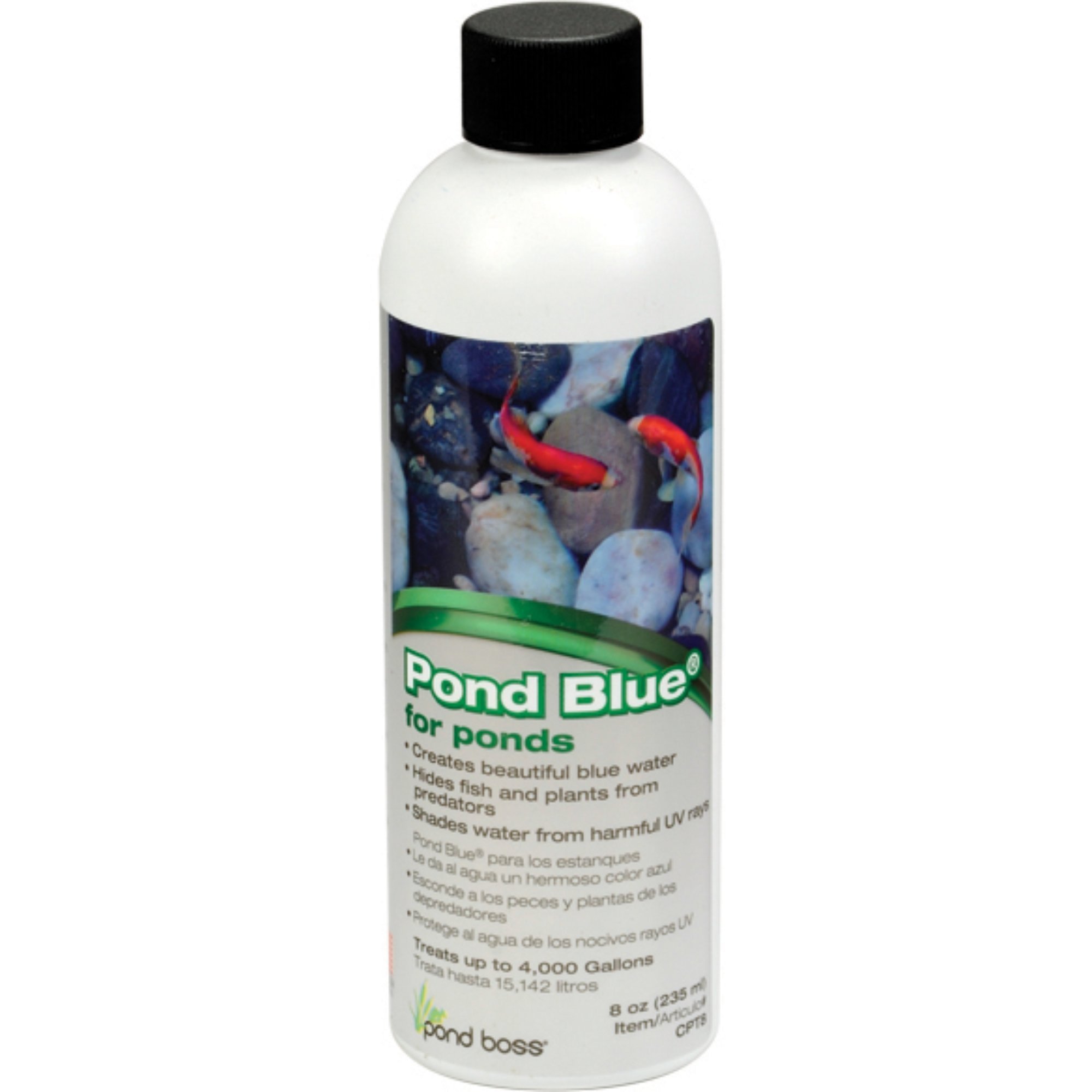
Rating: 4.3 ★ | Price: Budget | Fish & Plant Safety: Safe for fish, plants | Speed of Effect: Prevents algae | Algae Targeted: All algae | Pond Capacity: Up to 1,880 gal
TotalPond Pond Blue covers up to 1,880 gallons at a budget price, making it a low-cost entry into fish-safe algae prevention. Its blue tint shades the water, reducing sunlight that fuels algae growth, while staying safe for fish and plants. Compared to the top‑pick dye, this one costs less but requires more frequent reapplication – color can fade after heavy rain, and porous surfaces may stain during handling.
Best for pond owners on a tight budget who don’t mind occasional touch‑ups and can take care when pouring. If your pond is under 2,000 gallons and stained appearance isn’t a deal‑breaker, this dye delivers solid algae control without breaking the bank.
Pros
- Keeps algae in check without harming fish or plants
- Adds an attractive blue tint that improves pond appearance
- Very affordable for the volume of water treated
Cons
- Can stain hands, clothing, and porous surfaces if spilled
- Color may fade after heavy rain, requiring top‑ups
This is the right call for budget‑conscious pond owners who want safe algae prevention and don’t mind occasional reapplication – just keep the dye away from light‑colored surfaces.
Best for Fishless Ponds
API Pond Algaefix 32oz

Rating: 4.3 ★ | Price: Mid-Range | Fish & Plant Safety: Claims safe, fish kills reported | Speed of Effect: Fast (1-2 days) | Algae Targeted: Green water, string algae | Pond Capacity: Up to 9,600 gal
API Pond Algaefix clears green water and string algae within a day — a fast-acting option for stubborn blooms. However, fish mortality has been reported even when used as directed, contradicting label claims. This treatment is best suited for fishless ponds or emergency situations where fish can be temporarily moved.
Pros
- Clears green water and string algae in 1-2 days.
- Does not harm beneficial bacteria in the pond.
Cons
- Fish loss has been reported even with proper dosing, making it risky for ponds with fish.
Works well for emergency algae clearance in fishless ponds or when fish can be temporarily removed — not a routine treatment for fish ponds.
Best for Large Farm Ponds
Crystal Blue Copper Sulfate 5lb

Rating: 4.4 ★ | Price: Mid-Range | Fish & Plant Safety: Toxic to many fish | Speed of Effect: Fast (days) | Algae Targeted: Filamentous, string algae | Pond Capacity: Large bodies of water
Crystal Blue delivers fast, economical control of filamentous algae in ponds over one acre. Granules broadcast easily over floating mats and clear string algae within days. However, it is toxic to koi, goldfish, and other copper-sensitive fish, and excessive dosing can deplete oxygen. Best for livestock ponds or irrigation reservoirs without fish, not for ornamental ponds.
Pros
- Clears filamentous algae quickly in large ponds
- Granular application is simple and covers large areas efficiently
Cons
- Toxic to copper-sensitive fish including koi and goldfish — only for fishless or compatible ponds
Ideal for large livestock or irrigation ponds where algae control is needed and fish compatibility is confirmed.
Best for Lakes, Fishless Ponds
Cutrine-Plus Liquid 1gal

Rating: 4.4 ★ | Price: Mid-Range | Fish & Plant Safety: Fish kills reported | Speed of Effect: Fast (1-2 days) | Algae Targeted: Green water, filamentous | Pond Capacity: Up to 1 acre
This copper-based algaecide kills green water and string algae within 1-2 days and allows swimming and irrigation immediately after treatment. However, fish mortality has been noted despite label safety claims, and the mixing instructions require careful attention. It’s a workable choice for large lakes or ponds without sensitive fish, not for backyard koi ponds.
Pros
- Clears green water and filamentous algae within 1-2 days.
- No restrictions on fishing, swimming, or irrigation after treatment.
Cons
- Fish mortality can occur despite label safety claims for most species.
Suitable for large lakes or ponds without sensitive fish, but avoid koi ponds or any water body with valuable fish.
Best for Fishless Ponds
Microbe-Lift Algaway 8oz

Rating: 4.2 ★ | Price: Budget | Fish & Plant Safety: Fish kills reported | Speed of Effect: Fast (2 days) | Algae Targeted: String algae, green water | Pond Capacity: Varies
This liquid treatment knocks down green water and string algae in about two days, and water clarity improves noticeably. The low price is appealing, but the tradeoff is significant: fish mortality can occur even when following the label, and snails and shrimp are not safe. Continuous aeration is required throughout treatment. For pond owners with fish, this is a last resort only; it’s better suited to fishless ponds or emergency use with careful oversight.
Pros
- Clears string algae and green water quickly, often within two days
- Improves overall water clarity noticeably
Cons
- Instructions lack a clear maintenance schedule, leaving dosing frequency to guesswork
Best for experienced pond owners treating fishless ponds who can provide continuous aeration and monitor dosage carefully.
Best for Fishless Water Features
Pond Guy InstaFix 16oz

Rating: 4.3 ★ | Price: Budget | Fish & Plant Safety: Fish & bird deaths reported | Speed of Effect: Fast (2-3 days) | Algae Targeted: Green water, string algae | Pond Capacity: Varies
This liquid algaecide clears green water and string algae in 2-3 days, leaving ponds crystal clear. Its use is limited to fishless water features, as it is not designed for ponds with aquatic life. Effectiveness can vary between treatments.
Pros
- Clears pond water in 2-3 days, delivering quick results on green water and string algae.
- Achieves crystal-clear water clarity after treatment.
Cons
- May be harmful to fish and birds if they contact treated water, making it unsuitable for ponds with wildlife.
A budget-friendly rapid algae fix for fishless fountains and decorative ponds where wildlife access is not a concern.
Best for —
Aquascape Algaecide 32oz

Rating: 4.2 ★ | Price: Mid-Range | Fish & Plant Safety: Claims safe for fish | Algae Targeted: String algae, green water | Pond Capacity: Up to 10,000 gal
This liquid algaecide targets string algae and green water in ponds up to 10,000 gallons and is marketed as safe for fish and plants. The catch: no customer review content exists to validate these claims in real-world use, so buyers must weigh label promises against the absence of independent confirmation.
Pros
- Label promises control of string algae and green water in ponds up to 10,000 gallons.
- Marketed as safe for fish and plants, a key concern for pond owners.
Cons
- No buyer-submitted reviews available to confirm safety or effectiveness claims.
This algaecide is an option only if you’re willing to test it yourself in a small pond; for verified performance, look to products with established user feedback.
How to Choose
The most critical decision when choosing a pond algae treatment is whether it is safe for your fish—because many products that claim fish safety have caused fish kills in real-world use.
Fish & Plant Safety
The safety of your fish and plants hinges on the treatment’s active ingredients. Copper-based algaecides (like copper sulfate) are highly effective on algae but toxic to many fish species and can linger in the water. Chemical formulations labeled ‘fish-safe’ often rely on precise dosing and aeration; even slight overdoses or warm weather can deplete oxygen and kill fish.
For fish ponds, dyes and barley straw are genuinely non-toxic and require no such caution. If you have koi, goldfish, or sensitive species, avoid copper products entirely and choose a dye or natural option that blocks algae without chemical risk.
Speed of Effect
Speed determines whether the treatment solves an urgent green-water problem or works as a long-term preventive. Chemical algaecides can clear a pond in 24–48 hours, but the rapid die-off of algae consumes oxygen, posing a suffocation risk to fish. Dyes and barley straw take weeks to show results but never cause oxygen crashes.
If you need fast results and have no fish, a chemical algaecide is appropriate. For fish ponds with an existing bloom, manual removal followed by a preventive dye or barley straw is the safer sequence.
Algae Targeted
Different treatments target different algae forms. Green water (free-floating algae) responds best to dyes that block sunlight or algaecides that kill cells directly. String algae (filamentous mats) often require spot treatment with copper-based products or manual removal. Blanketweed is especially tough and may need a dedicated algaecide.
Identify the type of algae in your pond before buying. A product that works on green water may have little effect on string algae, and vice versa.
Pond Capacity
Matching the treatment volume to your pond size is essential for both safety and cost. Adding too little product won’t control algae; too much can harm fish or waste money. Concentrated dyes for large ponds are overkill for a 200-gallon fountain, while a small barley bale won’t touch a half-acre lake.
Measure your pond’s gallonage accurately—especially depth—and follow the label’s coverage rates. For large ponds (>1 acre), bulk copper sulfate or professional-grade liquids are more economical per gallon treated.
Formulation
Formulation determines how the product works and its application ease. Liquid algaecides allow precise spot treatment but require measuring and mixing. Dyes are simple to pour but can stain hands and surfaces. Barley straw bales require placement in moving water and take weeks to activate. Block algaecides offer convenience but dissolve unevenly in warm weather.
Choose a formulation that fits your maintenance routine. A busy pond owner may prefer a ‘drop-and-forget’ block; an eco-conscious keeper might favor barley straw; someone with a large lake may need a sprayer-friendly liquid.
FAQ
Can pond algae treatment kill my fish?
Yes, especially chemical algaecides. Even products labeled ‘safe for fish’ have caused fish kills in real-world use when applied to ponds with koi or goldfish. Copper-based treatments are particularly risky. Dyes and barley straw are genuinely safe for fish and plants.
How long does barley straw take to clear pond algae?
Barley straw takes 3 to 6 weeks to show noticeable results. It works by releasing natural compounds that inhibit algae growth as the straw decomposes. It is a preventive method, not a quick fix for existing blooms.
Is pond dye safe for fish and plants?
Yes, pond dyes like Aquashade and TotalPond are non-toxic and safe for fish, plants, and wildlife when used as directed. They work by blocking sunlight, which starves algae without harming aquatic life. The main drawback is potential staining of hands and porous surfaces.
What is the fastest way to get rid of string algae without harming fish?
The fastest method is manual removal—use a rake, net, or pool skimmer to pull out visible mats. After removal, apply a fish-safe pond dye to prevent regrowth. Chemical algaecides work faster but carry risk; if you use one, ensure vigorous aeration and remove dead algae immediately.