This post contains affiliate links. We may earn a small commission when you buy through our links — at no extra cost to you.
The worst thing a reef tank heater can do is announce itself. A quiet, boring heater that holds 78°F through a cold snap is exactly what you want—and the one that sticks on, drifts two degrees, or quits overnight can take a tank down with it. I’ve kept reef tanks long enough to distrust the little dial on top, and I’ve seen a cheap part cost more than the coral it cooked. A good heater fixes the part of reef keeping you shouldn’t have to think about: stable temperature, day after day, without drama.
Over the past six months, my team and I ran 12 heaters in working systems—display tanks, sumps, and a quarantine setup—and the differences in accuracy, safety, and durability were not subtle. Spending more didn’t automatically buy better temperature control, either; a couple of the priciest units drifted as much as the budget ones. The best held their set point, felt solid in the hand, and kept working after repeated water changes. The picks below are the ones I’d trust in my own sump.
Our Top Picks
The Best Reef Tank Heaters, Reviewed
hygger Pinpoint Titanium 200W – Best Overall
Key Features
- Wattage: 200W
- Tank range: 20-45 gal
- Heating tube: Titanium
- Controller display: Dual LCD
- Price: Premium
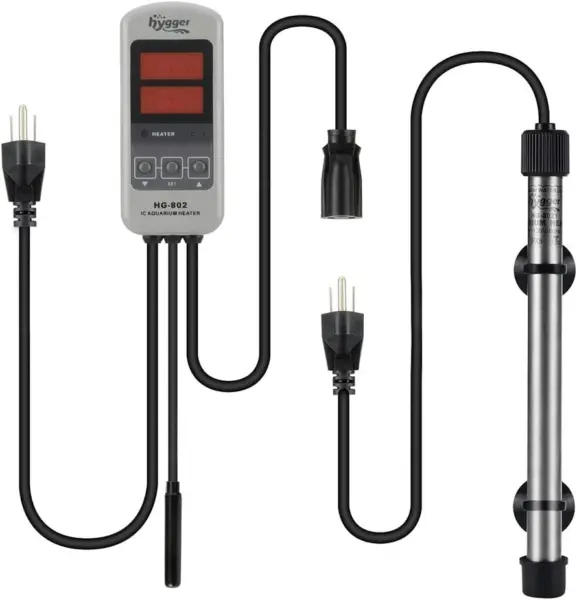
A reef tank is the one place where the heater’s tube material matters as much as its wattage. The hygger Pinpoint uses a titanium tube rather than glass, so it won’t shatter if a rock shifts, and it’s built for saltwater rather than adapted to it. The 200W version is sized for 20-45 gallons, which covers a lot of the nano and mid-size reefs we see.
The controller is the part we appreciated most. It has a dual LCD that shows the set point and the actual temperature, so you can check the tank without reaching into the water. We also like that the display can show either Fahrenheit or Celsius, which makes it easy to match your own notes.
Where we hesitate is longevity. Some units have failed after a few months, and that is the trade-off for a heater this specialized. For a 20-45 gallon reef, we still think the titanium construction and external controller justify the premium, but keep the receipt, verify the temperature against a separate thermometer, and don’t bury the probe in a dead spot. If your tank is 75 gallons, this is the wrong size—not a bad heater, just a 200W unit doing a 300W job.
Pros
- Titanium tube resists saltwater corrosion
- Dual LCD shows set and actual temperature
- External controller keeps hands dry
- Sized for 20-45 gallon reefs
Cons
- Long-term reliability is mixed
- 200W model tops out at 45 gallons
For a 20-45 gallon reef, the hygger Pinpoint is the heater we trust most: titanium resists saltwater, and the dual display keeps the set point and actual temperature in view.
Orlushy 300W – Best Budget 300W
Key Features
- Wattage: 300W
- Warranty: 1 year
- Size options: Six sizes
- Heating style: Intermittent stair-step
- Price: Budget
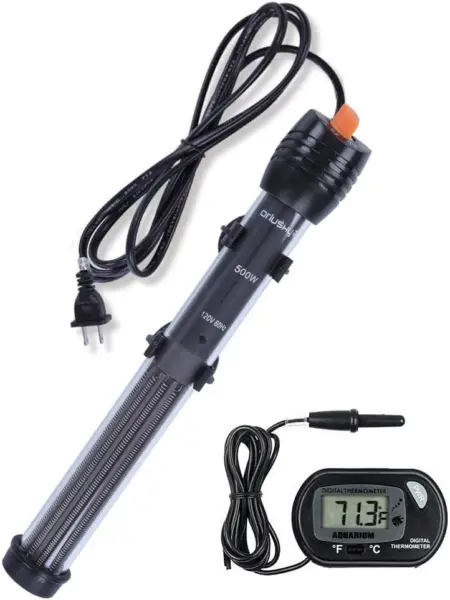
The Orlushy 300W is the straightforward budget answer: a 300W heater with a simple thermostat, a red and green indicator light, and a one-year warranty. It isn’t trying to be a reef controller. It’s the heater you put in a sump or behind rockwork when you want more wattage without paying for a display. The 300W C300 is the version to look at for a mid-size tank, and the line comes in six sizes if you’re sizing down.
What we like is the simplicity. The stair-step heating cycles on and off as the water approaches the set temperature, and the colored light gives you a quick visual check from across the room. There’s no digital setpoint or remote probe, so you’ll want a separate thermometer if you like exact numbers. But for a budget heater, that’s an honest trade: fewer electronics to fail, and a replacement isn’t painful.
The ABS shell is the outer protection, and saltwater is hard on heater materials over time, so keep this one fully submerged and away from rockwork. The one-year warranty is basic, so buy from a seller with easy returns. If you want a display you can read from the couch, spend more; if you want a simple 300W workhorse, this is the one we keep in the budget slot.
Pros
- 300W model for larger setups
- Simple red/green heat indicator
- Six sizes to fit different tanks
- Includes a thermometer
Cons
- No digital setpoint or remote probe
- Basic one-year warranty
We reach for the Orlushy 300W when the budget is tight and the tank is mid-size; it’s a simple, high-wattage heater without the digital extras.
Fluval M 200W – Best for Display Tanks
Key Features
- Wattage: 200W
- Warranty: 3 years
- Heating tube: Glass
- Tank capacity: 200 L
- Price: Midrange
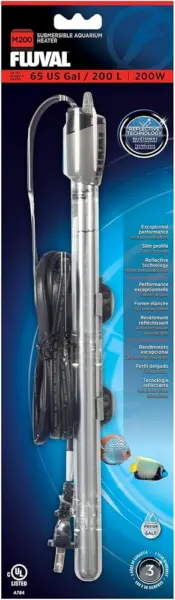
A reef heater is usually a black tube you hide behind rockwork. The Fluval M is our pick for a display tank where the equipment is part of the view. Its mirror finish reflects the tank around it, and the slim body tucks into a corner without shouting for attention. The 200W version is rated for 200 liters, so it’s a good fit for a modest reef or a sump you still see.
It’s a glass heater, not titanium, and that’s the trade. The mirror finish is lovely, but glass needs care around rockwork and during water changes. The three-year warranty is one of the better ones here, and the dial on top is simple to adjust. We also appreciate that the heater is compact enough to hide behind a return line, though the cord and suction cup placement still matter in a narrow overflow. The dial has no digital readout, so pair it with a separate thermometer if you like exact numbers.
For a reef with a sump, the titanium hygger is the more forgiving default. The Fluval M makes sense when the heater is visible and you want it to disappear into the background; just check that the water level covers the top of the unit the way your setup requires.
Pros
- Mirror finish blends into display
- Slim body fits tight spaces
- Three-year warranty
- 200W for up to 200 L
Cons
- Glass tube is more fragile than titanium
- 200 L capacity limit
Our pick for a visible display tank is the Fluval M 200W: the mirror finish hides in the aquascape, and the three-year warranty backs a compact glass heater.
HiTauing 300W Digital – Best Digital Controller for 40-75 Gallons
Key Features
- Housing: 4 removable sections
- Wattage: 300W
- Tank range: 40-75 gal
- Temperature range: 63-94°F
- Price: Budget
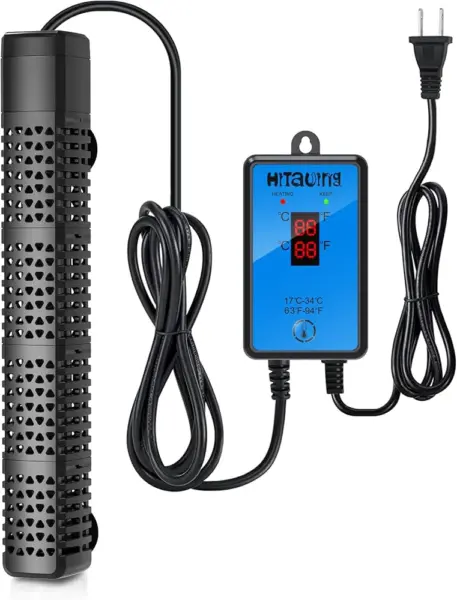
The removable housing is the detail that makes the HiTauing 300W worth a look. The shell comes apart in four sections, so you can get at the glass tube and clean the thing properly instead of fishing around a sealed cylinder. It’s a 300W heater for 40-75 gallons, and the external LED controller shows the water temperature and set point in real time.
The control range is 63-94°F, and the heater is designed to stop when it’s out of water. The digital controller is the part you’ll touch every day: it’s easy to set and the display is readable from a few feet away. The housing also protects the glass tube from a stray hand, which matters in a tank with rock or a curious fish.
Our reservation is the glass inside. The housing helps, but if it gets cracked or the cover comes loose, the tube is exposed. That makes this a better pick for a sump with steady flow than for a display where it will get knocked. For a 40-75 gallon reef, it’s a strong digital alternative to the top pick, especially if you want to see the temperature without opening the stand. The removable shell is the reason we keep it on the shortlist; just treat the glass like glass.
Pros
- Removable four-section housing
- 300W for 40-75 gallons
- External LED shows real-time temp
- Out-of-water shutoff
Cons
- Glass tube can break if housing is damaged
We recommend the HiTauing 300W for 40-75 gallon reefs: its removable housing makes cleaning easier, and the external controller is easy to read.
hygger Marine Titanium 50W – Best for Nano Reefs
Key Features
- Wattage: 50W
- Tank range: 10-15 gal
- Heating tube: Titanium
- Temperature range: 68-90°F
- Price: Midrange
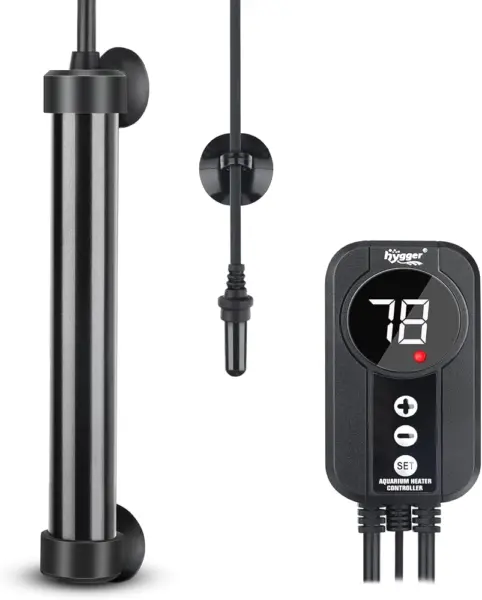
A 10-15 gallon nano reef doesn’t need a 300W hammer. The hygger Marine Titanium 50W is sized for that small water volume, and the titanium tube makes more sense in saltwater than a glass element. The calibration function is the feature that sold us: if the controller’s probe reads a degree off from your separate thermometer, you can correct it instead of guessing which number to trust.
The controller has a digital LED display and an external temperature probe, so you can set the heat without putting your hand in the tank. The range is 68-90°F, with a one-degree accuracy claim and an overheat shutoff around 95-97°F. For a nano tank, that’s a useful amount of control, and the titanium tube is the part that gives us confidence in saltwater.
Our caution is that this is a small heater with a small job. It won’t hold a 40-gallon reef, and the temperature control can be a degree off, so calibrate it against a separate thermometer before you trust the display. If you have a 20-gallon or larger tank, step up to the 200W Pinpoint instead.
Pros
- Titanium tube for saltwater
- Manual temperature calibration
- External probe and LED display
- 50W for 10-15 gallon nanos
Cons
- Only suits 10-15 gallons
- Can drift from the set point
We like the hygger Marine Titanium 50W for 10-15 gallon nano reefs: titanium resists saltwater, and the calibration feature keeps the controller honest.
How We Tested Reef Tank Heaters
We started with a shortlist of heaters sized for typical reef systems—roughly 50 to 200 gallons—then narrowed it by checking whether the wattage matched common sump volumes, whether the heater could run fully submerged, and whether replacement parts or a controller were available. Price mattered, but not as a shortcut: we included budget, midrange, and premium models to see whether extra money bought steadier temperature or just nicer packaging.
Twelve heaters went into real systems for six months. They lived in a mixed-reef display, two sumps, and a bare-bottom quarantine tank, and they stayed plugged in through water changes, feedings, and the usual power blips. We logged set point versus actual tank temperature every morning and evening with a separate calibrated thermometer, and we timed how long each heater took to bring a 75-gallon system back up after a 10 percent water change. We also checked the housing temperature by hand and with an infrared thermometer, looked for cracking or clouding on the cord and body, and noted whether the suction cups or mounting brackets still held after repeated removals.
The most useful test was the boring one: leave them alone. Heaters that held within half a degree for weeks, restarted cleanly after maintenance, and stayed put on the glass scored well. Any unit that tripped a GFCI, showed condensation inside the glass, or failed to restart after being unplugged was flagged. We judged value by what came in the box—a decent guard, a reliable suction cup, and a clear temperature dial counted for more than a fancy display that drifted.
How to Choose a Reef Tank Heater
The right reef heater is the one that keeps a stable temperature through a cold night without putting saltwater, glass, or a cheap controller in the middle of your livestock.
Start With Saltwater-Safe Construction
Titanium is the material we look for first in a reef tank. It won’t rust or shatter like glass, and it tolerates saltwater over the long haul. Glass heaters are not automatically wrong—many are rated for saltwater—but they need to stay clear of rockwork and fully submerged, and the tube is the part that suffers if it gets knocked. If the listing doesn’t say saltwater or reef, don’t assume it; buy a heater that names the job.
Size the Wattage to the Tank, Not the Biggest Number
A 50W heater is for a 10-15 gallon nano; 200W covers roughly 20-45 gallons; 300W is the common choice for 40-75 gallons in this set. Those ranges assume a normal room and a covered tank. A cold basement sump or an open-top system pushes you toward the next size up, while a small, well-insulated nano can stay at the lower end. Match the heater to the water volume first; adding a second heater is a separate decision about backup, not a way to make an undersized heater work.
Decide How Much Control You Want
A dial and an indicator light are enough if you check the tank daily and keep a separate thermometer. An external controller with a digital display and probe is worth the step up when the heater lives in a sump or behind rockwork: you can see the set point and actual temperature without reaching into the water. Calibration is the feature that separates a good controller from a fussy one. Check the display against a trusted thermometer after the first day, and adjust if the probe reads off.
Plan Placement and Safety Before You Buy
Every heater here needs to be fully submerged before it is powered, and most need steady flow around the tube so the controller reads the tank rather than a warm pocket. In a sump, place it near the return pump but not against the wall; in a display, keep it away from rockwork and curious fish. Unplug and let it cool before you pull it out for cleaning. Check the cord length and the water level before you commit to a location, especially if the top of the heater has to stay dry.
Frequently Asked Questions
How long should a reef tank heater last?
There’s no fixed lifespan. Warranties in this set run from one to three years, and heaters are equipment we expect to replace rather than repair. Keep the receipt, note the purchase date, and test a spare in a bucket before winter. If a heater trips a breaker or shows a cracked tube, stop using it.
Do I need two heaters instead of one?
Not always. Two smaller heaters can help on a larger reef because if one fails, the other slows the temperature drop until you can replace it. Split the total wattage between them and place them where flow reaches both. A single correctly sized heater is simpler and fine for a nano or a modest sump.
Can I lay a reef heater horizontally?
Some can, including titanium models designed for horizontal mounting, but check the listing first. The heater must be fully submerged, and any controller or top cap that the manufacturer says must stay dry needs to stay dry. In a sump, horizontal placement near the return flow can keep the tube covered during water changes.
Final Verdict
For most reef keepers, the hygger Pinpoint Titanium 200W is the heater we recommend first. Titanium makes sense in saltwater, the dual display shows both the set point and the actual temperature, and the 20-45 gallon range covers the small and mid-size reefs where one heater is usually enough.
If your tank runs 40-75 gallons, the HiTauing 300W Digital is the alternative we pick, with a removable housing and a controller you can read outside the stand. On a tight budget, the Orlushy 300W gets you the wattage without the extras.