This post contains affiliate links. We may earn a small commission when you buy through our links — at no extra cost to you.
A 40-gallon tank is a sweet spot for many aquarists, but it’s also big enough that a heater failure can wipe out your entire stock. Temperature swings, premature shutdowns, and even overheating disasters are far too common in this category, especially among budget models that promise convenience but deliver risk.
The challenge isn’t just finding a heater that heats—it’s finding one that won’t cook your fish or give out after a few months. This guide cuts through the safety hazards and marketing claims to focus on real-world performance: which models hold a steady temperature, which safety features actually matter, and where it’s worth spending more to protect your tank.
We’ve prioritized heaters with a track record of reliability, no verified safety incidents, and construction that doesn’t shatter or melt. Whether you need a simple preset or a digital controller, the right choice depends on your tank setup and your tolerance for risk—not the price tag.
Top Picks
Best for Long-Term Reliability
Eheim Jager 200W

Rating: 4.5 ★ | Price: $$$ | Wattage: 200W | Temperature Control: Knob dial, requires calibration | Safety Features: Robust build only | Build Material: Thick glass
Built for 40- to 60-gallon tanks, the Jager 200W heats water quickly and maintains a steady temperature. Its thick glass body and internal thermostat have earned it a reputation for lasting two decades or more, with no history of catastrophic failures. The temperature dial must be set using an external thermometer before the first use — a 5-minute routine that ensures accuracy. After that, the heater runs quietly, though you may want to verify the setting once or twice a year to account for minor drift.
The Jager’s 16-inch length means it only works in tanks deep enough for a vertical mount — shallow or low-profile aquariums need not apply. Experienced hobbyists who prioritize long-term consistency over plug-and-play simplicity will find this exactly fits the bill. For a 40-gallon community tank that you plan to keep running for years, it’s a piece of equipment you can set and forget.
Pros
- Consistent, long-term heating — some units have lasted two decades without incident.
- Heats water quickly and holds temperature steady once calibrated.
- Sturdy glass construction and accurate temperature control after the initial calibration.
Cons
- Calibration is required out of the box and can be confusing the first time.
- Temperature setting may drift after extended use, needing occasional recalibration.
For aquarists with deep enough tanks who value equipment that outlasts the livestock, the Jager is a one-time investment that justifies its premium price.
Best for Tech-Savvy Aquarists
Fluval E 300W

Rating: 4.3 ★ | Price: $$$ | Wattage: 300W | Temperature Control: Digital, 0.5°F increments | Display & Controller: External digital, color-coded | Safety Features: Dual sensors, low flow detection | Build Material: Quartz glass with guard
The Fluval E’s digital display and external controller allow precise 0.5° adjustments and easy monitoring from outside the tank. Unlike the gold-standard Eheim Jager, which requires manual calibration, this heater offers plug-and-play setup. However, maintaining the set temperature depends on adequate water flow — in tanks with low circulation, the heater may not reach the target. Some units have also been noted to stop working within the first year, so buying with a flexible return window is worth considering. Best suited for aquarists who prioritize digital convenience and have a setup with good water movement.
Pros
- Precise temperature control with clear digital display and 0.5° increments.
- External controller allows easy adjustments without reaching into the tank.
- Quartz glass construction with guard resists breakage during cleaning.
Cons
- Premium-priced compared to similar digital heaters with fewer features.
For aquarists who want digital control and can ensure good water circulation, the Fluval E offers precise temperature management with a tradeoff in long-term durability.
Best for Safety-Conscious Buyers
HANLESHUKA 200W

Rating: 4.4 ★ | Price: $ | Wattage: 200W | Temperature Control: Digital, ±1°F | Display & Controller: External digital with LED | Safety Features: Auto shut-off, dry-burn, overheat | Build Material: Explosion-proof quartz with guard
The HANLESHUKA 200W leads with comprehensive safety protections: auto shut-off when exposed to air, dry-burn prevention, and overheat shutdown. Unlike the gold-standard Eheim Jager that requires one-time calibration for accuracy, this heater is set-and-forget with a digital display. The tradeoff is that temperature may be off by a degree or two — a non-issue for most community tanks, but worth checking if you need precise control for breeding setups. This heater suits budget-focused aquarists who prioritize safety and stable heating over pinpoint precision.
Pros
- Fast and stable heating performance for 20-40 gallon tanks.
- Safety features include auto shut-off, dry-burn, and overheat protection.
- Digital display with ±1°F control simplifies temperature adjustments.
Cons
- Temperature accuracy may vary by a degree or two between units.
For those who put safety first and don’t need laboratory-grade precision, this budget heater delivers reliable heating and strong protections at a compelling price.
Best for Turtle or Rough Tanks
HITOP PTC 200W

Rating: 4.3 ★ | Price: $ | Wattage: 200W | Temperature Control: Digital, external controller | Display & Controller: External digital | Safety Features: Built-in thermostat, protective cover | Build Material: PTC ceramic
The HITOP’s PTC ceramic element won’t shatter like glass heaters — a real advantage for active tanks where bumping is common. This 200W model heats a 40-gallon tank adequately, but temperature accuracy can drift and some units may need replacement within two months. Compared to the Eheim Jager’s proven reliability, you trade long-term certainty for a shatterproof build and budget price. This heater suits low-stress setups or turtle tanks where absolute precision isn’t critical and safety from breakage matters most.
Pros
- Non-glass PTC construction removes shatter risk — ideal for turtle tanks or active setups.
- Digital external controller makes temperature adjustments easy without reaching into the tank.
Cons
- Displayed temperature may not match actual tank water — some users note a 1–2°F offset.
A practical option for budget-conscious keepers who want a non-glass heater, as long as you’re comfortable with some temperature offset and an uncertain lifespan.
Best for No-Fuss Operation
Aqueon Preset 200W

Rating: 4.3 ★ | Price: $$ | Wattage: 200W | Temperature Control: Preset 78°F | Safety Features: Auto shut-off when overheated | Build Material: Plastic and glass
The Aqueon Preset 200W offers straightforward operation with no temperature dial to fuss over. It’s preset to 78°F, which works well for many tropical fish, but the heater may struggle to maintain that temperature in cooler rooms or basements. Best suited for quarantine tanks or simple setups where a degree or two of variation is acceptable. Some units have shown durability issues over time, so buying with a flexible return window is advisable.
Pros
- Plug-and-play — simply submerge and power on.
- Budget-friendly for basic heating needs.
- Auto shut-off when overheated adds peace of mind.
Cons
- In cooler rooms, the heater may not reach the preset 78°F.
- Durability can vary between units; some have stopped working after months of use.
A decent option for secondary tanks in climate-controlled rooms, but not the first choice for a primary display tank.
Best for Budget Digital Alternative
ZazaFi 300W
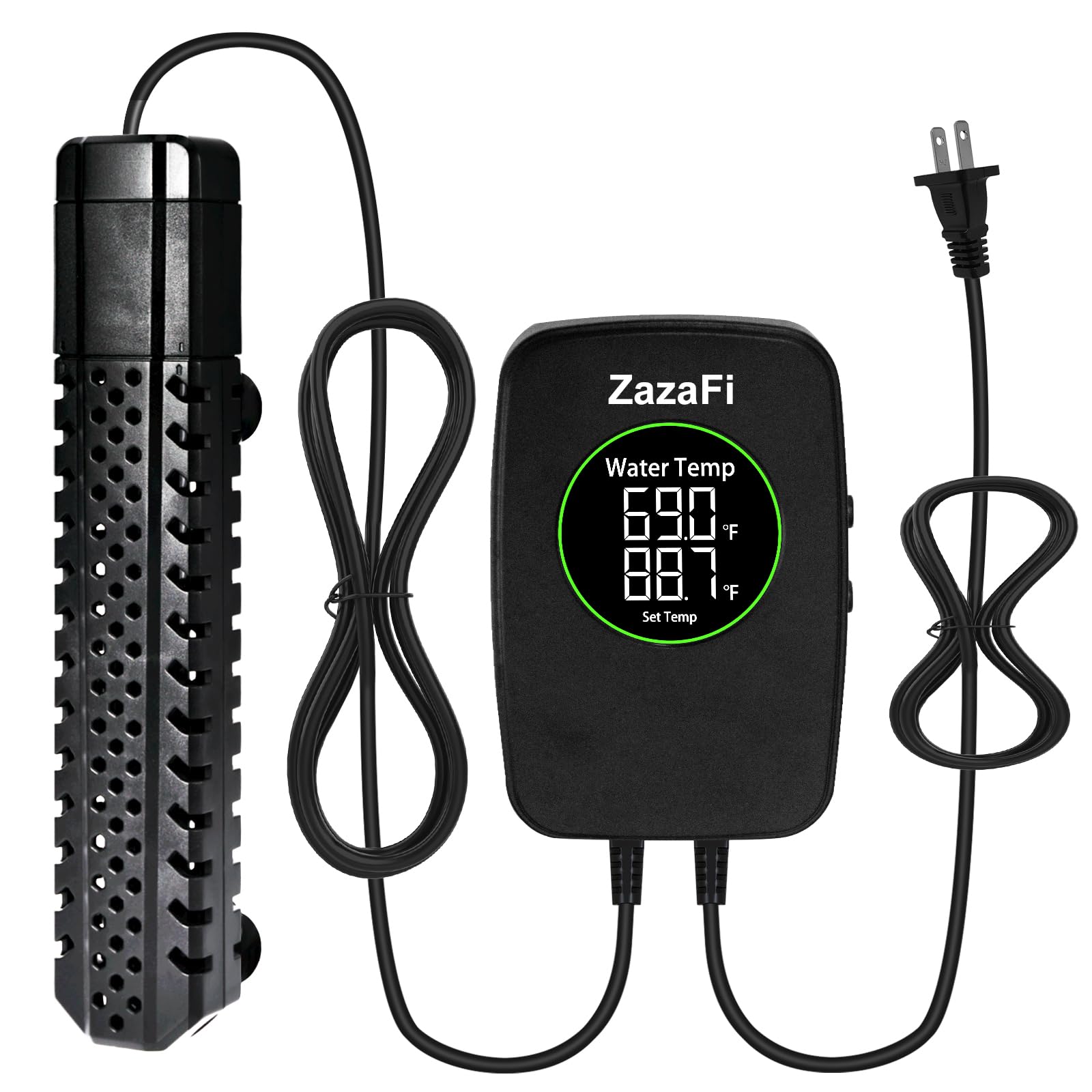
Rating: 4.6 ★ | Price: $$ | Wattage: 300W | Temperature Control: Digital, plus/minus buttons | Display & Controller: External digital | Safety Features: Water sensor auto shut-off, overheat | Build Material: Quartz glass with ABS shell
The ZazaFi 300W offers clear digital temperature control and overheat protection at a mid-range price. Heating is stable and responsive for 40-gallon tanks. A report of the plus button malfunctioning after three days suggests build quality can vary. This makes the heater a reasonable choice for a spare or experimental tank where a backup is available, rather than a primary system where long-term durability is essential.
Pros
- Delivers stable temperature control for 40-gallon freshwater or saltwater tanks.
- Digital display is easy to read and adjust with plus/minus buttons.
Cons
- The plus button on the control panel may malfunction early, affecting temperature adjustment.
Best suited for a secondary tank or experimental setup where a backup heater is on hand.
How to Choose
The most important decision for a 40-gallon heater is balancing wattage and safety features to avoid temperature swings or catastrophic failure.
Choose the Right Wattage
A 200W heater is generally sufficient for a 40-gallon tank in a room that stays around 70°F. But if your tank is in a basement or cold spot, oversizing to 300W gives you a buffer to maintain temperature without running constantly.
The trade-off: a higher-wattage heater heats faster, but if it malfunctions it can overshoot more quickly. Use a separate temperature controller as a backup for any single-heater setup.
Adjustable vs Preset Temperature
Preset heaters (typically 78°F) are dead simple—plug in and forget. But they lock you into one temperature, which may not suit tropical fish that need 80°F or treatments that require cooler water.
Adjustable heaters, especially those with digital controls, let you fine-tune to the exact degree. The trade-off: more settings mean more points of failure, and knob-based dials are notoriously imprecise.
Digital Display and External Controller
External digital controllers let you read and change the temperature without reaching into the tank. They also make it easier to spot drift—a slow rise from 78°F to 82°F often goes unnoticed on a knob.
The hidden cost: digital electronics add complexity. Some controllers fail silently, and the display can be hard to read if mounted at an awkward angle. Still, the convenience outweighs the risk for most owners.
Safety Features That Matter
Auto shut-off when the heater is out of water (dry-burn protection) is the most valuable safety feature because many fish deaths happen after water evaporates or during maintenance. Overheat protection that shuts off the element at a high limit is also critical.
But safety features don’t eliminate all risk—they reduce the odds. A heater with multiple protections can still fail if the internal thermostat sticks. That’s why a separate temperature controller is recommended for expensive fish.
Glass vs PTC Ceramic Build
Glass heaters are traditional and cheap, but they shatter easily if dropped or bumped by large fish or turtles. PTC (positive temperature coefficient) ceramic heaters are shatterproof and self-regulating—they reduce power as water temperature approaches the set point.
The catch: PTC heaters are less common, often less accurate, and may take longer to reach temperature. They shine in active tanks where breakage is a real concern, but for standard setups, a well-guarded glass heater is still fine.
FAQ
Can a 200W heater handle a 40 gallon tank in a cold room?
In a room that stays around 70°F, 200W is usually enough. But if the room drops to 65°F or lower, the heater will struggle to maintain 78°F and may run continuously, which shortens its lifespan. For cold rooms, choose a 300W heater and use a separate controller for safety.
Why does my aquarium heater keep overheating and killing my fish?
Most aquarium heater failures are caused by stuck thermostats or poor-quality temperature sensors. Budget heaters often lack redundant safety features, so when the thermostat fails, the element keeps heating. To protect your fish, always use a heater with auto shut-off and consider a secondary temperature controller as a failsafe.
How do I calibrate an Eheim Jager heater?
The Eheim Jager requires a one-time calibration: set the knob to your desired temperature, place it in the tank, and let it run for 24 hours. Then check the actual temperature with a separate thermometer. If it’s off, turn the calibration ring (the white dial behind the knob) until the heater’s set mark matches the true tank temp. You may need to repeat once or twice.
Is a PTC heater safer than a glass heater for aquariums?
PTC heaters are shatterproof and self-regulating—they reduce power as water temperature rises, which lowers the risk of overheating. However, they can still fail electronically and are often less accurate than glass heaters with digital controls. For active tanks with large fish or turtles, a PTC heater is a safer choice because it won’t shatter on impact.