This post contains affiliate links. We may earn a small commission when you buy through our links — at no extra cost to you.
A saltwater tank is part furniture, part life-support system. Get the design right and it blends into the room; get filtration or lighting wrong and you’ll spend more time with a bucket than your fish. I’ve kept reef tanks for years, and over the past 10 months my team and I lived with seven different tanks, from compact all-in-ones to larger setups. The best ones handle the boring work so you can enjoy the tank instead of babysitting it.
The biggest surprise was that sleek tanks weren’t always easiest to set up; a hidden filter is lovely until you reach behind the panel every week. I also measured real footprint, not advertised gallons—once rock and sand go in, a 20-gallon tank holds less water, and you still need room for a heater and skimmer. Some tanks look like a bargain until you price the missing gear, while others include decent lighting and filtration. The picks below range from desktop to living-room sizes, and each earned its spot by being well built and easy to live with.
Our Top Picks

The Best Saltwater Aquarium Tanks, Reviewed
Innovative Marine 25 Lagoon – Best Overall
Key Features
- Footprint: 23.6 x 19.7 x 11.8 in
- Filtration: Rear overflow wall, two 200-micron filter socks
- Return Pumps: Two 130 GPH DC
- Display Volume: 25 gallons
- Price: Midrange
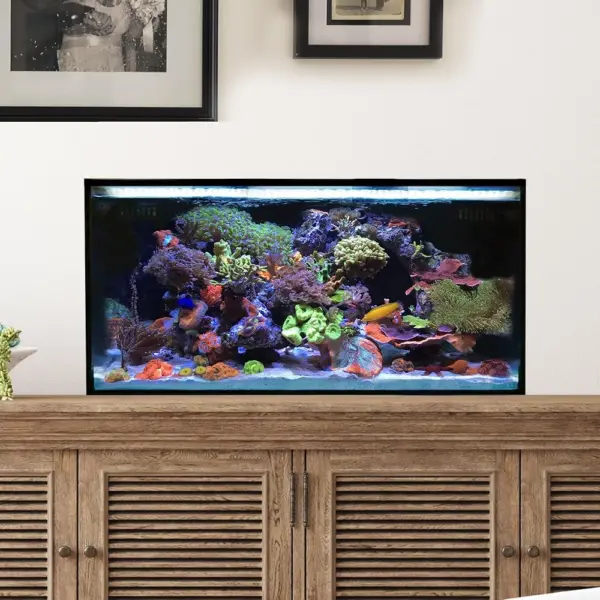
Two return pumps, two 200-micron filter socks, an overflow with its own emergency drain and a leveling mat already fitted: the 25-gallon Lagoon arrives as a marine tank rather than a glass box with a filter clipped on the back. That is the whole reason it is our top pick. The plumbing decisions a first reef forces on you are the ones most people get wrong, and here they are made already.
The footprint is the other thing that won us over. At 23.6 by 19.7 inches and only 11.8 inches tall, it is a lagoon — long, wide and shallow, so light reaches the bottom without a bank of fixtures and you get genuine depth for rockwork instead of a tall narrow column of water. The low-iron glass, beveled and polished at the edges, is as clear as anything in this group, and the black rear panel hides the overflow so the display reads as a clean rectangle from the sofa.
What is not in the box is a light, a heater or a lid, and that is the trade-off. A reef-capable light over a footprint this size is a serious purchase in its own right, and the open top loses water faster than a hooded tank will — plan on topping off by hand daily or adding an auto top-off from the start. We prefer the honesty of that arrangement: you buy the light you actually want instead of paying for one you will replace within a year.
The twin 130 GPH DC pumps give you gentle return flow plus a spare if one quits midweek. No other tank here has a second return pump or an emergency drain, and on a first reef that redundancy is worth more than another inch of glass. Set it on a stand that is genuinely level, mind — the mat absorbs a slight unevenness in a wooden top, not a floor that rocks.
Pros
- Overflow, two filter socks and two return pumps included
- Low-iron glass with beveled, polished edges
- Leveling mat pre-installed, one-year warranty
- Wide, shallow lagoon footprint leaves rockwork room
Cons
- No light, heater or lid in the box
- Rear wall cuts display depth to 16.9 inches
Our top pick: we recommend the 25 Lagoon to anyone starting a reef who wants the overflow and return pumps solved before the first bucket of saltwater.
Coralife BioCube 32 – Best Large All-In-One
Key Features
- Lighting: Three-channel LED, 24-hour timer
- Dimensions: 27.5 x 25.5 x 27 in
- Filtration: Rear chamber, submersible pump
- Display Volume: 32 gallons
- Price: Premium
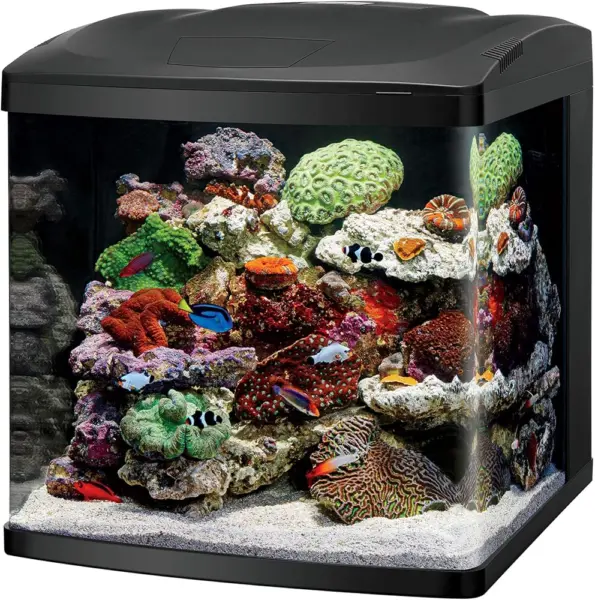
The hood is the pitch. Three independently controlled LED channels — bright white, blue and color-enhancing — run off a built-in 24-hour timer, so sunrise and moonlight happen without a controller, an app or a second power supply. On a tank this size that hood is also what makes the whole thing look like furniture rather than a science project, especially with the rounded front edges and the filtration tucked away in the back chamber.
We think it is the right answer for a tall display in a living room. Twenty-seven inches of height gives rock stacks and taller plants vertical room the shallow lagoons simply cannot, and a programmable ramp is a genuinely pleasant thing to live with. The catch is the electronics inside that hood: the light units and the timer display are the parts that can quit, and the cooling fan is audible in a quiet room. Buy it for the convenience, not for the silence.
Budget past the tank as well. You will still want a heater, rock and whatever media goes in the rear chamber. What the money actually buys is the largest tank here with a light already fitted — one purchase instead of four, and a lid that keeps jumpers in and evaporation down.
Pros
- Three-channel LED on a built-in 24-hour timer
- 32 gallons with filtration hidden in the back
- Rounded glass and a finished, hooded look
Cons
- Hood light and timer electronics can fail
- The priciest tank in this group
Buy the BioCube 32 if you want one box with the light, hood and timer already in it, and you are happy with a taller tank.
LANDEN EzFlux 60 26 – Best Rimless Build
Key Features
- Glass: 8mm low-iron, rimless
- Footprint: 23.6 x 17.7 x 15.8 in
- Return Pump: BIOSMO 700, 185 GPH
- Display Volume: 26 gallons total, 18.8-gallon display
- Price: Premium
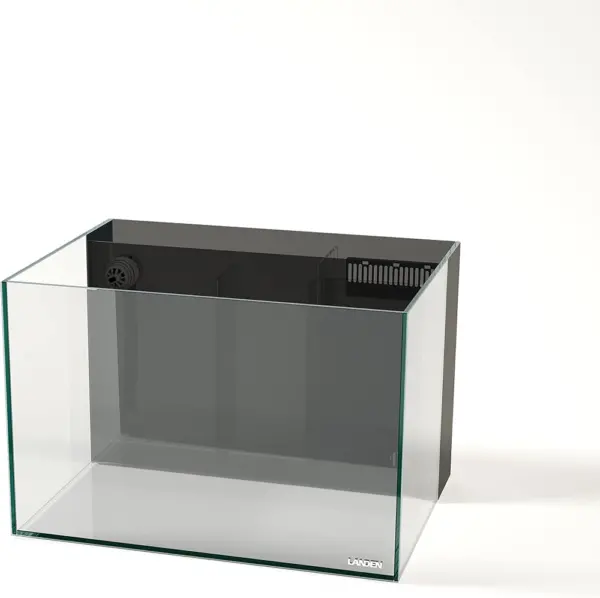
The glass is the first thing you notice: 8mm low-iron, rimless, beveled at the edges, with black silicone and seams clean enough that there is nothing to look at except what is inside. It also turns up in a wooden crate that takes a pry bar and a patient twenty minutes to open, which tells you something about how it survives the trip — and it does arrive intact.
We rate it as the pick for anyone who wants to decide what runs behind the display. A walled-off rear section splits into three chambers, fed through a detachable inlet and returned through an adjustable directional nozzle, so you choose the mechanical, chemical and biological media instead of buying a manufacturer’s cartridge forever. The BIOSMO 700 pump moves 185 GPH at 9W and comes in the box, which is real flow for a tank this size rather than a placeholder.
The rear wall is what you pay in space. Total volume is 26 gallons, but only about 18.8 of that is display — close to a third of the tank is filtration you look at from behind, and the overflow slots are wide enough that very small fish warrant a check before stocking. The rimless top also evaporates hard, so an auto top-off stops being optional. We accept both on a reef where salinity gets checked anyway, and 17.7 inches front to back is generous scaping room for the money.
Pros
- 8mm low-iron rimless glass with beveled edges
- 185 GPH return pump included
- Three configurable rear filter chambers
Cons
- Only about 18.8 gallons of the 26 is display
- Open rimless top evaporates quickly
We rate the EzFlux 60 the pick for reef keepers who want rimless glass and their own choice of media behind it.
LANDEN Cube 15.6 – Best for a Desktop Nano
Key Features
- Glass: 5mm low-iron, 91% light transmission
- Volume: 15.69 gallons
- Included: Nano foam leveling mat
- Dimensions: 15.7 x 15.7 x 15.7 in
- Price: Midrange
A 15.7-inch cube is the size that actually fits somewhere — the end of a desk, a kitchen counter, the shelf unit that has been waiting for an occupant. The LANDEN makes the most of those inches: low-iron glass rated at 91 percent light transmission, edges chamfered and mirror-polished, silicone lines even enough that we stopped hunting for flaws. It looks like a tank that costs considerably more than it does, which is why it is the cube we recommend for a desktop reef.
What you are buying is glass, and only glass. No pump, no filtration, no lid, no light. That is not a criticism, it is the point: a bare cube lets you hang the filter you trust and run the light you already own instead of paying for a hood you will replace. Plan the equipment before the tank lands, because a 15.7-inch footprint leaves little room behind the glass for a hang-on filter and a light clamp competing for the same rim.
Two things to know before ordering. The glass is 5mm, thin enough that clamp-on lights deserve a second thought — a wall or stand bracket keeps that load off the panel entirely. And it ships as freight, so open the crate and check every edge and seam before you sign, because a chipped corner becomes a leak later. The foam leveling mat in the box is a small inclusion that does real work on a wooden surface.
Pros
- Low-iron glass rated at 91% light transmission
- Compact 15.7-inch cube footprint
- Leveling mat included
Cons
- No filter, light or lid included
- 5mm glass is thin for clamp-on lights
This is the cube we point aquascapers to: beautiful glass, a tiny footprint, and nothing else in the box.
Aqueon 20 Gallon High – Budget Bare Tank
Key Features
- Volume: 20 gallons
- Warranty: Limited 5-year
- Dimensions: 24.5 x 12.5 x 16.75 in
- Construction: High-clarity glass, black trim
- Price: Budget
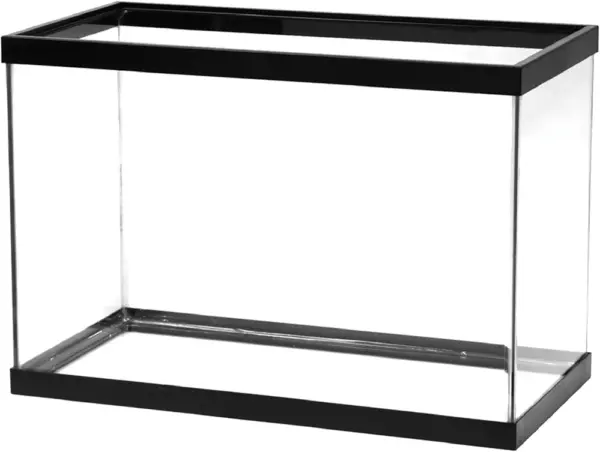
Twenty gallons, black trim, clear glass, and a lid you buy separately: the Aqueon 20 High is the plainest thing on this page and the least expensive route into saltwater. At 24.5 by 12.5 by 16.75 inches it is a tall, narrow tank, which means more water column than the shallow lagoons and a footprint that sits comfortably on a standard two-foot stand with space either side.
For marine use it is a shell, and we appreciate that it does not pretend otherwise. You choose and buy the overflow or hang-on skimmer, the return pump, the light, the heater and the lid, and drilling glass is a job for someone who has done it before. In exchange there is no rear chamber eating your display volume and no proprietary cartridge to keep buying — and the limited five-year warranty is stated in plain terms rather than as a promise.
We think it suits three buyers: the hobbyist assembling a system component by component, anyone who wants a spare tank for quarantine, and the first-timer on the tightest budget who would rather put the money into a good light and skimmer than into a hood. Just do not mistake a bare tank for a cheap hobby — everything that makes it marine is still on your list.
Pros
- Freshwater and saltwater compatible
- Limited five-year warranty
- Least expensive tank in this group
Cons
- Bare tank; every piece of equipment is extra
For the smallest outlay, we think a bare 20-gallon high is the honest way into marine, provided you are ready to buy everything else.
How We Tested Saltwater Aquarium Tanks
We started with a shortlist of 18 tanks, filtering by size, price, and whether each included the gear a saltwater setup actually needs—lighting, filtration, and space for a heater and skimmer. That left seven tanks, which we ran for 10 months in a living room and a home office, where they had to fit on a console, survive daily feeding, and look good enough to leave on when guests came over. We timed unboxing and first fill solo, noted how clear the instructions were, and measured actual footprint plus usable water volume after adding rock and sand.
After filling, we checked every seam and plumbing connection for weeping, then looked again at one week and one month; each tank also sat on a drip tray for a 24-hour leak watch. We ran pumps and fans continuously and logged any restart, rattle, or failure. Fan noise got checked at arm’s length and from couch distance, especially at night, because a tank in the living room shouldn’t hum over the TV. We noted how silicone and lids held up after repeated wiping and salt creep.
Filtration was judged by how fast the water cleared after feeding, whether surface scum built up, and how easily we could reach the media without pulling the tank apart. For lighting, we watched how the stock fixture rendered fish and corals, whether the spread covered the rockwork, and whether the timer held a schedule. At the end, we compared what came in the box against what we still had to buy—heater, skimmer, top-off—because a tank’s value is rarely just the glass.
How to Choose a Saltwater Aquarium Tank
The tank is the cheapest part of a marine setup and the only one you cannot easily swap later, so choose it for the equipment it lets you run rather than for the glass alone.
Start with all-in-one or bare glass
This decision shapes everything after it. An all-in-one gives you a rear chamber, an overflow and often a return pump, so the equipment disappears behind a wall and there is no plumbing to leak behind the tank. The Innovative Marine Lagoon and the LANDEN EzFlux 60 take that route openly; the BioCube hides the same idea under a hood. A bare tank like the Aqueon 20 High is just glass — cheaper, more flexible, and entirely yours to plumb.
Pick an all-in-one if you want one stand, one power strip and no drilling. Pick bare glass if you already own a filter and a light, or if you are planning toward a sump. What you cannot do is add a drilled overflow to a tank that is already full of water and livestock.
Volume and shape, not just gallons
A 25-gallon lagoon, a 32-gallon square and a 20-gallon high hold very different amounts of usable room in the same corner. Height buys water column for rock stacks and taller fish, front-to-back depth buys aquascaping room, and length buys swimming room. Measure the stand and the clearance above it first, because both your light and your forearm need somewhere to go.
Our rule: choose the footprint the room can take, then buy the largest volume that footprint allows. More water is more forgiving of a missed top-off or a heavy feeding, and it is usually the difference between a tank that rides out a bad week and one that does not.
What the kit leaves out
Nearly every kit here stops at the tank, the filtration and sometimes a pump. Lighting is the expensive omission: the BioCube includes three LED channels and a timer in its hood, while the Lagoon and both LANDEN tanks expect you to buy a reef light separately, and that is often the largest single line on the receipt.
Then there is the running cost — salt mix, purified water, replacement filter socks, and electricity for pump, light and heater. An open rimless top also evaporates fast, so an auto top-off stops being a luxury. Think about noise too: a hood fan or a return pump runs all night, and a tank beside the sofa is a different proposition from one in a hallway.
Glass, seams and the trip home
Low-iron glass, used on the Lagoon and both LANDEN tanks, takes the green tint out of the panels and lets coral color read properly. Thickness matters more than tint: 8mm on a rimless tank resists flex better than 5mm, and anything that clamps to the rim puts load on that panel. Rimless looks better and evaporates faster; trim hides the waterline and protects the edges.
All of these arrive as glass. Open the crate, check corners, edges and silicone before you sign, and photograph anything chipped, because a hairline at a corner becomes a leak later. Then set it on a stand that is genuinely level, on the mat the maker supplies — a mat forgives slight unevenness in a wooden top, not a floor that moves.
Frequently Asked Questions
Can I turn a freshwater tank into a saltwater tank?
Usually yes, if it is glass and holds water without leaks. Clean it thoroughly, and skip any tank that has run copper-based medication — copper can linger in silicone and stays toxic to shrimp, snails and corals long after the water is gone. A plain 20-gallon high is a sensible candidate; a scratched acrylic tank is not worth the effort.
Do I need a sump for a saltwater tank?
Not at this size. An all-in-one’s rear chamber does the same job — hiding the heater, media and pump — with no plumbing to leak. A sump adds water volume and room for a bigger skimmer, but it needs an overflow and a return line, which is the wrong first project. If a sump is the plan, start with a drilled tank rather than an all-in-one.
How soon can I put fish in a new saltwater tank?
Weeks, not days. The tank has to cycle first: ammonia has to rise and then fall to zero, followed by nitrite. Test both until they read zero, add a cleanup crew before any fish, and stock slowly after that. Buying the tank is the fast part; the waiting is where most new marine setups go wrong.
Final Verdict
For most people setting up a first marine tank, the Innovative Marine 25 Lagoon is the one to buy. The overflow, the two return pumps and the filter socks are already there, so the decisions that sink a new reef — where the water goes and how it comes back — are settled before you mix the first bucket of salt.
If the light needs to arrive with the tank, the Coralife BioCube 32 is the alternative. If you would rather pick every component yourself, the Aqueon 20 High leaves the whole system to you. Whichever you choose, put real money into the light — it decides what you can keep far more than another gallon does.