This post contains affiliate links. We may earn a small commission when you buy through our links — at no extra cost to you.
A new tank rarely crashes all at once. It goes a little hazy, one fish starts hovering near the surface, and the ammonia test reads a shade greener than it did yesterday. Beneficial bacteria is what’s supposed to keep that slide from happening — seeding the nitrifying colonies that convert fish waste into something far less toxic before your fish ever feel it.
I’ve cycled enough tanks to be skeptical of anything promising a shortcut, so over four months my team and I ran 14 different starters and supplements through new setups, filter cleanings, and one genuinely ugly ammonia spike. The ones that worked shared a tell: a real expiration date and a strain list that backed it up. Here’s the thing nobody tells you on the first tank — bacteria don’t replace water changes, and a bottle that’s spent a summer cooking on a warehouse pallet won’t do much of anything. The picks below are the ones I’d dose into my own tanks again.
Our Top Picks
The Best Aquarium Beneficial Bacteria to Cycle a Tank, Reviewed
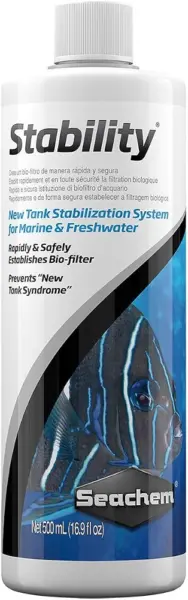
Seachem Stability 500 mL – Best Overall
Key Features
- Dose: 1 capful (5 ml) per 10 gal
- Form: Liquid
- Bottle size: 500 ml (16.9 fl oz)
- Price: Midrange
One capful per ten gallons, shaken first, with the UV and ozone switched off while it works: Stability’s instructions are short enough that you’ll actually follow them, which counts for more with a bacteria starter than anything printed on the label. This is the bottle we name first when someone is setting up a tank, freshwater or marine, and it’s the one we keep coming back to for the unglamorous reason that the routine is easy to repeat.
The 500 ml bottle is the practical size of the group. At a capful per ten gallons there’s a lot of dosing in it, and the label sends you back for a second dose after the first day rather than treating the whole thing as a one-shot fix. That is the honest shape of this category: bacteria in a bottle buys a head start on the nitrogen cycle, not a mature filter, and Stability is built around that idea rather than around a magic-pond promise.
What we appreciate most is how little drama there is around it. No pre-mixing, no pipette, no measuring cup to lose — you shake, you cap, you pour, and you keep testing. The instruction people skip is the UV and ozone line, and it’s the one that matters: run a sterilizer while a culture is establishing and you’re paying to kill what you just bought.
The one thing to plan around is that this is a routine, not a single dose. The culture keeps working over the first days while you test, and the bottle expects you to come back to it. If you want something you glug in once and forget, none of these really offers that; Stability at least makes the repeat a two-second job.
Pros
- Capful-per-10-gallon dose is hard to get wrong
- 500 ml bottle covers plenty of water
- Used in both freshwater and marine setups
Cons
- Dosing continues past the first day
Stability is the bottle we recommend first for a new tank: the dose is a capful per ten gallons, the 500 ml bottle lasts, and it suits freshwater and marine setups alike.
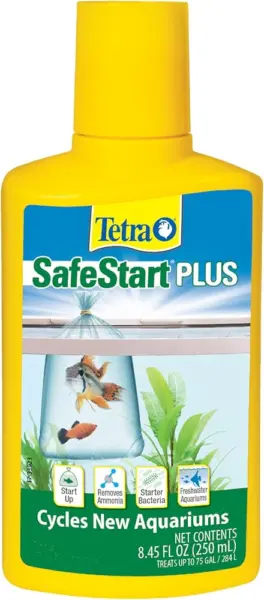
Tetra SafeStart Plus 8.45 oz – Best for Fish-In Cycling
Key Features
- Use: Setup, water changes, after meds
- Bottle size: 250 ml (8.45 oz)
- Water types: Freshwater
- Price: Midrange
The scenario SafeStart Plus is written for is the one that scares people: a new freshwater tank with fish already swimming in it. Tetra’s claim is that it prevents new tank syndrome, which is the polite name for the ammonia and nitrite spike that hits a tank whose filter hasn’t caught up yet.
It’s a fair thing to build a product around, and the 250 ml bottle is a sensible size for the job — enough for a small tank’s startup without a bottle so large it goes stale in the cupboard. What we like about the schedule is that it follows the life of a tank rather than just its first day: setup, water changes, new fish, and the round of dosing after medication.
One thing to plan around: fast-acting isn’t the same as instant. The bacteria start working straight away, but the cycle still runs its course, so stock lightly and test daily rather than filling the tank on day one. Treated that way it does what it says; treated as a shortcut past the nitrogen cycle, it can’t.
Pros
- Built for tanks that already hold fish
- Doses at setup, water changes, and after meds
- 250 ml is right for a small tank
Cons
- Freshwater aquariums only
If you’re starting a freshwater tank with fish already in it, SafeStart Plus is the bottle aimed squarely at that problem, and the 250 ml size suits a small setup.
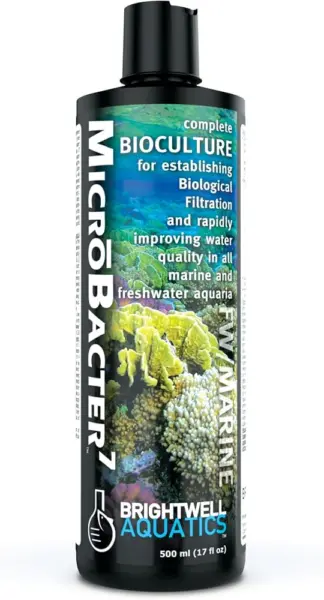
Brightwell MicroBacter7 500 mL – Best for Reef Tanks
Key Features
- Targets: Ammonia, nitrite, nitrate, phosphate
- Bottle size: 500 ml
- Water types: Marine and freshwater
- Price: Premium
Ammonia is only part of the story in a reef tank. MicroBacter7 goes after the rest of the chain — nitrite and nitrate, phosphate, and the organic carbon that feeds algae — which is why it’s the bottle that stays in use long after a cycle finishes.
The dose is the part that catches people out. You mix it with 250 ml of aquarium water in a clean container before it goes anywhere near the tank, and if you’re pipetting below the waterline, the pipette has to be clean. It’s a two-minute job, but it is more of a job than the capful-and-pour bottles here, and it rewards someone who keeps a routine rather than someone who wants to dump and run.
We think it earns its premium on a marine system. Water clarity is the steadiest of anything in this group — tanks that haze over under other bottles stay clear here — and the formula does maintenance work that the pure cycle starters don’t. If you keep a reef, a fish-only marine tank, or a heavily stocked freshwater system where nitrate is the recurring problem, this is the pick we point to.
The catch is price and fuss: it’s one of the pricier bottles here and the routine is more involved. On a simple freshwater starter tank, the plainer bottles do the same job for less, and there’s no shame in choosing one of those instead.
Pros
- Targets nitrate and phosphate, not just ammonia
- Clearest water of the picks here
- Works in marine and freshwater systems
- Useful long after the cycle ends
Cons
- Pricier than most bottles here
- Dose needs pre-mixing first
For a reef or marine tank, MicroBacter7 is worth the extra step and the extra money: it handles nitrate and phosphate as well as ammonia, and the water stays clear.
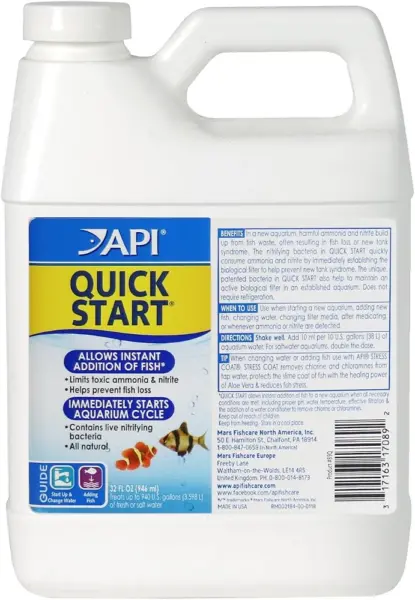
API Quick Start 32 oz – Best for Large Systems
Key Features
- Bottle size: 32 fl oz
- Water types: Fresh and saltwater
- Treats up to: 960 gallons
- Price: Premium
Thirty-two ounces and a claim of up to 960 gallons: Quick Start is the bottle for someone running several tanks or one big one. Where the small bottles here are sized for a nano tank and a couple of water changes, this one is meant to live on the shelf and get used.
It’s a runner-up rather than our top pick, and the reason is consistency. Effectiveness is the most uneven of the bottles in this group — in some tanks ammonia and nitrite fall the way you want them to, in others they barely move — and cloudiness is a real possibility in the first few days. What it has going for it is coverage and occasions: setup, adding fish, water changes, and filter media swaps are all listed uses, which is more than most of the group offers.
Our advice is to measure rather than guess. The 960-gallon figure is the whole bottle’s coverage, so a 40-gallon tank takes a small fraction of it — decant into a measuring cup, dose, and put the rest away. Buy it for volume, not for the last word in reliability.
Pros
- Treats up to 960 gallons per bottle
- Freshwater and saltwater use
- Doses at water changes and filter swaps
- Big bottle suits multi-tank households
Cons
- Most uneven effectiveness in this group
- Can cloud the water at first
Quick Start makes sense if you’re dosing several tanks or one large one and want a single big bottle that covers water changes as well as startup.
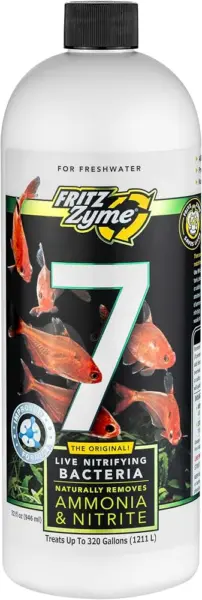
FritzZyme 7 32 oz – Best for Freshwater Tanks
Key Features
- Storage: No refrigeration, one-year shelf life
- Bottle size: 32 fl oz
- Water types: Freshwater and brackish
- Price: Midrange
A live culture that doesn’t need the fridge is the detail worth starting with, because it decides whether you’ll actually use the bottle. FritzZyme 7 is buffered to keep at room temperature with a one-year shelf life, so it can live in the cabinet next to your test kit instead of going in and out of a refrigerator the way some live products have to.
It’s the freshwater specialist here — freshwater and brackish systems specifically — and the 32-ounce bottle is the biggest in this group. That combination is what makes it the pick for a rack of tanks or one large one: the most water treated for the money of anything on this page, with enough volume that you’re not rationing doses after a filter cleaning.
The job it does best is the unglamorous one. FritzZyme 7 is meant to go in after maintenance as much as at startup — a gravel vacuum, a filter teardown, or a big water change can all knock a biofilter back, and dosing a live culture afterwards beats watching ammonia climb for a week. That’s where we reach for it: not only on the first day of a new tank, but the day after you cleaned the filter.
The boundary is salt water. This isn’t the bottle for a marine or reef tank, and the group has better answers for those. Keep it out of a hot car and out of direct sun, and the one-year window takes care of the rest.
Pros
- No refrigeration, one-year shelf life
- Most water treated for the money here
- Rebuilds the biofilter after filter cleaning
- Live nitrifying strains for freshwater
Cons
- Freshwater and brackish tanks only
For a freshwater or brackish tank, FritzZyme 7 is the bottle we buy in the big size: live nitrifiers, no fridge, and a year of shelf life to use it up.
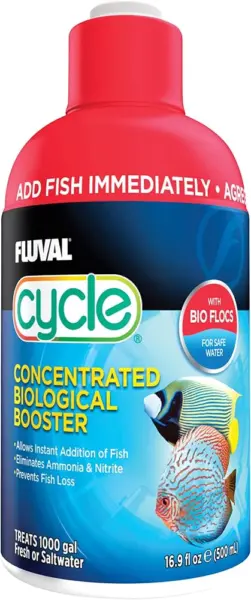
Fluval Cycle 16.9 oz – Everyday Tank Upkeep
Key Features
- Form: Liquid
- Bottle size: 16.9 oz
- Model number: A8351
- Price: Midrange
The listing tells you almost nothing — no dose table, no water-type claim, no shelf-life line — and with a bacteria starter the label is part of the product. Plan on reading the bottle in your hand for dosing details, because you won’t get them before you buy.
What it is, then: a 16.9-ounce biological enhancer, the same kind of product as everything else here, used at setup and again after water changes to keep the biofilter topped up. Nothing about the way it works is unusual. It seeds the nitrifying bacteria a new filter needs and gives an established one a boost after a cleaning.
Where it earns its place is the price of a full-size bottle. Against the other 16-ounce-and-up bottles in this group it’s the cheapest, and it holds up on the fundamentals: effectiveness is steady here, and the value is the strongest of the bottles we cover.
So here’s our read: it’s a solid, inexpensive bottle for a straightforward setup and a risky one to buy blind for a reef tank, because the water type isn’t stated anywhere on the listing. Check the label first. Expect the water to haze over for a few days while it settles; that’s common in this group and it clears.
Pros
- Cheapest full-size bottle here
- Steady effectiveness in this group
- Strongest value of the bottles covered
Cons
- Water type isn’t stated in the listing
- Clouds the water for a few days
Fluval Cycle is the value pick here: a full-size bottle for the least money, provided you check the label for the water type it’s meant for.
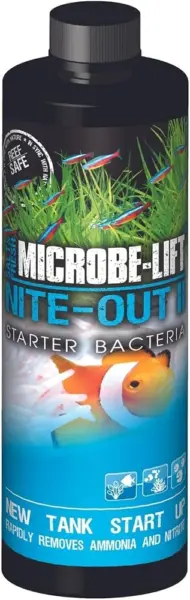
Microbe-Lift Nite-Out II 8 oz – Best for Small Tanks
Key Features
- Use: Reef and planted tanks
- Bottle size: 8 fl oz
- Water types: Fresh and saltwater
- Price: Budget
Open the bottle and you’ll know: Nite-Out II smells like a pond bottom, and that’s the culture, not a fault. It’s the smallest and cheapest bottle here, and for a single small tank on a budget that combination is hard to argue with — live nitrifying bacteria, a dose you can finish before it ages, and no premium for a name on the label.
The claims are the standard ones for this category — start-up, ammonia and nitrite reduction, fish on day one — and the reef-safe, freshwater-and-marine labeling is what separates it from the freshwater-only bottles here. We paid close attention to the small-bottle question, because 8 ounces sounds like very little: on a big tank it is, and this is a bottle sized for one or two small systems rather than a wall of them.
Two practical notes. The smell fades once it’s in the water, so dose before guests arrive rather than after. And buy the smallest bottle that covers your tanks — a live culture sitting half-used through a warm summer isn’t saving you anything, however cheap the sticker was.
Pros
- Cheapest bottle in this group
- Reef safe for fresh and salt water
- Right-sized for one or two small tanks
- Establishes nitrifiers at startup
Cons
- Small bottle runs out on big tanks
Nite-Out II is the budget bottle we hand to someone with one small tank: cheap, reef safe, and sized so you’ll finish it.
How We Tested These Bacteria Starters
To build the shortlist, I turned over every bottle I could find and read the back: strain names, colony counts, dose per gallon, and whether it carried a packed-on or expiration date. Anything undated went back on the shelf, and so did anything listing a single strain with nothing to support it. That narrowed the field to 14 products, which we put through four months of actual tank work rather than a bench test.
Each one went into a fresh 10- or 20-gallon setup running a sponge filter, a few hardy fish, and a liquid test kit checked every morning. We logged how many days passed before ammonia began falling, whether nitrite spiked and then cleared, and how the fish behaved in the meantime — surface gulping, appetite, color. Water changes and filter squeezes got a dose too, since that’s when most people actually reach for the bottle.
We also watched the unglamorous parts: whether the cap measured a clean dose or dribbled down the side, whether the bottle demanded refrigeration, how it smelled on opening, and how much shelf life was left when it arrived. Cost per dose counted for more than sticker price, because a cheap bottle dosed at 10 milliliters per 10 gallons isn’t cheap. Anything that hadn’t moved ammonia within two weeks, or that opened smelling of sulfur, was cut.
How to Choose Aquarium Beneficial Bacteria
The bottle matters less than whether it matches your water type and gets dosed through the days that follow — a bacteria starter shortens a cycle, it doesn’t replace one.
Match the Bottle to Your Water, Not the Word Aquarium
Every bottle here says aquarium, and several stop there. Tetra SafeStart Plus and FritzZyme 7 are freshwater products — FritzZyme also covers brackish — while Brightwell MicroBacter7 and Microbe-Lift Nite-Out II are built around marine and reef systems. Seachem Stability and API Quick Start are the broad ones. Read the water types before anything else, because a freshwater culture poured into a reef tank is money in the wrong water.
The trap is the generic label. If a listing doesn’t state freshwater, saltwater, or both, treat that as a question to answer on the bottle in your hand before you buy, not a detail that will sort itself out.
Size the Bottle to Your Gallons
Bottle size is where most of the money is won or lost. A capful of Stability treats ten gallons, and the 32-ounce bottles — FritzZyme 7 and API Quick Start — are meant for people running several tanks or one large system. Quick Start’s full bottle is listed at up to 960 gallons, which tells you a 40-gallon tank uses a small fraction of it.
The mistake is buying the big bottle for a single nano tank. A live culture has a shelf life, so a half-used 32-ounce bottle sitting in a warm room is not a bargain. Add up every tank you’ll actually dose, then buy for that number.
Storage and Shelf Life Decide Whether It Still Works
Live bacteria are a perishable good, and the packaging tells you how perishable. FritzZyme 7 is buffered to need no refrigeration and carries a one-year shelf life; other bottles expect cooler storage or simply don’t say. Heat is the enemy either way, so a bottle that spent a summer in a delivery van is worth less than one from a shop that turns its stock.
Treat the smell as information. Some cultures have a distinct odor — Nite-Out II is the obvious one — and a bottle that should smell of something and doesn’t is worth questioning before you dose it.
What to Expect in the First Week
Dechlorinate first. Chlorine and chloramine kill the culture you just paid for, so treat new water before the bacteria go in. Then switch off UV and ozone while it establishes, dose on the schedule, and test ammonia and nitrite daily. The cycle is done when both read zero and nitrate starts to show — not when the bottle is empty.
Cloudiness is the other thing first-timers don’t expect. Several of these bottles haze the water for a few days as the culture settles, and it usually clears on its own without a water change.
Frequently Asked Questions
Is bottled bacteria worth buying, or can I just let the tank cycle on its own?
You can cycle without it — time and an ammonia source will get there. What a bottle buys is the wait, and sometimes the risk: if fish are already in the tank, or you’re restarting after medication or a filter teardown, seeding nitrifiers shortens the window when ammonia does damage. For a patient fishless cycle the savings are real; for a tank with livestock in it, we spend the money.
Do I need to keep dosing after the tank has cycled?
No, not on a schedule. Most people dose at startup and then again after the things that knock a biofilter back — a filter media change, a deep cleaning, a course of medication, or adding a group of fish. If you keep one or two tanks, buy the small bottle; the culture has a shelf life and a half-used 32-ounce bottle is wasted money.
How soon can I add fish after dosing?
Sooner than in an unseeded tank, but not the moment the bottle is empty. Add a few hardy fish rather than a full stocking, feed lightly for the first two weeks, and test ammonia and nitrite daily. If either climbs, do a water change and hold off on more fish — the bottle gives a filter a head start, not a finished biofilter.
Final Verdict
Seachem Stability is what we tell people to buy for a new tank. A capful per ten gallons is a dose you can repeat without thinking, the 500 ml bottle covers a lot of water, and it works in freshwater and marine setups, which is more than most of the specialist bottles here can say.
The alternatives earn their places on specifics. FritzZyme 7 for a freshwater or brackish system where no refrigeration and the biggest bottle matter; Brightwell MicroBacter7 if a reef is involved and nitrate is the recurring problem; Tetra SafeStart Plus if fish are already in the water. Buy one of those for the job it’s built for, and Stability when you want the safe answer.