This post contains affiliate links. We may earn a small commission when you buy through our links — at no extra cost to you.
Many new tetra keepers discover that budget starter kits often trade filter reliability for a low price. Noise and early component failures are the top complaints. A well-chosen tank, however, can keep a school of tetras healthy for years with minimal fuss.
The real trade-off comes down to tank size versus component quality. Larger tanks give tetras room to school, but budget kits may need upgrades to filters or lights. Smaller premium tanks offer quieter, more durable components but limit your school size. This guide helps you decide which trade-off fits your space and budget.
We’ve focused on tanks that meet tetras’ minimum space requirements and stand up to daily use, so you can avoid the cycle of replacing parts months later.
Top Picks
Best for Tetra Beginners
Tetra ColorFusion 20 Gal
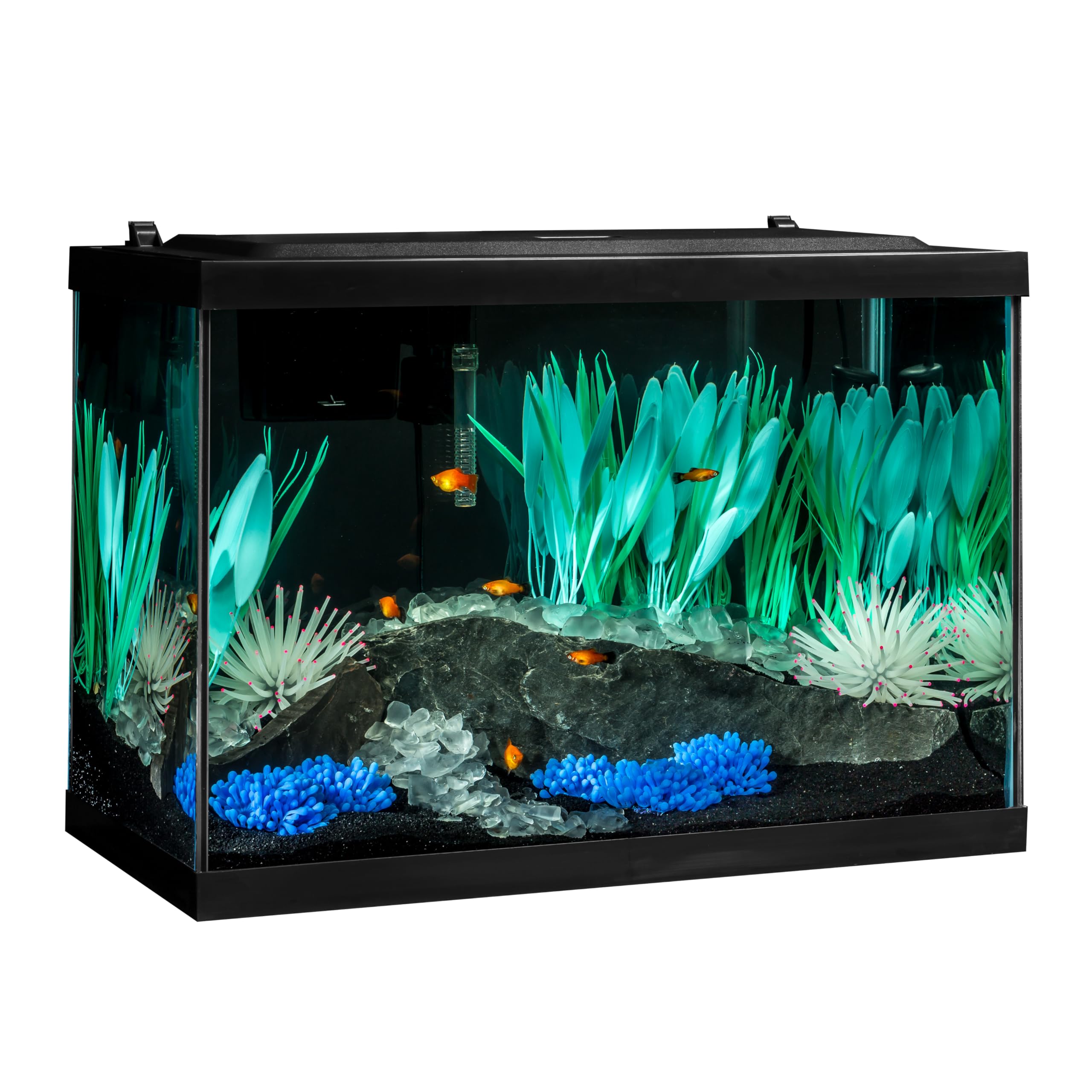
Rating: 4.3 ★ | Price: $$ | Capacity: 20 gallons | Filtration: Tetra Whisper 20 internal | Accessories: Heater, LED light, decor | Material: Glass | Dimensions: 24.2×12.4×16.7 in
The Tetra ColorFusion 20-gallon kit gives tetra keepers a ready-to-run setup with a heater, filter, and color-changing LED lighting. The 20-gallon size offers enough swimming space for a small community of tetras, and the included plants and anemone decor create an attractive underwater scene right away.
This kit targets first-time aquarium owners and families who want a complete solution for housing tetras without sourcing separate components. The included Whisper filter produces noticeable hum in quiet rooms, and occasional component issues (filter or heater replacements within months) have been noted — worth budgeting for a backup or upgrade down the line.
Pros
- Spacious 20-gallon tank that comfortably houses a small school of tetras
- Attractive appearance with included decorative plants and anemone
- Complete all-in-one kit with heater, filter, and LED lighting at a mid-range price
Cons
- The internal filter hum may be audible in quiet living rooms or bedrooms
- Heater and filter performance can vary between units, with some needing replacement within the first year
For tetra beginners who want everything in one box at a reasonable price, this kit is the most practical starting point — just plan for a quieter filter or a backup heater as needed.
Best for Small Tetras, Aquascaping
Fluval Flex 15 Gal Kit

Rating: 4.5 ★ | Price: $$$ | Capacity: 15 gallons | Filtration: 3-stage hidden filter | Accessories: LED light, remote | Material: Glass | Dimensions: 16x15x15 in
The Fluval Flex delivers whisper-quiet 3-stage filtration and customizable RGB LED lighting in a modern curved-glass design that stands out in any room. Compared to the Tetra ColorFusion 20-gallon kit, you sacrifice five gallons of capacity and a larger school of tetras, but gain a quieter pump and sleeker aesthetics. This kit suits intermediate hobbyists who value design and noise reduction over maximum swimming space — some units have developed glass cracks over time, and the filter intake vents can trap small tetras unless modified.
Pros
- Curved front glass and hidden filtration create a clean, modern look.
- Three-stage filter runs almost silently, ideal for quiet rooms.
- Sturdy glass construction with easy-access design for maintenance.
Cons
- Glass cracks or seal failures have been noted in some units after months of use.
- Small tetras can slip through intake vents into the filter compartment — a mesh guard is recommended.
A premium option for those who prioritize quiet operation and design over tank size, provided you’re comfortable with potential build inconsistencies.
Best for Custom Tetra Community
Tetra 29 Gal Tank Only

Rating: 4.6 ★ | Price: $$ | Capacity: 29 gallons | Filtration: None (tank only) | Material: Glass | Dimensions: 31.9×14.3×20.8 in
At 29 gallons, this bare glass tank delivers the most swimming space per dollar among tetra-sized options. It ships without a hood, filter, or light – a deliberate choice for experienced aquarists who prefer selecting their own components and already have the necessary gear for a large tetra community.
Pros
- Sturdy glass construction holds up well over time.
- 29-gallon capacity allows for a full school of tetras.
- Tank-only design lets you choose your preferred filtration and lighting.
Cons
- No hood, filter, or light included – requires separate purchases.
- Silicone seal inconsistencies can permit leakage in some units.
For experienced keepers who already own filtration and lighting, this is the most cost-effective path to a large, solid tetra tank.
Best for Betta, Nano
Marineland Portrait 5 Gal

Rating: 4.4 ★ | Price: $$ | Capacity: 5 gallons | Filtration: Hidden 3-stage | Accessories: LED light | Material: Glass | Dimensions: 9.5×9.5×14 in
The Marineland Portrait’s curved glass and hidden filtration create a sleek desktop nano tank, but its 5-gallon capacity makes it unsuitable for tetra schools. The compact footprint and included LED lighting are ideal for a single betta or shrimp.
Pros
- Curved glass design with hidden filtration maintains a clean, modern look.
- Compact footprint fits comfortably on a desk or shelf.
Cons
- Filter noise can be audible in quiet environments.
Best for desktop nano setups with a single betta or shrimp – tetra keepers need a larger tank.
Best for Quarantine, Betta
Koller 5 Gal Acrylic Kit

Rating: 4.2 ★ | Price: $$ | Capacity: 5 gallons | Filtration: Internal power 45 GPH | Accessories: LED light | Material: Acrylic | Dimensions: 16.5x10x11.8 in
The Koller 5-gallon kit offers attractive multi-color LED lighting and a compact acrylic tank that fits well on a desk. The included filter and light components may show signs of wear sooner than expected – making this a better fit for short-term use or as a quarantine tank. For those needs, the colorful lighting and small footprint are appealing.
Pros
- Attractive acrylic tank with color-changing LED lighting
- Compact 5-gallon footprint ideal for desktops or countertops
Cons
- Filter and LED lights may require replacement sooner than expected
This kit works well as a temporary quarantine tank or for a single betta, but it is not a dependable long-term choice for tetras.
How to Choose
Tetra fish are active schoolers – a 20-gallon tank is the recommended minimum to keep a stable school of 6-8 tetras healthy and stress-free.
Tank Capacity
Larger water volume dilutes waste and buffers temperature swings, which is critical for sensitive tetras like neons. A 10-gallon tank can hold a small school, but 20 gallons provides stable chemistry and room for a proper shoal.
In a 5-gallon tank, ammonia spikes from overfeeding can kill tetras within days. Always choose the largest tank your space allows – it directly reduces maintenance frequency and fish mortality.
Filtration Quality and Noise
Internal power filters are common in starter kits, but their impeller and flow design directly affect noise. Cheaper units lack sound-dampening, producing a constant hum or rattle that is especially noticeable in quiet rooms.
A filter’s GPH rating matters less than media capacity and turnover rate relative to tank volume. For a 20-gallon tank, a filter rated 150-200 GPH provides adequate flow without turning the tank into a washing machine.
Included Accessories
Many ‘complete kits’ omit a heater or include one with too low wattage for the tank size. A 20-gallon tank needs at least 50W to maintain 78°F, and budget heaters often fail within months.
LED lights in starter kits commonly fail from condensation because the seals are not rated for high humidity. If you plan to keep live plants, budget for a separate, sealed light fixture from the start.
Material: Glass vs Acrylic
Glass tanks resist scratches and hold their clarity for decades, but they are heavy and can crack during shipping. Acrylic tanks are lighter and more impact-resistant, but scratch easily even with a standard algae scraper.
For a tetra community that you’ll move once and set up long-term, glass is the straightforward choice. Acrylic suits temporary setups or locations where weight is a limiting factor.
Overall Dimensions
Tetras are horizontal swimmers – a long, shallow tank provides more usable swimming space than a tall, narrow one of the same gallonage. A 20-gallon ‘long’ (30x12x12 in) gives twice the swimming length of a 20-gallon high.
Always measure the footprint before buying. A tall tank may look space-efficient on a stand, but it restricts active schooling behavior and limits aquascaping options like driftwood and plants.
FAQ
What size tank do I need for neon tetras?
A 10-gallon tank can technically hold a small school of 6 neon tetras, but a 20-gallon tank is strongly recommended. The larger volume provides stable water parameters and enough swimming length for their natural schooling behavior. In a 10-gallon, any water quality mistake can quickly become lethal.
Why is my new aquarium filter making so much noise?
Most filter noise comes from trapped air in the impeller, debris, or a low water level. Unplug the filter, rinse the impeller and intake tube, and ensure the water level covers the intake. If the noise persists after cleaning, the pump may have an alignment defect – many budget filters have loose impeller shafts that create a grinding sound.
Can I keep tetras in a 5-gallon tank?
No. Tetras are active schoolers that need at least 10 gallons, and 20 gallons is the practical minimum for a healthy, low-stress shoal. A 5-gallon tank cannot sustain stable water chemistry for even a single tetra, and the confined space causes chronic stress and disease.
How to reduce filter noise in a small aquarium?
First, check that the water level is high enough to break the waterfall surface – a 1-inch drop creates splashing noise. Second, add a pre-filter sponge to muffle the intake hum. If the filter still rattles, replace the impeller or the entire unit; some budget filters are simply too loud for a bedroom or office.
How to handle fish entering the filter compartment in a Fluval Flex?
Small tetras can swim through the intake vents into the back sump. Install a fine mesh screen over the intake openings or block the gaps with filter sponge. Check the rear compartment weekly during water changes to retrieve any strays – they usually survive fine in the sump but miss feeding.