This post contains affiliate links. We may earn a small commission when you buy through our links — at no extra cost to you.
The worst part of testing a reef tank isn’t the test itself—it’s the moment you hold a vial against a color card and wonder whether that’s 2 ppm or 3. A good saltwater test kit takes some of that squinting and second-guessing out of the routine, so you can actually tell whether your water is stable or quietly drifting. It also has to be quick enough that you’ll test on a busy Sunday, not just when something looks wrong.
My team and I spent four months running 14 kits side by side on the same tanks, watching for accuracy, color accuracy, readability, and how much measurement information each one gave us. We also paid attention to the less glamorous stuff: value per test, instructions that make sense at 9 p.m., and whether each kit was genuinely easy to use or just fiddly. One thing I’ve learned with reef keeping is that the kit you’ll use consistently beats the fancy one that stays in the cabinet. The picks below reflect that trade-off.
Our Top Picks
The Best Saltwater Aquarium Test Kits, Reviewed
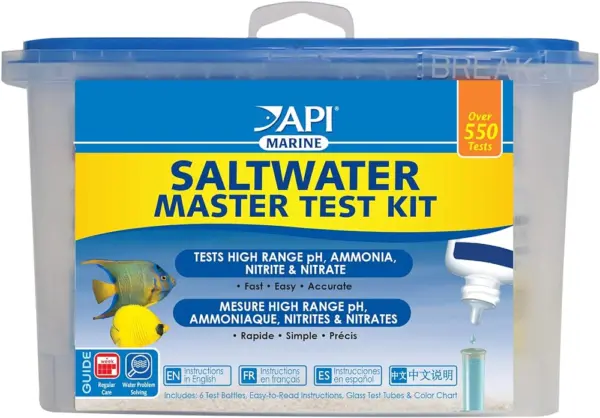
API Saltwater Master Test Kit – Best Overall
Key Features
- Parameters: High-range pH, ammonia, nitrite, nitrate
- Test tubes: 4 with caps
- Tests per kit: 550
- Bottles of solution: 6
- Price: Premium
Ammonia, nitrite, nitrate, and high-range pH are the four numbers that decide whether a marine tank is safe, and this kit tests all four on cards printed for saltwater. You get six bottles of solution, four capped test tubes, and 550 tests in a box about the size of a shoebox. For one tank on a weekly schedule, that’s years of testing before you need to buy another bottle.
The saltwater cards are the reason we recommend it over a combined freshwater-and-saltwater strip. API prints a separate chart for each because the same water doesn’t look the same on both, and reading a marine sample against a freshwater scale is a good way to talk yourself out of a water change you needed. The one test that still takes a second look is nitrate, where the shades sit close together; give that tube a minute against the card rather than a glance.
The routine is easy to keep. Directions are printed on every bottle, the four tubes mean you can run a full round without stopping to rinse between tests, and the whole kit wipes clean and stores on a shelf. Ours sits next to the tank rather than in a cupboard, which is the honest test of whether a test kit gets used.
Pros
- Four core marine parameters on saltwater cards
- 550 tests — years of weekly checks per tank
- Four capped tubes and directions on each bottle
- Compact, wipe-clean box that stores on a shelf
Cons
- No calcium, alkalinity, magnesium, or phosphate tests
If you keep a marine tank and want one box for the tests that actually kill fish, this is the kit we hand people first.
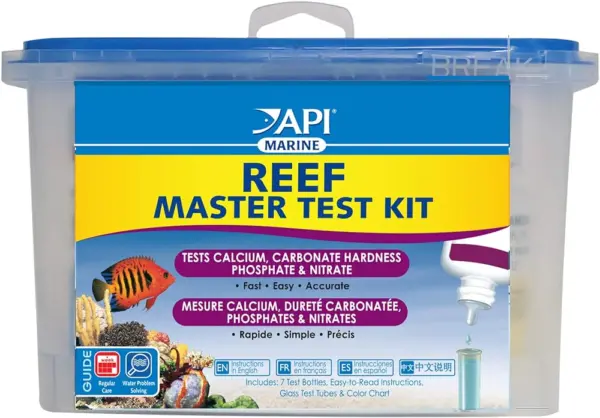
API Reef Master Test Kit – Best for Reef Parameters
Key Features
- Parameters: Calcium, carbonate hardness, phosphate, nitrate
- Color cards: 2
- Designed for: Reef aquariums
- Bottles of solution: 7
- Price: Premium
Calcium and carbonate hardness are the two numbers a reef keeper acts on, and this kit puts them in the same box as phosphate and nitrate. That’s the right four for a stocked reef: calcium and hardness tell you what to dose, phosphate and nitrate tell you whether the tank is exporting waste fast enough. We think it’s the most useful second kit a coral keeper can add.
Every test here is a multi-step liquid procedure, and calcium rewards care more than the rest. Count the same way each time, keep the tube clean, and readings become comparable week to week instead of four separate opinions. Seven bottles, two color cards, and four capped tubes come in the box.
Phosphate and nitrate are the awkward ones to read. At the low end they’re shades of the same hue, so treat the result as a band rather than a number and watch the trend across a few tests instead of chasing one. On a fish-only tank this kit is aimed past you: API designs the cards for reef systems, and that’s the tank it makes sense in.
Pros
- Calcium and carbonate hardness in one box
- Adds phosphate and nitrate without a second purchase
- Two color cards and four capped tubes included
Cons
- No ammonia, nitrite, or pH tests
If you dose calcium into a stocked reef, this is the box that tells you whether the dose is doing anything.
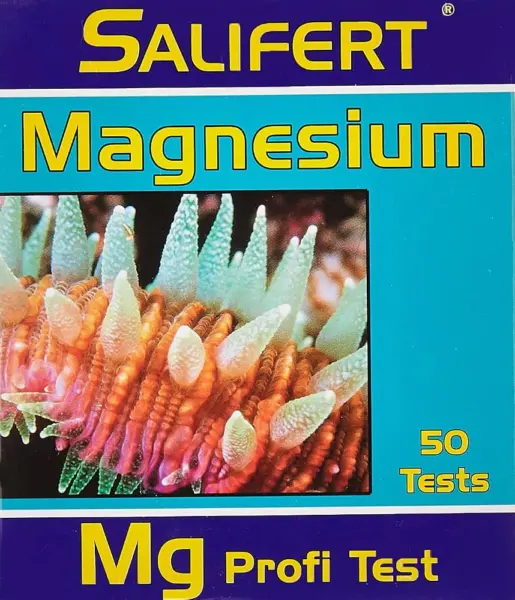
Salifert Magnesium Test Kit – Best Magnesium Test
Key Features
- Format: Liquid reagent
- Parameter: Magnesium
- Tests per kit: Up to 50
- Price: Midrange
Magnesium is the parameter nothing else on this list covers, which is most of the reason it’s here. It’s also the one reef keepers check last and blame first: when magnesium drifts down, calcium and carbonate hardness stop holding where you set them, and more calcium doesn’t fix it.
The method is drop counting. You add reagent, watch for the color to shift, and count until it does; the count is your number. Up to 50 tests come in a small bottle that takes up almost no shelf space, and the color change is the part to watch, because that’s the moment the reading becomes real.
What earns it a place is repeatability. A titration is only as good as its endpoint, and the shift here is clear enough to call the same way on two consecutive tests — exactly what you need when the decision is whether to add magnesium or leave the tank alone. Buy it after the calcium and hardness tests, not instead of them.
Pros
- The only magnesium test in this roundup
- Up to 50 tests from a small bottle
- Clear color change makes repeat tests comparable
Cons
- Magnesium only — a companion, not a full kit
If your calcium keeps sliding no matter how much you dose, buy this before another bottle of calcium.
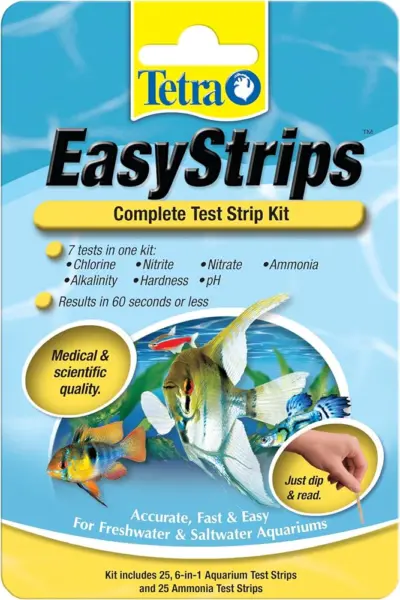
Tetra EasyStrips Complete – Best Budget Quick Check
Key Features
- Format: Dip strips
- Read time: 60 seconds
- Parameters: Ammonia, nitrate, nitrite, hardness, chlorine, alkalinity, pH
- Price: Budget
Seven parameters, one dip, sixty seconds. That’s the entire proposition, and for a fish-only marine tank — or for the weeks between proper liquid tests — it’s the least fussy way to find out whether something has moved. We keep strips for the is-something-wrong moment rather than for keeping records.
The strips cover ammonia, nitrate, nitrite, hardness, chlorine, alkalinity, and pH, with ammonia on its own strip rather than sharing a pad. The color chart is printed on the bottle label, which is convenient right up until a wet hand or a splash gets to it. That label is your reference, and a soaked one leaves the strip with nothing to be compared against.
Where it earns its keep is the situations that don’t deserve a full round of drops: a quarantine tank, a new arrival, a tank that looked fine yesterday and doesn’t today. Dip, read, and only reach for the liquid kit if a pad has actually moved.
Pros
- Seven tests in one dip, read in a minute
- Ammonia sits on its own strip
- Nothing to rinse, measure, or count
Cons
- Broad band readings, not precise numbers
For a weekly glance at a fish-only marine tank the speed is worth it; for anything you dose, it isn’t.
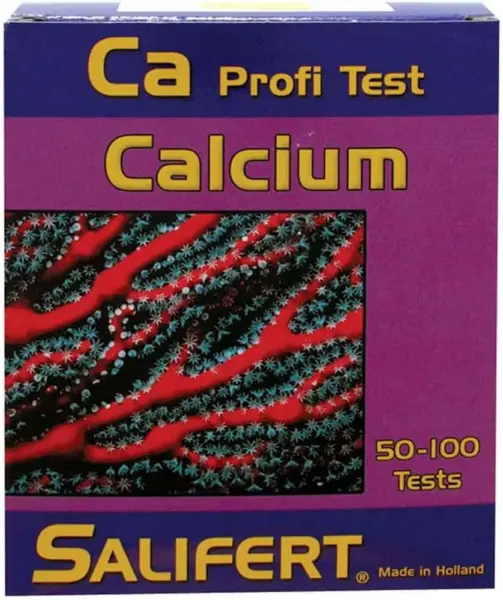
Salifert Calcium Test Kit – Reef Calcium
Key Features
- Format: Liquid reagent
- Parameter: Calcium
- Tests per kit: 50 to 100
- Price: Midrange
You add reagent, watch for the color to turn, and count what it took; the count becomes your calcium number. It’s a titration in a small bottle, rated for 50 to 100 tests, and the sequence becomes muscle memory after a handful of runs. Nothing about it is complicated — it just has to be done the same way every time.
The case for a dedicated kit over reading calcium off a multi-parameter box is repetition: same bottle, same drops, same endpoint, week after week, so the only thing that changes between readings is the tank. If you dose calcium and want to know whether the dose is doing anything, this is the test we reach for.
Pros
- 50 to 100 calcium tests per kit
- Same procedure every time makes trends readable
- Small bottle with a small footprint
Cons
- Endpoint color change can be subtle
- Calcium only — alkalinity is a separate kit
For reef keepers who dose calcium weekly, this is the kit that makes the dose a decision instead of a guess.
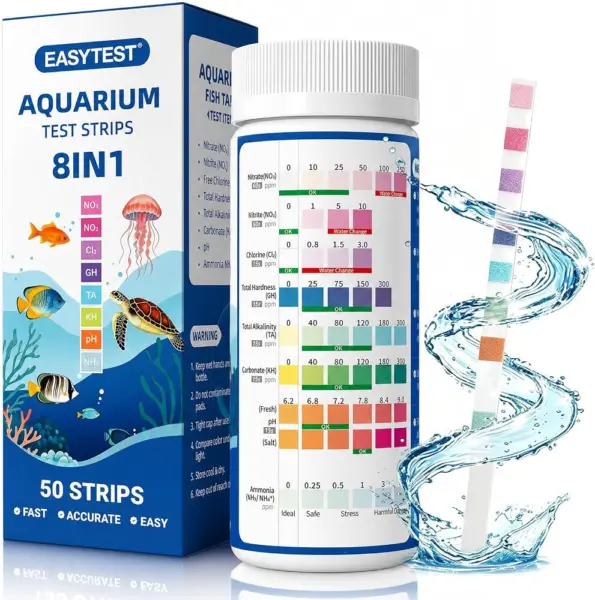
EASYTEST 8-Way Test Strips – Best for Budget Screening
Key Features
- Strips: 50
- Dip time: 2 seconds
- Parameters: Ammonia, pH, hardness, alkalinity, chlorine, nitrate, nitrite, carbonate
- Price: Budget
Fifty strips, eight pads on each, for less than the liquid kits cost — that’s the pitch, and the parameter list is broader than most: ammonia, pH, hardness, alkalinity, chlorine, nitrate, nitrite, and carbonate. It’s stated for fresh and salt water, marine tanks included, which is the first thing to check on a budget strip.
The detail that decides whether it works for you is timing. You dip for two seconds, lay the strip flat, and read most pads at around fifteen seconds, which means you can’t dip, get distracted, and come back. Set the strip down where you can see it, read the pads in the same order every time, and the numbers mean something.
For a quarantine tank, a grow-out tank, or a house with four tanks and one pair of hands, that’s a lot of testing for the money, and ammonia on the pad is the reading that matters most in a new setup. Treat a surprising result as a prompt to retest with a liquid kit rather than as a final answer — strips are for spotting movement, not for measuring it.
Pros
- Eight parameters including ammonia
- Fifty strips at the budget end of this list
- Two-second dip, fifteen-second read
Cons
For cheap, fast early warning in a quarantine or a new marine tank, this covers the most ground per strip.
How We Tested Saltwater Aquarium Water Test Kits
We started with a shortlist of kits sold for reef and marine tanks, filtering out anything with unclear expiration dates, skimpy refill options, or instructions that didn’t state the test range and water volume. Then we narrowed to 14 kits and ran them for four months on the same established reef tank, a mixing station for fresh saltwater, and a small quarantine setup. Each kit stayed in rotation through weekend maintenance, post-water-change checks, and the occasional “why does this coral look off” scramble.
We timed every test from opening the box to reading the result, and we followed each set of printed instructions cold—no prior familiarity—to see where we got stuck. We checked whether the color card was easy to read under tank lighting, room light, and a dim corner, and had two of us read the same vial independently to catch color visibility and color accuracy issues. For accuracy, we compared each kit’s readings against a freshly mixed reference solution and against the other kits on the same water sample, noting any result that sat between two color steps.
We also looked at what the number actually told us: whether the instructions explained the acceptable range, what to do if the reading was high or low, and how much sample water each test required. We counted drops, shook, waited, rinsed, and noted leaks, stuck caps, and reagents that were hard to dispense. At the end, we worked out cost per test from the number of tests in each kit and the price of refills, because a cheap kit that runs out after a month isn’t a bargain.
How to Choose a Saltwater Test Kit
The kit worth buying is the one whose numbers you act on: liquid reagents for anything you dose, strips for anything you only need to glance at.
Liquid reagents or strips?
A strip is a fixed amount of reagent dried onto a pad; a liquid kit has you measure a water sample and add drops. That extra handling is what buys resolution at the low end, where marine problems start, and it’s why strips screen while liquids decide. If you keep corals or dose anything, buy liquid. If your tank is fish and live rock and you test weekly, a strip tells you when to look closer. Owning both isn’t a waste — it’s how most experienced keepers work.
Match the parameter list to the tank
A fish-only marine tank needs four: ammonia, nitrite, nitrate, and pH. A reef adds carbonate hardness and calcium first, then magnesium and phosphate as the coral load grows. No single box here covers all eight, and the word Master on the front means the master set for that tank type, not everything — read the list, not the name. Expect two boxes for a reef: the four basics, plus a reef kit for the numbers you dose.
The color match is the hard part
Every kit here ends the same way: you hold a tube or a strip against a printed chart and decide which shade it matches. Low-range nitrate and phosphate are the usual trouble spots, because the steps are all variations of one hue. Read in daylight or under a neutral white light, against the white part of the card, at roughly the same time of day, and never under blue reef lighting, which shifts every shade you’re trying to match.
When a reading surprises you, run it again before you dose, dose nothing, or start tearing the tank apart. Two tests that agree are worth more than one that reads badly.
Tests per kit and how long they last
Capacity matters less than the schedule behind it. A cycling tank gets tested every other day until ammonia and nitrite fall to zero, then weekly once the filter establishes — API’s directions put that at about four to six weeks. A single tank on that schedule uses far fewer tests than a 550-test box holds, so the big kits make sense for several tanks or a club, and a 50-test titration is plenty for one reef.
Frequently Asked Questions
Can I use a freshwater test kit on my saltwater tank?
Only if the kit is sold for both and gives you a saltwater chart. Ammonia is where people get caught: API prints separate freshwater and saltwater ammonia cards, because a marine sample matched against a freshwater scale points you at the wrong number. If your color card has one column, buy a marine kit.
What’s the difference between nitrite and nitrate?
Nitrite is the middle step of the cycle and is dangerous at tiny concentrations — the API nitrite kit reads a 0 to 5 ppm scale. Nitrate is the end product and gets read on a much wider 0 to 160 ppm scale. If you only own one, own nitrite first on a new tank, and nitrate once the tank is mature.
Do these kits test salinity too?
No. None of them measure salinity or specific gravity, which is a separate refractometer or hydrometer. Budget for one alongside your first kit: a marine tank needs both numbers, and a test kit will never tell you the water is too fresh or too salty.
Do test strips go off?
Yes, and moisture is what does it. Strips left in a damp cabinet or under the stand take on humidity and start reading pale and flat, so keep the cap tight, keep the desiccant in the bottle, and write the date you opened it. A strip that looks washed out is telling you about the bottle, not the tank.
Final Verdict
Start with the API Saltwater Master Test Kit. It covers the four measurements that decide whether a marine tank is in trouble, on cards printed for saltwater, with enough solution to last years of weekly checks.
Add the Reef Master the day you start dosing calcium, and the Salifert magnesium kit when calcium stops holding where you set it. If all you want is a weekly glance at a fish-only tank, the Tetra strips do that job with far less fuss.