This post contains affiliate links. We may earn a small commission when you buy through our links — at no extra cost to you.
The worst thing an aquarium test kit can do is make you feel certain when you shouldn’t. A nitrate reading that looks close enough on the color card can talk you out of a water change; a pH result you can’t read in kitchen light can send you chasing a problem that isn’t there. The right kit turns all that into a short, repeatable habit—fill, dose, wait, compare—and gives you an answer you can act on. I’ve kept everything from a crowded community tank to a bare quarantine tank, and my team and I spent four months testing 14 freshwater and saltwater kits.
Some kits are wonderfully simple but vague on nitrate; others give a sharp color match and then ask you to count drops like a pharmacist. We weighed accuracy against the real chance you’ll stop testing if the process is a hassle, and we noted how each chart read in ordinary room light. A kit is only a good value if you’ll actually use it, and the picks below are the ones we kept reaching for.
Top Picks
Best for Freshwater Community Tanks
API Freshwater Master Test Kit

Rating: 4.8 ★ | Price: Premium | Format: Drop counts in 4 test tubes | Parameters: pH, high-range pH, ammonia, nitrite, nitrate | Water type: Freshwater only | Tests per kit: 800
Ammonia, nitrite, nitrate, pH and high-range pH, in one box, with reagent for 800 tests. That is the case for the Freshwater Master, and it is a strong one: those are the readings that tell you whether a tank is cycling, has crashed, or is quietly loading up on nitrate before a water change, and the kit measures them with drops and test tubes rather than pads you hold up to the kitchen light. Five parameters is not the widest spread here, but it is the right five.
Working through the whole set takes a few minutes and a stretch of bench space. The ammonia test wants two bottles and a wait, so we start it first and read pH while it develops; by the time the last tube is capped, the first has finished. The booklet is the part we appreciated most. It explains what each reading means and what to do about it, which is the difference between a test kit and a chemistry set.
Two gaps are worth knowing before you buy. There is no GH or KH test in the box, so if you keep shrimp, snails, or a heavily planted tank, plan on a hardness kit as well — the master kit will happily tell you your nitrogen is perfect while your molts fail. There is no chlorine test either, which matters mainly at water-change time. And nitrate is the fussy one: that second bottle needs a genuine 30 seconds of shaking, and at the top of the range the reds crowd together enough that a second opinion helps.
Eight hundred tests is the other half of the argument. At weekly testing on a couple of tanks this box lasts years, and the cost per test ends up well under what strips run you for the same coverage — which is why we send people here first and let them talk themselves out of it.
Pros
- Covers ammonia, nitrite, nitrate and both pH ranges
- 800 tests keeps the cost per test low
- Booklet explains what each result means
- Drop counts beat strips on the readings that matter
Cons
- No GH, KH or chlorine test in the box
We recommend the Freshwater Master to anyone keeping a freshwater tank: it reads the three nitrogen compounds and both pH ranges with drop-count precision, and one box covers years of weekly testing.
Best for Marine and Reef
API Saltwater Master Test Kit

Rating: 4.6 ★ | Price: Premium | Format: Drop counts in 4 test tubes | Parameters: High-range pH, ammonia, nitrite, nitrate | Water type: Saltwater only | Tests per kit: 550
Freshwater kits stop where saltwater starts. The ammonia test uses a different colour card for each water type, and marine pH sits above where a freshwater pH card tops out, so a freshwater master kit on a marine tank is a kit reading the wrong scale. The Saltwater Master is the same method rebuilt for salt water: high-range pH, ammonia, nitrite and nitrate, six bottles, four tubes and 550 tests.
Four parameters is the right scope for a fish-only marine tank, and we think that is the honest way to describe it. Ammonia and nitrite are what kill new fish, nitrate tells you the water change is due, and high-range pH is the reading a freshwater card cannot give you at all. For the first year of a saltwater tank this is the whole chemistry set, and it is the version we hand to someone setting up their first marine tank.
Reading it is the part that takes practice. Nitrate is where the shades bunch up, and a warm kitchen bulb will make two adjacent reds look identical; daylight and the white edge of the card settle most of it. Otherwise this is the same unglamorous, reliable chemistry as the freshwater kit, and 550 tests means you make the decision once rather than every couple of months.
Pros
- Marine-specific cards and high-range pH
- Covers the four readings that matter most
- 550 tests per box
Cons
- No alkalinity, calcium or magnesium tests
If your tank has salt in it, buy this one instead: high-range pH, ammonia, nitrite and nitrate, measured the same careful way as our freshwater pick, with 550 tests in the box.
Best for Multi-Tank Quick Checks
SJ WAVE 11-in-1 Test Strips
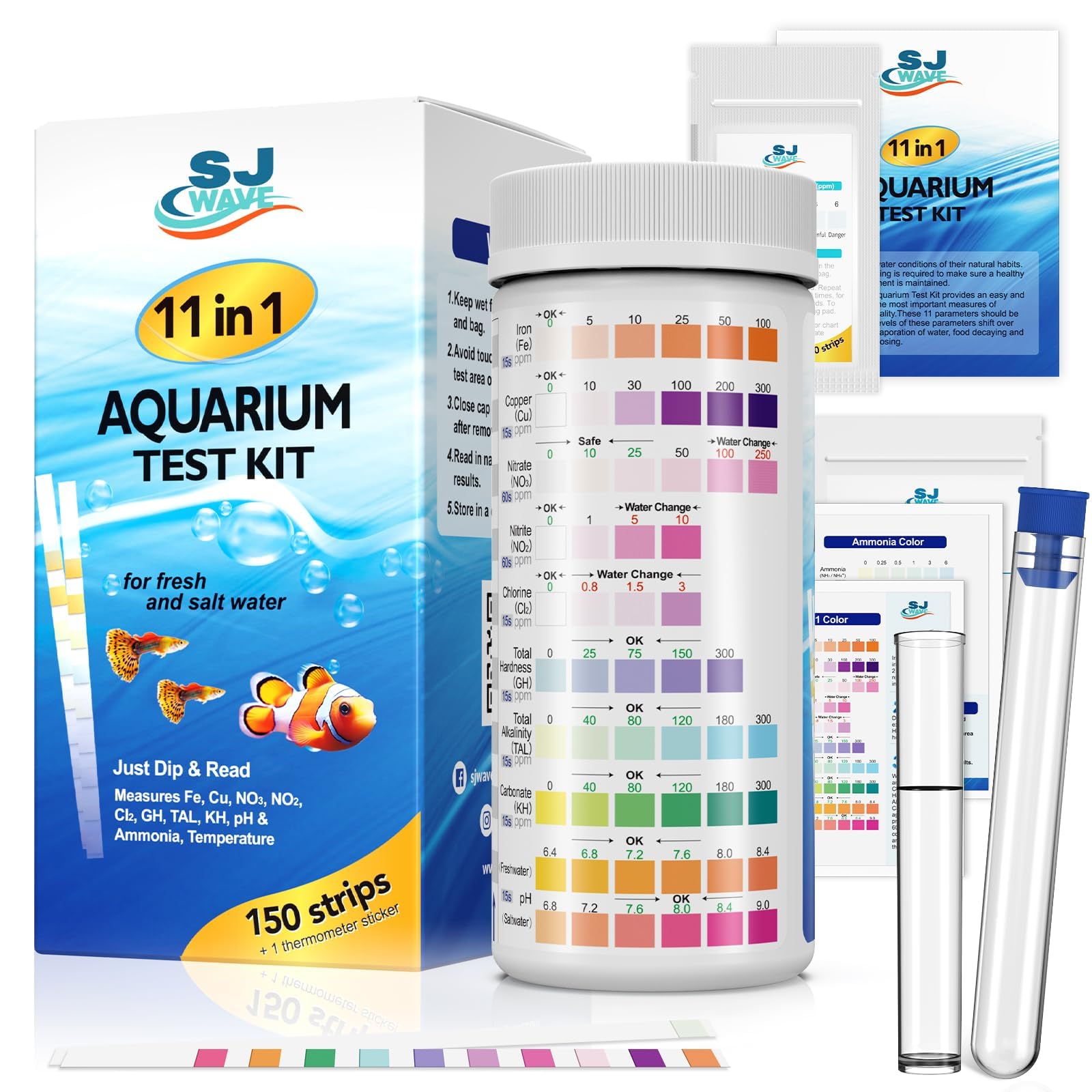
Rating: 4.5 ★ | Price: Midrange | Strips: 150, 50 of them ammonia | Parameters: 11, including a dedicated ammonia strip | Also included: Thermometer and ebook
A hundred and fifty strips is a different proposition from a box of reagents. Dip, lay flat, read, and a tank is done before you have capped anything back up — and this box splits the work eleven ways, with fifty of the strips dedicated to ammonia. That is the detail that earns these a place: ammonia is the parameter strip kits usually skip or squeeze into a pad too small to read, and a strip that can flag a spike is a strip worth keeping.
What you trade for the speed is precision. Eleven pads on one strip means small pads, and small pads mean shades that sit close together, nitrate worst of all. We treat these as a screening tool with a clear job: they tell you which tank needs a proper look, and a drop kit tells you what is actually happening in it. If you keep three or more tanks, that division of labour is worth paying for.
The extras are a mixed bag. There is a thermometer and an ebook in the box, and the ammonia strips come in their own bottle rather than sharing with the rest, which is the right instinct — damp pads are what kill a strip kit. The shelf-life claim is the maker’s rather than something we can promise. What we can say is that 150 strips at weekly testing across a few tanks is roughly a year of not thinking about reordering.
Pros
- 11 parameters with dedicated ammonia strips
- 150 strips is about a year of weekly tests
- Fast enough to sweep several tanks at once
Cons
- Small pads make close shades hard to read
For weekly glances across several tanks, these are the fastest thing here: 11 parameters, 150 strips, and 50 of them set aside for ammonia alone.
Best for Small Tanks, Beginners
Tetra EasyStrips Complete Kit

Rating: 4.5 ★ | Price: Budget | Strips: 25 six-in-one plus 25 ammonia | Read time: About 60 seconds | Parameters: Ammonia, nitrate, nitrite, hardness, chlorine, alkalinity, pH | Water type: Freshwater and saltwater
Two strips, about a minute, seven parameters. The Complete kit is Tetra’s small box, and what makes it worth its place is the split: a six-in-one strip for nitrate, nitrite, hardness, chlorine, alkalinity and pH, plus a separate strip for ammonia. Ammonia deserves its own pad — it is the reading you act on fastest, and squeezing it in beside six others is how strip kits end up with a pad nobody can interpret.
We like it best as a first kit. Twenty-five of each strip is enough to get through a cycle and a couple of months of weekly checks, and you are not committing to a reagent box before you know whether you will keep up with testing. For one small tank and a keeper finding their feet, that is about the right amount of kit to buy.
The chart is a label on the bottle rather than a loose card, which keeps it with the strips but makes it the thing that gets splashed. Dry your hands before you pick it up and the label outlasts the strips. Beyond that this is a small kit by design: keep more than a couple of tanks and the strips disappear faster than you expect, and one of the bigger boxes makes more sense.
Pros
- Dedicated ammonia strip alongside six other tests
- Seven readings in about a minute
Cons
- Colour shades are close on a small pad
A separate ammonia strip is what makes this the smart small kit: seven parameters in about a minute, and a sensible first purchase for one tank.
Best for Broad Cheap Screening
EASYTEST 8-Way Test Strips
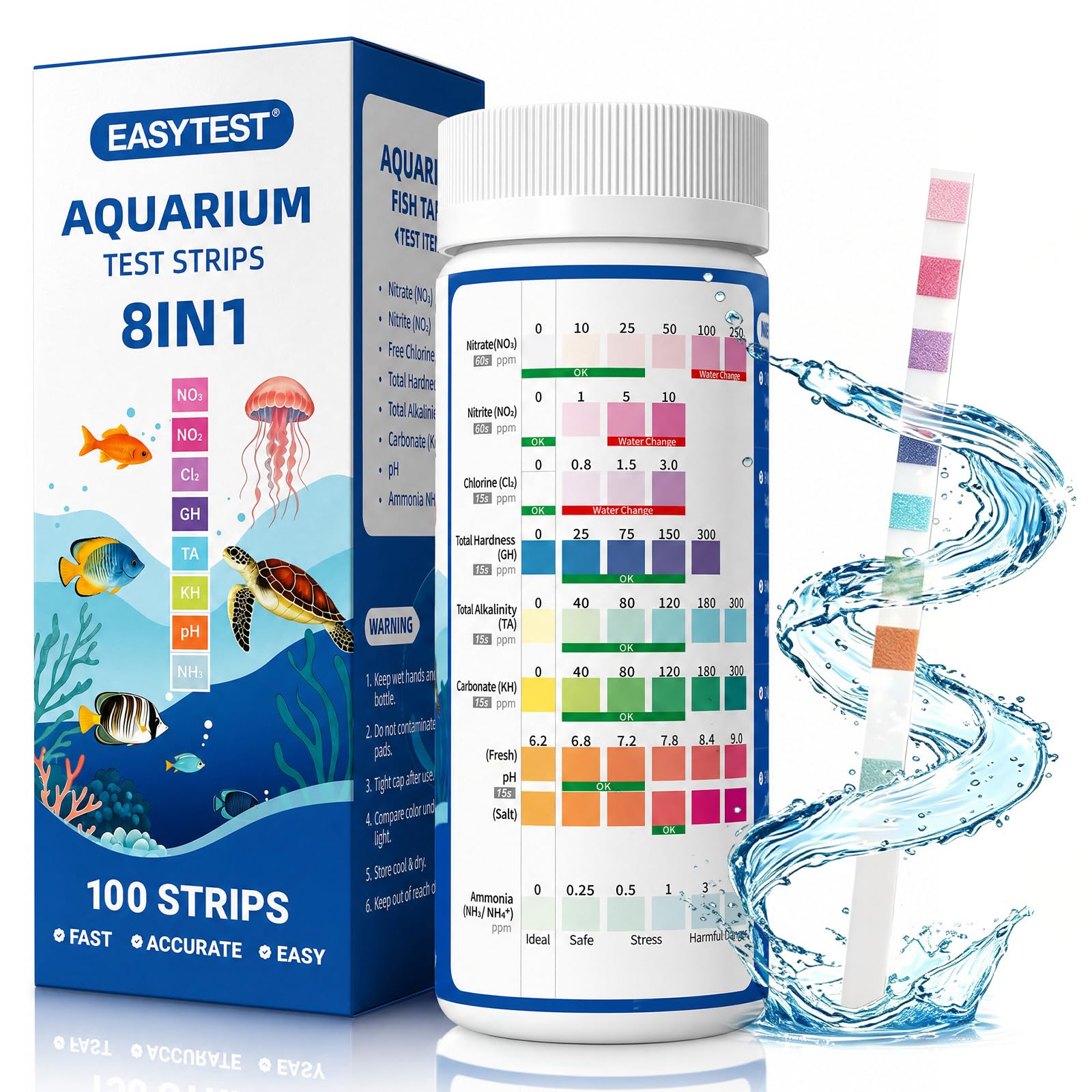
Rating: 4.5 ★ | Price: Budget | Strips: 100 | Parameters: 8, including ammonia and chlorine | Water type: Freshwater, saltwater, ponds
Colour bleeding is the classic strip failure: dip, lay it down, and the pad next to the one you are reading starts drifting into it. EASYTEST’s answer is the paper — a compact fiber construction designed to keep the pads from running together. We cannot verify a manufacturing claim from the outside, but it is the right problem to attack, and in our own use the pads have stayed distinct long enough to compare against the chart.
Eight parameters — ammonia, pH, hardness, alkalinity, chlorine, nitrate, nitrite and carbonate — is more than a beginner needs and about right for anyone running several kinds of water. The kit is labeled for freshwater, saltwater, betta and shrimp tanks and ponds, which makes it the one to throw in the bag when you are checking a quarantine tub or a friend’s setup.
Where it earns its place is bulk. A hundred strips means weekly testing without rationing, and the chlorine pad is genuinely useful on water-change day when you are topping up from the tap. What it is not is a precision instrument: treat a worrying result as a prompt to break out the drops rather than as a diagnosis, and read the strip in daylight, because eight similar pastels under a kitchen bulb is a guessing game.
Pros
- Eight parameters including ammonia and chlorine
- 100 strips for frequent testing
- Labeled for fresh, salt and ponds
Cons
- Screening-grade readings need drop-kit confirmation
Eight parameters including ammonia and chlorine, with 100 strips — the broadest cheap kit here for freshwater, saltwater, and ponds.
Best for Bulk Weekly Checks
Tetra EasyStrips 6-in-1 100-Count

Rating: 4.6 ★ | Price: Premium | Strips: 100 | Read time: About 60 seconds | Parameters: Nitrate, nitrite, hardness, chlorine, alkalinity, pH | Water type: Freshwater and saltwater
The first thing to know is what is not on the strip: ammonia. Six pads cover nitrate, nitrite, hardness, chlorine, alkalinity and pH, which is a useful set — the chlorine pad alone earns its keep on water-change day — but if you are cycling a tank or keeping goldfish, ammonia is the reading you check first, and there is not one here.
What is left is volume. A hundred strips is a season of Sunday checks across three or four tanks, and it is quick: dip, wait, read, done. We keep coming back to the chlorine pad at water-change time, because it is the one parameter a dechlorinator dose does not actually prove, and a strip is the right tool for a quick yes or no.
Nitrate is where these are weakest, and it is a strip problem more than a Tetra one: the pads sit close, the shades run together at the top of the range, and a pad left past its read time goes darker than the tank really is. Read at the stated time, in daylight, and do not trust the top end too precisely. Buy these for the weekly glance and the chlorine check, and keep a drop kit for anything that matters.
Pros
- 100 strips covers months of weekly checks
- Chlorine pad is useful at water changes
Cons
- No ammonia test on the strip
For a multi-tank keeper who already owns an ammonia test, these 100 strips are cheap, fast weekly coverage of everything else.
How We Tested Aquarium Water Test Kits
We started with a spreadsheet of kits sold for freshwater and marine tanks, then narrowed it by the parameters each one covered, how many tests a refill would buy, and whether replacement reagents were easy to find. Kits with vague instructions or refills that cost nearly as much as a new kit were set aside, because value for money matters most when a test you rely on disappears from the shelf. That left 14 kits, which we used for four months across my own tanks and a borrowed quarantine setup.
That testing followed the rhythm of tank care, not a lab bench. On Sunday mornings I ran the full panel before a water change; on weeknights I spot-checked ammonia and nitrite after feeding or adding fish. With each kit I filled the tube to its marked line, counted drops aloud, timed the wait, and read the result against the card in ordinary kitchen light and again by a window. A second person read the same tube without seeing my answer, because color accuracy and readability are not the same thing: a chart can be precise and still be impossible to match at a glance.
For nitrate, I paid special attention to whether the low range separated cleanly from the next step and whether the high range required dilution, since that’s where many kits get vague. I also noted whether caps sealed without leaking, whether the tube markings stayed legible after repeated rinsing, and whether the instructions told me what to do when a result fell between two colors. We ran each kit twice on the same sample and flagged any kit whose two readings disagreed by more than one color step. At the end, we counted how many tests each kit actually delivered before the reagents ran out.
How to Choose an Aquarium Water Test Kit
The kit you will actually use every week beats the one with the longest parameter list, so start from what you will genuinely test and work outward.
Cover the readings that can kill fish first
Ammonia and nitrite are the two that kill, nitrate is the one that accumulates between water changes, and pH is the one that drifts when nobody is looking. A kit covering those four will carry you through a cycle and the year after it. Chlorine matters mainly on water-change day, and GH and KH matter if you keep shrimp, snails, livebearers, or a heavily planted tank, where hardness decides whether anything molts or grows properly.
The API Freshwater Master covers the first group well and leaves hardness out entirely, so a shrimp keeper should budget for a separate GH and KH test alongside it rather than discover the gap after a failed molt.
Drop kits and strips do different jobs
Strips are for frequency; drops are for certainty. A strip gives you a reading in about a minute, which is why it gets used on a Tuesday evening when you are already running late. A drop kit takes several minutes of shaking and waiting, which is why it gets used when something looks wrong. Neither replaces the other, and plenty of experienced keepers own both.
The trap with strips is timing. The pads keep developing after the stated read time, so a strip left lying on the lid while you hunt for the chart will read higher than the tank does. Read at the time the label gives you, then decide what to do.
Read the colour, not the mood
Nearly every complaint about every kit here comes down to matching a shade. Two things help more than any accessory: daylight, and a white background. Hold the tube or the strip against the white edge of the card in indirect window light rather than under a warm kitchen bulb, and compare one pad at a time instead of the whole strip at once.
Above the middle of the nitrate range the shades bunch together on the cards themselves. Treat a high reading as high rather than as a precise number, and confirm it with a second test before you start moving water around.
Count tests, not bottles
The headline number on a master kit is tests, and it is the one worth doing arithmetic on. The API masters run to 800 and 550 tests, which at weekly testing on two or three tanks is years of use; a 25-strip kit is a couple of months. Reagents expire, so a large box only pays off if you will genuinely test often.
If you keep one nano tank and test monthly, a small strip kit makes more sense than a master kit slowly going stale on the shelf. If you have four tanks and a quarantine tub, the arithmetic flips fast.
Freshwater, saltwater, and the pH range trap
Freshwater and saltwater kits are not interchangeable, and the difference is more than the label: the ammonia test uses a different colour card for each water type, and marine pH sits above where a freshwater pH card stops. Buying the wrong one is an easy mistake and an expensive way to misread a tank.
Watch the range on pH tests especially. A cheap pH kit that reads 6.0 to 7.6 is fine for a community tank and useless for African cichlids, goldfish, or anything marine, so check the scale before you buy rather than after. The API Freshwater Master sidesteps this by carrying both pH scales in one box.
Frequently Asked Questions
My fish look healthy, so do I still need a test kit?
Ammonia and nitrite are invisible and odorless, and fish often behave normally until the damage is already done, so ‘they seem fine’ is not a reading. A new tank wants testing every other day while it cycles, which typically takes four to six weeks, then weekly once the filter is established.
If you only ever buy one test, make it ammonia. It is the reading that turns a mystery into a decision.
Why does my nitrate test read higher than my test strip?
Nitrate is the fussiest test in any kit. The second reagent bottle settles out, so it needs a hard shake before you add the drops, and a bottle that has been sitting for months needs longer rather than shorter. If a strip and a drop kit still disagree after that, trust the drops and check the expiry date on both.
Can I pour the tested water back into the tank?
No. The tube holds reagents by the time you have read the result, and the drop-kit directions say plainly not to return it to the aquarium. Pour it down the drain, rinse the tube with clean water, and let it air dry.
The same goes for strips, which belong in the bin rather than back in the water. Keep the bottles out of reach of children and away from the tank lid.
Final Verdict
For a freshwater tank, buy the API Freshwater Master and stop looking: ammonia, nitrite, nitrate and both pH ranges, measured with drops rather than pads, 800 tests in the box and a booklet that tells you what to do with the numbers. Saltwater keepers should take the Saltwater Master instead, which is the same method with the marine cards and the high-range scale.
And if your testing habit is really a fast Sunday glance across several tanks, the SJ WAVE strips will get more use than either — just keep a drop kit for the results that scare you.