This post contains affiliate links. We may earn a small commission when you buy through our links — at no extra cost to you.
Test strips promise a quick dip-and-read answer, but many aquarists find their nitrate readings don’t match what a liquid kit shows. That mismatch can lead to overfeeding or missed water changes in a reef tank, or unnecessary panic in a freshwater setup.
The real divide is between convenience and precision. Liquid reagent kits take a few extra minutes but give you a reliable number you can act on. This guide breaks down when strips work fine and when you need a liquid kit — so you spend money on the right tool for your tank.
The right test kit eliminates that doubt — and keeps your fish healthy.
Top Picks
Best for Freshwater Accuracy
API Freshwater Master Test Kit

Rating: 4.8 ★ | Price: Premium | Test Method: Liquid reagent | Parameters: 5 (pH, NH3, NO2, NO3) | Test Count: 800 | Low-Range: Reliable >5 ppm | Color Chart: Hard in low light
800 tests covering pH, ammonia, nitrite, and nitrate provide comprehensive parameter coverage for any freshwater aquarium. The liquid reagent method delivers consistent results that dip strips cannot match, making it the reference standard for weekly monitoring and troubleshooting during tank cycling.
Best suited for aquarists who prioritize accuracy over speed and are comfortable with deliberate testing steps. The nitrate color chart requires consistent lighting to differentiate shades – something to consider if you test in dimly lit spaces. This kit works well for beginners wanting a complete starter set and for hobbyists managing multiple tanks who need repeatable readings across all critical parameters.
Pros
- Single kit tests pH, high range pH, ammonia, nitrite, and nitrate – no separate purchases needed.
- Liquid reagent method offers consistent accuracy that is preferred over test strips for diagnosing water quality issues.
- Includes approximately 800 tests, lasting months of weekly use for a single tank.
Cons
- Test tube caps can leak if not fully tightened, potentially causing drips during the shaking step.
- Liquid test procedure takes more time and careful reading compared to quick dip strips.
For freshwater aquarists who want accurate, repeatable test results for all essential parameters, this kit is the straightforward choice.
Best for Quick Weekly Checks
API 5-in-1 Test Strips 25pk

Rating: 4.6 ★ | Price: Mid-Range | Test Method: Test strip | Parameters: 5 (pH, NO2, NO3, GH, KH) | Test Count: 25 | Low-Range: Reliable >10 ppm | Color Chart: Easy to read
Dip-and-read simplicity makes these strips the go-to for fast water quality checks: 30 seconds, no mixing, no timing. While the top pick’s liquid kit nails nitrate precision, these strips trade that accuracy for speed — readings can vary between batches, especially for nitrate. Best for busy hobbyists maintaining low-bio-load tanks where exact numbers aren’t critical. For tanks with sensitive fish or reef inhabitants, the batch-to-batch variation makes liquid testing the safer call.
Pros
- Dip-and-read results in seconds — ideal for quick weekly checks.
- Lower per-test cost than buying strips individually at pet stores.
Cons
- Readings can differ from liquid test results, especially for nitrate — best for trend tracking rather than precise dosing decisions.
If speed and ease are your priority over exact nitrate numbers, these strips deliver exactly that — an efficient daily tool for routine monitoring.
Best for Reef Precision
Salifert Nitrate Test Kit

Rating: 4.6 ★ | Price: Mid-Range | Test Method: Liquid with powder | Parameters: Nitrate only | Test Count: ~60 | Low-Range: Reliable to 0.2 ppm | Color Chart: Clear endpoint
The Salifert Nitrate Test Kit delivers the sensitivity reef keepers need, reading as low as 0.2 ppm with a clear color endpoint that removes the guesswork often required by broader liquid kits. This single-parameter focus means it is not a replacement for an all-in-one master kit, but for tracking nitrate specifically it outperforms both strips and standard liquid tests.
This kit suits reef aquarists who must keep nitrate below 5 ppm and have struggled with the readability of API tests. However, it is worth inspecting the contents upon arrival — some units have arrived missing the measuring spoon for reagent 2, which makes the test unusable until a replacement is obtained.
Pros
- Detects nitrate as low as 0.2 ppm, essential for reef tanks needing precision below 5 ppm.
- Clear color endpoint reduces reading errors common with API nitrate tests.
- Well-regarded by the reef keeping community for budget precision testing.
Cons
- Powder reagent requires careful measuring, which some may find fiddly.
The go-to liquid nitrate test for reef aquarists who need sensitivity below standard test kits — just verify the spoon is included upon arrival.
Best for Tech-Savvy Reefers
Hanna HI782 Nitrate Checker

Rating: 4.5 ★ | Price: Premium | Test Method: Digital colorimeter | Parameters: Nitrate only | Test Count: 10 (refills sold) | Low-Range: Digital readout 0-100 ppm | Color Chart: No chart (digital)
Digital colorimeter removes lighting-dependent color matching, giving a clear numeric reading from 0–100 ppm in both freshwater and saltwater. Unlike the API Master Kit’s color chart or standard strip tests, this delivers consistent results across different lighting conditions. Best for serious reef keepers who test nitrate infrequently and want precision over cost. However, the included 10 reagent packets cover only initial use; refill packets add significant ongoing expense and may be harder to source than standard liquid reagents.
Pros
- Eliminates guesswork with a digital readout – no more squinting at color charts.
- High accuracy repeatable across tests – suitable for tracking trends in sensitive tanks.
- Works with both freshwater and saltwater – single tool for multiple setups.
Cons
A precision instrument for aquarists who value a numeric nitrate reading and are willing to pay a premium per test.
Best for Budget Beginners
Tetra EasyStrips 6-in-1

Rating: 4.6 ★ | Price: Budget | Test Method: Test strip | Parameters: 6 (NO3, NO2, pH, GH, KH, Cl) | Test Count: 25 | Low-Range: Reliable >10 ppm | Color Chart: Clear and readable
Tetra EasyStrips 6-in-1 offers a clear, easy-to-read color chart at a budget-friendly price, making it the most accessible nitrate test strip for beginners. The dip-and-read process delivers results in seconds — far faster than the liquid kit that sets the accuracy standard. This convenience suits casual weekly checks on a stable tank. However, for precise readings during cycling or troubleshooting, a liquid test kit is more appropriate. The strip also omits ammonia testing, so a separate kit is needed for new tank setups.
Pros
- Dip-and-read process provides quick results with no complex steps.
- Budget-friendly alternative to buying multiple single-parameter kits.
- Color chart uses clear, distinguishable shades for easy reading.
Cons
- Readings can vary compared to liquid test kits, especially for nitrate and pH.
For budget-conscious beginners with a stable tank who want a quick nitrate check, this strip delivers convenience and clarity without the commitment of a liquid kit.
Best for Frequent Multi-Testers
SJ WAVE 11-in-1 Strips 150pk
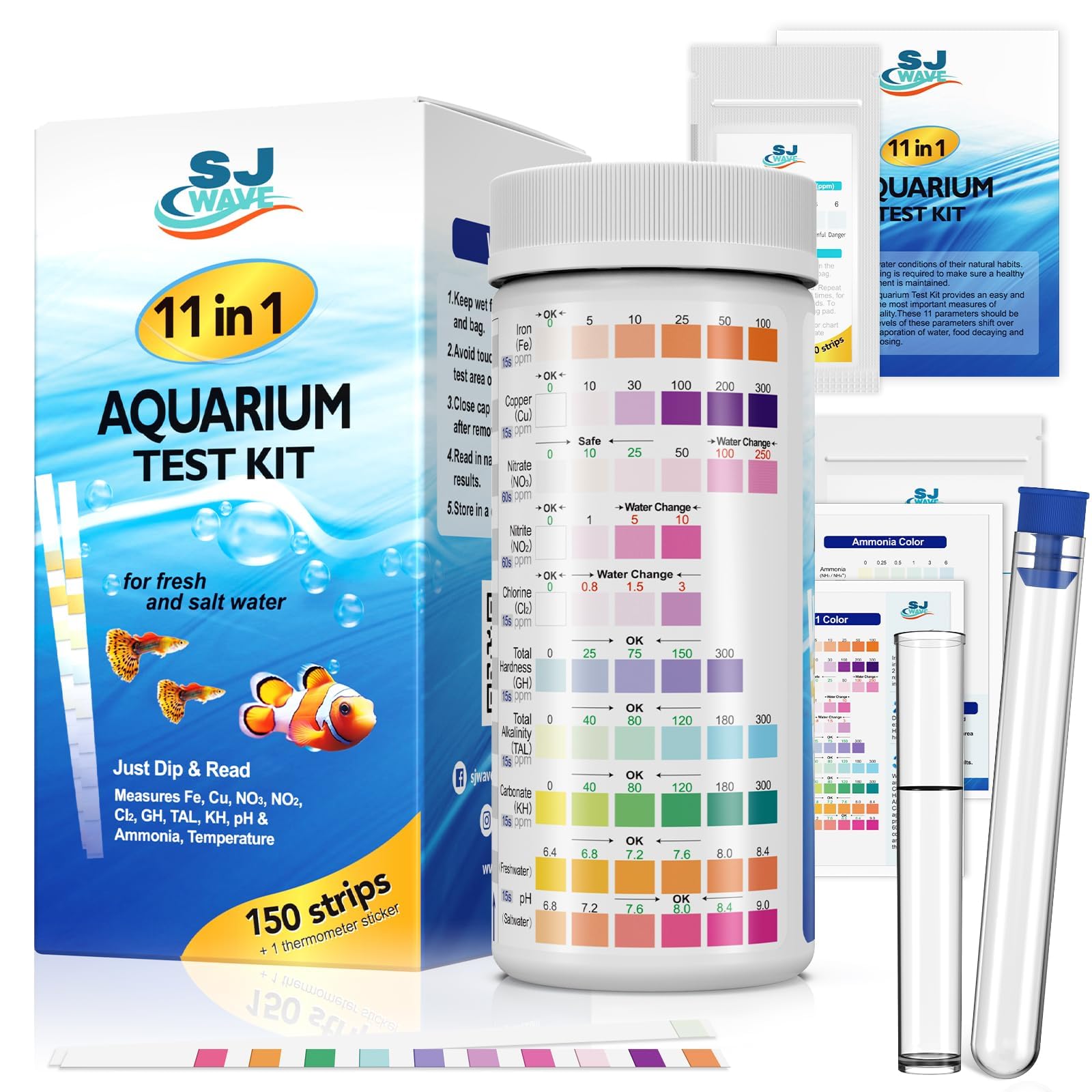
Rating: 4.5 ★ | Price: Mid-Range | Test Method: Test strip | Parameters: 11 incl. NH3 (separate pad) | Test Count: 150 (50 NH3 + 100 gen) | Low-Range: Reliable >10 ppm | Color Chart: Easy to read
This kit measures 11 aquarium parameters, from pH and hardness to nitrate and nitrite, plus a dedicated ammonia pad — more than any other test strip bundle currently available. Unlike standard 5-in-1 strips that omit ammonia, this gives a broader snapshot in one dip. The tradeoff: the ammonia pad may not react consistently, so aquarists who need precise ammonia readings during cycling or troubleshooting should keep a separate liquid test kit handy. For routine weekly checks and those who test often, the 150-strip count and mid-range price make this a practical choice.
Pros
- Covers 11 water quality parameters in one dip, including ammonia, nitrate, nitrite, and pH
- 150-test count at a mid-range price suits frequent testers
Cons
- Ammonia test pad may not indicate ammonia levels, requiring a separate test for that parameter
Best for hobbyists who want broad parameter coverage and test frequently, as long as they supplement with a liquid ammonia kit for that specific reading.
Best for Casual Monitoring
AAwipes 8-in-1 Strips 100pk

Rating: 4.4 ★ | Price: Budget | Test Method: Test strip | Parameters: 8 (NH3, NO3, NO2, pH, etc.) | Test Count: 100 | Low-Range: Reliable >10 ppm | Color Chart: Easy to read
These strips are easy to dip-and-read and offer 100 tests at a low per-strip cost. However, the ammonia test pad may not change color, making that reading effectively unavailable. Overall accuracy is variable, so they work best for casual trend watching where exact numbers aren’t needed.
Pros
- Simple dip-and-read process with clear instructions.
- Low per-test cost for a multi-parameter strip pack.
Cons
- Ammonia test pad may not change color, making the ammonia reading unreliable.
Best for casual hobbyists who want a cheap way to get rough estimates and don’t need to track ammonia precisely.
Best for Api Refill Users
API Nitrate Test Kit 90-Test

Rating: 4.7 ★ | Price: Budget | Test Method: Liquid reagent | Parameters: Nitrate only | Test Count: 90 | Low-Range: Reliable >5 ppm | Color Chart: Hard in low light
Offering 90 nitrate-specific tests at a low per-test cost, this is a sensible refill for existing API Master Kit users who test nitrate often. It’s not for beginners—without the master kit, you’d miss ammonia and nitrite. And like the master kit, the color chart struggles with low-level differentiation (0–20 ppm), requiring good lighting for accuracy.
Pros
- Simple two-step process delivers quick nitrate readings
- Lower per-test cost than buying a full master kit
Cons
- Color chart makes it difficult to differentiate between 0, 10, and 20 ppm under dim light
Best for experienced aquarists who already have the API Master Kit and want to stock up on nitrate reagent without buying a new full kit.
Best for Quick Reference
DIPSTIK 7-Way Strips 100pk

Rating: 4.5 ★ | Price: Budget | Test Method: Test strip | Parameters: 7 (NO3, NO2, Cl, GH, KH, CO3, pH) | Test Count: 100 | Low-Range: Reliable >10 ppm | Color Chart: Easy to read
The DIPSTIK 7-Way strips deliver a low-cost way to check nitrate and other basic parameters in both freshwater and saltwater. The dip-and-read process is simple enough for beginners. However, pH and hardness readings may deviate from expected values, making this kit better suited for broad trend monitoring than for critical water management decisions.
Pros
- Affordable per-test cost for frequent checks
- Simple dip-and-read operation suitable for beginners
Cons
- pH and hardness results may not match liquid kit readings, limiting diagnostic use
A budget-friendly option for casual, non-critical parameter checks where exact numbers aren’t needed.
Best for Frequent Budget
HOVIRAN 7-Way Strips 125pk

Rating: 4.5 ★ | Price: Budget | Test Method: Test strip | Parameters: 7 (NO3, NO2, Cl, GH, KH, CO3, pH) | Test Count: 125 | Low-Range: Reliable >10 ppm | Color Chart: Easy to read
For the price, you get a lot of strips — enough for daily checks without worrying about cost. The dip-and-read method is about as simple as it gets. But accuracy is the tradeoff: some strips may fail to change color or give inconsistent results, so this is not a tool for making decisions about water changes or sensitive livestock. It works for general trend watching in stable tanks where rough readings are enough.
Pros
- Extremely low cost per strip — one of the cheapest ways to test frequently.
- Simple dip-and-read method requires no mixing or timing.
Cons
- Some strips can fail to change color, making readings unreliable for any meaningful water management decisions.
If you want a cheap way to get a rough sense of water parameters without needing to act on the numbers, this pack delivers value — just don’t rely on it for anything critical.
Best for Broad Parameter Set
JNW Direct 9-in-1 Strips 100pk

Rating: 4.3 ★ | Price: Mid-Range | Test Method: Test strip | Parameters: 9 (incl. Cu, Fe) | Test Count: 100 | Low-Range: Reliable >10 ppm | Color Chart: Color bleeding reported
This strip kit covers more parameters than most, including copper and iron – a rare find for planted tank keepers. The wide parameter set comes with a tradeoff in reading precision, limiting its use for critical water management. It’s a tool for trend-watching rather than exact measurements.
Pros
- Tests copper and iron alongside standard parameters – useful for planted tank care.
- Easy to use – just dip and compare against the color chart.
Cons
- In some cases, color bleeding between pads can make readings ambiguous, especially for nitrate and pH.
Best for planted tank hobbyists who want a rough gauge of copper and iron levels and accept approximate readings for other parameters.
Best for Planted Tank Metal
Wutest 9-Way Strips 150pk

Rating: 4.5 ★ | Price: Mid-Range | Test Method: Test strip | Parameters: 9 (incl. Cu, Fe) | Test Count: 150 | Low-Range: Reliable >10 ppm | Color Chart: Easy to read
This 9-parameter strip kit includes nitrate testing but stands out for its iron and copper tests, useful for planted tank monitoring. However, color change accuracy can be inconsistent between strips, so it’s best as a secondary test rather than a primary tool for precise nitrate management.
Pros
- Unique iron and copper tests alongside standard parameters – a rare combination in strip kits.
- Simple dip-and-read method with no mixing required.
Cons
- Extra iron and copper tests add complexity if you only need nitrate monitoring.
A niche strip for planted tank keepers who want to track iron and copper, but not a substitute for a precise nitrate test kit.
How to Choose
For accurate nitrate readings, a liquid reagent kit vastly outperforms test strips, especially when you need to measure levels below 10 ppm.
Test Method: Liquid vs. Strip vs. Digital
Liquid reagent kits use chemical reactions that produce a color proportional to nitrate concentration. They are the most reliable method for freshwater and reef tanks because the reaction is consistent and the color intensity scales predictably.
Test strips rely on a pad that changes color after contacting water. The color is affected by temperature, lighting, and how long you hold the strip. Digital colorimeters like the Hanna HI782 remove human interpretation entirely by measuring light absorption, but they cost more per test and require refill packets.
Parameters Included
A multi-parameter kit tests nitrate alongside ammonia, nitrite, and pH — essential for monitoring the nitrogen cycle. Dedicated nitrate kits only test nitrate, which is fine if you already own a master kit for the other parameters.
Many test strips omit ammonia, forcing you to buy a separate ammonia test. If you are cycling a new tank or keeping sensitive fish, ensure your kit includes ammonia or be prepared to test it separately.
Number of Tests Per Kit
Liquid kits often claim 800 tests, but that number is based on using the minimum reagent volume per test. In practice, you get fewer tests if you follow the recommended drop counts. Strips give exactly the number listed — no guesswork.
For a single tank tested weekly, a 25-strip box lasts about six months. A 100-strip box covers two years. Liquid kits with 800 tests can last over a year even with frequent testing, making them cheaper per test in the long run.
Low-Range Nitrate Accuracy
Reef tanks with SPS corals require nitrate below 5 ppm, often below 1 ppm. Standard liquid kits like the API Master Kit have color charts that make it hard to distinguish 0, 10, and 20 ppm. Dedicated low-range tests like Salifert use a refined reagent that produces a distinct color shift at 0.2 ppm.
Test strips cannot reliably detect nitrate below 10 ppm. If you keep discus, shrimp, or corals, a liquid kit with a low-range scale is the only safe choice.
Ease of Reading Color Charts
Color charts work well under bright, white light. Under LED or dim lighting, matching shades becomes unreliable — especially for the API nitrate test where the orange-to-red gradient is subtle. Some users photograph the results against a white background to improve accuracy.
Digital testers bypass color matching entirely. For aquarists who test multiple times a week, the upfront cost of a colorimeter may be offset by the elimination of second-guessing.
FAQ
Why do my test strip nitrate readings differ from the pet store’s liquid test?
Test strips are less precise than liquid reagent kits. The color development on a strip is affected by humidity, temperature, and how long you dip it. Pet stores typically use liquid test kits that are calibrated and controlled. Expect strip readings to be 10–20 ppm off from liquid results, especially in the 20–80 ppm range.
How accurate are API test strips for nitrate in a freshwater tank?
API test strips provide a rough estimate, not a precise number. Many users report that strip readings differ from their API liquid master kit by 10–20 ppm. For tracking trends (rising or falling nitrate), strips work; for exact dosing or water change decisions, use the liquid test.
Do I need a liquid nitrate test kit for a reef tank or are strips good enough?
Strips cannot reliably measure nitrate below 10 ppm, which is the range most reef keepers need to maintain for SPS corals. A liquid kit like Salifert or a digital checker like the Hanna HI782 is essential for reef tanks where nitrate must stay below 5 ppm.