This post contains affiliate links. We may earn a small commission when you buy through our links — at no extra cost to you.
More light grows healthier plants, and more light grows algae — that’s the tradeoff nobody puts on the box when you buy your first planted-tank light. What you’re really shopping for is control: enough brightness to push new growth, a spectrum that favors leaves over green water, and a schedule you can set and forget. Get that right and a modest strip will outperform the hood bulb that came with your tank; get it wrong and you’re scraping glass every weekend.
I’ve kept anubias, java fern, and a stubborn patch of monte carlo under a rotating cast of these lights, and over the past three months my team tested 14 of them in tanks ranging from a 5-gallon shrimp jar to a 40-gallon community setup. The surprise was how much the hardware around the LEDs mattered — a light whose suction cups let go overnight has effectively been off for a week. The picks below are the ones that stayed stuck, held their schedule, and looked good enough that I left them on the tank.
Our Top Picks
The Best Submersible Aquarium Lights for Plants, Reviewed
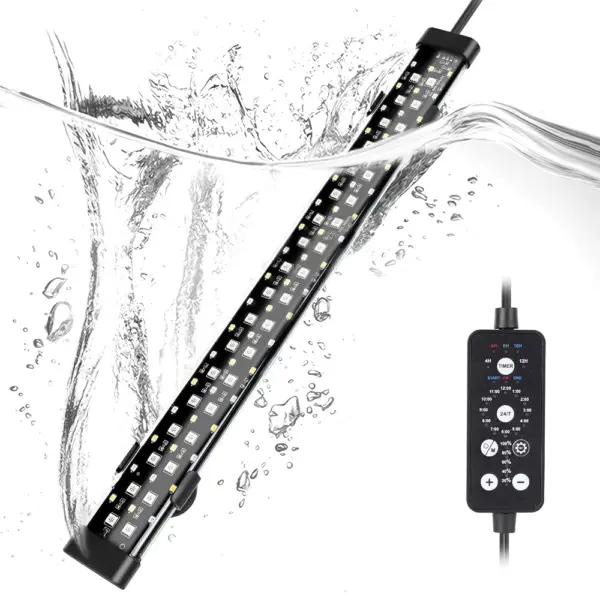
hygger 14W 15in Submersible LED – Best Overall
Key Features
- Wattage: 14 watts
- LED array: 90 LEDs in 5 rows
- Tank coverage: 16 to 27 inches
- Timer settings: 4, 6, 8, 10, or 12 hours
- Price: Midrange
Fourteen watts through fifteen inches and ninety chips across five rows — that ratio is the whole argument for this bar. A submersible light usually sits under a hood, a few inches from the surface, and it has to push light down to the substrate from there; concentrating the output over a shorter length does that better than spreading the same wattage thin. It’s why this is our default for a 20-gallon high or any tank in the 16-to-27-inch range the maker specifies.
The 24/7 mode is the part you live with daily. It comes up orange around six, shifts to white for the working day and fades to blue at night, ramping over fifteen minutes at each change instead of snapping on — a hard jump from dark to full output is what startles fish, and plenty of budget bars still do exactly that. The catch is the default day: roughly fourteen hours of white, which is more than a planted tank wants. Switch to DIY mode for four, six, eight, ten or twelve-hour windows, ten brightness steps and nine colors, so eight hours at 60 percent becomes the whole routine.
Plan on mounting it under the hood rather than hanging it on the glass. Cups are the weak joint on every light in this category and they let go on textured or curved panels; tucked under a lid, the bar never moves and you get the hidden look it’s designed for. Programming takes a few passes with the cord keypad before a schedule sticks — not difficult, just not obvious. The two-year warranty is longer than most here, which counts for something on a part that spends its life underwater.
Pros
- Dense five-row, 90-chip array for its length
- Timer windows from 4 to 12 hours
- 15-minute sunrise and sunset ramp
- IP68 rated for full submersion
Cons
- Controller programming takes patience
Our pick for most planted tanks: 14 watts packed into 15 inches, and timer settings from four hours to twelve that suit real plant photoperiods.
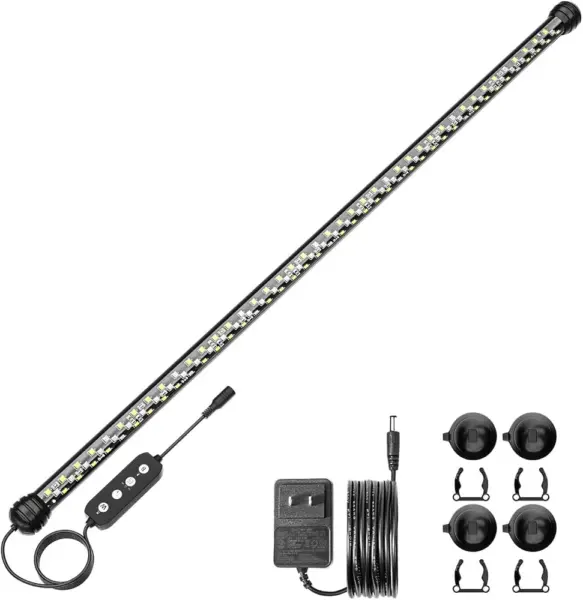
SEAOURA 27in Submersible LED – Best for Long Tanks
Key Features
- Length: 27 inches
- Wattage: 14 watts
- Timer settings: 6, 10, or 12 hours
- Waterproof rating: IP68
- Price: Midrange
A 27-inch bar solves something a 15-inch one can’t. On a 30-inch tank — a 29-gallon, most 37-gallon setups — a short light puts a bright circle in the middle and leaves the corners dim, and sliding it along just moves the hotspot. At 26.8 inches long and an inch wide, this one carries its LEDs almost the full length of the tank.
Even coverage end to end is what we prefer it for, and it’s why it costs more than the hygger. Fourteen watts across 27 inches is a gentler dose per inch than the 14-watt, 15-inch bar, which suits a shallow, wide tank and is less suited to a deep one — think about depth before length. The 6500 K white plus red, green and blue chips, at a color rendering index of 89, is a spectrum that grows plants rather than only showing them off.
Controls sit on the cord: 6, 10 or 12-hour timers, ten brightness steps, and a memory that holds the schedule through a power cut, which matters if your breaker trips more than once a winter. Mounting is the most flexible here — under the hood, behind the tank as a background glow, or inside the tank itself.
Pros
- Even coverage across a 30-inch tank
- Power-off memory keeps the schedule
- CRI 89 with white, red, green and blue
Cons
- Timer jumps from 6 to 10 hours
- Cups struggle to hold on bare glass
We prefer it for tanks 30 inches and longer, where a short bar can’t light the ends and a 27-inch fixture can.
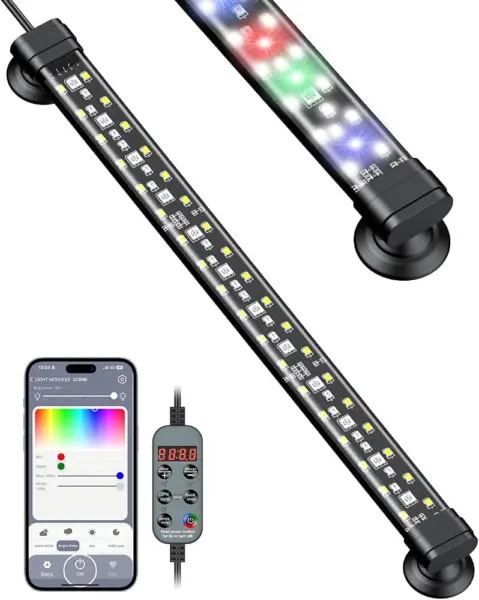
Pawfly 6.5W Bluetooth LED – Best App Control
Key Features
- Control: Bluetooth app
- Wattage: 6.5 watts
- Spectrum: 6500 K white plus 660, 525, 455 nm
- Tank coverage: 13 to 22 inches
- Color rendering index: 98
- Price: Midrange
Red at 660 nm, green at 525, blue at 455, plus 6500 K white at a stated color rendering index of 98 — this is the only light in the group that spells out its wavelengths rather than promising full spectrum and leaving it there. Red is the band plants use hardest, and having it on a channel you control means you can push it without turning the whole tank pink.
The Bluetooth app handles the rest. Three automatic day-night presets — Dutch, Jungle and Japanese — set a schedule for you, or you can build a custom start time and ramp. Everything is reachable from the cord controller too, which is the fallback when a phone misbehaves.
At 6.5 watts over 12 inches it’s the least powerful light here, and that sets the ceiling. Rated for 13 to 22-inch tanks, it suits a 15 or 20-gallon high with plants that don’t need blasting, and it’s the wrong choice for a 24-inch-deep tank where the light has to punch further. We rate it the most tunable of the six and the least forceful: CRI 98 makes fish and plants look the way they do in daylight, and dialing in a spectrum beats picking from nine presets if you’re the sort who adjusts.
Pros
- Stated 660 nm red and CRI 98
- Three automatic day-night timer presets
- Full app control of color and brightness
Cons
- Bluetooth pairing can be finicky
- Smaller in person than the photos suggest
We rate this the one to buy if you want to tune a spectrum rather than pick a preset, provided the tank is small.
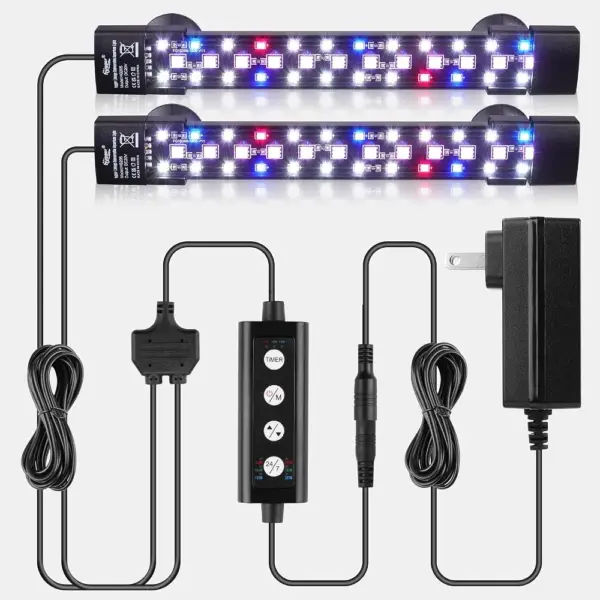
hygger Dual-Channel 2-Pack – Best for Multi-Light Setups
Key Features
- Control: Single synchronized controller
- Wattage: 12 watts total
- Timer settings: 6, 10, or 12 hours
- Lights included: 2
- Price: Midrange
Two lights usually means two controllers, two schedules, and a slow drift where one half of the tank is lit and the other is still ramping down. This set runs both bars from a single controller harness — up to three if you add one — so brightness, color and mode stay synchronized across the tank, with one power supply instead of two and half the cable clutter behind the cabinet.
Each bar carries three rows of chips and the pair totals 12 watts. The 24/7 mode gives the same orange-to-white-to-blue day we liked on the single hygger, and DIY mode offers 6, 10 or 12-hour timers across five brightness levels and seven colors — a narrower set than the 15-inch bar, which is the trade for driving two fixtures as one.
It’s the pick for a 40 breeder or a 55 where a single bar can’t span the top, and for anyone splitting a long tank into two zones. The best part is that the second light doesn’t cost you a second timer to think about; the cost is flexibility on photoperiod. hygger backs it for two years, the longest coverage in this group.
Pros
- One controller syncs two or three lights
- Single power supply cuts cable clutter
- Two-year warranty
Cons
- Timers limited to 6, 10 or 12 hours
We like it for two lights on one big tank: one controller, one timer, and no drift between the halves.
AQUANEAT 7.5in Submersible Light – Best for Small Budget Tanks
Key Features
- LEDs: 12 white
- Modes: All on or all off
- Length: 7.5 inches
- Tank coverage: 8 to 12 inches
- Price: Budget
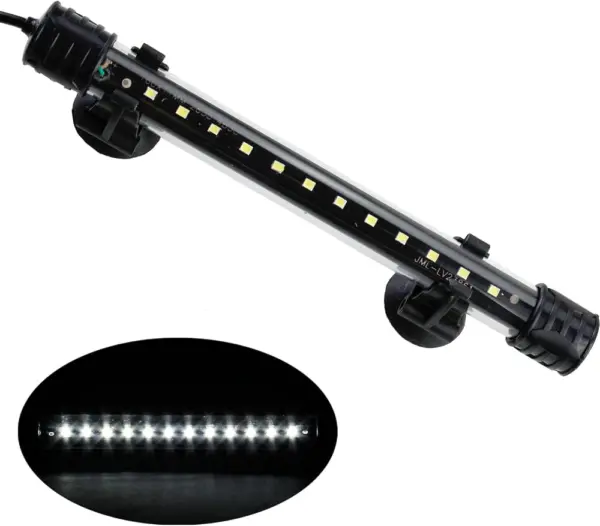
One button does everything on this one: press to light the tank, press again to put it out. Twelve white LEDs in a sealed housing, two suction cups, a 6.4-ounce bar. Nothing to program, nothing to reset after an outage — for a quarantine tank or a child’s first setup that’s closer to a feature than a shortfall. Press it on in the morning, press it off at night.
Coverage is where it asks you to think. It’s rated for 8 to 12-inch tanks and measures 7.5 inches, so on a standard 10-gallon — 20 inches long — it lights the middle and leaves the ends dim. Two of them, one per section, is the honest setup for anything wide, and the pair still undercuts the programmable lights here.
The spectrum is white only, with no red or blue channels, so plan on low-light plants — java fern, anubias, moss — rather than a carpet. As a hospital tank light, or a small tank where a cheap outlet timer handles the scheduling, it does the job without a manual. What we appreciate is how little there is to go wrong: a sealed bar, a button, and a cord.
Pros
- Fully sealed body with nothing to program
- Lowest-cost route to a lit small tank
- Light enough for two small cups
Cons
- No timer, dimmer, or color control
- Cups weaken after a few months
The simplest way to light a small tank — if you’re happy pressing a button twice a day.
Novique 4W Submersible Light – Best for Nano Tanks
Key Features
- Modes: Blue, white, or both
- Length: 7.5 inches
- Wattage: 4 watts
- Timer settings: 4, 8, or 12 hours
- Price: Budget
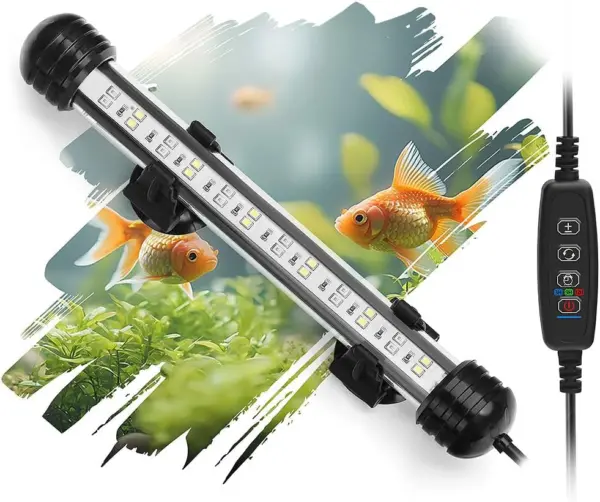
Four watts looks like a misprint next to the 12- and 14-watt bars above, and it isn’t: this is a 7.5-inch, 18-LED light built for the small end of the market — a 5-gallon desktop tank, a 10-gallon on a dresser — where 14 watts across the top would be more light than the tank can use.
What you get is more control than the size suggests. Blue, white or both, dimming from 10 to 100 percent, and a repeating timer with 4, 8 or 12-hour settings. That 4-hour window is unusual in this group and genuinely useful: it’s the setting for a low-tech tank fighting algae, or for splitting a photoperiod into two blocks with a dark gap in the middle. The housing is IP68 sealed and runs on a low-voltage supply, with a one-year warranty behind it.
Where it stops is spectrum. Blue and white only, no red channel, so it’s a display and low-light plant light rather than a growth light; a carpet or anything red-leaved wants the hygger or the Pawfly. For a nano tank of anubias and moss, we think it’s the sensible buy: dimmable, timed, sealed, and gentle enough not to overwhelm a few gallons of water.
Pros
- Dimmable from 10 to 100 percent
- Timer includes a 4-hour window
- IP68 sealed with a one-year warranty
Cons
- Blue and white spectrum only, no reds
We think it’s the right small-tank light for anyone who wants a schedule without an app — dimmable, sealed, and gentle.
How We Chose and Tested These Aquarium Lights
We built the shortlist from about 40 models pulled off aquarium forums, planted-tank specialty shops, and the big marketplaces, then cut anything that wasn’t rated for full submersion, never listed a wattage or spectrum, or needed an extra controller just to run a basic on/off cycle. That left 14 lights, which we ran for three months across a handful of home tanks.
Brightness is nearly impossible to judge from a listing, so we judged it by plants: we tracked new leaf growth on anubias and java fern, checked whether light actually reached the substrate in a 24-inch-deep tank, and flagged strips that looked blinding at the surface but dim at the bottom. For color options, we ran each light at full white, then at its red-heavy and blue-heavy settings, and watched whether a red ludwigia held its color or faded toward green. Appearance counted too — how the housing sat against the rim, whether the cord disappeared neatly, and whether the light washed out fish.
Suction cups got their own test: we pressed each mount onto clean glass, left it submerged for two weeks, and noted which ones crept downward or let go entirely when we lifted the lid. Timers and Bluetooth were set once and left alone — we checked for schedule drift after seven days and whether the app reconnected after the tank was unplugged for a water change. At the end we inspected every seal, looking for condensation inside the housing and fraying where the cord meets the grommet. Value came down to what shipped in the box: a remote, spare cups, and a bracket that holds a long bar level instead of sagging in the middle.
How to Choose a Submersible Light for a Planted Tank
The hard part of this purchase isn’t brightness — it’s finding a bar whose spectrum suits plants, whose timer fits a real photoperiod, and whose seal survives a year underwater.
Length and light density pull against each other
Wattage on its own tells you very little. Fourteen watts spread over 27 inches is a gentle, even wash; the same fourteen watts over 15 inches is nearly twice the dose per inch, and that difference decides which tanks each one suits. Measure the inside of the tank before anything else. If one bar covers most of that length, take it. If it doesn’t, two lights on one controller beat a single bar with a bright middle and dark ends — and a 7.5-inch fixture rated for 8 to 12-inch tanks leaves a 20-inch ten-gallon half lit.
What full spectrum should actually contain
Nearly every light here claims full spectrum, and they don’t mean the same thing. The minimum is white plus red and blue; the better bars in this group add green and separate red chips, which is what carries a plant through the day rather than just making the tank look bright. Two numbers help: color rendering index, where 89 and 98 sit at the top of this set, and a named red wavelength instead of a vague promise. A white-only bar with no red channel is a display light, not a growth light.
Pick the photoperiod before the brightness
Most planted tanks do best on six to eight hours of light, which makes the timer steps more important than the lumen figure. A fixture offering only 6, 10 or 12 hours pushes you to the short end or over the top; one with 4, 6, 8, 10 and 12 lets you land on eight. Watch the 24/7 modes too — the simulated day on more than one of these runs roughly fourteen hours of white by default, which is fine for fish and too much for plants. Confirm the window you want exists before you buy.
The seal decides how long it lasts
A submersible light that takes on water doesn’t dim gracefully; it flickers and dies, usually within a few months. Buy a stated IP68 rating rather than the word waterproof, and treat the power supply as the other half of the seal: keep the brick above the waterline, with a drip loop in the cord so spills run off instead of down into it. This is the specification worth paying a little more for, because it’s the one you can’t fix later.
Decide where it will sit before it arrives
Suction cups are the standard fitting and the standard frustration. They grip clean flat glass well enough and let go on textured, curved or algae-filmed panels. If you run a hood or a lid, mount the bar underneath and the problem disappears — most of these are built for that placement and look better for it. If the light will hang in open water instead, plan on replacing cups now and then, and on adding a couple more than the fixture ships with.
Frequently Asked Questions
Can I use one of these lights on a saltwater or reef tank?
Treat them as freshwater lights unless the maker says otherwise. Most here are specified for freshwater planted tanks, and the one that mentions coral still doesn’t carry a marine-specific rating. Salt creep attacks housings and seals in a way freshwater doesn’t, so an IP68 rating earned in a planted tank doesn’t automatically transfer. Check for marine use before you buy; if the listing only says freshwater, it’s freshwater only.
Do I need to unplug the light during a water change?
Yes. Unplug it or lift it clear of the water before the level drops below the fixture. The low-voltage supplies on most of these reduce the risk, but they don’t make a half-submerged bar with a wet cord a good idea, and repeatedly draining past a running light is how water finds its way into a housing. Unplug first, then drain, and leave a drip loop so nothing runs downhill into the outlet.
How many of these lights does a 55-gallon tank need?
Two at minimum. A 55-gallon is 48 inches long and the longest fixture here is 27 inches, so a single bar leaves both ends dim. Put a 27-inch SEAOURA at each end, or use the dual-channel hygger pair plus a third bar if you want the middle covered — that controller runs up to three lights on one schedule.
Final Verdict
Most planted tanks between 16 and 27 inches should get the hygger 15-inch. It’s the densest light here, its timer covers the six-to-eight-hour window plants actually want, and the fifteen-minute ramp keeps the daily switch from startling anything in the tank.
Go to the SEAOURA 27-inch if your tank is 30 inches or longer and you need the ends lit. If you want to dial a spectrum rather than choose a preset, the Pawfly’s app and 660 nm red channel are worth the fiddling — just keep it to a small tank.