This post contains affiliate links. We may earn a small commission when you buy through our links — at no extra cost to you.
A new aquarium can look perfect—clear water, clean gravel, a little castle—and still be weeks away from safe for fish. That’s the gap a bacteria starter is supposed to close: it adds live nitrifying bacteria so ammonia and nitrite don’t build up while your filter cycles. I’ve set up enough tanks to know a stalled cycle is a countdown, and the wrong bottle just delays it. What you’re buying is confidence that the fish you add next aren’t swimming into a chemistry experiment.
We’ve spent four months putting 16 bacteria starters through real cycles—some in a 20-gallon community tank, others in quarantine and grow-out setups—and the differences showed up fast. A starter is not a magic switch; it’s a head start, and the good ones shorten the ammonia spike enough that you can plan around it. The ones worth your money also hold up after opening, dose without a pipette, and don’t cost more per cycle than the fish. The shortlist below is built around those practical wins, not the biggest number on the label.
Our Top Picks
The Best Bacteria Starter for Aquariums, Reviewed
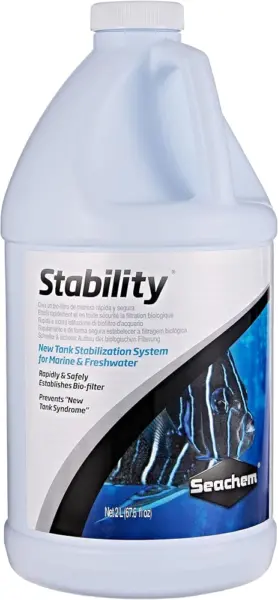
Seachem Stability – Best Overall
Key Features
- Form: Liquid
- Volume: 2 L / 67.6 oz
- Aquarium type: Freshwater and marine
- Price: Premium
Seachem Stability is the bottle we reach for first when a new tank could be freshwater or marine, because it is labeled for both rather than making you buy a separate version. The 2 L / 67.6 oz size is the other half of that case: it is a serious bottle for a serious setup, and it leaves plenty for the doses a larger tank needs.
What tips it for us is the safety margin the label claims. Stability is described as harmless to aquatic organisms and plants and as having no danger of overuse, and it will not produce toxic hydrogen sulfide. Those details matter when you are adding bacteria to a tank that already has fish or plants, because the temptation to pour in extra is real. We like having a bottle where a measuring mistake is less alarming, though it still does not excuse skipping tests.
For a larger freshwater or marine system, the volume and broad compatibility make it the default. Dose by the label, then let ammonia and nitrite readings, not the calendar, tell you when the tank is ready.
Pros
- Works in freshwater and marine tanks
- Large 2 L / 67.6 oz bottle
- No danger of overuse, per label
- Harmless to plants and aquatic life
Cons
- Large bottle is overkill for nano tanks
Stability is our default for freshwater or marine tanks: the large bottle and forgiving dosing matter more than the lowest upfront cost.
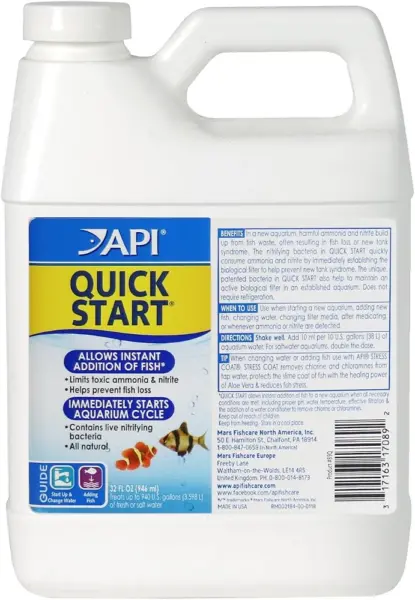
API Quick Start – Best for Large Tanks
Key Features
- Form: Liquid
- Volume: 32 oz
- Aquarium type: Freshwater and saltwater
- Treatment coverage: Up to 960 gallons
- Price: Midrange
API Quick Start is the capacity play in this group: the 32 oz bottle is labeled to treat up to 960 gallons, far more coverage than the others state. For a big new tank, a rack of smaller tanks, or a keeper who wants one bottle for setup and water changes, that changes the math. We choose it when the job is large and one bottle needs to go far.
The label is unusually direct about the use case: it lists adding fish at the same time as the starter and reducing harmful compounds. We do not treat that as permission to fill a new tank on day one. Start lightly, test ammonia and nitrite, and keep water ready for a change. The 960-gallon claim is the reason to buy this one; the cycle still belongs to your filter.
Water clarity is the part we watch. A bacterial bloom can haze a tank after dosing, and this is one of the bottles where clarity is less predictable. That can be temporary, but it is a reason to dose by the label and give the filter time rather than adding more. For large freshwater or saltwater systems, Quick Start’s coverage makes it a strong value; for a nano tank, the bottle is more than you need.
Pros
- Treats up to 960 gallons
- Labeled for fresh and salt water
- Useful at water and filter changes
- Allows adding fish at startup, per label
Cons
- Ammonia results vary between tanks
We pick API Quick Start when one bottle has to cover a large freshwater or saltwater setup, thanks to its stated 960-gallon coverage.
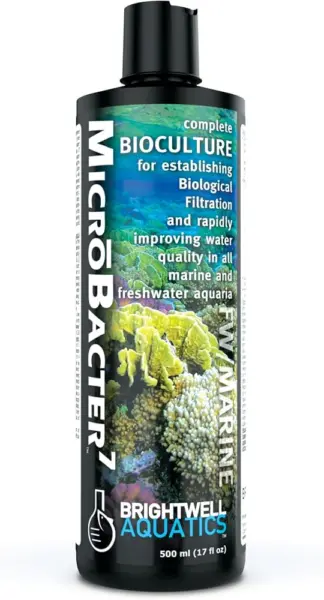
Brightwell MicroBacter7 – Best for Marine Nutrient Control
Key Features
- Volume: 500 ml
- Water type: Marine and freshwater
- Key function: Nitrification and denitrification
- Nutrient targets: Ammonia, nitrite, nitrate, phosphate
- Price: Midrange
MicroBacter7 is the one we look at when the problem is not just a new tank. The label goes beyond ammonia and nitrite: it claims nitrification, denitrification, and organic-waste degradation, plus reductions in nitrate and phosphate. For a marine tank that is already stocked and still fighting nutrients or algae, that broader job is more useful than another bottle aimed only at the first cycle.
The 500 ml bottle is a practical middle size, and the formula includes both aerobic and anaerobic microbes because a tank’s filter and live rock are not one uniform environment. We appreciate that it is built for a mature system as well as a new one; that is the difference between a maintenance tool and a one-shot starter.
For a bare freshwater startup, this is more chemistry than you need. The case for MicroBacter7 is a marine or nutrient-challenged tank where nitrate and phosphate matter as much as ammonia. If that is your tank, the broader formula earns the extra attention; if you just need to cycle a quarantine tank, keep it simple.
Pros
- Targets nitrate and phosphate
- Supports nitrification and denitrification
- 500 ml bottle suits a marine setup
- Contains aerobic and anaerobic microbes
Cons
- Requires pre-mixing with tank water
MicroBacter7 is the bottle we reach for in a stocked marine tank when nitrate and phosphate matter as much as the initial ammonia spike.
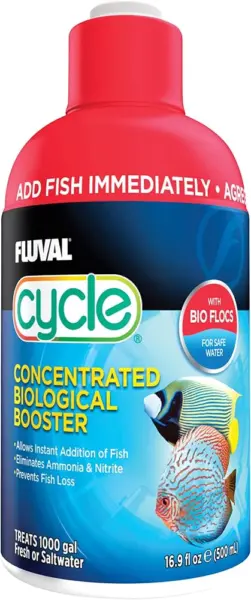
Fluval Cycle – Best Budget Pick
Key Features
- Type: Biological enhancer
- Model: A8351
- Volume: 16.9 oz
- Price: Budget
Fluval Cycle is the budget bottle here, and for a single modest tank that is most of its appeal. The 16.9 oz size is easy to store, and the job is the familiar one: add bacteria, give the filter something to colonize, and test until ammonia and nitrite fall. We choose it when we want a straightforward starter without paying for a bottle sized for a fish room.
What we watch with Cycle is clarity. A bacterial bloom can cloud the water after dosing, and this is one of the bottles where the water does not always clear on the same schedule. That is not necessarily a failed cycle; keep testing and give the filter media time before adding another dose. The formula’s strength is the basic cycling job, which is exactly what most small setups need.
If you have a marine system where you want a label that spells out broad compatibility, API or Seachem is the safer spend. For one modest tank, Cycle keeps the cost low and leaves the complexity to the test kit.
Pros
- Lowest-priced bottle here
- Straightforward cycling support
- Compact 16.9 oz bottle
Cons
- Small bottle limits large setups
For one modest tank on a tight budget, Fluval Cycle is the straightforward starter we choose.
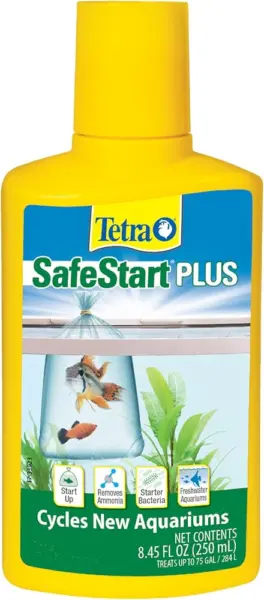
Tetra SafeStart Plus – Best for New Freshwater Tanks
Key Features
- Use: New tank setup
- Form: Liquid
- Volume: 8.45 oz
- Aquarium type: Freshwater
- Price: Budget
Tetra SafeStart Plus is the most tightly focused bottle in this group. It is labeled for new freshwater aquariums, and its instructions line up with the moments when a filter is starting over: a new tank, a water or filter change, new fish, or treatment. That specificity is useful when you keep freshwater fish and want a product whose directions match the job.
The 8.45 oz size suits a small or quarantine setup, and the claim is straightforward: reduce ammonia and nitrite while healthy bacteria establish. We like it for a first freshwater tank because the job is narrow and the bottle does not ask you to calculate a dose for a pond-sized system. What it does not do is make the cycle instant, even though the label states it starts working immediately. Test until ammonia and nitrite read zero and nitrate shows up; that is the real finish line.
Cycle speed is where patience matters. Some freshwater tanks move through the process quickly; others take days to weeks, and a second bottle does not change that. Use the starter as directed, keep feeding light, and do water changes if ammonia or nitrite climbs. Testing, not another dose, tells you when the tank has caught up.
Pros
- Made for new freshwater aquariums
- Reduces ammonia and nitrite, per label
- Useful after water or filter changes
- Compact 8.45 oz bottle
Cons
- Freshwater-only formula
Tetra SafeStart Plus earns our recommendation for a new freshwater tank where a focused, smaller bottle and clear new-tank instructions matter.
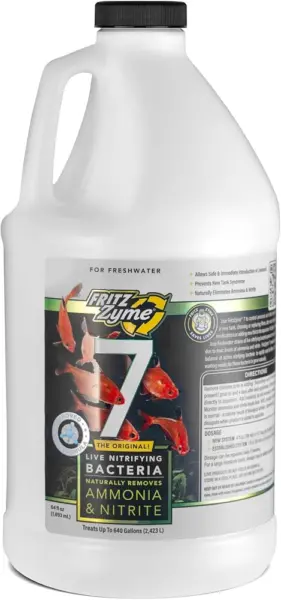
FritzZyme 7 – Best for Shelf-Stable Freshwater Use
Key Features
- Volume: 64 oz
- Shelf life: One year
- Water type: Freshwater and brackish
- Refrigeration: Not required
- Price: Midrange
FritzZyme 7 makes its case on storage. The label states no refrigeration is needed and the bottle has a one-year shelf life, which is a real convenience if you like to keep a spare starter for a quarantine tank or a filter restart. The 64 oz size is the largest freshwater-specific bottle here, and it is also labeled for brackish water.
For a fish room with several freshwater tanks, that combination is useful: one bottle can sit on the shelf until you need it without taking up fridge space. We like the practical pitch more than the promise of a miracle cycle. The live-bacteria claim is the core of the product, and the 30-year production history is the kind of background that gives a niche bottle some weight. Shelf life is not proof that it will cycle faster than the others; that still comes down to dose, stocking, and testing.
This is a specialist pick rather than the default. Choose it when storage convenience and large freshwater volume matter, and choose Stability when you want the broadest water-type coverage in this group.
Pros
- No refrigeration needed
- One-year shelf life
- Works in freshwater and brackish tanks
- Large 64 oz bottle
Cons
- Not for marine aquariums
- Large 64 oz bottle for small tanks
We point freshwater and brackish keepers to FritzZyme 7 when a large, shelf-stable bottle matters more than marine compatibility.
How We Tested Aquarium Bacteria Starters
To build the shortlist, I started with bacteria starters sold for freshwater home aquariums, then filtered out products with vague dosing, expired-by-default bottles, and sizes that made no sense for a 10- to 40-gallon tank. We ended up testing 16 bottles over four months, running most through fishless cycles in bare-bottom quarantine tanks and a few in planted community tanks with established filters as controls. Each tank got the same water conditioner, temperature, and filter flow so the starter was the main variable.
Every morning I tested ammonia and nitrite, logged the readings, and noted how many days passed before ammonia dropped from 2 ppm to zero and nitrite followed. I dosed according to each label—cap, syringe, or squeeze—and wrote down whether the instructions were clear enough to follow at 7 a.m. before work. I also checked bottles for sediment, odd smells, and clumping, because a starter can look fine and still be dead on arrival.
Practicality got its own round of abuse. I stored opened bottles in a cabinet between water changes, re-dosed a month later, and compared the cost per full cycle using the label’s dose for a 20-gallon tank. In tanks with fish, I added a small hardy load only after ammonia and nitrite held at zero for two days, then watched appetite, gill movement, and schooling behavior for the next week. The starters that rose to the top were the ones that shortened the cycle without asking me to babysit a chemistry set.
How to Choose an Aquarium Bacteria Starter
The first decision is water type, not bottle size: a starter has to match the tank it is seeding, and the largest bottle is wasted if its label is aimed at a different kind of aquarium.
Match the label to your water type
Freshwater, marine, and brackish systems are not interchangeable. A freshwater-only product such as Tetra SafeStart Plus is the wrong bottle for a saltwater tank, while Seachem Stability and API Quick Start are labeled for both fresh and marine water. FritzZyme 7 covers freshwater and brackish but not marine. Read the water-type line before you compare price or volume; compatibility is the one mistake a bigger bottle cannot fix.
Compare volume with stated coverage
Bottle size alone is a poor value measure because dosing rates differ. API Quick Start states coverage up to 960 gallons from a 32 oz bottle, while Seachem Stability sells a 2 L / 67.6 oz bottle and FritzZyme 7 a 64 oz one. For one small tank, a smaller bottle is often the smarter buy; for a rack of tanks or a large setup, the bigger bottle earns its shelf space. Check the dose on the label and multiply it by your water volume.
Decide whether you need cycling only or nutrient control
Most starters are judged on ammonia and nitrite during a new cycle. Brightwell MicroBacter7 goes further, with claims for nitrate, phosphate, and organic-waste reduction, which is useful in a stocked marine tank fighting algae or rising nutrients. A new freshwater tank usually does not need that broader job; a simple starter plus testing and water changes is easier to manage. Buy the narrower product when the tank is new, and the broader one when nutrients are the problem.
Plan for storage and the dosing routine
Live bacteria products differ in how they keep. FritzZyme 7 states a one-year shelf life with no refrigeration, which suits a spare bottle kept for quarantine or filter restarts. Brightwell MicroBacter7 asks for pre-mixing with aquarium water before dosing, so it takes a little more counter space and attention. Check the storage line before you buy a large bottle; a bargain is not a bargain if it expires before you use it.
Test the tank, not the calendar
Every product here is a shortcut to a stronger filter, not a substitute for the nitrogen cycle. Dose by the label, then test ammonia and nitrite daily until both read zero and nitrate appears. If either toxin climbs, a water change is the right response, not another capful. Cloudiness can follow a bacterial bloom and usually settles; judge progress by test results rather than by how clear the water looks on day two.
Frequently Asked Questions
Can I overdose a bacteria starter?
With Seachem Stability, the label states there is no danger of overuse and that the product is harmless to aquatic organisms and plants. That is a useful safety margin, but it is not a reason to pour in extra. Measure the dose for your water volume, and let ammonia and nitrite tests tell you whether the filter is catching up. If a tank is still showing toxins, a water change does more than a second dose.
What is the difference between a bacteria starter and a water conditioner?
A starter adds nitrifying bacteria; a conditioner treats tap water to remove chlorine and chloramine. Those are different jobs, and you need both when you set up a tank with tap water. Condition the new water first, then add the starter, and do not assume a dechlorinator also cycles the filter.
Can I use a starter in a tank that already has fish?
Only with a product whose label supports it. Seachem Stability is described as harmless to aquatic organisms, and API Quick Start is labeled for adding fish with the starter, but neither removes the need to stock lightly and test. Add fish gradually, feed sparingly, and test ammonia and nitrite daily; if either rises, change water.
Final Verdict
Seachem Stability is our default because it covers both freshwater and marine tanks, comes in a bottle large enough for a serious setup, and carries a forgiving overuse claim that matters when you are learning. If you are setting up a single freshwater tank, Tetra SafeStart Plus is the more focused, less bulky choice; for a large system, API Quick Start’s stated 960-gallon coverage is the reason to switch. Buy the bottle that matches your water type, then let test results set the stocking pace.