This post contains affiliate links. We may earn a small commission when you buy through our links — at no extra cost to you.
Many new aquarists discover that the most effective dechlorinators smell like rotten eggs. That sulfur odor is a sign the product contains powerful detoxifying agents—but it can be off-putting. Meanwhile, odor-free options often lack the concentration to handle chloramine or ammonia spikes.
This guide cuts through the confusion by matching each conditioner to your specific tank size, water chemistry, and fish sensitivity. The right choice depends on whether you prioritize emergency detox capability or a gentler, slime-coat formula. We’ll explain the key differences between concentrated liquids, powders, and budget-friendly basics.
You’ll learn why some products cause temporary cloudiness and how to avoid dosing mistakes. By the end, you’ll know exactly which conditioner fits your routine.
Top Picks
Best for Any Tank
Seachem Prime 500 ml

Rating: 4.8 ★ | Price: $$$ | Removes Chloramine: Yes | Detoxifies Ammonia/Nitrite: Yes | Concentration: 5mL/50 gal | Slime Coat: No | Fresh & Saltwater: Both
Seachem Prime removes chlorine and chloramine instantly, and its concentrated formula treats up to 5,000 gallons per 500 mL bottle. Beyond simple dechlorination, it detoxifies ammonia, nitrite, and nitrate—a capability that allows temporary protection during cycle crashes or fish-in cycling when dosed at up to 5 times the normal amount.
This conditioner suits freshwater and saltwater aquarists who want a single, versatile product for both standard water changes and unexpected ammonia spikes. The one tradeoff is a distinct rotten-egg sulfur odor when dispensing—this dissipates quickly once mixed into the tank and is harmless, but it can surprise new users.
Pros
- Instantly removes chlorine and chloramine while detoxifying ammonia, nitrite, and heavy metals.
- Extreme concentration—5 mL treats 50 gallons, making a 500 mL bottle last for thousands of gallons.
- Safe for emergency overdosing up to 5x normal dose, providing a safety net during ammonia spikes.
Cons
- Strong sulfur odor during dispensing can be unpleasant, though it dissipates quickly once mixed in the tank.
For aquarists who routinely treat tap water and want emergency detox capability in one bottle, Prime’s concentration and multi-function formula justify its price. The sulfur smell is a momentary tradeoff that disappears almost immediately in the tank.
Best for Freshwater Tanks
API Stress Coat 16 oz

Rating: 4.8 ★ | Price: $$ | Removes Chloramine: Yes | Detoxifies Ammonia/Nitrite: No | Concentration: 5mL/10 gal | Slime Coat: Yes | Fresh & Saltwater: Fresh
API Stress Coat removes chlorine and chloramine while depositing a protective slime coating on fish, making it a strong choice for freshwater tanks where fish experience handling stress or minor scrapes. The aloe vera formulation sets it apart from basic concentrated dechlorinators, but this same ingredient can feed bacteria if fish have open wounds or infections. It is not suitable for saltwater or reef setups. For healthy freshwater fish, the added protection is a genuine advantage during routine water changes.
Pros
- Neutralizes chlorine and chloramine while adding a healing slime coat.
- Clear dosing instructions make it easy to use for beginners.
- 16-ounce bottle treats about 480 gallons at a cost-effective price.
Cons
- Oily film may appear on the water surface after dosing, though it dissipates on its own.
If your tank has healthy freshwater fish and you want a dechlorinator that actively supports healing, Stress Coat is the right pick – just avoid it for injured fish or saltwater.
Best for Large Tanks/ponds
API Tap Water 16 oz

Rating: 4.7 ★ | Price: $ | Removes Chloramine: Yes | Detoxifies Ammonia/Nitrite: No | Concentration: 1mL/20 gal | Slime Coat: No | Fresh & Saltwater: Fresh
API Tap Water delivers the highest concentration of any liquid dechlorinator here: a single milliliter neutralizes chlorine and chloramine in 20 gallons, making it the most cost-effective option for large volumes. Unlike slime-coat formulas such as API Stress Coat, this contains no aloe or ammonia detox — just pure dechlorination. Budget-conscious aquarists managing big tanks or multiple setups get exceptional value per drop, but fish with injuries won’t receive protective coating, and the cap can break if dropped. This is the right fit for anyone who prioritizes economy over extras.
Pros
- Ultra-concentrated formula — a few drops treat many gallons, reducing bottle replacements.
- Effectively removes chlorine and chloramine — fish-safe water after each dose.
- Exceptional value per gallon treated — budget-friendly for high-volume users.
Cons
- No slime coat or extra additives — fish with handling stress or open wounds miss protective coating.
- The plastic cap may shatter if the bottle is dropped — requires careful handling.
A no-frills dechlorinator that delivers unbeatable value for large tanks — skip it if you need slime coat or ammonia protection.
Best for Fish Rooms
Seachem Safe 250 g

Rating: 4.7 ★ | Price: $ | Removes Chloramine: Yes | Detoxifies Ammonia/Nitrite: Yes | Concentration: 1/4 tsp/300 gal | Slime Coat: No | Fresh & Saltwater: Both
Seachem Safe delivers the same ammonia-detoxifying chemistry as Prime, but in a dry powder — a single 250 g jar treats up to 60,000 gallons. You trade liquid convenience for extreme per-gallon savings, making this the budget choice for fish rooms with multiple large tanks or pond keepers. The sulfur odor is stronger than Prime’s, and dosing requires a small measuring spoon — an extra step compared to pouring liquid.
Pros
- Treats up to 60,000 gallons per jar — the best value for high-volume setups.
- Same proven formula as Prime: removes chlorine, chloramine, and detoxifies ammonia, nitrite, and nitrate.
- Compact powder stores easily and remains effective for years in a sealed container.
Cons
- Dosing requires a small measuring spoon — accuracy matters more than with liquid conditioners.
- The powder has a strong sulfur scent when opened, which may be noticeable during dosing.
For hobbyists managing high water volumes, Safe offers unbeatable per-gallon savings — worth the extra handling steps.
Best for Family Tanks
Tetra AquaSafe Plus 33.8 oz
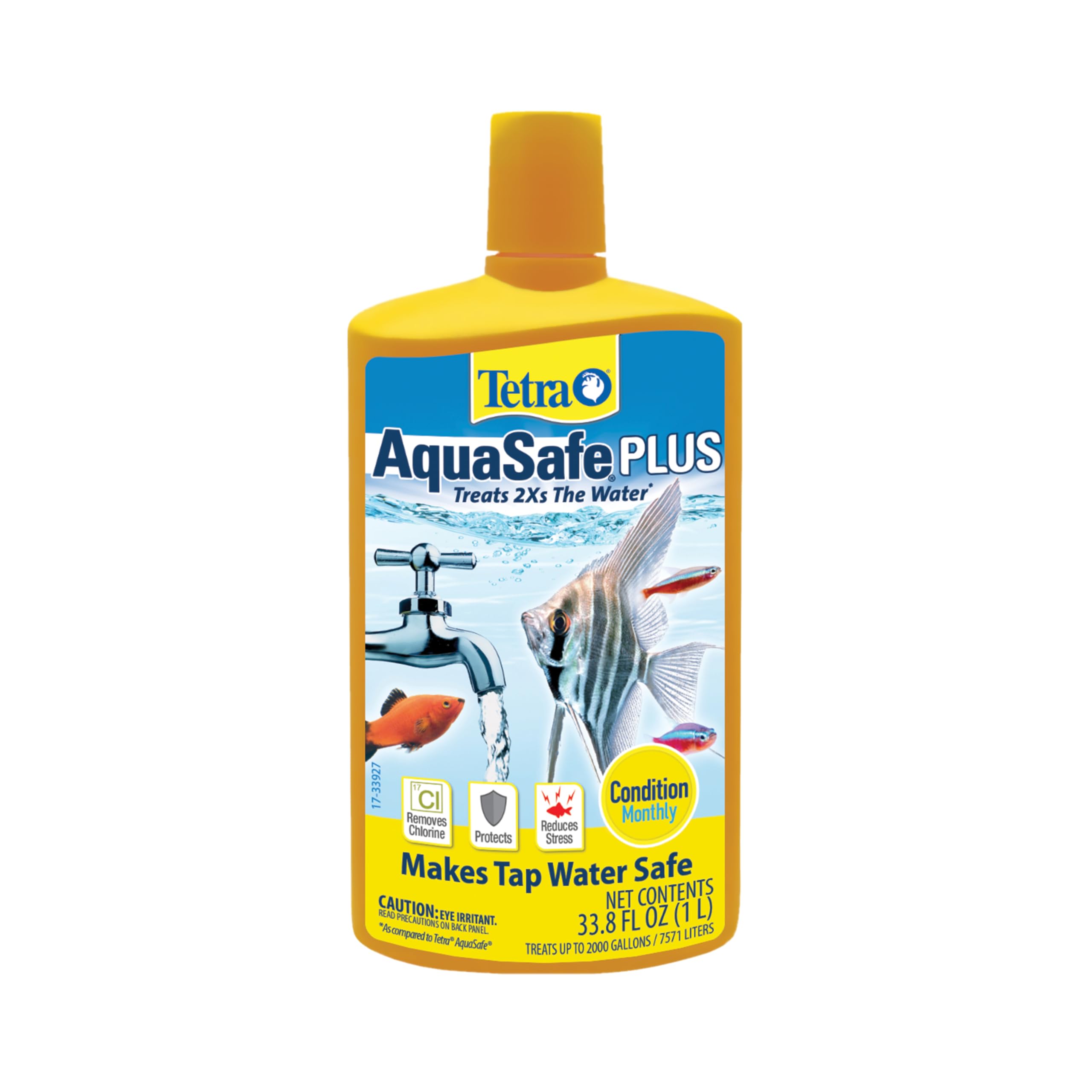
Rating: 4.8 ★ | Price: $$ | Removes Chloramine: Yes | Detoxifies Ammonia/Nitrite: No | Concentration: 5mL/10 gal | Slime Coat: Yes | Fresh & Saltwater: Fresh
The 33.8-ounce bottle treats about 1,000 gallons, offering good value for families with standard freshwater tanks. It adds slime coat and vitamins, but dosing is less concentrated than the top contender, requiring 5 mL per 10 gallons. Some tanks may see temporary cloudiness after use, which typically clears within a few hours. This conditioner suits beginners who want a big bottle and prefer a single purchase to last, rather than advanced aquarists needing maximum concentration or emergency ammonia detox.
Pros
- Large 33.8-ounce bottle treats about 1,000 gallons at a reasonable price.
- Adds slime coat and vitamins to support fish health and water clarity.
- Brand is widely available in pet stores and online.
Cons
- Measuring cap marks may be imprecise; using a separate syringe is recommended for consistent dosing.
- Requires 5 mL per 10 gallons — more product per dose than concentrated alternatives.
For families who prioritize bottle size and extra slime coat over concentration, this is a practical choice.
Best for Prime Alternative
Fritz Complete 16 oz
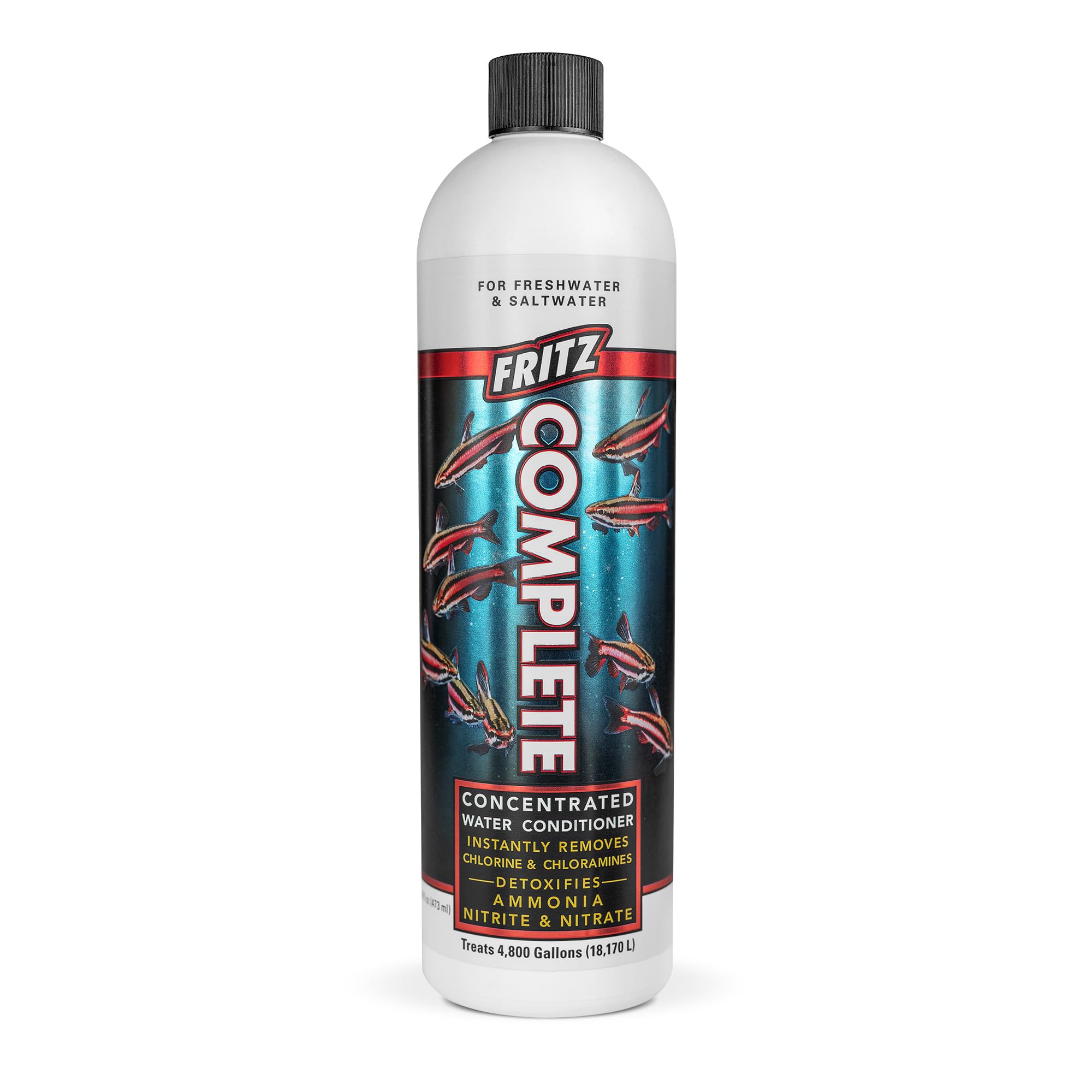
Rating: 4.8 ★ | Price: $$ | Removes Chloramine: Yes | Detoxifies Ammonia/Nitrite: Yes | Concentration: 5mL/50 gal | Slime Coat: No | Fresh & Saltwater: Both
Fritz Complete delivers the same sulfur‑based dechlorination and ammonia/nitrite/nitrate detox as the market leader, at a per‑gallon cost that can undercut it depending on the seller. The 16‑ounce bottle treats roughly 1,600 gallons — matching Prime’s concentration. The catch: Amazon doesn’t set a fixed price, so you’ll need to compare listings. And yes, the familiar sulfur odor is present. This is a straightforward alternative for aquarists who already trust Prime’s formula and want to save when the listing aligns.
Pros
- Concentrated liquid treats 1,600 gallons per bottle — matches top competitors.
- Detoxifies ammonia, nitrite, and nitrate in addition to chlorine and chloramine.
- Often priced lower than the leading brand, depending on current seller listing.
Cons
- Price is not listed on Amazon and varies by seller — comparison shopping required.
- Strong sulfur smell during dosing, similar to other concentrated conditioners.
A direct alternative to Prime that matches its core performance — worth checking current sellers for a potential discount.
Best for Small Tanks
TankFirst Complete 500 ml
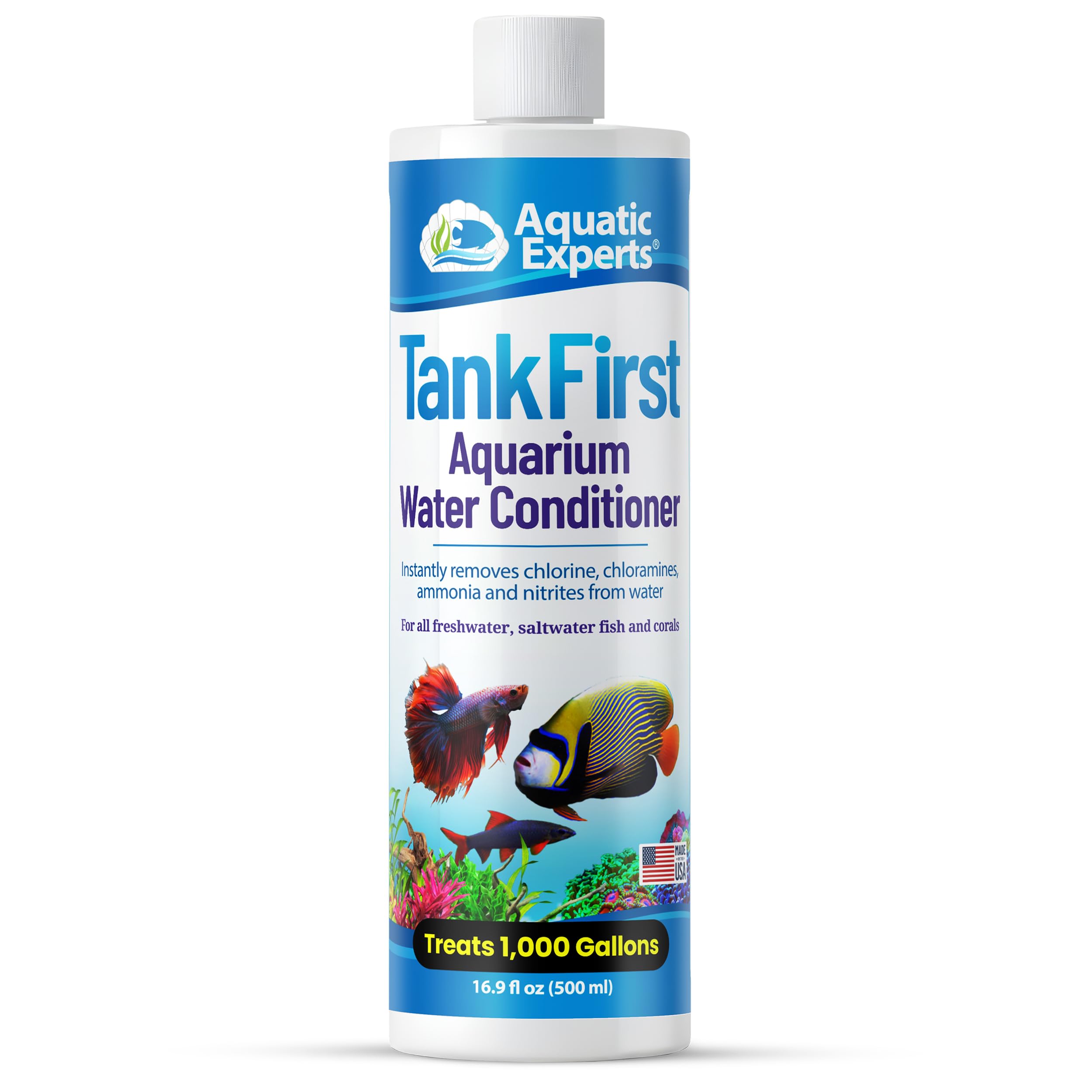
Rating: 4.7 ★ | Price: $$ | Removes Chloramine: Yes | Detoxifies Ammonia/Nitrite: Yes | Concentration: 5mL/10 gal | Slime Coat: Yes | Fresh & Saltwater: Both
This is the dechlorinator to reach for if the typical sulfur odor bothers you. It removes chlorine, chloramine, and ammonia without any smell, and keeps the water clear. The tradeoff is lower concentration than Prime – you’ll use about five times as much per gallon – and some tanks may not see the claimed nitrite reduction.
Pros
- No sulfur smell – comfortable for scent-sensitive aquarists.
- Quickly clears tank water during water changes.
Cons
- Does not reduce nitrites as claimed – some tanks see no improvement.
Best for small to medium freshwater tanks where avoiding the dechlorinator smell matters, and you don’t need high concentration or nitrite control.
Best for Budget Tanks
Aqueon 16 oz

Rating: 4.7 ★ | Price: $$ | Removes Chloramine: Yes | Detoxifies Ammonia/Nitrite: Yes | Concentration: 5mL/10 gal | Slime Coat: Yes | Fresh & Saltwater: Fresh
The Aqueon water conditioner effectively removes chlorine and chloramine while adding slime coat, providing good value for budget-conscious aquarists. Its mid-range price and large bottle treat about 480 gallons. However, reports of fish loss after use suggest dosing instructions could be clearer, making it less suitable for keepers of sensitive fish.
Pros
- Effective chlorine and chloramine removal with added slime coat
- Good value per gallon in a large bottle
Cons
- Bottle cap may leak during shipping, causing product loss
Best for budget-focused aquarists who are comfortable with careful dosing and minor packaging quirks.
Best for Multi-Function
API Aqua Essential 16 oz

Rating: 4.7 ★ | Price: $$ | Removes Chloramine: Yes | Detoxifies Ammonia/Nitrite: Yes | Concentration: 1mL/20 gal | Slime Coat: No | Fresh & Saltwater: Fresh
This all-in-one conditioner handles chlorine, chloramine, and nitrogen compounds, making it a functional multitasker for standard water changes. Recent price increases and occasional cloudiness after dosing have dented its value, especially compared to more concentrated alternatives like the top pick.
Pros
- One bottle removes chlorine, chloramine, ammonia, and nitrite – no need for separate additives.
- Highly concentrated – 1 mL treats 20 gallons, so the bottle lasts through many water changes.
Cons
- Water may appear cloudy temporarily after dosing – a visual tradeoff for display tanks.
A decent all-in-one for hobbyists who want ammonia detox in a single bottle, but the price and cloudiness risk make it a secondary option after comparing per-gallon costs.
Best for All-In-One
Natural Rapport All-in-1 16 oz

Rating: 4.5 ★ | Price: $$ | Removes Chloramine: Yes | Detoxifies Ammonia/Nitrite: Yes | Concentration: 5mL/10 gal | Slime Coat: Yes | Fresh & Saltwater: Both
This conditioner removes chlorine, chloramine, ammonia, and heavy metals while adding slime coat and electrolytes – a single-bottle solution for regular water changes. Temporary cloudiness can occur after dosing, making it less suited for display tanks where water clarity is a priority. Priced similarly to Seachem Prime but with less consistent results on fish health.
Pros
- One bottle handles dechlorination, ammonia detox, and slime coat – simplifies water change routine.
- Concentrated 5 mL per 10 gallons, treating 960 gallons per 16 oz bottle.
Cons
- Temporary cloudiness can occur after dosing, particularly in tanks with low circulation.
A reasonable choice for hobbyists who want a multifunctional conditioner and can accept occasional cloudiness, but those who prioritize water clarity should consider the top pick instead.
Best for Low Bio-Load
Kordon Novaqua Plus 16 oz

Rating: 4.8 ★ | Price: $ | Removes Chloramine: Yes | Detoxifies Ammonia/Nitrite: No | Concentration: 5mL/10 gal | Slime Coat: Yes | Fresh & Saltwater: Both
Kordon Novaqua Plus handles basic dechlorination — removing chlorine, chloramine, and heavy metals — while adding a slime coat and vitamins at a very low cost. It is safe for all species including shrimp and corals, making it a gentle option for sensitive tank setups. The catch is that it does not effectively neutralize ammonia, so fishkeepers with low-bioload tanks where ammonia spikes are rare will get the most value; those dealing with elevated ammonia or high fish waste will need a supplementary product.
Pros
- Budget-friendly price for basic dechlorination
- Safe for all aquarium inhabitants, including shrimp and corals
Cons
- Ammonia neutralization is not effective, so it works best paired with a dedicated ammonia detoxifier
For routine water changes in lightly stocked tanks where ammonia levels stay low, this is a cost-effective choice.
Best for Small Tanks
Fluval 8.4 oz

Rating: 4.7 ★ | Price: $ | Removes Chloramine: Yes | Detoxifies Ammonia/Nitrite: No | Concentration: 5mL/10 gal | Slime Coat: Yes | Fresh & Saltwater: Fresh
Fluval’s 8.4 oz bottle is a budget-friendly choice for small aquariums under 20 gallons. It effectively neutralizes chlorine and chloramine while adding a slime coat to reduce stress. The small size keeps the price low, but for tanks larger than 20 gallons the cost per gallon rises quickly. Some users note temporary cloudiness after dosing, though this typically clears within hours with aeration.
Pros
- Budget-friendly for small tanks – treats about 250 gallons per bottle.
- Trusted brand with consistent water-quality results.
Cons
- Temporary cloudiness may occur after dosing in some aquariums.
Best for nano tank keepers on a budget who value a trusted brand over a larger volume or extra features like ammonia detox.
Best for Starter Tanks
API Start Up Pack 2×1.25 oz

Rating: 4.7 ★ | Price: $ | Removes Chloramine: Yes | Detoxifies Ammonia/Nitrite: No | Concentration: 5mL/10 gal | Slime Coat: Yes | Fresh & Saltwater: Fresh
This pack combines Stress Coat dechlorinator and Quick Start bacteria for a hassle-free startup in tanks under 10 gallons. The 1.25 oz bottles are too small for ongoing water changes – not a long-term dechlorination solution – and some shipments may arrive with broken seals, so inspect the packaging.
Pros
- Starter kit includes both dechlorinator and bacteria starter – simplifies new tank setup.
- Compact size makes it a practical emergency backup when you run out of your regular conditioner.
Cons
- At 1.25 oz per bottle, this pack runs out quickly – intended for one-time use, not weekly water changes.
Best for the initial setup of a nano tank or as an emergency stash – not a cost-effective choice for routine water changes.
How to Choose
The most important factor when choosing a dechlorinator is whether your tap water contains chloramine, because many basic conditioners only remove chlorine.
Chloramine Removal
Chloramine is a stable compound of chlorine and ammonia that many municipal water utilities use. Not all conditioners break the chloramine bond—some only neutralize free chlorine. If your water report shows chloramine, look for a product that explicitly states it removes both chlorine and chloramine.
Seachem Prime, API Tap Water Conditioner, and Seachem Safe all use reducing agents that neutralize chloramine. Basic conditioners often require a separate ammonia detoxifier to handle the ammonia released when chloramine is broken.
Ammonia and Nitrite Detoxification
Some conditioners convert toxic ammonia and nitrite into non-toxic forms for 24–48 hours, buying your biofilter time to catch up. This is essential during new tank cycling or after a filter crash.
Products like Seachem Prime, Safe, and Fritz Complete provide this emergency buffer. Conditioners without detox, like API Stress Coat or Tetra AquaSafe, rely solely on your biological filter to handle ammonia.
Concentration and Dosing
Concentration determines how many gallons you can treat per bottle. Highly concentrated conditioners (Seachem Prime, API Tap Water, Seachem Safe) treat thousands of gallons per container, reducing long-term cost. The trade-off is precise dosing for small tanks—you may need a micro-syringe or dilution.
Less concentrated options (Tetra AquaSafe, API Stress Coat) are easier to measure for 10–20 gallon tanks but cost more per gallon over time. Match the concentration to your typical water change volume.
Slime Coat Additives
Many conditioners add aloe vera or synthetic polymers to replace the fish’s natural slime coat. This helps healing from minor injuries, transport stress, or handling. However, aloe vera can feed bacteria if fish have open wounds, potentially leading to infection.
For healthy fish in stable tanks, slime coat additives are unnecessary. They are most useful for new fish arrivals or after netting. Avoid them if you keep sensitive species like axolotls or if you prefer a minimalist water treatment.
Fresh and Saltwater Compatibility
Not all conditioners are safe for marine tanks. Some ingredients (like aloe vera) can trigger algae blooms or harm invertebrates. Seachem Prime and Seachem Safe are explicitly labeled for saltwater, while API Stress Coat is freshwater only.
If you keep a reef or saltwater tank, choose a conditioner that specifically states it is safe for marine systems. Freshwater-only conditioners may contain phosphates or other additives that disrupt delicate water chemistry.
FAQ
Does Seachem Prime remove chloramine from tap water?
Yes, Seachem Prime neutralizes both chlorine and chloramine. It also binds free ammonia into a non-toxic form for up to 48 hours, making it effective for city water with chloramine. Use 5 mL per 50 gallons for standard treatment.
Why does my water conditioner stink so bad?
The strong sulfur (rotten egg) odor comes from sodium thiosulfate or similar reducing agents used to break chlorine and chloramine bonds. The smell dissipates within minutes after mixing into the tank. It is completely harmless to fish and is a sign the product is working.
Can I use API Stress Coat in a saltwater aquarium?
No, API Stress Coat is formulated for freshwater only. The aloe vera additive can cause water quality issues in marine tanks. For saltwater, use Seachem Prime or another conditioner labeled reef-safe.
How much Seachem Safe should I use for a 10-gallon tank?
Seachem Safe is extremely concentrated: 1/4 teaspoon treats 300 gallons. For 10 gallons, you need about 1/640 tsp — too small to measure accurately. Instead, mix 1/4 tsp in a gallon of water, then use 1/64 cup of that solution per 10 gallons. Store the leftover solution in a sealed bottle.