This post contains affiliate links. We may earn a small commission when you buy through our links — at no extra cost to you.
Most listings promise ‘extremely porous’ ceramic rings, but many best-selling products are actually dense mechanical pre-filter media. The result: frustrated aquarists who don’t see the ammonia drop they expected.
The difference comes down to a single spec — how much surface area the rings provide for beneficial bacteria. Dense rings trap debris but offer little colonization space, while true bio media uses microscopic pores to host your biological filter.
This guide cuts through the marketing by focusing on what each product delivers: real biological filtration, mechanical pre-filtering, or a mix. You’ll know exactly which rings fit your tank size, filter type, and budget.
Top Picks
Best for Medium-Large Tanks
AQUANEAT 6lb

Rating: 4.7 ★ | Price: $$ | Porosity: Extremely porous | Ring Size: 11/16" x 5/8" | Weight: 6 lbs | Mesh Bags: 6 bags
The AQUANEAT bio ceramic rings are highly porous — the dimpled surface provides abundant area for beneficial bacteria to colonize, which is the point of biological media. Multiple users note visible clearing of cloudy water within a day, suggesting the pore structure is genuinely open and effective for nitrifying bacteria growth.
Six pounds come pre-divided into six zippered mesh bags, making it easy to distribute media across filter trays or sump compartments without measuring or buying extra bags. The per-pound cost undercuts many competitors while maintaining the same pore quality. A quick rinse before installation removes any shipping dust and ensures the rings are ready to work.
This set fits aquarists running canister filters or sumps on tanks between 40 and 100 gallons. The pre-bagged portions save time, but the bags may be too large for small HOB filter compartments — measure your filter basket first. If you want true bio media without the high price of premium brands, these rings deliver the balance of porosity and quantity.
Pros
- High porosity provides ample surface area for beneficial bacteria growth.
- Six pounds in six separate mesh bags saves time and money over buying media and bags separately.
- Notable clearing of cloudy water within a day of installation.
Cons
- A small number of rings may arrive with dust or broken pieces from shipping.
- Pre-filled mesh bags may be too large to fit small HOB filter compartments.
For medium to large tank setups, this 6 lb bio media with mesh bags offers the porosity and quantity needed for reliable biological filtration at a practical price.
Best for Brand-Conscious Beginners
Marineland 140ct
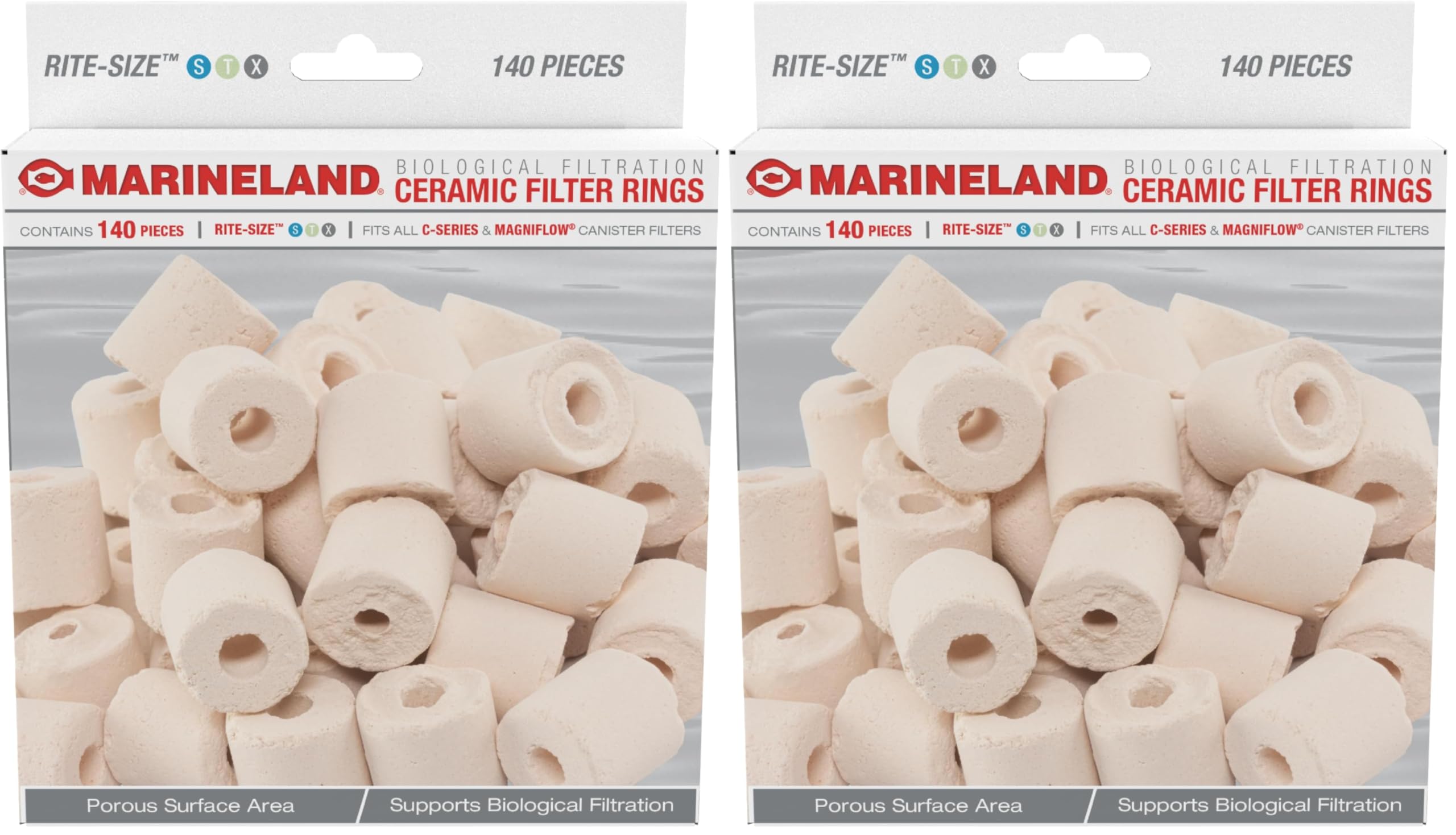
Rating: 4.7 ★ | Price: $$ | Porosity: Mixed (dense) | Weight: 140 rings
Marineland’s ceramic rings are the most-bought option in this category, backed by nearly 5,000 reviews and a long-standing hobby presence. This makes them the default recommendation for first-time buyers who want a product that has worked for countless others.
This product fits aquarists who value brand familiarity over chasing maximum biological surface area. The rings have lower porosity than some premium alternatives—a tradeoff that can affect bacterial growth in heavily stocked systems but is acceptable for standard community tanks and moderate bioloads.
Pros
- Widely reported to maintain clear water and stable ammonia/nitrite levels.
- Reported to last years of continuous use without degrading.
- Compatible with most medium-to-large canister filters, including Marineland’s own models.
Cons
A safe choice for beginners who want a well-tested biological media backed by a massive user base rather than the highest possible surface area.
Best for Small Tanks (5-20 Gal)
Sukh 3-Bag 425g
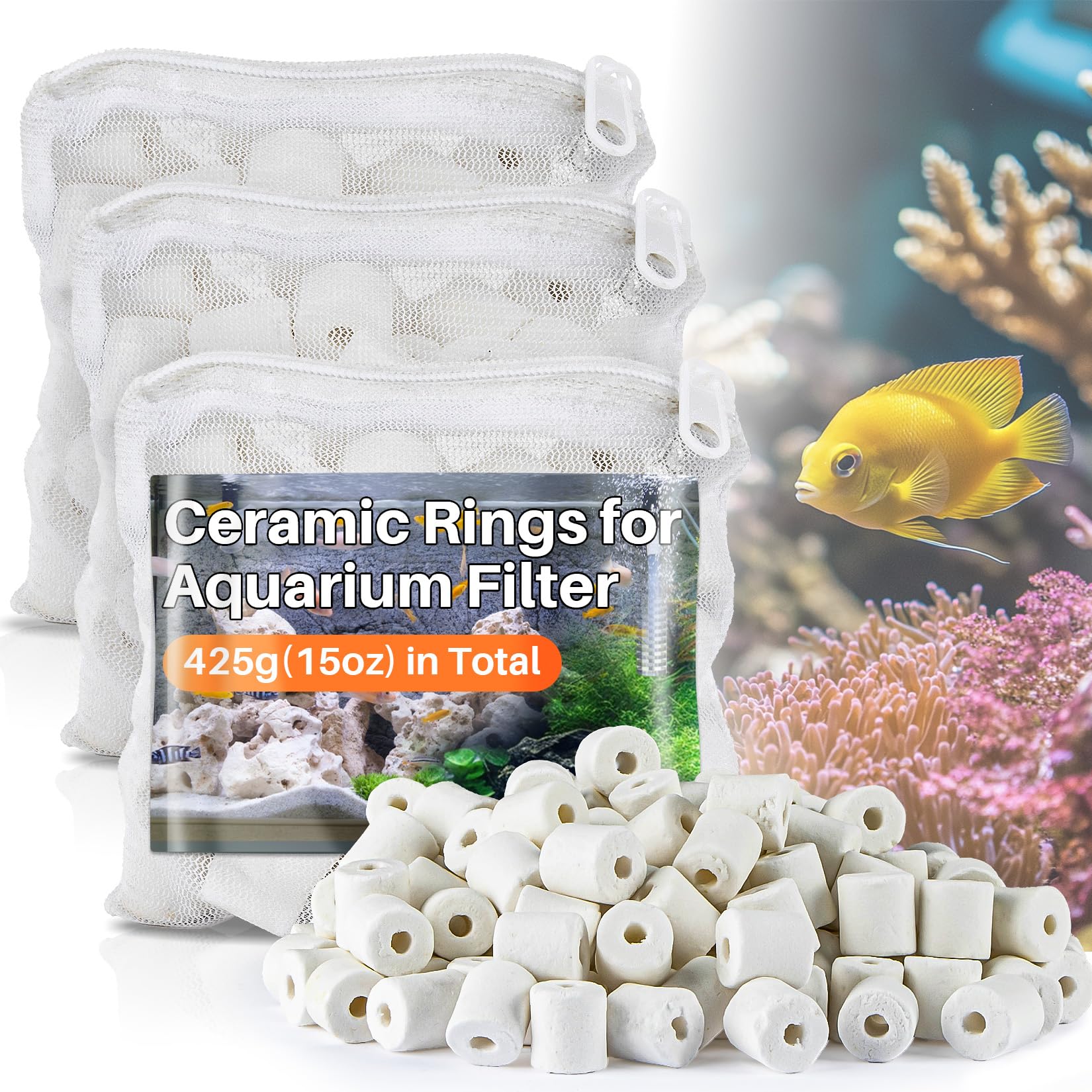
Rating: 4.7 ★ | Price: $ | Porosity: Porous (small rings) | Ring Size: Marshmallow-sized | Weight: 15 oz (425 g) | Mesh Bags: 3 bags
At a price that undercuts most competitors, this 3-bag set delivers solid biological filtration for tanks under 20 gallons. The pre-packed mesh bags drop directly into HOB or small canister filter trays, saving the step of portioning bulk media. Compared to the top pick’s 6-pound bundle, this is a lighter, smaller-ringed alternative that suits tight budgets and tight filter baskets.
This set fits beginners setting up a 10-gallon HOB filter or a small canister. The rings are marshmallow-sized — about half the diameter of chunky media — so they work best in filters with narrow compartments. If you’re running a filter rated for 50+ gallons, the total 425g volume and small ring size will likely feel insufficient; those buyers should look at bulkier options.
Pros
- Excellent value for small tanks, especially for budget-conscious setups
- Comes in three reusable mesh bags, ready to drop into HOB or small canister filters
- Works reliably in 10-gallon HOB filters and similar compact systems
Cons
- Rings are smaller than typical ceramic media; may feel inadequate for larger filter compartments
- Total media volume is limited to 425g, requiring additional refills for filters over 20 gallons
For nano and small tanks that don’t need bulk media, this is a budget-friendly choice that skips the hassle of larger bags.
Best for Cost-Conscious Aquarists
Reefing Art 1lb

Rating: 4.7 ★ | Price: $ | Porosity: Extremely porous (5400 sq ft) | Ring Size: Slightly larger | Weight: 1 lb (180 rings) | Mesh Bags: 1 bag
The Reefing Art 1lb ceramic rings pack more surface area per dollar than any other budget option, with 180 rings and a claimed 5,400 sq ft of porous surface. That translates to rapid biological colonization in small to medium tanks. Compared to the slimmer rings in the budget set, these are wider in diameter – a tradeoff that prioritizes porosity over compact fit.
This 1lb bag suits cost-conscious aquarists running HOB or canister filters with generous media trays. The larger ring size may prevent use in very narrow filter baskets, so checking dimensions beforehand is advised. It’s also a single 1lb bag, not bulk – buyers with larger systems will need to purchase multiple bags.
Pros
- Exceptional value – very low price for highly porous ceramic media
- Excellent biological filtration – many small holes provide massive surface area
- Durable and easy to clean, comes in a bag for simple maintenance
Cons
- Rings are slightly larger in diameter than some competitors – may not fit very narrow filter baskets
- This listing is for 1 lb only – not a bulk option for larger tanks requiring more media
For maximum porosity per dollar in a small package, this is the bio media to grab – just confirm your filter can accommodate the slightly larger rings.
Best for Medium Tanks (40-75 Gal)
ALEGI 4lb

Rating: 4.7 ★ | Price: $$ | Porosity: Porous claimed | Ring Size: 1/2" x 1/2" | Weight: 4 lbs | Mesh Bags: 4 bags
Four individual mesh bags ready to drop into filter trays set this kit apart from the top pick, which offers 6 lbs across six bags at a shade lower per-pound cost. The ALEGI kit sacrifices a few pounds for a no-measure, no-extra-bags setup that fits directly into canister compartments. The ceramic rings themselves claim porous surface area comparable to known brands, and they maintain biological filtration in turtle ponds and well-stocked 75-gallon tanks without functional complaints.
The rings measure a true 1/2 inch — smaller than the photos suggest, but the compact size allows denser packing in media trays. Aquarists setting up a 40–75 gallon tank or a pond filter who want ready-to-use bags will find the size discrepancy a non-issue. This kit suits buyers who prioritize easy installation over maximum bulk weight, and who plan to use it in standard canister filters or as a drop-in pond media layer.
Pros
- Four pre-filled mesh bags eliminate the need to measure, bag, or buy separate media sacks.
- Porous ceramic handles biological load in turtle ponds, 75-gallon tanks, and general freshwater aquariums without performance issues.
- Ceramic quality is on par with established brand-name media, at a mid-range price.
Cons
- Rings are smaller than product images suggest; the 1/2-inch size may disappoint buyers expecting larger media, though functionally it packs well.
A pre-bagged 4 lb ceramic ring kit that drops straight into filter trays — for aquarists who value convenience and don’t mind a compact ring size, it covers medium tanks and pond filters without fuss.
Best for Ponds & Large Canisters
JIHAQUA 18lb

Rating: 4.7 ★ | Price: $$$ | Porosity: Porous claimed | Ring Size: 1/2" x 1/2" | Weight: 18 lbs | Mesh Bags: 18 bags
The JIHAQUA 18 lb set delivers the lowest cost per pound of any ceramic ring option here, with 18 separate mesh bags ready to distribute across pond filters or multiple large canisters. The rings are durable and hold up to repeated cleaning without breaking down. Where the top pick focuses on verified high porosity, the JIHAQUA emphasizes sheer volume for heavy-duty mechanical and biological filtration. The upfront cost is higher than smaller bags, but the per-pound value is unmatched for large-scale setups.
This bundle is suited for pond owners, commercial multi-tank setups, and canister filters like the FX6 that demand bulk media. Dusty upon arrival; rings require a thorough rinse before adding to the filter — a one-time prep that pays off in filtration capacity. Not recommended for small home aquariums where 18 lbs would be excessive.
Pros
- 18 lbs in pre-bagged portions — enough for multiple large canisters or a pond filter.
- Rings withstand cleaning cycles without deteriorating.
- Low cost per pound for heavy-duty bulk media.
Cons
- Premium upfront cost despite low per-pound value — may strain small budgets.
- Excess quantity for standard home aquariums under 50 gallons — better suited for ponds.
The most cost-effective bulk ceramic ring option for heavy-duty filtration, provided you have the filter capacity to use 18 lbs.
Best for Mechanical Pre-Filter
Fluval Pre-Filter

Rating: 4.7 ★ | Price: $ | Porosity: Dense (mechanical) | Weight: 26.45 oz
Fluval’s ceramic rings trap debris effectively, keeping sponges cleaner longer. But these dense rings lack the high porosity required for biological filtration—they won’t grow beneficial bacteria like true bio media. For Fluval canister owners needing mechanical pre-filtration, this is a budget-friendly addition; for biological filtration, choose a porous alternative.
Pros
- Holds up to repeated rinsing without degradation.
- Captures large particles before they reach filter sponges.
Cons
- Not suitable as biological media due to low porosity—use only as a mechanical pre-filter.
Best suited as a mechanical pre-filter for Fluval canisters; not a replacement for biological media.
Best for Medium Tanks
JIH 4lb
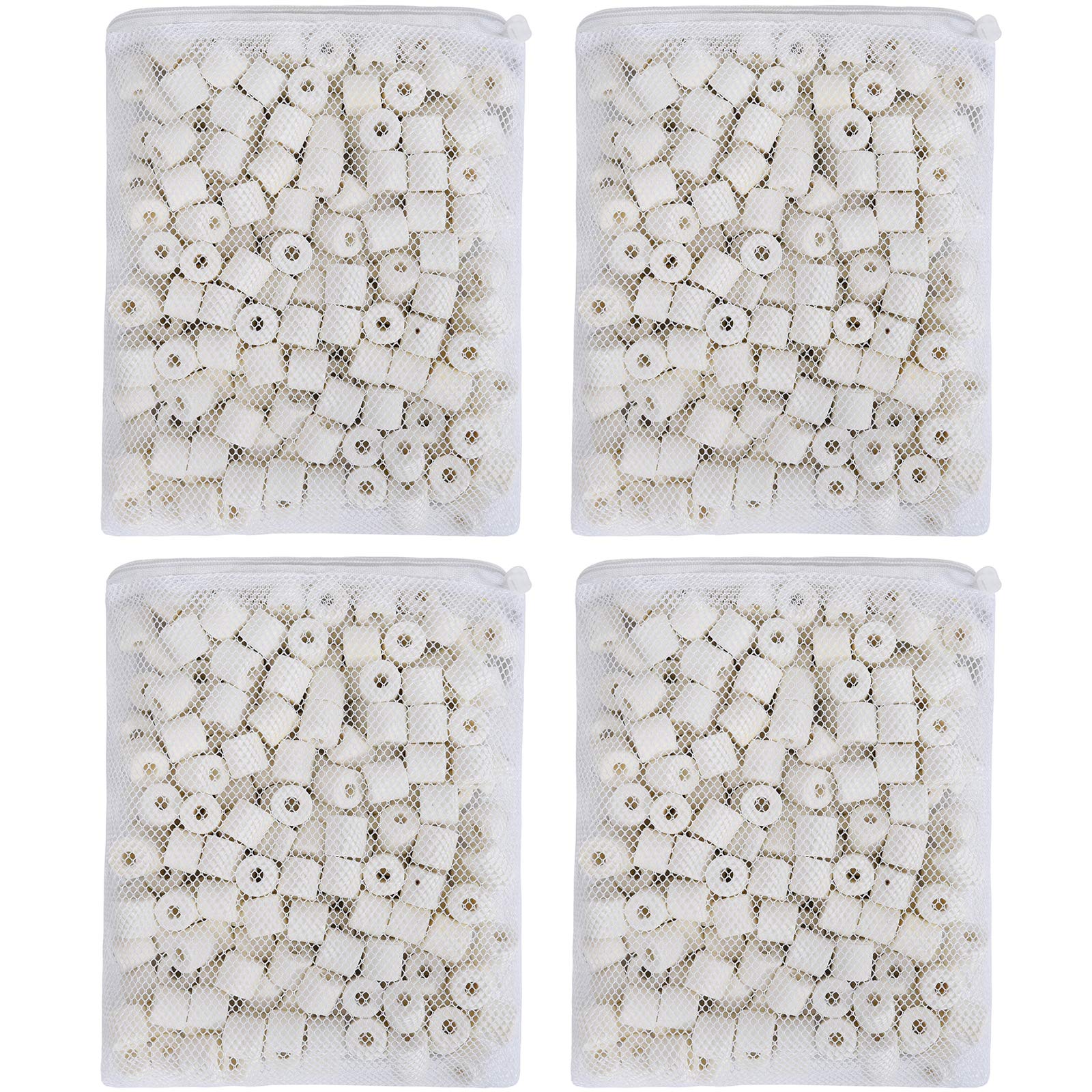
Rating: 4.7 ★ | Price: $$ | Porosity: Porous (moderate) | Ring Size: 1/2" x 1/2" | Weight: 4 lbs | Mesh Bags: 4 bags
JIH’s 4 lb ceramic ring set works in both fresh and saltwater filters, with four mesh bags ready to drop into canisters or sumps. Porosity may be lower than premium brands, making it a solid choice for general biofiltration at a budget-friendly price. For maximum surface area, the top pick offers higher porosity.
Pros
- Generous 4 lb quantity at a competitive price – buyers consistently report getting more than expected for the cost.
- Effective in both freshwater and saltwater setups, verified by users running canisters and sumps.
Cons
- Porosity may be less than premium media – worth considering if you prioritize maximum surface area for bacteria growth.
For budget-conscious aquarists with medium tanks who need a bio media that works in both fresh and saltwater, this JIH set delivers solid value – just be aware that porosity is not the highest available.
Best for Large Canisters & Ponds
Aquapapa 5lb
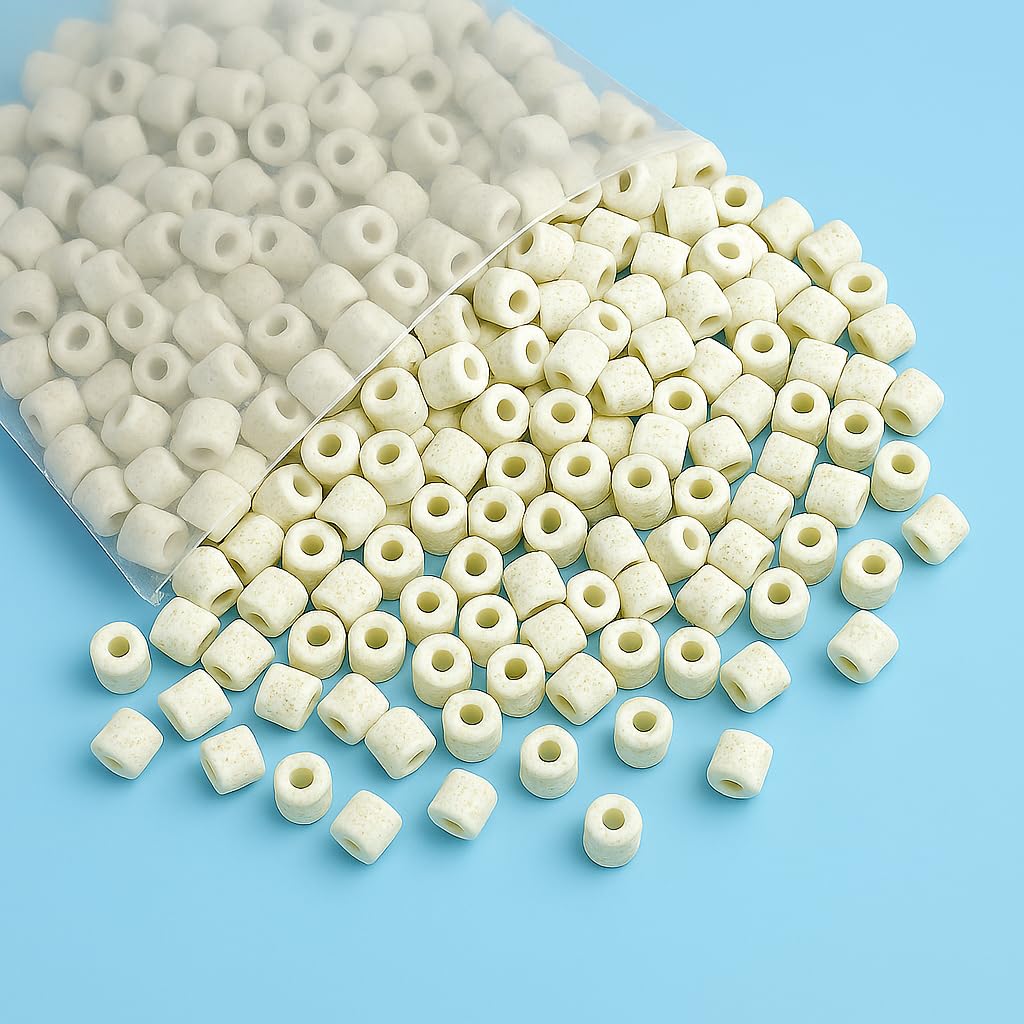
Rating: 4.7 ★ | Price: $$ | Porosity: Porous claimed | Ring Size: 11/16" x 5/8" | Weight: 5 lbs | Mesh Bags: 1 large bag
This 5-pound bag of ceramic rings offers a budget-friendly way to pack large canister or sump chambers with bio media. The rings perform well in canisters like FX4 and FX6, but you’ll need to rinse away heavy ceramic dust before use, and the single bulk bag means you may have to buy separate mesh bags if your filter requires divided trays. That makes it a smart pick if you prefer portioning media yourself rather than paying for pre-bagged convenience.
Pros
- Great value per pound for bulk bio media
- Performs effectively in large canister filters and HOBs
Cons
- Heavy dust requires thorough pre-rinsing—messier than some alternatives
- Comes in a single bulk bag; purchasing mesh bags may be necessary for filter trays
Ideal for aquarists who run large sumps or canisters and don’t mind rinsing and bagging media themselves to save on cost.
Best for Medium-Large Tanks
Aquapapa 6lb

Rating: 4.7 ★ | Price: $$ | Porosity: Porous claimed | Ring Size: 1/2" x 1/2" | Weight: 6 lbs | Mesh Bags: 6 bags
Six separate mesh bags make distributing media in canister and sump filters straightforward — no need to portion or source your own bags. The rings provide adequate surface area for biological filtration in medium to large freshwater tanks. Porosity varies between batches; some rings may arrive with less porous material, which can reduce their effectiveness for bacteria colonization. Buyers who need guaranteed high porosity may want to inspect each bag upon arrival.
Pros
- Individual mesh bags allow quick placement in canister filter trays, saving setup time and mess.
- Rings rinse clean easily and hold their shape through multiple cleanings, reducing maintenance effort.
Cons
- Porosity consistency varies between batches — some rings may be less porous, limiting bacteria growth potential.
A practical pick for aquarists who want the convenience of pre-bagged media and are willing to check porosity condition upon arrival.
Best for Ponds & Large Canisters
AQUACITY 5lb
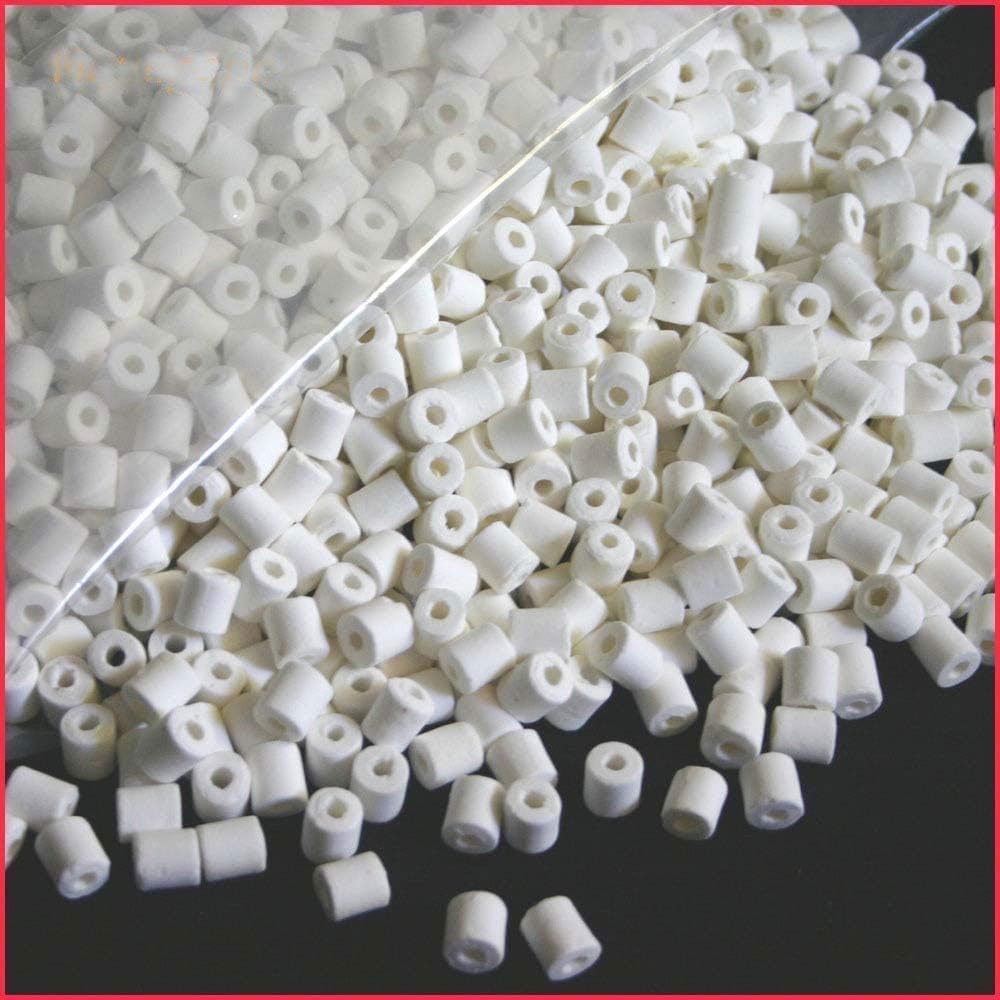
Rating: 4.7 ★ | Price: $$ | Porosity: Disputed (33% positive) | Ring Size: 1/2" x 1/2" | Weight: 5 lbs | Mesh Bags: 1 bulk bag
This 5-pound bag delivers a low per-pound cost for ceramic rings, making it a budget-friendly option for pond filters and large canisters where slight flow restriction is acceptable. The primary tradeoff is that porosity can be inconsistent—some rings may not be truly porous, which reduces their effectiveness for biological filtration. Additionally, the rings are smaller than typical, which can slow water flow in narrow filter baskets. This is why it is not recommended for high-performance biofiltration needs where maximum surface area is critical.
Pros
- Budget-friendly price for 5 pounds of ceramic filter media.
- Reported effective for biological filtration in pond and canister setups.
Cons
- Smaller ring size can slow flow in filters with narrow compartments.
A practical bulk choice for pond filters where quantity and price are the main priorities.
Best for Nano Tanks
PULACO 1lb

Rating: 4.6 ★ | Price: $ | Porosity: Microporous claimed | Ring Size: 0.6" x 0.6" | Weight: 1 lb | Mesh Bags: 1 bag
These ceramic rings are microporous, offering ample surface area for beneficial bacteria, and the included mesh bag simplifies setup. At 1 lb, the quantity suits tanks under 20 gallons or adding to existing media—not enough for larger canister filters.
Pros
- Microporous structure provides effective biological filtration surface area.
- Ready-to-use mesh bag eliminates the need for separate media bags.
Cons
- Ring diameter (0.6 inches) can be too large for compact internal filters designed for 40-75 gallon tanks.
Best suited for nano tanks or as a biological media supplement in existing filters, not as a primary fill for large canisters.
Best for Small Tanks (20-30 Gal)
Aquafa 2lb

Rating: 4.6 ★ | Price: $ | Porosity: Extremely porous claimed | Ring Size: 1/2" x 1/2" | Weight: 2 lbs
These rings deliver decent water clarity improvement for the low price and the small 1/2-inch size fits neatly into compact filter compartments. The trade-off is that a thorough pre-rinse is needed to remove manufacturing dust, and in some cases individual rings may break down into a fine powder after weeks of use. That makes this bag a practical choice for a 20- to 30-gallon temporary setup or as a secondary media layer, but not a set-and-forget solution for long-term primary filtration.
Pros
- Good quality for the price, with small rings that fit smaller filter compartments.
- Effective at keeping water clean in small tanks.
Cons
- Requires thorough rinsing before use to remove dust – a simple upfront step.
- Some rings may break down into dust over time, reducing long-term effectiveness – best suited for short-term or monitored use.
Acceptable for small temporary setups or as secondary media, but plan to inspect and replace if rings begin to degrade.
Best for Sump & Large Canisters
TOPZEA 6lb
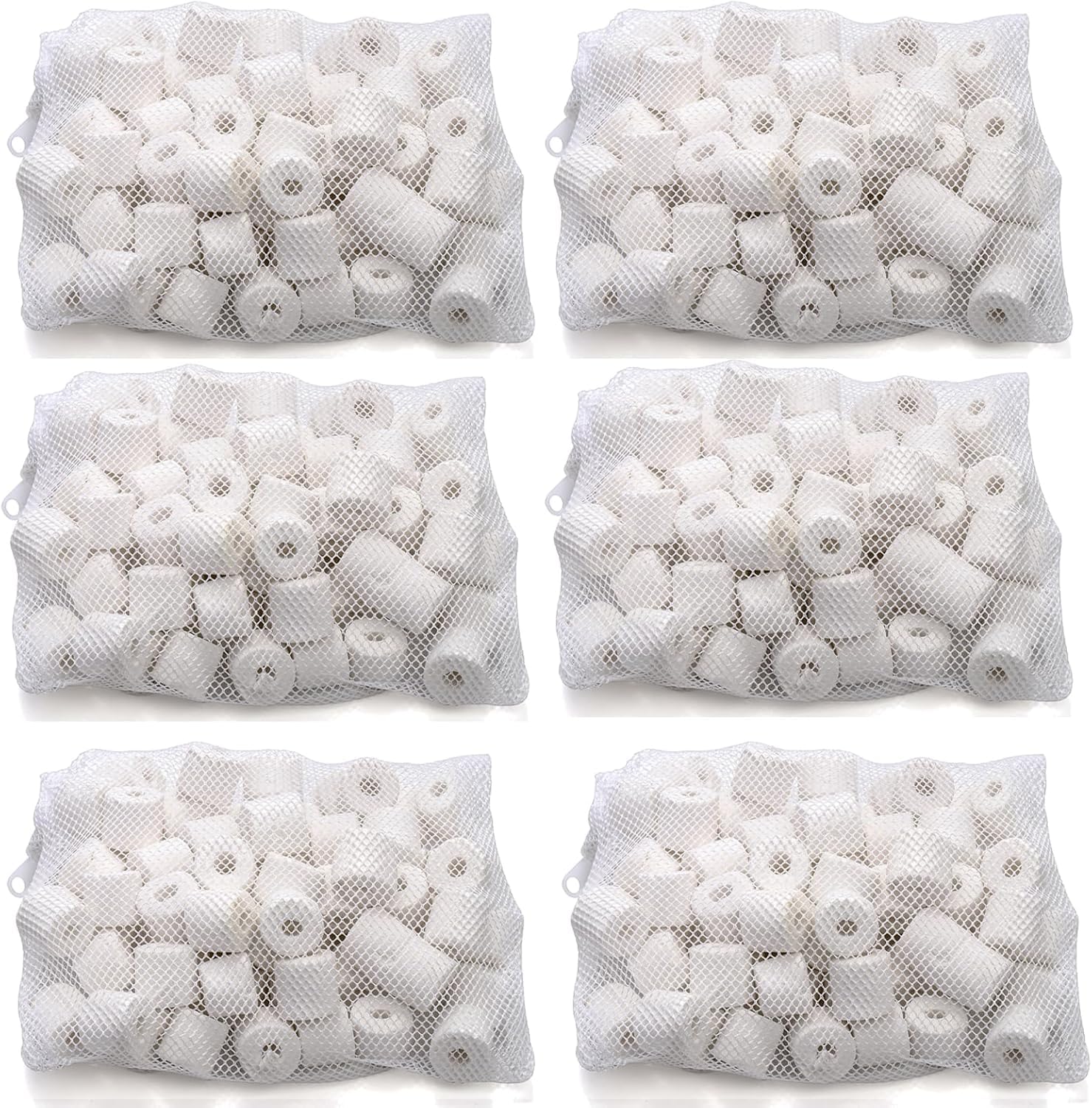
Rating: 4.4 ★ | Price: $$ | Porosity: Porous claimed | Ring Size: 0.75" dia x 0.6" | Weight: 6 lbs | Mesh Bags: 6 bags (QC issue)
This 6 lb set of ceramic rings comes in six separate mesh bags, making it easy to distribute in sump or canister filter trays. The price is competitive for the weight. The rings perform as expected for biological filtration. The main caveat is a quality control inconsistency: some buyers have received fewer bags than advertised. If you’re comfortable verifying the contents and the bag count matches the listing, this is a functional bio media at a reasonable cost.
Pros
- 6 lbs of media in six pre-packed mesh bags saves setup time.
- Works well in sump canisters and HOB filters for maintaining water balance.
Cons
- Some bags may be missing from the package – worth counting upon delivery.
A functional bio media at a reasonable price, best for buyers who don’t mind checking the bag count and can accept occasional QC inconsistencies.
How to Choose
The single most important insight: many ceramic rings are actually dense mechanical pre-filter media, not true biological media—always check porosity before buying.
Porosity and Surface Area
Porosity is the key spec that determines how much surface area the rings offer for beneficial bacteria. True bio media uses microscopic pores and a dimpled surface to maximize colonization space, often claiming thousands of square feet per pound. Dense rings, by contrast, have few visible pores and function mainly as mechanical debris traps.
If your goal is ammonia and nitrite control, prioritize products with verified high porosity—look for reviews that mention rapid water clarity improvement or bacterial growth. A non-porous ring will never perform as biological media, no matter how long it sits in your filter.
Ring Size
Ring diameter directly affects fit and water flow. Smaller rings (around 1/2 inch) fit easily into HOB filter baskets and tight canister trays, while larger rings (3/4 inch or more) can restrict flow in compact filters. However, larger rings allow water to pass with less resistance, which can be beneficial in big canister filters with high flow rates.
Before buying, measure your filter media compartment. A ring that is too large will leave gaps or not fit at all; one that is too small may compact together and create dead zones. Most products list ring dimensions—match them to your filter’s internal width.
Weight or Volume
The amount of media you need depends on tank size and bioload. A general rule: 1 pound per 10–15 gallons of aquarium volume for porous ceramic rings. For a 55-gallon tank, that means 4–5 pounds. Pond filters require much more—figure 5–10 pounds per 500 gallons.
Be careful with weight-based claims: some listings advertise ‘6 lbs’ but include the bag weight, and others have very dense rings that weigh more but have less actual surface area. Volume (how many rings) and porosity together give a better picture of biological capacity.
Mesh Bags
Mesh bags make media handling and cleaning much easier—you can pull the entire bag out without scooping loose rings. Look for bags with reinforced stitching and metal zippers, as plastic zippers often break after repeated rinsing. Some bulk products come in a single large bag; you may need to add your own smaller bags for filters with multiple trays.
If your filter has separate media compartments, pre-bagged sets (e.g., 6 separate 1-lb bags) save setup time. For sumps or pond filters, one large bag might be fine. The trade-off: convenience vs. cost per pound.
FAQ
Why do my ceramic rings have white dust after rinsing?
White dust is normal for most new ceramic media. The manufacturing process leaves fine ceramic powder on the surface. Rinse rings in a bucket of dechlorinated water until the water runs clear—usually 3–4 rinses. If dust persists after multiple washes, consider the media poor quality, but a small amount won’t harm your tank.
Can I use ceramic rings intended for mechanical pre-filter as bio media?
No. Dense pre-filter rings (like Fluval’s) have very little surface area for bacteria. They trap debris but won’t support meaningful biological filtration. If you need biofiltration, choose a product explicitly labeled as porous bio media. Using dense rings as biological media will leave you with elevated ammonia levels.
How much ceramic media do I need for a 55 gallon aquarium?
For a 55-gallon tank with moderate stocking, use about 4–5 pounds of porous ceramic rings. If you have heavy bioload or lots of fish, go up to 6 pounds. Fill the filter basket about 2/3 full with rings—don’t pack them tightly, as water needs to flow through them.
Do ceramic rings actually grow beneficial bacteria or are they just mechanical filters?
It depends on the ring’s porosity. True bio ceramic rings with microscopic pores provide enormous surface area for nitrifying bacteria—they are the best biological media for freshwater and saltwater. Dense, non-porous rings are only mechanical filters. Always verify porosity claims by checking user reviews for evidence of ammonia reduction or water clarity improvement.