This post contains affiliate links. We may earn a small commission when you buy through our links — at no extra cost to you.
The first time I reached elbow-deep into a tank to scrub a green haze off the front pane, I learned two things: algae lifts off glass easily, and sleeves don’t. A magnetic cleaner solves that in one motion — a pad inside the tank, a handle outside, the two holding each other through the glass — so you can wipe the whole pane with dry arms. What separates a good one is what happens when the halves slip apart, or when the inside pad picks up a grain of sand and drags it across the glass. Get it right and the job takes two minutes, with no drips on the floor and no scratches to stare at later.
We’ve spent four months with 14 of these cleaners across three tanks, and the differences showed up fast. Something first-time buyers don’t always realize: the magnet strength you need tracks your glass thickness, not your tank’s gallon count — a pair that grips beautifully on a nano tank can skate straight over the algae on a bigger pane. Bulk matters too, since a cleaner that can’t fit between the glass and a rock isn’t cleaning much. The picks below are the ones that held.
Our Top Picks



The Best Aquarium Magnet Cleaners, Reviewed
Aqueon Aquarium Algae Scraper – Best Overall
Key Features
- Surfaces: Glass, Acrylic
- Head size: 1.5"L x 2.25"W x 3"H
- If separated: Falls straight down
- Price: Budget
Acrylic is the reason the Aqueon sits at the top of this guide. Only two cleaners here are rated for both glass and acrylic, and for anyone with a scratched-up acrylic tank that alone shortens the shopping list to almost nothing. It also happens to be one of the cheaper picks we cover, though we chose it for the surface rating and kept it there because the rest holds up: the compact head, a firm hold on small and mid-size glass, and a price that makes a second one for the quarantine tank seem sensible.
The head is small — about 1.5 by 2.25 inches — so a pass covers a couple of inches of glass. On a 10- or 20-gallon front pane that’s a handful of strokes; on a six-foot tank you’ll feel every one of them. The payoff is maneuverability: this is the pick that slips between stem plants and into corners where a wide pad bridges across the gap and stops cutting.
Retrieval works differently from the floaters here. The inner half is weighted and drops straight down when the pair separates, which makes it easy to follow with your eye and easy to net. In a bare tank a floating pad is handier; in a thicket of stems, a sinking one is easier to find than a pad that has drifted into the filter intake.
Contact is the thing to manage. The halves can come apart mid-pass, and the fix is technique rather than parts: keep the outer handle square to the glass, use short strokes, and don’t tip it as you turn a corner. Do that and it stays coupled across a full pane, which is why it’s still the one we hand to most people.
Pros
- Rated for glass and acrylic
- Compact head works around plants and corners
- One of the cheaper picks here
- Weighted inner half drops predictably
Cons
- Small pad means many passes on long tanks
We point most people to the Aqueon because it handles glass and acrylic, steers into corners better than the wide pads, and still counts as a budget buy.
hygger Strong Magnetic Cleaner – Best for Thick Glass
Key Features
- Blades: Metal and plastic
- Body size: 3.7” L × 1.8” W × 1” H
- If separated: Floats
- Glass thickness: 1/5" – 3/8"
- Price: Midrange
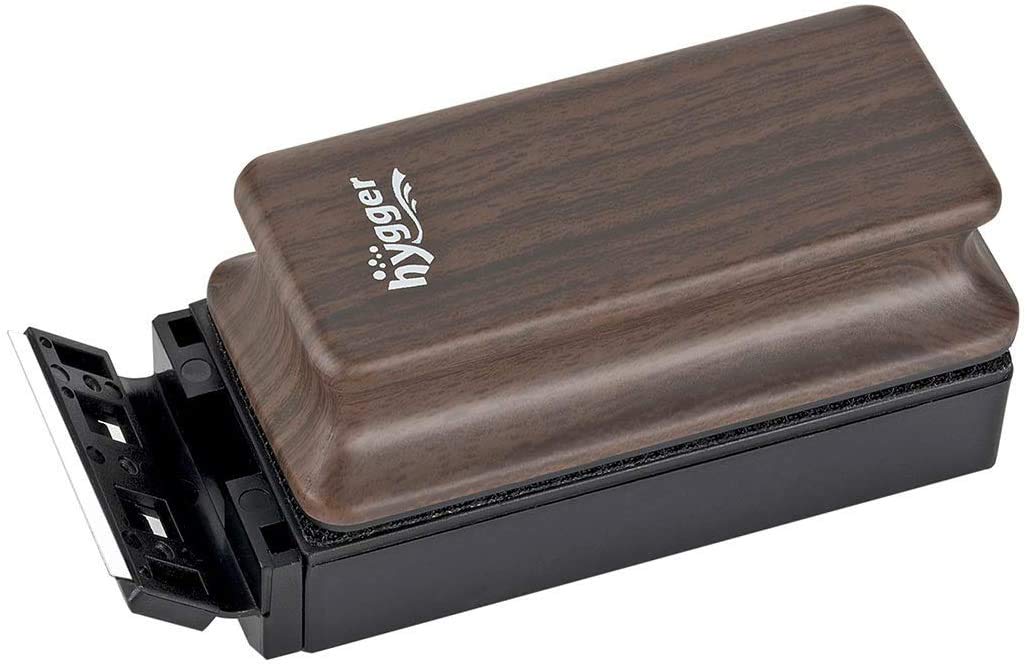
Where the Aqueon runs out — thick glass — the hygger starts. It’s rated for panes from 1/5 inch to 3/8 inch and meant for glass only, which puts it in the running for a 75- or 125-gallon tank where a small pad and a light magnet lose contact the moment you push. The body is 3.7 inches long by 1.8 wide, so it still turns corners; the magnet behind it is the real difference.
What we appreciate most is the blade setup: hygger ships a stainless blade for freshwater and a plastic one for saltwater, and the swap takes seconds. Steel is what lifts hard green spot algae that a scrub pad only smears around, and the plastic blade keeps you from dragging metal across a tank that shouldn’t see it. The wood-grain handle is a nicer detail than it needed to be — it stays put in a wet hand.
Two things to know. The inner half floats, so a separation is a nuisance rather than a rescue. And scratching is the risk that comes with any strong magnet: a grain of sand trapped under the pad gets pressed into the glass and dragged, which is how permanent lines appear. Rinse the pad between passes and stay an inch above the substrate. Do that and the grip that makes it good on thick glass stops being a liability.
Pros
- Rated for glass up to 3/8 inch
- Two blades for fresh and salt water
- Inner half floats for easy retrieval
- Textured grip stays put when wet
Cons
- Glass only, not for acrylic tanks
For glass a quarter-inch thick or more, we reach for the hygger: the magnet holds, the steel blade takes hard algae off, and the price stays sensible.
FL!PPER Nano Magnetic Cleaner – Best 2-In-1
Key Features
- Blade: Stainless steel
- Weight: 3.2 oz
- Tank size: Up to 25 gallons
- Glass thickness: Up to 1/4" (6 mm)
- Price: Premium
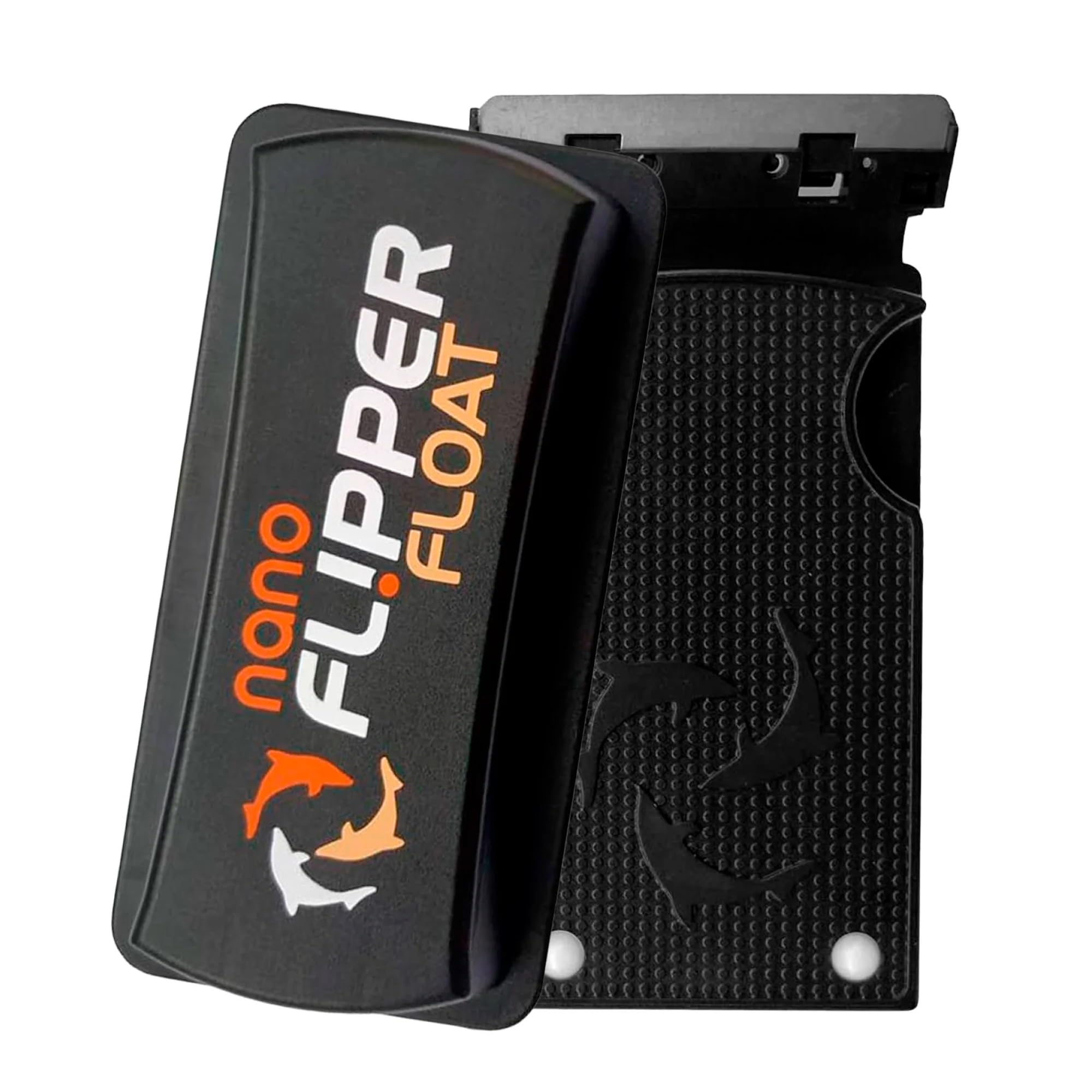
Flip it and the pad becomes a scraper. The Flipper’s trick is a sliding outer handle that rotates the inner half between a felt scrub pad and a stainless blade, so moving from wiping film to lifting hard algae doesn’t involve pulling your arm out of the tank and reaching back in. On a small tank, where you’re working in front of the glass in a tight space, that’s a bigger convenience than it sounds.
The Nano is the small version: rated to 1/4 inch glass or 25 gallons, 3.2 ounces in the hand, and it floats if it releases. The blade side has three contact points holding the edge slightly off the glass, a design decision aimed at keeping grit from being dragged along under the blade — the sort of detail that matters more the longer you own a tank.
We think the flip earns its premium on a small tank with coralline or hard green algae, where a scrub-only magnet just polishes the surface. The reservation is magnet mass: on a pad this size the grip is fine for its 1/4-inch rating and thin for anything thicker, and the float doesn’t always bring the inner half back up when the halves let go. A 20-gallon with stubborn spots, yes. A 75-gallon, no.
Pros
- Two tools in one handle
- Floats when it comes apart
- Blade sits off the glass to limit grit drag
- Light and precise in the hand
Cons
- Premium price for a nano-sized pad
- Rated only to 1/4 inch glass
The Flipper is the one we hand to someone with a small tank and stubborn algae: flip, scrape, flip back, and your sleeve stays dry.
DaToo Mini Magnetic Scrubber – Best for Nano Tanks
The DaToo is barely bigger than a matchbox, and the part that surprised us is the grip. An N38 neodymium magnet in a 2.39-ounce body snaps onto 10-gallon glass and stays there through a full pass, which is more than a cleaner this small has any right to do. For a nano tank, a betta setup with a filter, or a kid’s first 5-gallon, it does the whole job with one hand and very little money.
The limits are the pad and the glass. The cleaning face is small — the tool overall is 4.5 by 2.1 inches — so on a 55-gallon it’s stroke after stroke, and thin panes need a light touch because the magnet pulls harder than you want for the glass around it. Scratches are the other watch item: a grain of grit under a small pad leaves a mark, so rinse it before each pass. Kept beside a small tank as the everyday cleaner, we have no argument with it.
Pros
- Strong magnet for a nano body
- Very little money for a working cleaner
- Small enough to store on the tank
Cons
- Nano pad is slow work on larger tanks
For a two- to ten-gallon tank, the DaToo is the one we grab: tiny, cheap, and a stronger magnet than its size suggests.
Pawfly Aquarium Magnetic Brush – Best Budget for Mid-Size Tanks
Key Features
- Weight: 3.84 oz
- Head size: 1.8" D x 2.3" H
- Tank size: Up to 30 gallons
- Glass thickness: Under 4/5 inch
- Price: Budget
The Pawfly sits between the nano cleaners and the thick-glass magnets. Its pad is 1.8 inches across and 2.3 tall, rated for tanks up to 30 gallons and glass under 4/5 inch. That thickness figure reads generous for a pad this size; what we trust is the tank rating, which lines up with a 20- to 30-gallon glass tank and not a great deal more.
Both halves float, and we rate that higher than we expected to. When contact breaks halfway up the front pane, the inner half surfaces where you can lift it out instead of disappearing into the substrate. Add a concave grip that sits well in a wet hand and 3.84 ounces of weight, and one-handed work across a 29-gallon is comfortable.
Pads are the wear item, as they are on every cleaner here. Rinse both halves after use, keep the inner pad off the sand line, and expect to replace the pad rather than the tool. It’s a sensible middle: more cleaning face than the nanos, less magnet than the big-glass picks, and priced to match.
Pros
- Both halves float when separated
- Good pad size for 20-30 gallon tanks
- Comfortable non-slip grip
Cons
- Glue can leave residue on the outer glass
We like the Pawfly for a 20- to 30-gallon glass tank: a bigger pad than the nano picks, both halves float, and it doesn’t ask much of your budget.
AQUANEAT Magnetic Brush – Best for 5-10 Gallon Tanks

Key Features
- Weight: 2.08 oz
- Surfaces: Glass only
- Head size: 1.5" D x 1.2" H
- Tank size: Up to 10 gallons
- Price: Budget
The AQUANEAT doesn’t float, and that shapes how you use it. If the inner half lets go near the bottom of the tank, it sinks and stays there until you net it out or reach in. We work top-down with this one, finishing the upper half of the glass first, and keep a net within arm’s reach.
For that you get a genuinely strong little magnet. On a 5- or 10-gallon it holds firmly and pulls ordinary film off without much scrubbing, and the 1.5-inch head slips into the corners of a rimmed tank where a wider pad catches on the frame. Two pads, coarse inside and soft outside, mean you can wipe the outside of the glass with the same tool.
It’s a spare, not a main cleaner. Ours lives in the cupboard for the quarantine tank and the shrimp bowl, and for that role the sinking half is a fair trade. Make it the only cleaner on a 29-gallon and the small pad and the retrieval will wear on you by the second week.
Pros
- Strong magnet on small tanks
- Lowest price of the picks here
- Compact head reaches rimmed corners
Cons
- Glass only, not rated for acrylic
The AQUANEAT is what we buy for a 5- or 10-gallon glass tank when budget decides: a strong little magnet at the lowest price here.
SEAOURA Magnetic Cleaner with Thermometer – Cleaning Plus Temp

Key Features
- Weight: 2.88 oz
- Battery: 1 CR2032
- Glass thickness: 4 mm to 10 mm
- Temperature range: 0 °F to 99 °F
- Price: Midrange
A thermometer in the outside handle is a good idea — you’re standing at the glass anyway. The SEAOURA puts a small digital display in the outer half, reading 0 to 99 °F, with a CR2032 cell behind it and a three-second press to switch between Fahrenheit and Celsius.
As a cleaner it’s ordinary in the way that works: a small pad rated for 4 mm to 10 mm glass, which covers most 10- to 40-gallon tanks, with enough magnet to hold through a pass and a body compact enough to slip behind a filter intake. It takes film off the front pane without drama.
The temperature side is where we hesitate. The readings are the least consistent part of the product, and the display changing scales mid-check is the kind of thing that sends you looking for a second thermometer to confirm. As a rough second opinion on tank temperature it’s fine. As the number you set a heater by, it isn’t.
So the case for it is narrow and clear: a small tank, one less tool on the shelf, and a rough temperature check without adding another suction cup to the glass. Anyone who needs an accurate reading, or who has 3/8-inch glass, is better served by a plain cleaner and a separate thermometer.
Pros
- Cleans and reads temperature in one tool
- Compact pad suits small tanks
- Can float if the halves separate
Cons
- Temperature readings can be inaccurate
- Capped at 10 mm glass
We treat the SEAOURA as a small-tank cleaner that happens to show the temperature, not as a thermometer you can rely on — and at that job it’s handy.
How We Tested 14 Aquarium Magnet Cleaners
To build the shortlist, I started with what a tank actually demands: I read through specs for glass-thickness ratings, whether the inside half floats or sinks, pad material, scraper blades, and available sizes, then cut anything that came in only one footprint or couldn’t be bought with replacement pads. That left 14 cleaners, which we used for four months across three tanks — a planted 20-gallon, a 55-gallon with heavy front-pane algae, and a nano tank with thin glass and tight corners.
Every cleaner got the same job: clear a taped-off patch of green spot algae from the front pane in overlapping passes, and we counted the passes it took. We also tried to lose the inside half on purpose, yanking the outside handle away mid-stroke, to see whether the inner piece floated where we could scoop it up or sank into the gravel. Adhesion got judged on the glass itself — pairs that held fine on the nano tank slid and skipped on the 55-gallon, and a few chattered on any pane thicker than a quarter inch.
Before each reuse, we dragged the pad through a patch of sand and fine gravel, then checked the pane under raking light for scratches. Pads that trapped grit got marked down no matter how well they cleaned. For models with a built-in thermometer, we compared the reading against a digital probe and timed how long it took to settle. And because pads wear out, we looked at how each one attaches, whether refills are sold separately, and whether the whole cleaner still felt worth the money once a replacement pad entered the math.
How to Choose an Aquarium Magnet Cleaner
A magnet cleaner lives or dies on two numbers most shoppers never look at: the glass thickness it is rated for and whether the tank is glass or acrylic.
Match the magnet to your glass, not your gallon count
A cleaner’s pull has to carry through the pane, and that makes thickness the specification to shop by. A 20-gallon tank can wear 5 mm glass; a 125-gallon can wear 3/8 inch. Buy below your thickness and the outer half slides off the moment you push it; buy far above it and a thin pane gets a cleaner that snaps together hard and steers like a shopping cart with a bad wheel.
Measure at the top rim where the edge is exposed, or look up the tank maker’s figure for your model. Across this guide the ratings run from a 1/4-inch nano to a 3/8-inch magnet, and that spread is more useful to compare than any gallon number on the box.
Glass or acrylic narrows the list fast
Acrylic scratches if you look at it wrong, and most magnetic cleaners are glass-only by design — the pads and blades are chosen for a harder surface. Only two picks here are rated for both, which means an acrylic owner’s shortlist is effectively already written.
If your tank is glass you have the full range, but an acrylic-rated cleaner is never a bad buy: it covers the quarantine tank you haven’t set up yet, and it is the safer thing to hand a beginner.
Float or sink when the halves let go
Every magnet cleaner loses contact eventually — a fast stroke, a corner, a brace. What happens next decides how much you resent it. A floating inner half rises to the surface where you can pluck it out. A weighted one drops straight down and waits to be netted.
Neither is wrong. On a bare-bottom tank a floater is faster. In a thicket of stem plants, a floater drifts into the stems and a sinking half stays where you can see it, so the predictable drop of something like the Aqueon is easier to recover.
Pads, blades, and what actually scratches glass
A felt or non-woven pad handles film and soft algae. A stainless blade lifts hard green spot algae and coralline, which is why blade-equipped cleaners cost more. Two rules follow: metal is for freshwater glass, and saltwater or acrylic calls for the plastic blade if one is included.
The blade is rarely the culprit behind a scratch. A grain of sand trapped under the pad and dragged along the glass is. Rinse the pad between passes and stop an inch above the substrate line, and you remove most of the risk.
Pad size against tank size
A wide pad covers more glass per stroke but drags harder, bridges over curves and catches on braces. A small pad cuts around plants and corners and needs more strokes to finish a pane.
Our working rule: nano pads for tanks up to about 10 gallons, a pad around 2 inches for 20 to 40 gallons, and real magnet mass for 55 and up. A nano cleaner will eventually get a 75-gallon clean — it just takes an afternoon.
Frequently Asked Questions
Why use a magnetic cleaner instead of a long-handled scraper?
A magnet cleans both sides of the glass without putting your arm in the tank, and it reaches behind rockwork where a handle can’t swing. A long-handled scraper still wins in a deep tank, where its reach beats a magnet’s, and for heavy coralline across a big pane. For weekly film on the front glass, the magnet is faster and drier.
Can I leave the magnet attached to the tank between cleanings?
Yes, and most people do — leave the pair coupled on the outside of the glass and the pad stays wet and ready. Two cautions: don’t store it coupled with grit between the pads, and keep it out of reach of children, because the halves snap together with enough force to pinch. Rinse and separate the pair if it’s going into a cupboard for weeks.
Do magnetic cleaners work on bow-front and curved tanks?
A small pad follows a curve; a wide flat one bridges it and stops cutting. On a bow-front, a compact head with a curved pad like the Aqueon’s tracks the glass better than a 2-inch pad does. Expect to finish the strips where the curve meets the flat side by hand.
How often do the pads wear out, and can I buy replacements?
The pad is the wear part: the abrasive face loads up with algae and grit and stops cutting long before the magnet weakens. Plan on replacing pads rather than the whole cleaner, and check that replacements are easy to order before you buy — a few popular models sell pads only as add-ons, which is a nuisance when you need one. Rinsing after each use gets more life out of them.
Final Verdict
If you’re buying one magnet cleaner and you don’t know your glass thickness offhand, buy the Aqueon. It is rated for acrylic as well as glass, its small head steers around plants and braces better than the wide pads, and it sits in the budget tier. That combination is why it leads this group.
Measure before you decide otherwise. At 1/4 inch and up, or on anything over 55 gallons, the hygger’s stronger magnet and steel blade make more sense. And if hard, stuck-on algae is the whole reason you’re shopping, the Flipper’s flip is worth the extra money on a small tank.