This post contains affiliate links. We may earn a small commission when you buy through our links — at no extra cost to you.
Aquarium filter floss is a tradeoff in a bag: the thicker and fluffier the material, the more fine particles it grabs, and the faster it clogs and gets thrown out. Buy thin, loose floss to save a few dollars and the haze in your water never quite lifts. That’s the whole job here — floss is the last stage water passes through before it returns to the tank, catching what your sponge and bio media let through and keeping that gunk off the media your fish depend on.
We’ve spent four months running 16 flosses through three tanks, and the pattern is consistent: the ones that work hold their shape when wet without packing so tight that flow drops. Something nobody tells a first-time buyer — a loose bag you cut yourself costs a fraction of precut pads, as long as you cut it slightly oversized so it seals the edges of the slot. Everything below earned its place by clearing water, not by looking neat in the package.
Our Top Picks



The Best Aquarium Filter Floss for Clear Water, Reviewed
Aquatic Experts FilterFirst Roll – Best Overall
Key Features
- Reuse: Rinse and reuse
- Roll size: 12 in x 72 in
- Thickness: 3/4 to 1 in
- Construction: Dual-density polyester
- Price: Midrange
A dual-density roll is the most useful shape for most aquariums, and this one earns the top spot because it gives you a coarse face and a finer layer in the same sheet. You cut a piece to fit a canister, sump, or hang-on-back tray, and the two layers catch the big debris before the fine side pulls out the haze. We like that flexibility more than any pre-cut pad here: one roll covers several filters and lets you cut a fresh piece when the old one loads up.
The 12-inch by 72-inch roll is thick enough to seat without folding over, and the polyester fibers hold together through several rinses. We found the dual-density construction especially useful ahead of biological media, where the coarse side keeps the fine side from clogging as fast. It is not a dedicated polishing pad for a tank that is already milky, and you still need to fix the cause, but as everyday mechanical filtration it is the pick we reach for first.
Cut it slightly oversized and press the edges flat so water cannot slip around it. A cardboard template made from the first pad saves time on the next change, and the roll is long enough that a sloppy cut is not a crisis. For most people, this is the balance of clarity, flow, and cost per change that makes filter floss worth keeping on the shelf.
Pros
- Dual-density layer handles coarse and fine debris
- Cut-to-fit roll suits canisters, sumps, and HOB filters
- Rinses and reuses several times
- Large roll lowers cost per change
Cons
- Thickness varies; measure the chamber
For most aquariums, this is the filter floss we recommend: a cut-to-fit dual-density roll that handles coarse debris and fine haze.
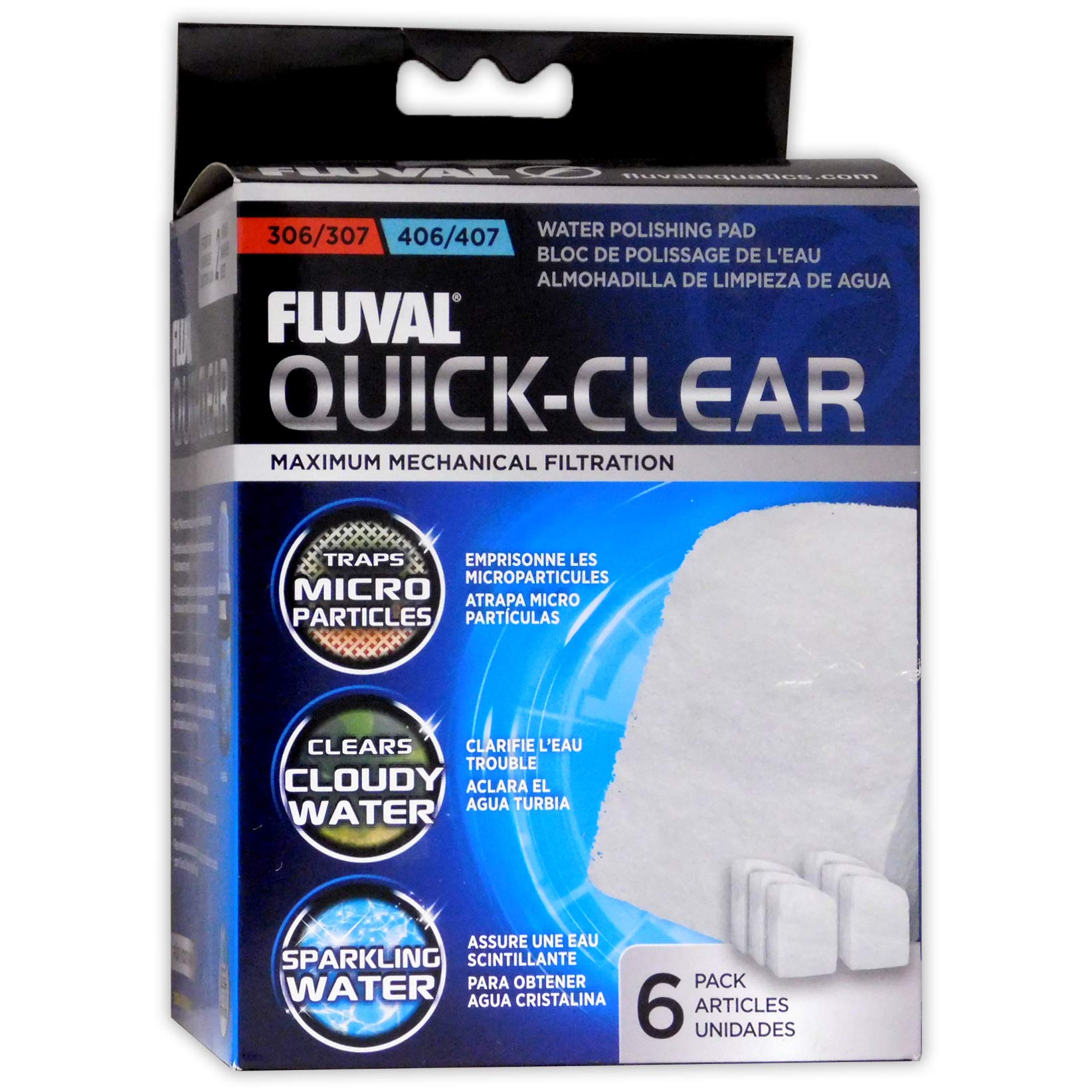
Fluval Quick-Clear Pads – Best for Fluval Canisters
Key Features
- Use: Water polishing
- Material: Ultra-fine polyester
- Pack count: 6 pads
- Compatibility: Fluval 306/307/406/407
- Price: Budget
If your filter is a Fluval 306, 307, 406, or 407, the Quick-Clear pads remove the cutting step entirely. They drop into the fine-filter slot as a complete set of six, and the extra-thick polyester is aimed at the cloudy-water moments after maintenance or a substrate disturbance.
We reach for these when we want the fastest possible polish in a Fluval canister. The fit is the real feature: a pad that seals the tray edge stops water from sneaking around the media, and that matters more than a fancy fiber blend. The pads are dense enough to pull fine particles, and the six-pack gives you spares for the next few cleanings.
The catch is what happens after the pad loads. These are not the reusable workhorses in this group; they can be rinsed, but they often come out fragile, and some crumble before you get a second or third use. If you dislike disposable media, a cut-to-fit roll is the better long-term buy. If you have the matching Fluval and want a no-trim pad, this is the one we keep for that job.
Pros
- Exact fit for Fluval 306/307/406/407
- Dense pads clear cloudy water
- Six pads per pack
Cons
- Fits only four Fluval models
We keep these on hand for Fluval 306, 307, 406, and 407 canisters when a no-trim polishing pad matters more than long-term reuse.
Aquatic Experts 100 Micron Pad – Best for Fine Polishing
Key Features
- Grade: 100 micron
- Cleaning: Machine washable
- Thickness: 1/8 in
- Sheet size: 24 in x 36 in
- Price: Midrange
The 100-micron figure is the reason to consider this pad: it is a fine-polishing layer, not an everyday coarse floss. The dense fiber network is designed to catch the particles that make water look hazy, and the sheet is thin enough to slide into a tray without stealing much space. We think of it as the last stage in a filter, not the first.
At 24 by 36 inches and an eighth of an inch thick, one sheet gives you plenty of material to cut into custom pads for a canister, sump, or hang-on-back filter. The polyester is strong enough that Aquatic Experts says it can go in a washing machine, which is a nice option if you want to deep-clean a loaded pad rather than toss it. We prefer to rinse it in a bucket first, because fine media can hold a lot of gunk.
Use it after a coarser pad has taken the bulk of the debris, and pull it out for a quick rinse without disturbing the rest of the filter. It is the strongest fine-grade option here for a final polish before a water change or a photo, and it earns its place as a finishing layer rather than the whole mechanical stage.
Pros
- 100-micron pad catches very fine haze
- Cut-to-fit sheet covers multiple filters
- Machine washable for deep cleaning
Cons
- Clogs quickly as a primary filter
We reach for this 100-micron pad when the tank is clear but still hazy, and we treat it as a final-stage polisher rather than a primary filter.
sera Filter Wool – Best Loose Wool
Key Features
- Form: Loose wool
- Reuse: Rinse and reuse
- Quantity: 500 g / 1.1 lb
- Price: Premium
Loose wool is the least glamorous form of filter floss, and the sera bag is the one to consider when you want to stuff a chamber rather than cut a neat rectangle. The bag holds 500 grams, or about 1.1 pounds, of fine white wool that you can pull apart and shape around media baskets, overflows, or DIY filter compartments.
You tease out a loose handful, pack it so water has to pass through rather than around it, and rinse it when it loads. The upside is that you can fill odd spaces that a rigid pad cannot reach, and you can make the density heavier or lighter depending on what the tank is throwing at the filter. It is also easy to top up a thin spot without replacing the whole pad.
We like it best for custom sumps and older filters where the media chamber is an odd shape. The wool is durable enough to rinse and reuse, and a bag this size lasts a long time, so the higher upfront cost spreads out. It is the best loose wool here because it fills gaps a cut pad cannot reach and lets you adjust density by feel.
Pros
- Loose wool fills odd-shaped chambers
- Rinses and reuses
- Large 500 g bag lasts
Cons
- Needs hand shaping for each chamber
Our pick for custom chambers is this loose wool: it fills odd spaces, rinses reusable, and makes a big bag last.
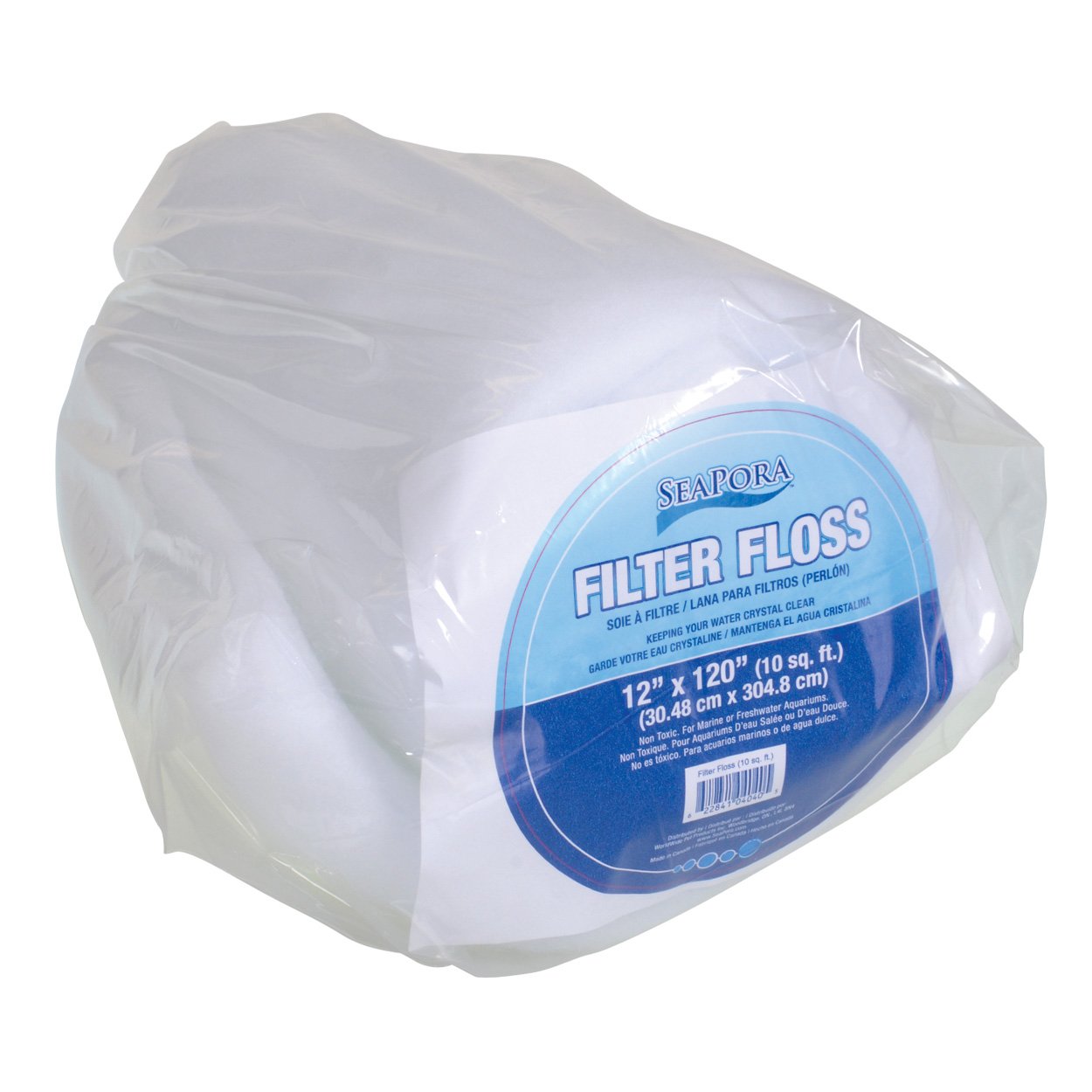
Seapora Filter Floss Roll – Best Budget Roll
Key Features
- Use: Freshwater or saltwater
- Area: 10 sq ft
- Roll size: 12 in x 120 in
- Construction: Dense mechanical floss
- Price: Budget
The Seapora roll is the bulk-buy option: a 12-inch by 120-inch length that gives you 10 square feet of dense white floss to cut into pads. If you keep several tanks or change media often, that is a lot of mechanical filtration in one package, and the roll format lets you make pieces as small or large as each filter needs.
We like it as a budget roll for sumps and multiple small filters, especially when you want a fresh pad without paying for a molded shape. The material is dense enough to catch debris and keep water clear, and it cuts cleanly with ordinary scissors. It is not as structured as the dual-density rolls here, so it can be fiddly in a tray that depends on a fat pad to stay put.
Cut a cardboard template from your filter tray before you start; the roll is big enough that a sloppy first cut wastes a long strip. Treat the floss as a source of cut pieces rather than a precision pad, and cut slightly oversized so you can tuck the edges down. For a budget roll, that approach gets you a lot of useful pads with very little waste.
Pros
- 10 sq ft roll cuts many pads
- Dense floss clears fine debris
- Budget-friendly for multi-tank use
Cons
- Delivered roll dimensions can be off from the listing
We like this roll for budget-minded multi-tank keepers who want plenty of cut-to-fit floss and can check the delivered dimensions.
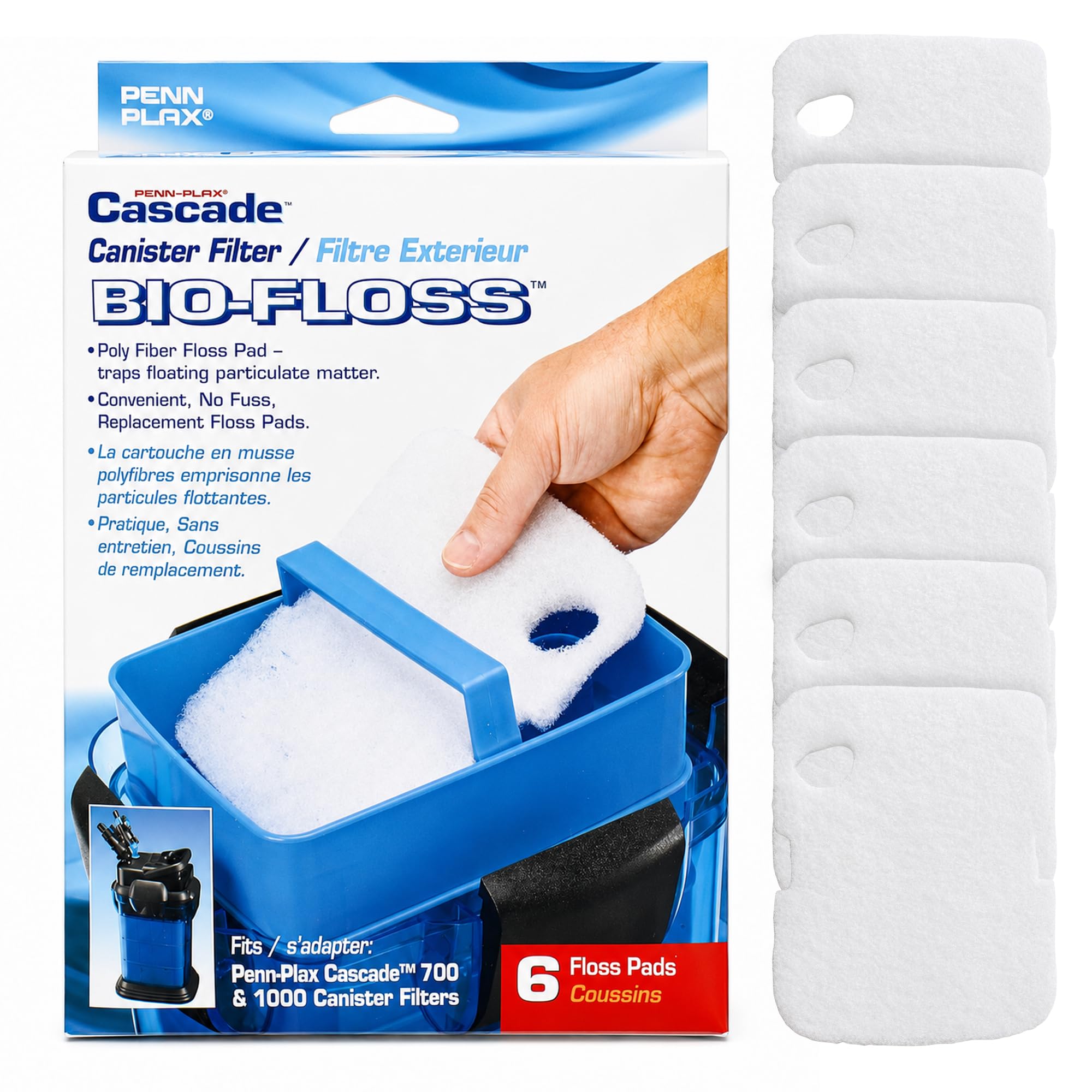
Penn-Plax Cascade Bio-Floss – Best for Cascade Canisters
Key Features
- Type: Mechanical floss
- Material: Poly fiber floss
- Pack count: 6 pads
- Compatibility: Cascade 700/1000
Cascade 700 and 1000 canisters get the same no-trim convenience here that Fluval canisters get from the Quick-Clear pads. The six-pack is cut for those canister models, and the poly fiber floss is meant to sit in the mechanical stage and trap detritus before it reaches the finer media.
The fit is the strongest part of the case. These pads seat cleanly in the tray, and the cut edges are neat enough that you are not fighting loose fibers every time you open the canister. They are white, so it is easy to see when they have loaded up, and swapping one out is a quick job rather than a project.
We recommend them for Cascade canisters when you want a simple drop-in pad. For a long-term reusable pad, a cut-to-fit roll is better; for the right shape with no trimming, these earn their place. The six-pack also makes it easy to keep a spare on the shelf instead of cutting a new piece in the middle of a water change.
Pros
- Drop-in fit for Cascade 700/1000
- Clean-cut edges seat neatly
- Six-pad pack simplifies changes
Cons
- Pads can come apart after short use
We recommend these pads to Cascade 700 and 1000 canisters when drop-in fit matters more than long-term durability.
Marineland Bonded Pad – Best for Small Custom Cuts

Key Features
- Area: 312 sq in
- Cutting: Cut to fit
- Sheet size: 12 in x 24 in
- Construction: Bonded pad
- Price: Budget
The Marineland pad is a bonded sheet rather than a loose floss, which gives it a firmer hand and cleaner edges. It is a 12-by-24-inch pad, about 312 square inches, and the idea is to cut it to fit a hang-on-back filter, canister, or sump tray. The bonded construction is meant to trap dirt without shedding stray fibers into the tank.
That firmness is useful when you want a pad that stays flat in a media basket. It does not flop over or bunch up the way loose wool can, and it is easy to cut with scissors. Measure your filter before cutting and use a cardboard template if you want to avoid waste.
It works best as a prefilter or a mechanical layer ahead of biological media. It traps particles and keeps the water from carrying debris into the finer stages, and it can be rinsed a few times before it loses its shape. It is not a fine polisher on its own; it is a workhorse pad, not a 100-micron polisher.
We reach for the Marineland sheet when we need a small, stiff pad for a custom cut and do not want to unroll a big bulk roll. It is an affordable way here to try a bonded pad in a filter that does not have a dedicated cartridge. For one or two filters, it is a tidy, low-cost option that cuts cleanly and stays put.
Pros
- Firm bonded pad stays flat in trays
- Cuts cleanly without loose fibers
- Works as a prefilter ahead of bio media
Cons
- Small sheet limits multi-tank use
The Marineland sheet is our small-job pick: firm enough to cut cleanly and affordable enough to try in a custom filter.
AQUANEAT Dual-Density Roll – Budget Dual-Density Media

Key Features
- Use: Canister, sump, HOB
- Roll size: 72 in x 12 in
- Thickness: 3/4 to 1 in
- Construction: Dual-density bonded floss
- Price: Midrange
The AQUANEAT roll uses two colors to mark two densities: a white open-fiber side for larger debris and a green denser side for finer particles. It is a 72-by-12-inch roll with a listed thickness between three-quarters of an inch and an inch, so you can cut it to fit a canister, sump, or hang-on-back filter.
The idea is sensible: one piece gives you a coarse and a fine layer without stacking two separate pads. The roll is big enough to make dozens of custom pieces, and the material cuts easily with scissors. For a budget setup, that combination is appealing, especially if you are already cutting your own media and do not want to buy a separate polishing pad.
That combination makes sense for a sump or a quarantine tank where perfect polish matters less than having plenty of cut-to-fit media on hand. We treat it as a budget roll: inspect each piece before it goes in, cut slightly oversized, and replace it when it stops holding shape.
We see it as a budget alternative for a sump or a quarantine tank where perfect polish matters less than having plenty of cut-to-fit media on hand. If you want the most predictable dual-density roll, the Aquatic Experts FilterFirst is the better default. If you want to spend less and do not mind a budget roll, this one earns a try.
Pros
- Dual-density sides handle coarse and fine debris
- Large cut-to-fit roll suits sumps and HOB filters
- Lower-cost way to try dual-density media
Cons
- Density varies from piece to piece
- Fine layer can separate when rinsed
We see this as a budget dual-density roll for sumps and quarantine tanks, where variable density matters less than having plenty of media.
How We Tested Aquarium Filter Floss
We started by gathering every product genuinely sold as filter floss — precut pads sized to common hang-on-back slots, rolls, and loose bags — then compared thickness by weight per sheet, listed dimensions, fiber type, and price per square foot. Anything that arrived compressed into a stiff board, or shed visible fibers when we pulled it apart dry, came off the list. Sixteen made the cut.
Each one went into rotation in the same filter slot on three tanks: a 55-gallon community tank running a canister filter, a 20-gallon planted tank with a hang-on-back, and a 10-gallon quarantine tank that clouds up fast. We swapped floss weekly, checked the water twelve hours after each change to see whether the fine haze had actually cleared or just moved around, and watched the outflow for the first sign that flow was dropping.
Before anything went in, we noted how much a wet pad fluffed up and whether it stayed seated in the slot or sagged toward the impeller. When it came out, we squeezed it in a bucket of tank water to see how many rinses it survived — some held together for three, others matted into a gray pancake on the first. We tracked cost per week of real use, which is where the cheap pads separated from the expensive ones, and watched the water column afterward for shed fibers.
How to Choose Aquarium Filter Floss
The right floss is the one that traps the particles your filter is currently pushing back into the tank without choking flow or falling apart at the first rinse.
Match the Media to the Filter
Start with the shape of your filter, not the brand of floss. A model-specific pad such as the Fluval Quick-Clear or Penn-Plax Cascade Bio-Floss saves trimming and seals the tray edge, but it only fits the listed canisters. A cut-to-fit roll is more versatile: one length can serve a canister, a sump, and a hang-on-back filter, and you can make a fresh piece whenever the old one loads. Loose wool is the best choice for odd chambers and DIY baskets where a flat pad cannot reach. We choose the format first because the wrong shape either bypasses water or wastes media.
Choose the Grade Before You Chase Clarity
Mechanical floss comes in coarse, dual-density, and fine-polishing grades. A coarse or dual-density pad is the everyday workhorse: it catches food, waste, and plant bits before they reach the biological media. A 100-micron pad is a finishing layer for the haze that remains after the big debris is gone. The trap is treating the finest pad as the first stage; dense media clogs quickly and can slow flow. Put the fine pad last, check it often, and keep a coarser pad ahead of it. That way the polishing layer does the detail work without becoming the bottleneck.
Plan for Rinsing, Not Just Buying
Ask how the floss behaves after it loads, not just how it looks dry. Bonded pads and polyester rolls usually hold their shape through several rinses; loose wool can be reused but needs gentle handling; some model-specific pads are effectively disposable. We prefer media that can be rinsed at least a few times, because the cost per change matters more than the sticker on the pack. If you hate rinsing, buy a bulk roll and cut several spares at once so a dirty pad never becomes a reason to skip maintenance. If you enjoy precise, low-mess changes, pre-cut pads are worth the convenience.
Cut for a Seal, Not Just a Fit
A pad that is slightly too small lets water slip around its edges, which defeats the point of mechanical filtration. Cut a template from cardboard, trace it onto the floss, and make the new piece a little oversized so it presses against the chamber walls. Thickness matters too: a pad that is too thin can shift or fold, while one that is too thick may stop the tray from closing. Check the chamber with the pad dry, then trim again after the first rinse. A snug, flat seat is what turns a good floss into clear water.
Frequently Asked Questions
Can I use craft batting or pillow stuffing as aquarium filter floss?
No, not unless the package specifically says it is aquarium-safe. Craft batting can carry oils, dyes, or sizing that you do not want in tank water. Buy a dye-free aquarium floss instead; the small savings are not worth the risk to fish or corals.
How often should I replace filter floss?
Rinse it at every water change and replace it when it stays matted or the flow drops. In a heavily stocked tank, a fine polishing pad can load in about a week, while a coarser pad may last longer. Keep a spare cut piece ready so a clogged pad never delays maintenance.
Does filter floss remove ammonia or nitrite?
No. Floss is mechanical media; it traps particles, not dissolved ammonia or nitrite. Those are handled by your biological media. Put floss ahead of the bio stage and rinse it gently so you clean the mechanical layer without stripping the bacteria you need.
Can I rinse filter floss under the tap?
Rinse it in a bucket of tank water when you can; chlorine in tap water can harm the bacteria you are trying to keep. If you do use tap water, dechlorinate the floss before it goes back into the filter. Replace it if it stays clogged after rinsing.
Final Verdict
For most aquariums, the Aquatic Experts FilterFirst roll is the best default: dual-density, cut-to-fit, and reusable enough to handle routine mechanical filtration without a stack of pre-cut pads. If you have a Fluval 306, 307, 406, or 407 and want a no-trim pad, the Fluval Quick-Clear is the better fit; if your water still looks hazy, add the 100-micron pad as a final polish. Match the format to the filter first, and the rest gets simple.