This post contains affiliate links. We may earn a small commission when you buy through our links — at no extra cost to you.
Biological media doesn’t strain anything you can see. It exists to give nitrifying bacteria somewhere to live, so ammonia from fish waste gets converted to nitrite and then to nitrate before it ever registers as a spike on a test kit. Two bags of ceramic rings can look identical in the package and behave completely differently once they’re wet. The right media cycles a new tank faster, holds its colony through a filter cleaning, and keeps the water clear instead of hazy while it settles in.
I’ve kept tanks for fifteen years, and my first sump was stuffed with whatever media was cheapest by the pound. It worked, but I was rinsing dust out of it constantly and replacing it far sooner than I expected. Over the past four months, we’ve run 14 different biological media through working filters on stocked tanks, and the spread in weight, dust, and how quickly each one handled a deliberate ammonia dose was wider than I anticipated. The picks below are the ones that earned a permanent spot in my sump.
Our Top Picks
The Best Biological Media for Aquarium Filters, Reviewed
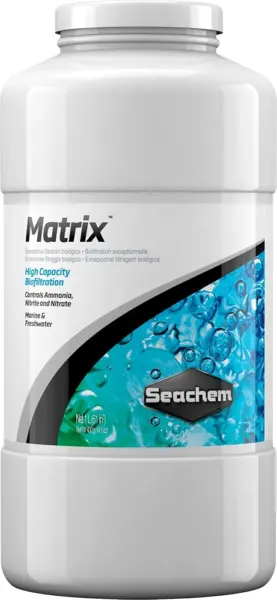
Seachem Matrix 1L – Best Overall
Key Features
- Item form: Solid
- Item weight: 1.7 lb
- Media volume: 1 liter
- Price: Midrange
The difference between Matrix and a bag of ceramic rings is where the surface is. A ring gives you a lot of outside area; these grains carry pores through their interior, which is where the slow, low-oxygen pockets form that turn nitrate into nitrogen gas. That is why we recommend it first — of the two media here built for the end of the cycle rather than the start, this is the one that also fits any filter you happen to own.
Nothing about it is brand-locked. The grains drop into a canister tray, a hang-on-back basket, a sump, or a media bag hung off a sponge filter’s lift tube. One liter is a working amount rather than a token scoop, enough to fill a media tray in a typical canister, with enough left that a second small tank can be seeded from the same bottle.
The one thing you must buy is a bag. The grains are small enough to fall through the slots in most trays and end up in the impeller, so budget for a mesh bag in the same order. Once it is in, rinsing is the entire maintenance story — we rinse ours in siphoned tank water and put it straight back, and the grain does not crumble at the edges the way cheaper ceramic does.
What you give up is convenience: a bottle of porous gravel plus a bag plus a couple of minutes with a funnel. The trade is a measurable saving against the pre-bagged inserts, and a media you will still be using when the filter it went into has been replaced.
Pros
- Works in canisters, HOBs and sumps alike
- Interior porosity targets the nitrate stage
- Holds together through repeated rinsing
- A liter fills a full media tray
Cons
- Loose grains need a separate media bag
If you want one media that goes into whatever filter you own and does not need replacing, this is the one we point people to first.
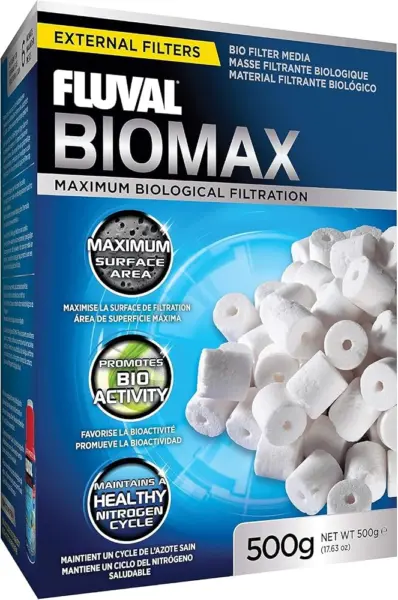
Fluval BioMax 500g – Best for Fluval Canisters
Key Features
- Item form: Granules
- Item weight: 1.3 lb
- Media volume: 500 ml
- Filter compatibility: Fluval 104–106, 204–206, 304–306, 404–406, FX5, FX6
- Price: Midrange
Fluval lists BioMax against nearly its whole canister range — the 104 through 406 series, plus the FX5 and FX6 — and that is the honest way to read this pack: media cut to a specific family of trays. If you own one of those filters, the sizing question is already answered before you open the box.
We like it for exactly that reason. No bag to buy, no guessing at grain size, and a 500-gram pack that leaves a little spare after topping up a mid-size canister — spare that is genuinely useful the week you set up a quarantine tank in a hurry.
Ignore the monthly replacement instruction on the label. Bio media is not a cartridge; the colony living on it is the entire point, and swapping the whole lot resets your cycle. Rinse it in water you have siphoned out during a water change and put it back. The half-at-a-time note printed on the same pack is the useful half of that advice: if it ever does need replacing, do half and let the old media seed the new.
Set against the Matrix, this is the more brand-locked buy — excellent inside a Fluval canister, unremarkable in anything else. Granule size is the reason. These pieces are substantial, which is fine in a deep canister basket and awkward in a shallow hang-on-back chamber where they bridge the gap water needs to pass through.
Pros
- Sized for the whole Fluval canister line
- Enough in one pack for a mid-size tray
- Holds up without breaking apart
Cons
- Granules are too large for shallow chambers
For a Fluval canister owner, this is the media that drops into the trays without a bag and without guesswork.
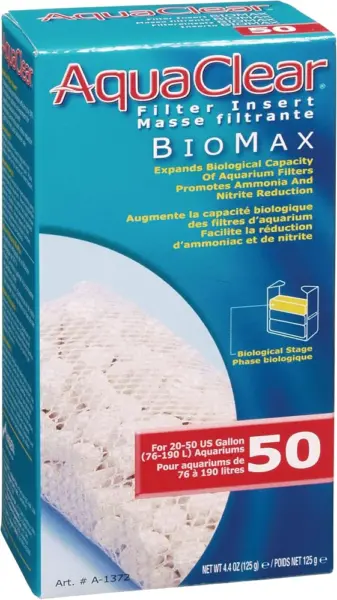
AquaClear BioMax 50 – Best Drop-In for Aquaclear
Key Features
- Item form: Mesh bag
- Filter fit: AquaClear 50
- Unit count: 4.4 oz
- Tank rating: Up to 50 gallons
- Price: Midrange
The bag is the product here. BioMax arrives in a mesh insert cut for the AquaClear 50’s basket, so a media change is a lift-out, rinse and drop-in job. Anyone who has stood at a counter weighing loose rings into a mesh bag knows what that saves. It also means the media is already contained when you lift it out, so nothing escapes into the impeller.
The material is the same porous media Fluval uses across its line — rated here for tanks up to 50 gallons and fine in fresh or salt water. There is nothing dramatic about it. The point is that the bacteria have somewhere permanent to live instead of inside a cartridge that gets thrown away at the next water change, and that alone changes how a small tank behaves.
Our reservation is cost per ounce. You are paying for the bag and the sizing, and a box of loose rings goes several times further for similar money. That is a fair trade only if you own the filter it was cut for. In a canister or a different hang-on-back, buy loose media and a bag, and put the difference into more of it.
Pros
- Drops straight into the AquaClear 50 basket
- No bagging or measuring to do
- Rated to 50 gallons, fresh or salt
Cons
- Higher cost per ounce than loose rings
- Only fits AquaClear 50-size baskets
If you own an AquaClear 50, this is the least fiddly way to keep biological filtration running: bagged, sized and ready.
Biohome Ultimate 2 lb – Best for Nitrate Control
Key Features
- Material: Sintered glass
- Item form: Granules
- Media weight: 2 lb
- Price: Premium
Biohome is the priciest media in this group, and the pitch behind that price is specific: sintered glass with pores deep enough to shelter the bacteria that consume nitrate, not just the ones that process ammonia. We think that is a real distinction rather than a marketing one, because pore depth is the difference between a surface and a habitat — but it only pays off where ammonia and nitrite already sit at zero.
In the filter it behaves like gravel with a job. It rinses clean without crumbling at the edges, so repeated water-change rinses do not turn it into silt in the bottom of your canister. That matters more than it sounds: the media that survives ten years of rinsing is the cheapest media you will ever buy, and this one shows no sign of disintegrating.
The honest caveat is that nitrate is a system number, not a filter number. Stocking, feeding and water-change volume move it far more than any media will, so if your changes are irregular, fix that first. Where this earns its place is the tank that is otherwise well run, tested regularly, and still sitting on a nitrate reading the owner does not like.
Pros
- Deep pores aimed at the nitrate stage
- Holds together through repeated rinsing
- Two pounds of media in one pack
Cons
- The most expensive media per pound here
Our premium pick: sintered glass with pores deep enough to target nitrate, priced accordingly. It earns the money only on a tank where water changes are not enough.
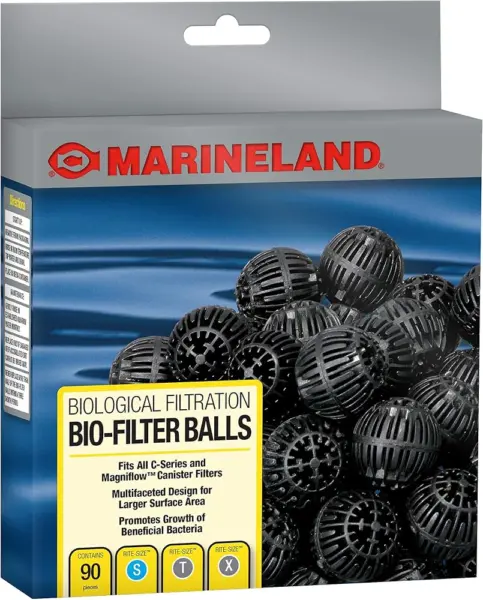
Marineland Bio-Balls 90 – Best Budget Pick
Key Features
- Count: 90 balls
- Item form: Balls
- Item weight: 6.4 oz
- Filter compatibility: Marineland C-series and Magniflow
- Price: Budget
Bio balls do their best work where water tumbles over them and air gets at them — trickle towers, wet/dry sumps, the top tray of a canister that is not packed tight. These are small and light enough to go almost anywhere: Fluval canisters, hang-on-back baskets, even a bog filter. The bag has no closure on it, so open it inside a bowl unless you want to chase ninety small balls across the kitchen floor.
We keep a pack around for exactly one job: a tray that is two-thirds full of rings and could use more surface without a second box. At this end of the price range they are the cheapest way to add biological capacity to a system you already own, and nothing else here comes close on cost.
What they are not is a shortcut to a full chamber. Ninety balls look like a lot in the bag and settle into very little in a basket, so read the count as a top-up quantity rather than a fill. For a sump or a canister you are packing from empty, rings go considerably further per box.
Pros
- Fits nearly any canister or HOB chamber
- Cheapest way to add surface area
- Easy to rinse and reuse
Cons
- Light enough to float out of open baskets
Keep a pack for topping up a half-empty tray or filling a DIY trickle filter: they are the cheapest surface area in this group.
AQUANEAT Ceramic Rings 6 lb – Best for Multi-Tank Setups
Key Features
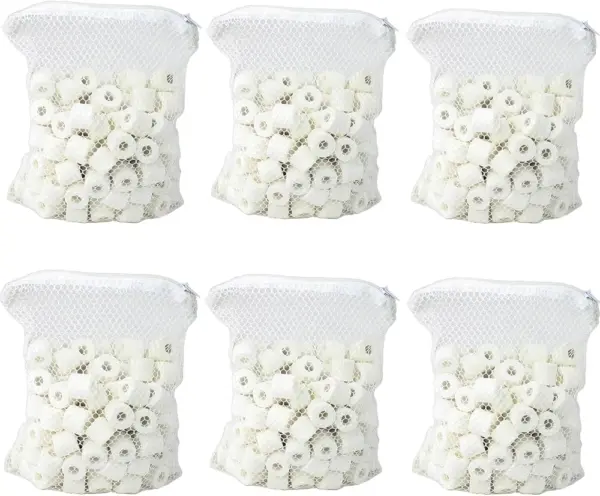
- Bag size: 8 x 5.5 inches
- Ring size: 11/16 x 5/8 inch
- Media weight: 6 lb
- Included bags: 6 mesh bags
- Price: Midrange
Six zippered mesh bags come in the box, each around eight by five and a half inches, and that is what makes this pack useful rather than merely large. You can split six pounds of rings across three or four filters and still have a full bag spare. Each bag lifts out for rinsing, which beats fishing loose rings out of a tray with a net.
The rings themselves are dimpled rather than smooth, and a rough surface gives bacteria more to grip than a polished one does. At roughly eleven-sixteenths of an inch across they are substantial pieces, hollow through the middle so water passes through rather than only around. A loosely packed bag does more work than a crammed one, which is worth remembering when you are tempted to fill every gap.
Six pounds is a serious quantity. In one small tank it is more than you will use in a decade, and the rest sits in a cupboard until a filter fails or a friend sets up a tank. Where it makes real sense is a multi-tank household, a large sump, or a pond filter being packed out for the first time — three bags go into the filter and the rest wait.
Value is why it is here. Per pound of ceramic this is the best price in the group, and the six zippered bags are the part you otherwise buy separately. We treat it as a stock purchase rather than a one-filter purchase: buy it when you know more tanks are coming, not when you are setting up a single twenty-gallon.
Pros
- Six pounds of media with six zippered bags
- Dimpled rings give bacteria a grip
- Bags lift out for rinsing
Cons
- Chunky rings need a compartment with depth
The box we reach for when several tanks need media at once: six pounds, six bags, and spare for the next setup.
Reefing Art Rings 1 lb – Best for Small Tanks
Key Features
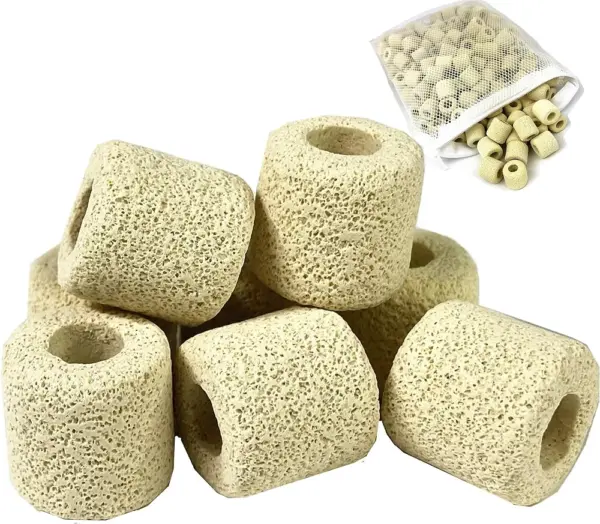
- Count: 180 rings
- Tank rating: 20–40 gallons
- Included bag: 1 mesh bag
- Media weight: 1 lb
- Price: Budget
Buying bio media by the pound is a trap for anyone with one small tank: the bulk boxes are better value and you will use a tenth of one. This is the counter to that. A pound of rings, a hundred and eighty of them, plus a zip-top mesh bag — enough for the 20- to 40-gallon range the listing rates it for, with a little to spare.
The surface-area figure on the page, five thousand four hundred square feet, is the seller’s arithmetic, and the gallon rating behind it assumes a light fish load. Treat both as a starting point rather than a specification: a heavily stocked tank wants more media, not more claims. What is concrete is the format — loose rings in a bag you can drop into a hang-on-back basket or a small canister tray without buying anything else.
What we appreciate here is the sizing. For a nano tank, a quarantine setup or a first aquarium, this is the sensible purchase: enough to do the job, cheap enough that trying it costs very little, and complete out of the bag. If you are packing a large canister or a sump, buy in bulk instead and accept the cupboard space.
Pros
- A pound of rings with a mesh bag
- Rated for 20-40 gallon tanks
- Low cost of entry for a small setup
Cons
- A pound fills only one small basket
The right size for a single hang-on-back or a nano tank, bag included, and no six-pound box left half-finished in a cupboard.
ALEGI Sponge Pad – Best for Sponge Filters
Key Features
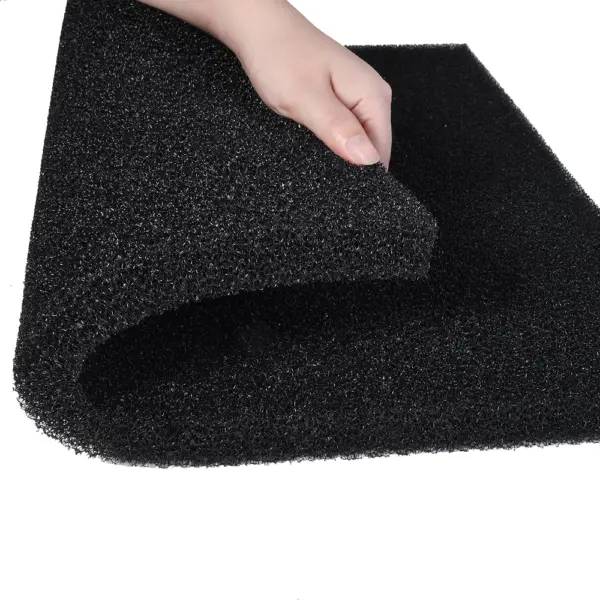
- Sheet size: 20 x 20 x 1 inches
- Item weight: 3.52 oz
- Pore density: 20 PPI
- Price: Budget
This is the one pick here that is not really biological media, and it is worth being straight about that. Foam’s first job is mechanical: it traps particles before they reach the media that hosts your bacteria. It does host bacteria too — that is why a sponge filter works at all — but in a canister it belongs before the rings, not in place of them.
Where it is genuinely useful is anywhere you need a barrier in a shape nobody sells. A twenty-inch square of 20 PPI foam cuts with household scissors into a prefilter sleeve, a baffle for a hang-on-back outflow, or a replacement pad for an odd-sized compartment. One sheet covers several of those jobs, and each piece rinses and goes back in.
Measure what arrives before you cut. The sheet is listed at an inch thick and can come in under that, so cut one test piece for the slot you have rather than trusting the number on the listing. Cut slightly oversize and compress it into place; foam that fits snugly seals better than foam that fits exactly.
It is the piece of media we reach for when a compartment is an odd shape or a fish is getting pulled toward an intake. The quiet argument for keeping a sheet around is that one purchase yields several pads, each of which rinses and returns instead of being thrown out with the cartridge it replaced. That is the difference between buying filtration and renting it.
Pros
- Cuts to fit any compartment
- Rinses and goes back in
- One sheet covers several jobs
Cons
- Traps debris and clogs faster than sintered media
A cut-to-fit foam sheet for prefilters and sponge filters: cheap, reusable, and the first stage of filtration rather than the last.
How We Tested Biological Filter Media
We started by rounding up what’s actually sold as biological media: sintered glass, ceramic rings and noodles, plastic bio-balls, coarse open-cell sponges, lava rock, and a couple of molded bio-blocks. Anything that was really mechanical or chemical filtration in disguise got cut. We then narrowed by price per liter, whether the pieces fit a standard media bag and a small hang-on-back chamber, and whether the manufacturer published any usable surface-area figures we could compare across products. Fourteen made the cut.
Each one ran for four months in a separate bay of a multi-chamber sump fed by a single system, so every media saw the same water, the same fish load, and the same feeding schedule. We dosed ammonium chloride to a set reading every week and tested with a liquid kit each morning, logging how many days it took ammonia and nitrite to fall back to zero. Water clarity got checked by eye against a white card behind the tank, and we noted whether a new batch clouded the display before it cleared.
Handling told us as much as the chemistry. We rinsed every media in a bucket on day one and counted how many passes it took before the water ran clear, since dust that reaches the tank is dust your fish are breathing. Pieces were measured with calipers and weighed dry, then weighed again after a soak, and we checked whether a full bag actually fit a small filter without throttling flow. Every two weeks we lifted each bag and rinsed it in tank water, watching for crumbling edges, shedding, and compacted spots that made water channel around the media instead of through it. Cost per liter was recorded alongside how long we’d reasonably expect each one to last before it needed replacing.
How to Choose Biological Filter Media
The right bio media is the one that fits the compartments you already have and gets water moving through it; every other number on the pack is a distant second.
Where the bacteria actually live
A ceramic ring’s surface is mostly outside, where water passes quickly. A porous grain carries pores into its interior, and those deeper pockets are where the slow, low-oxygen work of turning nitrate into nitrogen happens. Rings handle ammonia and nitrite perfectly well, and that is the first job — cheap media does it.
Pore structure is what you pay extra for when ammonia and nitrite already hold at zero and nitrate is the number that keeps climbing between water changes. Cycling a new tank, buy rings. Fighting nitrate in a mature, well-stocked tank, buy porosity.
Fit the shape to the compartment you own
Measure the depth of the compartment before you order. A ring around eleven-sixteenths of an inch across needs clearance above and below it for water to move, and a shallow hang-on-back basket is better served by a pre-bagged insert or a small ball. Loose media in a tray with slotted floors needs a mesh bag, or the grains find the impeller.
If you own an AquaClear 50, the pre-cut inserts drop straight in. The same spend on loose rings buys several times the volume, but you will be filling bags yourself — that is the whole trade.
Buy for the compartment, not the gallon rating
Media quantity follows the space you have, not the size of the tank. Pack it loosely enough that water still moves through the whole block; a solid brick of rings with flow running around it is decoration.
That is why the biggest box here is not automatically the right buy. Six pounds of rings is sensible for several tanks or a large sump and absurd for one twenty-gallon with a single basket. A liter or a pound is the working unit for most single-filter setups, and you can always add more.
Rinse in tank water and stop replacing it
Biological media is not a cartridge, whatever the label suggests. Some packs still recommend a monthly swap, and following that throws away the colony the tank spent weeks growing. Rinse the media in water you siphoned out during a water change — never under the tap — and put it back.
If a bag is genuinely breaking down, swap half at a time so the old half seeds the new. Budget for it as a one-time purchase, which is most of why bio media beats cartridges across a year.
Frequently Asked Questions
Can I mix ceramic rings with Matrix or Biohome in the same filter?
Yes, and it is a good way to use what you already own. Put the most open media first and the finer, more porous media last, so the water reaching the porous material is already carrying less debris and the pores stay open.
Mixing does not dilute the bacteria. They colonize whatever surface the water reaches, so two forms in one tray simply give them more room.
How long does new bio media take to start working?
Weeks, not days. The colony has to establish on the surface, and the tank will usually show ammonia first, then nitrite, before both fall away. Seeding with a bag of media from an established tank or a bacterial starter shortens that considerably.
Test ammonia and nitrite every few days through the cycle and only start adding fish once both hold at zero after a feeding.
Will ceramic or sintered media raise my pH or hardness?
Aquarium-safe ceramic and sintered glass are inert, and the reputable listings say so. The one to avoid is media that fizzes when you drop a piece in vinegar — that is carbonate, and it will lift both pH and hardness.
If you keep shrimp or sensitive fish, check pH and KH after the first two weeks. If either moved, pull the media and test it before putting it back.
Final Verdict
Matrix is our pick because it does the job in whatever filter you already own and keeps doing it: bag a liter, drop it in the tray, and stop buying cartridges. If you run a Fluval canister, its own BioMax fits the trays without a bag and is the easier purchase.
And if ammonia and nitrite already sit at zero while nitrate keeps climbing, Biohome’s deep-pored sintered glass is the one worth the premium — provided your water changes are already regular, because that is still where most nitrate goes.