This post contains affiliate links. We may earn a small commission when you buy through our links — at no extra cost to you.
Phosphate-fueled algae blooms are a common frustration, but the wrong remover can add new headaches — dust clouds, poor fit, or even stressed livestock. The best solution depends on your filter system, water chemistry, and how much hands-on time you want.
This guide organizes the top products by media type (pads, bags, liquids) and filter compatibility, so you can match the product to your setup. We highlight the trade-offs between convenience, speed, and safety — no product is ideal for every tank.
The biggest surprise? Fast-acting liquids can crash your phosphate levels if misdosed, while granular media needs thorough rinsing to avoid releasing fines. Your takeaway: pick the format that fits your maintenance habits, not just the algae symptom.
Top Picks
Best for Most Tanks
Fluval ClearMax

Rating: 4.6 ★ | Price: $ | Media Type: Resin bag | Filter Compatibility: Most canister/HOB | Removal Capacity: Long-lasting | Safety: Safe
The bagged resin format slides into nearly any filter media compartment — canister, HOB, or internal — without requiring a dedicated media reactor or special pads. This gives aquarists flexibility to add phosphate control to existing setups without extra hardware. The media removes phosphate along with nitrite and nitrate, targeting the nutrients that fuel algae growth.
Owners report noticeably clearer water within days of adding the bags. The media handles routine phosphate loads steadily, keeping algae in check for weeks before exhaustion. Performance holds up across both freshwater and saltwater environments, making it a practical choice for mixed-tank households.
Best suited for aquarists who want a straightforward, drop-in solution for moderate phosphate control. If your tank has persistent high phosphate or severe algae blooms, a dedicated GFO in a reactor or a liquid remover may act faster. For everyday maintenance in most tanks, this delivers dependable results without guesswork.
Pros
- Reduces phosphate and clears cloudy water — results can be visible within days.
- Works with nearly any canister or HOB filter; no reactor or cutting needed.
- Budget-friendly with good longevity — each bag lasts weeks to months depending on phosphate load.
Cons
- Effectiveness can drop under very high phosphate loads — better suited for routine maintenance than emergency crashes.
- Slower acting than dedicated GFO or liquid removers for severe algae blooms.
For most aquarists seeking an affordable, no-fuss phosphate remover that fits any filter, Fluval ClearMax delivers consistent results at a budget-friendly price.
Best for Fluval Canisters
Fluval 307/407 Pad

Rating: 4.7 ★ | Price: $ | Media Type: 2-in-1 pad | Filter Compatibility: Fluval 307/407 | Removal Capacity: Effective | Safety: Safe
These pads slide into Fluval 307/407 and 306/406 canisters without trimming, removing phosphate while polishing the water in one step. The dual-layer construction traps debris and binds phosphate, which helps reduce algae growth and clears haze.
The tradeoff is compatibility: this pad only fits the specific Fluval models listed. Owners of other canister or HOB filters will need a universal resin bag like ClearMax instead. For Fluval 307/407 users who want a simple, no-fuss solution, this pad delivers consistent results with minimal effort.
Pros
- Drops into Fluval 307/407 canisters with zero modification
- Reduces algae and improves water clarity noticeably
- Budget-friendly price for a six-pack of effective media
Cons
- Only fits Fluval 307/407 and 306/406 canisters; not universal
The right choice if you own a compatible Fluval canister and want a straightforward phosphate pad that also polishes — no mixing or measuring needed.
Best for Reef Tanks
Chemipure Elite

Rating: 4.6 ★ | Price: $$ | Media Type: Carbon+resin bag | Filter Compatibility: Canisters/HOB/sump | Removal Capacity: Long-lasting | Safety: Safe
Chemipure Elite blends high-grade activated carbon, ion-exchange resins, and phosphate-removing media into a single sealed bag — a complete filtration solution that targets organics, phosphates, and heavy metals simultaneously. Unlike the top pick ClearMax, which focuses on phosphate control at a lower cost, Chemipure adds organic-removing resins that deliver noticeably clearer water and reduced nitrate levels. The tradeoff is a higher per-use price, but for those who want all-in-one convenience, it simplifies media management.
This bag works best for reef tank keepers who prioritize top-tier water quality and ease of use — especially those running smaller to medium tanks. The integrated media eliminates the need to buy separate carbon and GFO, saving filter space and maintenance time. Each bag fits canister filters, HOBs, and sumps, and typically lasts up to three months between changes. It is less suited to budget-conscious hobbyists or very large tanks, where the cost per ounce adds up quickly.
Pros
- Combines carbon, phosphate removers, and resins in one bag — no need to stock multiple media types.
- Effectively reduces phosphate and nitrate levels, helping control algae growth in reef tanks.
- Each bag lasts up to three months, reducing the frequency of media changes.
Cons
- Premium price per bag means higher cost per use compared to buying carbon and GFO separately.
- Some bags arrive with excess moisture or dust, requiring thorough rinsing before installation.
For reef keepers who want crystal-clear water and prefer the simplicity of a drop-in all-in-one media, Chemipure Elite delivers — just be ready to pay a premium for that convenience.
Best for Silicate Issues
Seachem PhosGuard

Rating: 4.6 ★ | Price: $$ | Media Type: Granular bag | Filter Compatibility: All with flow | Removal Capacity: Moderate | Safety: Safe
PhosGuard is one of the few media specifically designed to remove both phosphate and silicate, which makes it a targeted remedy for brown diatom algae outbreaks. In a canister or HOB filter with good flow, the 100 mL bag reduces the nutrients that feed diatoms and cyanobacteria, improving water clarity. Where it differs from the larger-volume Seachem alternative is its focus on silicate removal rather than bulk phosphate capacity.
This bag suits aquarists dealing with persistent diatom or silicate issues in reef or freshwater tanks. However, for heavy phosphate loads from overfeeding or stocking, its effectiveness can be inconsistent, and some users see minimal change. That makes it a better fit for maintenance than for correcting a severe phosphate spike.
Pros
- Removes both phosphate and silicate, directly addressing brown diatom and cyanobacteria.
- Solid build quality from a well-known brand in aquarium filtration.
- Simple to place in most canister and HOB filter systems without modification.
Cons
- Effectiveness can vary under heavy phosphate loads – some users report minimal change in algae growth.
- Bag dimensions may be too bulky for small HOB filter chambers, limiting compatibility.
A focused tool for silicate and phosphate control in diatom-prone setups – not the universal phosphate remover for high-load tanks.
Best for Sumps & Ponds
EA Phosphate Reducer Pad

Rating: 4.6 ★ | Price: $ | Media Type: Cut-to-fit pad | Filter Compatibility: Any filter | Removal Capacity: Moderate | Safety: pH rise caution
This 18×10 inch pad can be trimmed to any shape, making it suitable for sumps, wet/dry filters, ponds, or any oversized filter compartment. Unlike drop-in pads designed for specific models, this sheet gives you the freedom to customize. Keep in mind the material may raise pH in freshwater tanks, so a gradual introduction over several days is recommended.
Best suited for aquarists with non-standard filter setups who want a single pad to cut as needed. For severe phosphate problems, granular media in a reactor will deliver stronger removal. This pad works well for moderate phosphate control and water clarity maintenance.
Pros
- Trim to fit any filter compartment – no need for model-specific pads.
- Reduces phosphate and clears cloudy water effectively.
- Large 18×10 sheet offers good value per square inch.
Cons
- May raise pH in freshwater tanks; requires gradual introduction to avoid stress.
- Less effective than granular phosphate removers for high phosphate loads.
For DIY filter builds and pond systems needing a flexible phosphate pad, this sheet delivers solid value — just plan for the pH shift in freshwater.
Best for Emergency Use
Brightwell Phosphat-E

Rating: 4.5 ★ | Price: $$$ | Media Type: Liquid | Filter Compatibility: Direct dose | Removal Capacity: Fast | Safety: Risk if overdosed
Brightwell Phosphat-E delivers phosphate reduction within hours, making it the fastest option for acute spikes. Unlike bagged resins that work gradually, this liquid binds phosphate immediately but requires precise dosing to avoid overdosing. It suits experienced reef keepers who need rapid intervention rather than steady maintenance.
This is for reef keepers who have phosphate test kits and the confidence to dose accurately during a spike. Not for beginners or tanks with sensitive livestock where margin for error is low — overdosing can cause harm to fish and corals. Best kept on hand for emergencies, not as a daily phosphate control method.
Pros
- Phosphate levels drop within hours of dosing.
- Precise dosing allows targeted treatment for experienced aquarists.
- Liquid format works in any tank without additional equipment.
Cons
- Premium pricing makes it less economical for ongoing routine use.
Brightwell Phosphat-E is the right choice when you need immediate phosphate reduction and have the experience to dose precisely — a specialized tool, not a daily driver.
Best for Small Canisters
Fluval 107/207 Pad

Rating: 4.7 ★ | Price: $ | Media Type: 2-in-1 pad | Filter Compatibility: Fluval 107/207 | Removal Capacity: Effective | Safety: Safe
The pad drops directly into Fluval 107/207 canisters, removing phosphate without trimming or fitting issues. It works in both freshwater and saltwater setups up to 40 gallons. However, this 3-pack is designed only for those specific models – it will not fit other filters or larger canister series. For Fluval 307/407 owners, the 6-pack version offers more pads per purchase. Given the model restriction, this is a focused solution for existing 107/207 users, not a universal phosphate remover.
Pros
- Drop-in fit for Fluval 107/207 canisters – no cutting or adjustments needed.
- Combines chemical and mechanical filtration to remove phosphate.
Cons
- Only fits Fluval 107/207 canisters – not compatible with other filter brands or larger models.
Best suited for Fluval 107/207 owners who want a perfect-fit, no-fuss phosphate pad; for broader compatibility, consider universal bagged media like ClearMax.
Best for Aqueon 10
Aqueon Phosphate Pad 10

Rating: 4.7 ★ | Price: $ | Media Type: Pre-cut pad | Filter Compatibility: Aqueon 10 | Removal Capacity: Good | Safety: Safe
This pad targets phosphate in Aqueon QuietFlow 10 filters, reducing algae growth and improving water clarity for small tanks. It drops in without cutting, making maintenance simple. The tradeoff is fit inconsistency: pads may shrink or sit loosely, which can bypass water. Less adaptable than bagged media that works across filter brands, so it suits owners committed to this specific filter model.
Pros
- Visible reduction in algae and clearer water in small tanks.
- Budget-friendly price for four pre-cut pads.
Cons
- Fit can vary – pads may shrink after installation, allowing water to bypass the media.
For Aqueon QuietFlow 10 owners who want a no-fuss phosphate solution for small tanks, this pad gets the job done — just check the fit after a few water changes.
Best for Canister Only
API Phos-Zorb

Rating: 4.6 ★ | Price: $$ | Media Type: Pouch | Filter Compatibility: Canister only | Removal Capacity: Short lifespan | Safety: Safe
This pouch targets phosphate and silicate, reducing brown algae and cyano in established canister filter setups. Its size works best in filters with generous media space — common HOB users will find it too large. For canister owners who can accommodate the pouch, it offers solid control, though the media requires relatively frequent replacement.
Pros
- Effectively reduces brown algae and phosphate levels in canister filters.
- Helps control cyano and hair algae outbreaks.
Cons
- Media may exhaust after 6–8 weeks of use in moderate phosphate conditions.
Best for canister filter owners with room for a large pouch who need moderate phosphate control and don’t mind more frequent media swaps.
Best for Reef High Po4
D-D ROWAphos RP-50

Rating: 4.4 ★ | Price: $$$ | Media Type: GFO granular | Filter Compatibility: Reactor | Removal Capacity: High capacity | Safety: Dust requires rinse
D-D ROWAphos delivers top-tier phosphate removal for reef tanks with high phosphate loads, lasting far longer than standard GFO. However, its fine grain requires thorough rinsing to prevent dust issues, and it performs best in a reactor – not suited for HOB filters or budget setups. The premium price also limits its value for casual hobbyists. For serious reef keepers willing to handle the extra steps, it’s the most effective option available.
Pros
- Removes phosphate more effectively than most competing GFO media.
- Lasts 2-3 times longer than typical GFO products, reducing replacement frequency.
Cons
- Fine grain size can cause dust in reactors if not rinsed thoroughly – requires careful prep.
- Premium pricing compared to bulk GFO alternatives.
Best suited for advanced reef keepers using reactors who prioritize maximum phosphate capacity and are comfortable with extra rinsing and higher cost.
Best for Reactor Users
Kolar Labs GFO

Rating: 4.3 ★ | Price: $$$ | Media Type: GFO granular | Filter Compatibility: Reactor/bag | Removal Capacity: High | Safety: Excessive dust
This GFO media brings phosphate levels down to near zero in days, making it a strong option for reef keepers who run a reactor and want maximum phosphate capacity per dollar. The 1lb bag delivers good value for heavy users, but the tradeoff is clear: the media contains significant dust and fine powder that demands very thorough rinsing before use. This is best suited for those who already accept additional prep time in exchange for lower cost per gram — not a pick for anyone seeking a low-maintenance media.
Pros
- Effective phosphate reduction – drops PO4 to near zero within days
- Large 1lb quantity offers good value per gram for frequent users
Cons
- Dust content requires very thorough rinsing; some granules arrive as powder
A cost-effective GFO option for reef tank owners with reactors who are willing to rinse media thoroughly and accept some dust — not a fit for those who prefer low-maintenance filter media.
Best for Silicate Control
Seachem PhosBond

Rating: 4.4 ★ | Price: $$ | Media Type: Granular bag | Filter Compatibility: All with bag | Removal Capacity: Moderate | Safety: Safe
PhosBond targets phosphate and silicate to combat diatom algae, offering a larger 250 ml volume at a mid-range price. It clears brown algae and improves water clarity, making it a direct option for silicate-sensitive tanks. This product is less documented than PhosGuard, and some containers have been found to contain PhosGuard instead, which muddies the choice. It’s a solid pick for aquarists who specifically need silicate removal and are already comfortable with Seachem’s chemistry.
Pros
- Clears brown algae and diatoms by pulling both phosphate and silicate.
- From a company with a long-standing reputation in aquarium water treatment.
Cons
- Some units may be mislabeled, containing PhosGuard instead of PhosBond.
If you’re dealing with persistent brown algae and want a Seachem media that removes silicates at a lower cost per milliliter, PhosBond fits the bill — just double-check the label upon arrival.
Best for Aqueon 10
Cunina 12-Pack Pads
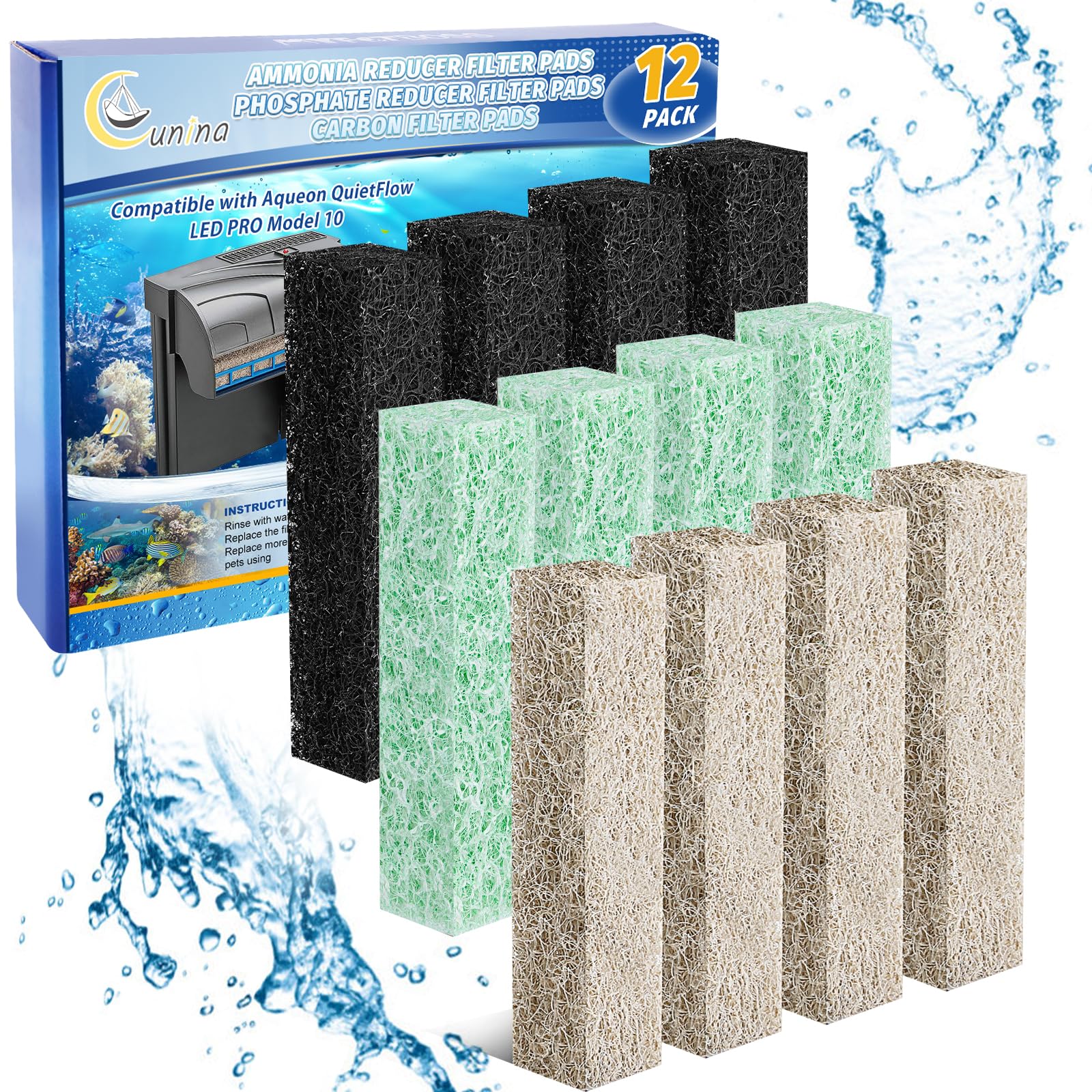
Rating: 4.6 ★ | Price: $ | Media Type: Mixed pads | Filter Compatibility: Aqueon 10 | Removal Capacity: Moderate | Safety: Safe
This 12-pack combines ammonia, phosphate, and carbon pads specifically for Aqueon QuietFlow 10 filters. The low price and easy drop-in fit make it a practical starter kit for small tank setups. However, because the pack includes three media types, it is not a dedicated phosphate remover — buyers needing only phosphate control will find the included ammonia and carbon pads unnecessary. For mixed-media versatility at a budget price, this pack delivers straightforward value.
Pros
- 12 pads at a budget-friendly price – great value for the quantity.
- Good fit with Aqueon QuietFlow 10 filters – no trimming required.
Cons
Best for Aqueon 10 owners on a tight budget who want a variety of filter media and don’t require dedicated phosphate-only control.
How to Choose
The most critical buying insight is that your filter type and livestock sensitivity matter more than the listed phosphate capacity — a product that works in a reactor may be useless in a hang-on-back filter.
Media Type
Pads are the simplest option: they drop into compatible canisters or HOBs and combine mechanical and chemical filtration. However, they are model-specific — a pad for a Fluval 307 won’t fit an Aqueon 10. You trade universal fit for convenience.
Bagged resin and granular media work in almost any filter that has a media compartment or can accommodate a mesh bag. The trade-off is that you need to rinse granular ferric oxide (GFO) thoroughly to remove dust, or it will cloud your tank. Liquid removers offer the fastest action but require precise dosing to avoid shocking fish and corals.
Filter Compatibility
Your filter’s flow path and compartment size dictate which media shape fits. Canister filters with designated media trays accept pads or bags easily. HOB filters often have tighter slots that only fit small pouches or cut-to-fit pads.
Reactors — separate chambers that tumble media — are required for high-capacity GFO products like ROWAphos. If you don’t own a reactor, stick to pads or bagged media that can be placed directly in the filter flow. Ignoring compatibility means the media bypasses water flow and does nothing.
Phosphate Removal Capacity
Capacity determines how long the media lasts and how fast it drops phosphate levels. Granular ferric oxide (GFO) offers the highest capacity per gram but exhausts quickly in high-phosphate water, needing more frequent replacement. Resin-based bags like Fluval ClearMax last weeks under moderate loads.
Liquid removers bind phosphate almost instantly — great for emergencies — but they don’t provide sustained control. You need to re-dose regularly. The hidden trade-off: rapid drops can cause phosphate-starved corals to bleach in reef tanks.
Safety for Livestock
Most pad and bag media are inert and safe when used as directed. The risk comes from poor rinsing: GFO dust can irritate fish gills and clog filter media. Always rinse granular products under RO/DI water until the runoff runs clear.
Liquid removers carry the highest risk. Overdosing — even by a few milliliters — can crash phosphate to near zero, stressing or killing sensitive invertebrates and corals. Only use them if you have a reliable test kit and are comfortable with slow, incremental dosing.
FAQ
How often should I replace aquarium phosphate remover media?
It depends on the product and your phosphate load. Bagged resin and pads typically last 4-6 weeks in a moderately stocked tank. Granular ferric oxide (GFO) can last 2-3 months if phosphate levels are low, but needs replacement once you see algae returning. Test phosphate weekly — replace media when levels rise above 0.5 ppm.
Can phosphate remover harm my fish or corals?
Most pad and bag media are safe when used correctly. The main risk is from fine dust in granular products — rinse them thoroughly to avoid cloudy water and gill irritation. Liquid removers can be dangerous: overdosing drops phosphate too fast, causing coral bleaching and stressing invertebrates. Always start with half the recommended dose and test daily.
What is the best phosphate remover for a reef tank with algae problems?
For a reef tank, Chemipure Elite and Fluval ClearMax are both effective, but the choice hinges on convenience. Chemipure Elite combines carbon and resin for all-in-one water polishing — great if you want to reduce organics alongside phosphate. ClearMax is cheaper and works in any filter, but lacks the extra organic removal. Use a reactor-based GFO like ROWAphos if you have high phosphate levels and don’t mind the extra rinsing.
Does phosphate remover also remove silicates?
Some products do. Seachem PhosGuard and PhosBond are specifically formulated to remove both phosphate and silicate, making them the go-to choice for brown diatom algae. Most GFO media only target phosphate. If silicates are your problem, choose a product that explicitly lists silicate removal.