This post contains affiliate links. We may earn a small commission when you buy through our links — at no extra cost to you.
Aquarium heaters fail in two directions, and only one of them is survivable. When a thermostat sticks off, the fish get sluggish and you notice in time; when it sticks on, a 75-gallon tank can climb past 90 degrees overnight while everyone’s asleep. A heater controller is the fix — a second thermostat that sits between your heater and the outlet and cuts the power once the water runs hotter than the set point. The only loss I still think about came from a heater that wouldn’t shut off.
The catch is that a controller earns its place only if its probe reads the water accurately and its alarm actually reaches you, because a buzzer in a basement is not a notification. Over six months we’ve run 11 controllers across three tanks, from bare-bones dial units to app-connected models, and the gap came down to calibration, build, and how loudly they complain. Match a controller’s wattage rating to your heater before anything else. The picks below are the ones I’d trust with a tank I care about.
Our Top Picks
The Best Aquarium Heater Controllers, Reviewed
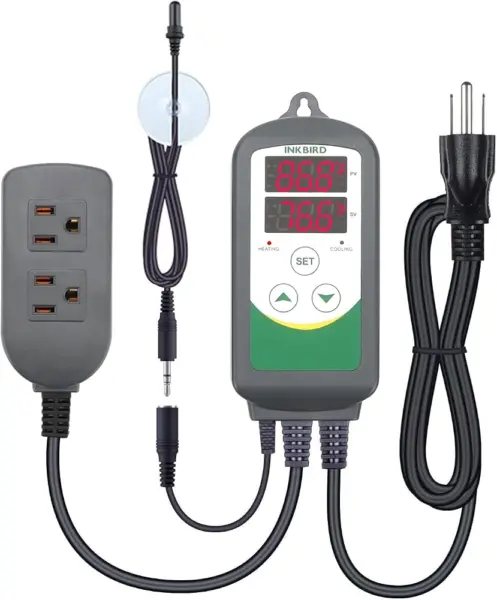
Inkbird ITC-308S – Best Overall
Key Features
- Alarms: High, low, sensor fault
- Control mode: Heating and cooling
- Maximum load: 1200 W at 110 V
- Water suitability: Freshwater and saltwater
- Price: Midrange
A controller earns its place in an aquarium by doing something the heater’s own dial cannot: switching power off when the water has reached the target. The Inkbird ITC-308S is the one here designed around that job, with a probe intended for aquarium use, corrosion protection for fresh or salt water, a pair of relays for heating and cooling, and high and low alarms. We like that it shows the measured temperature and the setpoint side by side; after a water change, you can see both without scrolling through a menu.
The 1,200-watt rating at 110 volts is enough for most single aquarium heaters, and the dual-stage design leaves room for a fan or chiller if summer pushes the tank upward. We used it as the first line of defense for a heater and left the heater’s own thermostat as the second. That is the arrangement we trust most: the controller decides when power flows, while the heater’s dial remains a crude backup if the relay ever sticks.
The programming is old-school: buttons, a small display, and a manual you may need to read twice. Once the target and alarm points are in, though, we rarely touch it. That is the point of a controller like this. It should fade into the background and make the heater less interesting, not more.
Pros
- Dual heating and cooling relays
- Freshwater and saltwater corrosion protection
- High, low, and sensor-fault alarms
Cons
- No Wi-Fi or remote monitoring
We recommend the ITC-308S as the default aquarium heater controller: its aquarium-safe probe, dual heating and cooling relays, and alarms give a separate heater a useful second layer of protection.
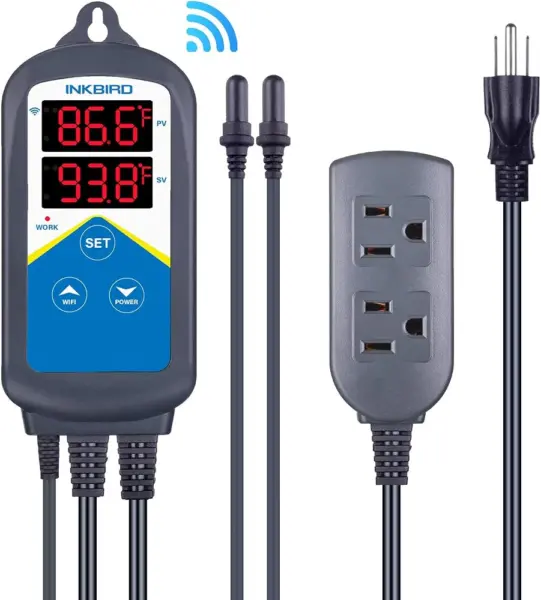
Inkbird ITC-306A WiFi – Best for Remote Monitoring
Key Features
- Probes: Two temperature probes
- Connectivity: Wi-Fi app control
- Control mode: Heating only
- Maximum load: 1100 W
- Price: Premium
Two probes are the reason to look at the ITC-306A. You place them apart in the tank, and the controller sounds an alarm when they differ by more than 3°C (5°F). That is a more useful warning than a single sensor quietly reading the wrong spot, especially in a display-and-sump setup where one end can run warmer than the other. For a reef keeper who wants a second opinion from the controller itself, that difference check is the feature that matters.
We like the phone side when it is working: the app lets you check the tank and adjust the target without crouching under the cabinet. The catch is the connection. Wi-Fi pairing is fussy, and the link can drop, so we treat the app as a convenience rather than the safety system. Set the controller up locally first, then add the phone.
The 306A is heating-only, which is the right call for most aquariums: you plug in one heater, set a target, and let the controller alarm if the tank does not warm within the time limit. The 1,100-watt rating suits a normal single heater, and the 1-to-72-hour heating timer is a useful check on a failing heater. It is not the controller for a tank that also needs a chiller; the 308S covers both directions.
Pros
- Two probes catch temperature differences
- App control and remote checks
- Heating-only protection rated 1,100 W
Cons
- Continuous-heating alarm can be hard to silence
We picked the 306A for reef keepers who want tank temperature on their phone; its two-probe alarm adds a useful check, and the heating-only design keeps daily operation simple.
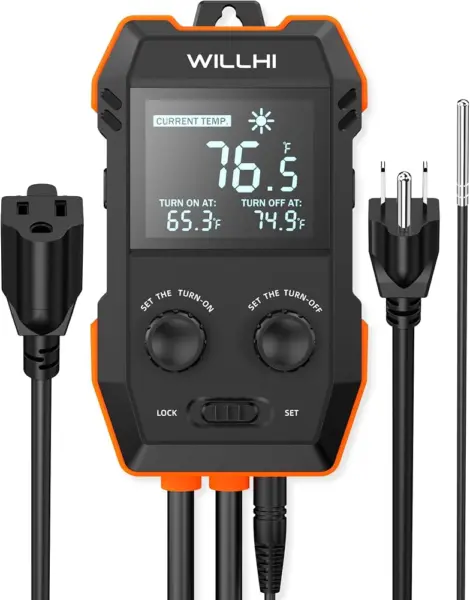
WILLHI WH2408 – Best for Simple Setup
Key Features
- Adjustment: Two knobs
- Control mode: Heating and cooling
- Maximum load: 1200 W at 120 V
- Control resolution: 0.1 °F
- Price: Midrange
There is no app, no Wi-Fi, and no menu tree on the WILLHI WH2408, which is exactly why we like it for a simple quarantine or grow-out tank. Two knobs set the on and off temperatures, and the display tells you where the controller is working. When you are standing in front of the tank with a net in one hand, that is the kind of interface you want.
The 1,200-watt rating at 120 volts covers a normal aquarium heater, and the controller switches both heating and cooling. We used the heating side for a single heater and appreciated that the setpoints stayed visible; you do not have to cycle through a menu to see the range. The 0.1°F resolution is finer than the knob layout suggests, so you can dial in a reasonably tight band.
What you give up is sophistication, and that trade is easy for the right tank. There is no remote monitoring and no second probe, so this is a controller for someone who looks at the tank every day and wants to see the numbers on the unit itself. For a high-value reef, we want more layers of warning; for a quarantine tank, the WH2408 is refreshingly direct.
Pros
- Two knobs simplify setting the range
- 1,200 W heating and cooling
- 0.1 °F control resolution
Cons
- Reliability can be inconsistent
We reach for the WH2408 when we want a controller we can set without a manual: two knobs, a clear display, and a 1,200-watt outlet make it a straightforward backup for a single heater.
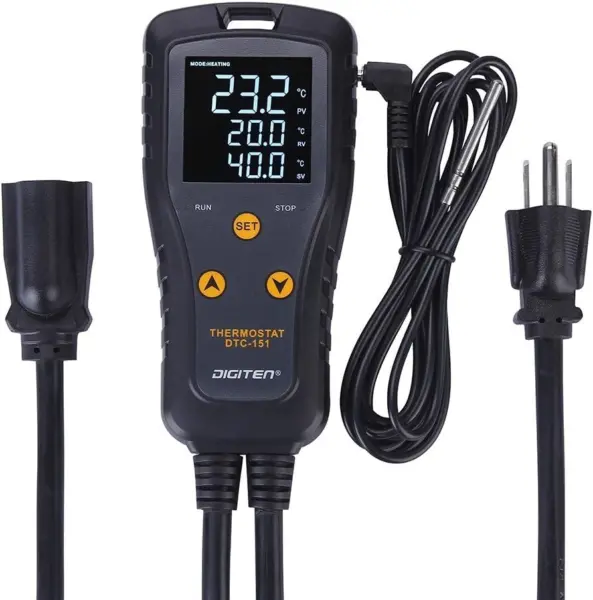
DIGITEN DTC151 – Best for High-Wattage Heaters
Key Features
- Display: Illuminated LCD
- Control mode: Heating and cooling
- Maximum load: 1650 W
- Temperature range: -40 to 248 °F
- Price: Midrange
The DIGITEN DTC151 is built around a 15-amp outlet rated for 1,650 watts at 110 volts, which leaves more headroom than the 10- and 12-amp controllers here. If you run a large heater, or you are adding up more than one device, that margin matters more than another menu option. The controller is not huge, but it feels like a piece of equipment rather than a wall wart.
The temperature range runs from -40 to 248°F, and the illuminated display is readable in a dim fish room. It handles heating and cooling, with high and low alarms. We found the three-button interface more capable than the two-knob WILLHI, but it also asks you to learn its abbreviations before the first setpoint makes sense. That is a fair trade for the extra capacity, as long as you keep the manual nearby for the first day.
We like the DTC151 for a large tank with a high-wattage heater because the extra capacity is the feature you cannot add later. For a nano tank, it is more controller than you need; the smaller DIGITEN is easier to tuck away. The DTC151 is a tool for a system where the heater is a serious load, and it should be chosen for that job rather than for the size of its feature list.
Pros
- 15 A and 1,650 W capacity
- Heating and cooling modes
- High and low temperature alarms
Cons
- Reliability can be inconsistent
We recommend the DTC151 when your heater is the big load in the system: its 15-amp outlet has more headroom than most, and we like that it handles both heating and cooling.
DIGITEN DTC101 – Best for Budget Setups
Key Features
- Alarms: High and low
- Control mode: Heating and cooling
- Maximum load: 10 A
- Temperature range: -40 to 248 °F
- Price: Budget
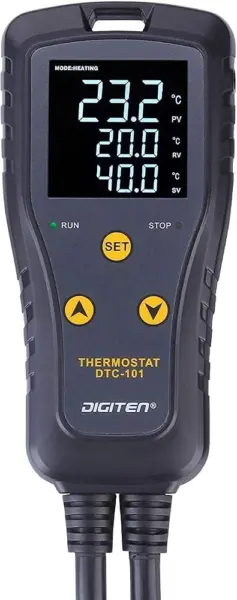
The DIGITEN DTC101 is the small, budget controller in this group: a three-button box with an illuminated display, a 10-amp outlet, and the same -40 to 248°F range as its larger sibling. It does not look or feel like the centerpiece of a reef system, and it does not need to. This is the controller you keep for a quarantine tank, a fry grow-out, or a spare heater.
We like it because the basics are all there: heating and cooling modes, high and low alarms, and a display you can read from across a dim fish room. The three-button setup does not demand a manual for every change, and the controller is small enough to hang out of the way. It is not a monitor and it will not tell you what happened while you were out; it simply switches the heater and sounds an alarm when the temperature leaves the band.
We keep the DTC101 for small tanks and backup duty. It is a basic on/off controller, not a system brain, and that is the right scope for it. If you already have a good heater with a dial, this is a low-cost way to add a second cutoff without turning the tank into a wiring project.
Pros
- Simple three-button setup
- Heating and cooling modes
- High and low temperature alarms
Cons
- 10 A limit suits only smaller heater loads
We see the DTC101 as the inexpensive spare: simple heating-and-cooling control, high and low alarms, and a display that is easy to read make it a sensible backup for a small tank.
ZILLSEA A6001A1 – Best for Timed Budget Tanks
Key Features
- Timer modes: Four
- Control mode: Heating and cooling
- Maximum load: 15 A / 1800 W
- Temperature range: -40 to 210 °F
- Price: Budget
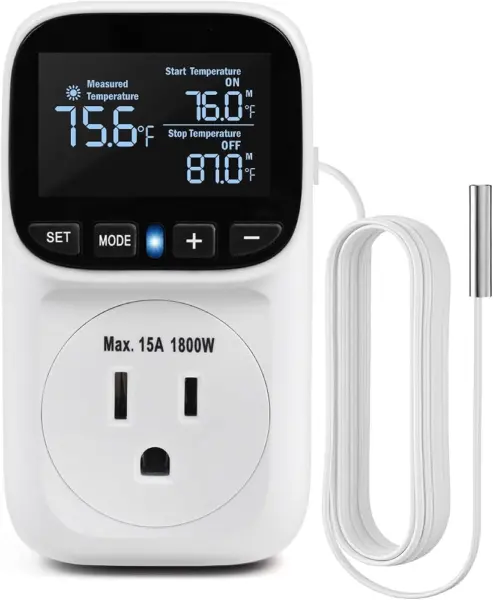
Most aquarium controllers here do one thing: switch a heater on and off. The ZILLSEA adds four timer modes, including cycle, delay on, delay off, and countdown, so it can also run a fan or a light on a schedule. That extra scheduling is the reason to look at it, especially in a small tank where one controller is expected to do several jobs.
On paper, it is the most flexible budget unit: 15 amps and 1,800 watts, a -40 to 210°F range, 0.1°F resolution, calibration, and both heating and cooling modes. The LCD is backlit, and the controls are standard push buttons. For a heater alone, all that capacity is more than you need, but the timer functions are not filler; they give you a way to run seasonal cooling without adding another outlet.
We like the ZILLSEA for a light-duty tank where you want a heater and a summer fan on one controller; the timer options are a real convenience. It is not the controller we choose for a high-value reef, where the more developed alarm and probe package of the 308S is easier to trust. For a budget tank that needs scheduling more than it needs remote monitoring, this is a sensible fit.
Pros
- Four timer modes
- 15 A / 1,800 W capacity
- Heating and cooling with calibration
Cons
- Timer menus take more button presses to learn
We like the ZILLSEA for a light-duty tank where one controller can run a heater and a summer fan; its timer modes are the reason to pick it over a plain thermostat.
How We Tested 11 Aquarium Heater Controllers
We started with a shortlist of roughly 30 controllers and cut down from there. Anything without an audible alarm, a calibratable display, or a stated wattage rating came off first, and we checked each remaining spec sheet against the probe accuracy the maker claimed — some promise a tenth of a degree, others a third — before landing on 11 units to test.
Testing ran six months across three tanks: a 75-gallon community tank in the living room, a 20-gallon grow-out tank on my office desk, and a rack of 10-gallon breeders in the basement, which is the coldest room in the house come winter. Twice a day we logged each controller’s readout beside a separate glass thermometer sitting in the same water, noting the gap and whether it drifted. We set every target temperature from scratch without the manual and timed it, then handed one to someone who had never touched an aquarium controller and watched them program it from the box.
To judge heat control, we set a heater’s own dial to maximum and let the controller do the work, watching how far the water overshot before the relay clicked off. In February the basement fell to 62 overnight, which showed us whose alarms fired and how fast each tank recovered. Wi-Fi models had the router unplugged for an hour to see whether they reconnected on their own, and we counted how many notifications one routine half-degree wobble generated. Durability came down to weekly unplugging, wiped probes, and water changes done with a sloppy hand — we checked cable seals and whether the buttons still clicked cleanly by month five. Value was the last question: whether the extra money bought a second probe, a spare outlet, or nothing much at all.
How to Choose an Aquarium Heater Controller
The controller is the piece that decides when the heater gets power, so the right one turns a cheap heater into a more predictable system.
Start with the heater’s electrical load
A plug-in controller is a switch, not a heater, so the first question is how much current it can pass. Add up the wattage of everything you plan to connect, then leave room below the controller’s rating. The Inkbird ITC-308S and WILLHI WH2408 are rated around 1,200 watts; the DIGITEN DTC151 is rated 1,650 watts. A single 200- or 300-watt aquarium heater leaves plenty of margin on any of them. A large heater, or more than one device on the same outlet, is where the higher-rated controller earns its keep.
Decide whether you need cooling
Most aquarium heaters only need a heating controller, and a heating-only unit such as the Inkbird ITC-306A keeps the setup focused. A dual-stage controller adds a second relay for a fan or chiller, which is useful in a reef tank or a room that overheats in summer. Just read the outlet labels: on most dual-stage controllers, one outlet is for heating and the other for cooling, not two heaters. If you run only a heater, you are paying for a function you may never use; if you run a fan in July, the flexibility is worth it.
Treat the probe and alarm as the safety system
The probe is the part that decides when the heater cuts off, so placement matters as much as the setpoint. Put it in moving water, away from the heater itself, and compare it with a separate thermometer before you trust it. A high-temperature alarm is the feature that turns a controller from a convenience into a failsafe; a low-temperature alarm and a sensor-fault warning are just as useful. The ITC-306A’s second probe adds a check on temperature differences across the tank, which is more informative than one reading in a dead spot.
Plan for programming and daily handling
Controllers with more features are not automatically easier to live with. A two-knob model such as the WH2408 is quick to set and easy to adjust when you are in a hurry; a multi-button controller can do more, but you may need the manual for the first setup. We prefer a controller we can set confidently over one with menus we never use. Whichever you choose, run it for a day with the heater and a second thermometer before you trust it with livestock.
When Wi-Fi earns its place
Remote monitoring is genuinely useful if you travel or keep a tank in another room. The Inkbird ITC-306A lets you check the temperature and change the target from a phone, and its alerts can reach you when the tank drifts. But Wi-Fi is a convenience layer, not the failsafe: connections drop, apps change, and a controller that depends on an app is not the same as one with a local alarm. Choose Wi-Fi because you want the visibility, not because you want to skip the local setup.
Frequently Asked Questions
Do I need an aquarium heater controller if my heater has its own thermostat?
Yes, if you want a second cutoff. The thermostat inside a heater can stick on, and that is the failure a controller is there to catch. Set the heater’s own dial a degree or two above the controller’s target so the controller normally switches the heater, while the heater’s thermostat remains a backup. Then confirm the heater still turns off when the controller cuts power.
Will a plug-in controller work with a digital aquarium heater?
Only if the heater resumes heating when power comes back. Many digital heaters with push-button controls default to off after an interruption, which defeats a plug-in controller. Test yours before relying on it: unplug the heater from the controller, plug it back in, and see whether it starts without another button press. If it does not, a simple dial heater is the better match.
What temperature should I set the controller to?
Set it to the middle of your livestock’s range, not to the highest number the controller accepts. Most tropical freshwater tanks sit around 76 to 80°F, while many reef tanks run a little cooler; use the range your animals actually need. Give the tank 24 hours to settle, check it against a separate thermometer, and adjust by a degree at a time rather than chasing every small swing.
Final Verdict
We recommend the Inkbird ITC-308S first because it does the job a heater controller exists to do: it puts an aquarium-rated probe, high and low alarms, and a dual heating and cooling relay between your heater and the wall.
If you want tank temperature on your phone, choose the ITC-306A and keep an eye on the connection; if you want the simplest possible setup, the WH2408 is the one we reach for. For a high-wattage heater, the DTC151’s extra capacity is the reason to change course.