This post contains affiliate links. We may earn a small commission when you buy through our links — at no extra cost to you.
Many aquarium heater controllers promise precise temperature control, but a closer look at real-world feedback reveals a different story. Units with glowing ratings often suffer from relay failures, probe corrosion, or confusing programming – issues that matter when your livestock depends on stable temperature. The gap between marketing claims and actual performance is the real challenge when shopping in this category.
That doesn’t mean reliable controllers don’t exist. A handful have proven themselves across thousands of installations, offering consistent accuracy and simple operation. The trick is matching the controller’s design to your specific aquarium – freshwater versus saltwater, heating-only versus dual-stage, basic versus WiFi-enabled.
This guide focuses on the controllers that deliver on their promises, organized by the use-cases that actually matter for fish keepers. Whether you need a corrosion-resistant probe for a reef tank or a simple budget-friendly option for a quarantine setup, the right pick is here.
Top Picks
Best for Freshwater Tanks
Inkbird ITC-308

Rating: 4.6 ★ | Price: $$ | Temp Control Type: Heating & Cooling | Max Wattage: 1100W | Probe Type: Standard (not submersible) | Alarm Features: High/low temp, sensor fault | WiFi: No
The ITC-308 keeps water temperature within 1°F of the setpoint, switching between heating and cooling as needed. This level of accuracy makes it a practical choice for freshwater aquariums where temperature stability matters for fish health or for fermentation batches that need consistent conditions.
Setup involves plugging in the controller, attaching the probe, and setting the target temperature via the dual LCD display that shows both current and set readings. The included manual has rough translations, but the interface is straightforward enough that most users can program it within a few minutes. For those who prefer a visual walkthrough, online videos fill the gap.
This controller suits freshwater aquarists and homebrewers who want precise temperature management without WiFi, timers, or programmable cycles. The standard probe is not submersible — it can corrode in high-humidity environments or saltwater. For marine reef tanks, Inkbird offers the ITC-308S with a corrosion-resistant probe.
Pros
- Holds temperature within 1°F of the setpoint for both heating and cooling.
- Dual LCD display shows measured and set temperatures side by side for easy monitoring.
- Priced competitively for a dual-stage controller with this level of consistency.
- Alarm sounds if temperature drifts outside set range or sensor faults.
Cons
- Under heavy cycling, the internal relay may wear out over months — worthwhile for setups that run continuously at high demand.
- Initial programming can be confusing due to the poorly translated manual — online guides help.
The ITC-308 delivers dependable dual-stage temperature control at a mid-range price, ideal for freshwater aquariums and fermentation where extra features aren’t needed.
Best for Saltwater Reefs
Inkbird ITC-308S

Rating: 4.6 ★ | Price: $$ | Temp Control Type: Heating & Cooling | Max Wattage: 1200W | Probe Type: Corrosion-resistant | Alarm Features: High/low temp, sensor failure | WiFi: No
The ITC-308S takes everything that makes the standard ITC-308 a category staple — heating and cooling outlets, high/low temperature alarms, and a simple dual LCD interface — and replaces the probe with a submersible, corrosion-resistant version. That single change makes it the clear choice for marine tanks, where a standard probe can degrade quickly in saltwater. The controller still delivers temperature stability within a tight band, cycling heaters and chillers to prevent spikes without constant manual intervention.
Saltwater and reef keepers who need dual-stage temperature management without paying for extras they won’t use will find their match here. WiFi connectivity and day/night scheduling are absent, so those who want remote monitoring or breeding cycles should look at Inkbird’s connected models. Setup is plug-and-play: plug in your heater and cooler, position the probe, and set your target temperature on the clear front-panel display. The built-in sensor-failure alarm adds a layer of safety for expensive livestock.
Pros
- Corrosion-resistant submersible probe holds up in saltwater and reef tanks far better than standard probes
- Temperature control within 0.5–1°F reduces heater cycling and keeps water conditions steady
- Intuitive plug-and-play setup takes minutes with no complicated programming required
Cons
- No suction cup or bracket for the probe is included in the box
- Probe may eventually show corrosion after years of continuous saltwater immersion, requiring replacement
For saltwater tanks where a submersible probe is non-negotiable, the ITC-308S delivers corrosion resistance and dual-stage control without the cost of features you don’t need.
Best for Breeders & Hobbyists
Inkbird ITC-306T-A

Rating: 4.6 ★ | Price: $$ | Temp Control Type: Heating only | Max Wattage: 1200W | Probe Type: Permanent (non-replaceable) | Alarm Features: Over-temp, sensor fault | WiFi: No
The Inkbird ITC-306T-A stands out by offering programmable day and night temperature setpoints, allowing a natural temperature drop at night — a feature missing from the top pick. This makes it a strong match for reptile keepers, fish breeders, or anyone simulating seasonal or diurnal cycles. The dual outlets let you run two heaters from one controller, though it lacks any cooling capability, so it’s heating only.
Where this controller fits best is with hobbyists who value that day/night scheduling enough to accept a few tradeoffs. The temperature probe is permanently attached — if it fails, the whole unit needs replacing. Setup requires reading the manual; the programming sequence isn’t intuitive for quick plug-and-play. For users who don’t need cooling and want a mid-range price point for cyclic heat control, it delivers.
Pros
- Day/night scheduling for natural temperature cycling
- Accurate temperature control within 1°F
- Good value for a heating controller with advanced scheduling
Cons
- Programming requires reading the manual; setup isn’t intuitive
- Probe is permanently attached — not replaceable if damaged
Buy this if day/night temperature cycling is important for your reptiles or breeding setup; otherwise, the top pick’s simpler dual-stage control and replaceable probe may serve you better.
Best for Reef Tanks
Inkbird ITC308S (Submersible)
Rating: 4.6 ★ | Price: $$ | Temp Control Type: Heating & Cooling | Max Wattage: 1200W | Probe Type: Submersible (detachable) | Alarm Features: Over-temp, sensor fault | WiFi: No
The ITC-308S sets itself apart with a detachable rubber probe that can be fully submerged, making probe replacement or cleaning straightforward. The submersible design eliminates corrosion concerns common with standard probes in marine tanks, and the dual heating/cooling outlets let you manage both a heater and a cooling fan from one unit.
This controller targets saltwater and reef aquarists who need a durable probe and dual-stage temperature regulation. Keep in mind the temperature display updates only every 15 minutes — not ideal for tanks that require rapid feedback — and there is no WiFi for remote monitoring. If those limitations don’t apply to your setup, the submersible probe and easy programming make it a fitting choice.
Pros
- Fully submersible detachable probe resists saltwater corrosion and simplifies replacement.
- Holds water temperature within 1°F of the set point with minimal fluctuation.
- Button-based interface makes setting target temperature and differential fast, even for new users.
Cons
- Temperature readings refresh every 15 minutes, which can lag behind rapid changes in a heavily stocked reef tank.
- Probe cable can become inoperative after a power surge or outage, requiring a replacement probe.
Best for saltwater aquarists who want a submersible probe and dual-stage control without needing WiFi or sub-minute temperature updates.
Best for Remote Monitoring
Inkbird ITC-306A

Rating: 4.4 ★ | Price: $$$ | Temp Control Type: Heating only | Max Wattage: 1200W | Probe Type: Dual probes (standard) | Alarm Features: App push + audible | WiFi: Yes (2.4GHz)
The Inkbird ITC-306A brings WiFi remote monitoring to the familiar dual-probe heating controller design, letting you check tank temperature from anywhere via the InkbirdSmart app. This convenience comes with tradeoffs: the controller only works on 2.4GHz networks and is heating-only, so it cannot manage a chiller. Compared to the top-pick ITC-308, the WiFi adds flexibility but requires more technical setup.
This model suits tech-savvy aquarists who already have a dedicated 2.4GHz network and want the ability to monitor multiple tanks remotely. The dual probes provide redundancy, but some units may experience accuracy drift over time – keep an eye on readings. If you prefer simple, plug-and-play reliability without app dependency, the standard ITC-308 is a better fit.
Pros
- Remote monitoring and push alerts via WiFi app provide peace of mind.
- Dual temperature probes offer redundancy to guard against single-probe failure.
- Solid build with thick cords feels durable and well-constructed.
Cons
- WiFi setup requires a 2.4GHz network and can be finicky; connectivity drops may happen.
- Audible alarm beeps loudly and cannot be silenced, even in Do Not Disturb mode.
The ITC-306A is the right call for aquarists who prioritize remote access and have the tolerance for occasional WiFi hiccups – for everyone else, the non-WiFi ITC-308 offers simpler, more reliable control.
Best for Reptile Keepers
Zilla Digital Controller

Rating: 4.6 ★ | Price: $$$ | Temp Control Type: Heating only | Max Wattage: 1000W | Probe Type: Standard | WiFi: No
Build quality and simple day/night programming are the standout features of this Zilla controller — owners note years of consistent operation and easy setup for separate day and night temperatures. Compared to the dual-stage Inkbird ITC-308, this unit is heating-only with no cooling capability, no audible alerts, and a higher price for a narrower feature set.
This controller makes sense for reptile keepers who value brand reliability and want a straightforward way to program temperature cycles. For aquarium use, the absence of cooling control means it cannot manage chillers or prevent overheating, and the lack of alarms removes a safety net. The cost also sits above comparable Inkbird models that offer more functionality — something to weigh if precise water temperature and fail-safes are priorities.
Pros
- Sturdy construction that holds up over years of use
- Simple day/night programming with intuitive setup
- Temperature accuracy within 1–2°F for an on/off controller
Cons
- Two-prong outlets may not fit heaters that require a ground plug
- No alarm or audible alert if temperature drifts outside the set range
If you keep reptiles and want a durable, no-fuss thermostat for day/night cycles, this Zilla delivers. For aquarium keepers, the missing cooling control, alarms, and premium price point make it a less suitable option than the Inkbird ITC-308.
Best for Greenhouse & Reptile
WILLHI WH2408

Rating: 4.5 ★ | Price: $$ | Temp Control Type: Heating or Cooling (selectable) | Max Wattage: 1200W | Probe Type: Food-grade (not saltwater) | Alarm Features: None (resettable fuse) | WiFi: No
Simple dial controls and a responsive probe make the WILLHI WH2408 straightforward to set and forget – ideal for greenhouse or seedling mat use. The fire-retardant shell and ETL-certified cord add a reassuring build quality at this price. However, the integrated circuit breaker may trip under moderate loads, interrupting power unexpectedly. For continuous aquarium operation where stable heating is critical, this is a notable risk; it suits intermittent or non-critical applications better.
Pros
- Dial-based setpoint adjustment eliminates menu navigation – just turn to the desired temperature range.
- Temperature probe provides consistent readings with minimal drift, keeping the environment stable.
Cons
- Probe is not saltwater-rated – corrosion will occur over time in marine tanks.
For greenhouse, reptile, or seedling mat temperature control, the WILLHI WH2408 delivers straightforward operation at a low cost – just avoid relying on it for continuous aquarium duty.
Best for Heating-Only Tanks
Inkbird ITC-306T Plus
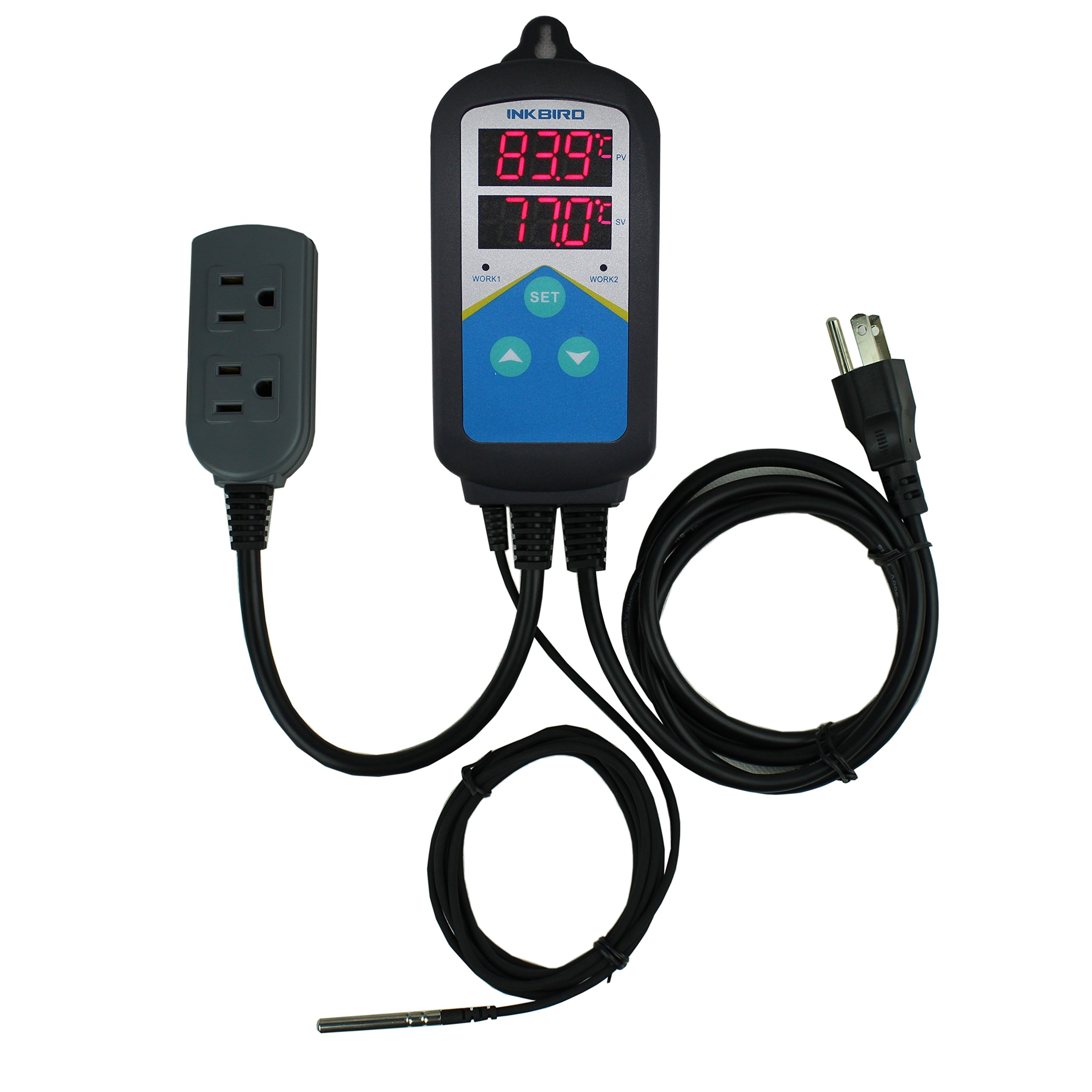
Rating: 4.5 ★ | Price: $$ | Temp Control Type: Heating only | Max Wattage: 1200W | Probe Type: Submersible (rubber) | WiFi: No
The ITC-306T Plus brings a fully submersible probe and dual heater outlets to heating-only control, making it a practical choice for larger tanks that need consistent warmth. The 1°F minimum adjustment may feel coarse for sensitive setups, and the instruction manual requires patience (online videos help). It lacks the day/night scheduling found on the ITC-306T-A, but the submersible probe and redundant outlets offer solid value for those who don’t need timed temperature shifts.
Pros
- Submersible rubber probe provides accurate temperature readings directly in the water.
- Dual outlet design allows two heaters to share the load, useful for larger tanks.
Cons
- Setup process is confusing due to poorly translated instructions; online tutorials are often needed.
- Minimum temperature adjustment of 1°F may be too coarse for tanks requiring finer control.
Best for aquarists who prioritize a submersible probe and dual heater redundancy over fine temperature steps and can work around a confusing manual.
Best for High-Wattage Loads
DIGITEN DTC151

Rating: 4.4 ★ | Price: $$ | Temp Control Type: Heating or Cooling (selectable) | Max Wattage: 1650W | Probe Type: Waterproof (standard) | Alarm Features: High/low temp | WiFi: No
The DIGITEN DTC151 stands apart for its 15A capacity, enough to control high-wattage devices such as a large space heater or an attic fan. The probe reads temperature accurately with decimal resolution and can be calibrated, which suits hobbyists who need precise control for non-aquarium setups like smokers or greenhouses. However, the controller operates in either heating or cooling mode – not both simultaneously – and some units have been noted to stop switching after several months of use. For an aquarium keeper who needs dual-stage failover and long-term dependability, the top pick (Inkbird ITC-308) is a more consistent choice.
Pros
- 15A power rating handles large heaters, fans, and other high-wattage appliances
- Temperature probe reads with decimal precision and can be calibrated for accuracy
Cons
- Display turns off after 30 seconds, requiring a button press to check current temperature
- Some units may stop switching after several months of use, which can be a concern for temperature-sensitive setups
Best suited for controlling high-wattage heating or cooling gear in non-critical environments where occasional replacement is acceptable.
Best for Budget-Limited Use
DIGITEN DTC101

Rating: 4.4 ★ | Price: $ | Temp Control Type: Heating or Cooling (selectable) | Max Wattage: 1100W | Probe Type: Waterproof silicone | WiFi: No
For the price, this controller offers basic heating or cooling control that works for projects like seed mats or mini fridges. Build quality feels better than expected for an entry-level device. However, the temperature reading can be off by several degrees, requiring manual calibration, and the programming instructions are vague enough to cause setup frustration. Without dual-stage capability, it cannot manage both heating and cooling simultaneously. These limitations rule it out for aquarium use where precision and reliability matter, but it remains a functional option for non-critical applications.
Pros
- Very affordable entry point for basic temperature control tasks
- Solid build quality that exceeds expectations at this price
Cons
- Temperature accuracy can be off by several degrees, requiring calibration against a known thermometer
- Setup instructions are vague, making initial programming frustrating to navigate
This controller works for budget-limited projects where rough temperature control is acceptable — not for aquariums where accuracy and ease of use are essential.
Best for Wifi Dual-Stage
Inkbird WiFi ITC-308

Rating: 4.0 ★ | Price: $$$ | Temp Control Type: Heating & Cooling | Max Wattage: 1200W | Probe Type: Stainless steel (not saltwater-safe) | Alarm Features: App push + audible | WiFi: Yes (2.4GHz)
The Inkbird WiFi ITC-308 brings remote monitoring and dual-stage control to a single device — you can manage both a heater and a chiller from your phone. The pre-calibrated sensor reads accurately out of the box. Where it falls short is long-term consistency: the stainless steel probe may give false high readings after months of use, and WiFi connectivity can be inconsistent during setup. This makes the ITC-308 best suited for freshwater tanks where the probe sees less corrosion, and for keepers willing to replace the sensor periodically. For saltwater or high-value livestock, the standard (non-WiFi) ITC-308S is a more dependable choice.
Pros
- WiFi monitoring lets you check and adjust temperature from anywhere
- Controls both heater and chiller in a single unit
Cons
- WiFi setup can be time-consuming and the connection may drop
- Temperature probe may develop inaccuracies over months of use
A workable WiFi controller for freshwater tanks if you’re prepared to replace the probe every year or so; skip this for saltwater or critical setups.
Best for Non-Aquarium Use
BN-LINK Reptile Thermostat

Rating: 4.5 ★ | Price: $ | Temp Control Type: Heating only | Max Wattage: 1000W | Probe Type: Standard | WiFi: No
For its budget price, this BN-LINK thermostat offers easy setup with a clear display and works well for seed mats, brooders, or temporary reptile enclosures. However, temperature readings can drift by several degrees, and some units may malfunction over time – limitations that rule it out for critical aquarium temperature management where precision and long-term dependability are required.
Pros
- Simple three-button operation with a bright LED display
- Budget-friendly price for basic heating control in non-critical setups
Cons
- Temperature readings can drift by several degrees, requiring occasional verification
- Some units may not power off when expected, making direct supervision advisable for safety
A decent choice for temporary or low-risk heating needs like seed mats or brooder lamps, but not for aquariums where consistent temperature is critical.
How to Choose
The right heater controller starts with matching its core features to your tank’s specific demands.
Heating and Cooling Dual-Stage vs. Heating-Only
A dual-stage controller manages both a heater and a cooling device like a fan or chiller – essential for reef tanks that overheat under lights. Heating-only models are simpler and cheaper, but leave you without an automatic response to rising temperatures. For tanks prone to temperature swings, dual-stage is worth the extra cost.
Maximum Wattage
Wattage rating determines how much heater power the controller can safely switch. A 1200W unit handles most home tanks, but if you run multiple heaters exceeding that limit, you’ll need a higher-rated controller or separate units. Underpowering can cause relay failure or overheating.
For large tanks with combined heater wattage above 1000W, check the controller’s sustained load rating, not just peak. Budget models may not handle continuous high loads.
Probe Type
Probes are the weakest link in any controller. Standard stainless steel probes corrode in saltwater; fully submersible rubber or corrosion-resistant probes are essential for marine tanks. Even ‘waterproof’ probes vary in longevity – some fail after months in high humidity.
If your controller’s probe is permanently attached, a failure means replacing the entire unit. Detachable probes allow easy swapping and prolong overall lifespan.
Alarm and Safety Features
Alarms for high/low temperature or sensor failure can save your livestock, but many budget controllers lack them entirely. Audible alarms are critical if your tank is in a separate room, while app notifications offer remote awareness.
Some controllers produce a loud, un-silenceable beep – consider placement before buying. At minimum, choose a unit with a high-temp shutoff.
WiFi Connectivity
WiFi controllers let you monitor temperature from your phone, but often require a 2.4GHz network and can disconnect unexpectedly. This added complexity can frustrate users who want a simple plug-and-play solution.
If remote monitoring is a must, prioritize a unit with stable connectivity and backup alarms that work independently of the internet. A non-WiFi controller with audible alarms may be more reliable for daily use.
FAQ
Why does my aquarium temperature controller keep beeping at night?
The beeping is usually a high or low temperature alarm. If the tank cools naturally at night, the controller may trigger the low-temp alarm if the setpoint is too tight. Check the alarm threshold settings; you can widen the acceptable range to prevent false alarms. Some controllers have a ‘Do Not Disturb’ mode that silences alerts during certain hours.
Can I use a reptile heat mat thermostat for my fish tank heater?
Yes, but with caution. Reptile thermostats like the BN-LINK are heating-only and often less accurate and reliable than aquarium-specific controllers. For a quarantine or low-stakes tank, it may work temporarily, but for a main display tank with sensitive fish, invest in a proper aquarium controller with a submersible probe and safety alarms.
How often should I replace the temperature probe on my Inkbird controller?
Inkbird probes are generally durable, but in saltwater environments, even the corrosion-resistant versions may degrade after 12-18 months. If you notice temperature readings drifting or the controller showing sensor errors, replace the probe immediately. Standard probes in freshwater can last several years with occasional inspection.
Will a WiFi aquarium thermostat work if my internet goes out?
Yes, the controller will continue to function locally – it will still heat or cool and sound audible alarms. Only remote monitoring and notifications via the app will stop. If reliable remote access is critical, choose a model with stable WiFi and consider a secondary standalone alarm as backup.