This post contains affiliate links. We may earn a small commission when you buy through our links — at no extra cost to you.
Many aquarium temperature controllers claim precision, but real-world accuracy often drifts by a degree or more. Worse, some units stop working within a year, leaving your fish at risk.
The key is matching the controller to your specific setup — whether you need simple heating backup or dual-stage control for a chiller. This guide focuses on models that deliver consistent performance and safety features without unnecessary complexity.
A common fork is choosing between a heating-only controller with day/night scheduling and a dual-stage unit that handles both heating and cooling. Your tank size and future plans should decide that trade-off.
Top Picks
Best for Saltwater Tanks
Inkbird ITC-308S

Rating: 4.6 ★ | Price: $$ | Outlets: 2 heat/cool | Max Load: 1200W | Probe Type: Corrosion-resistant submersible | Control Interface: Button menu | Safety Alarms: Temp & sensor alarm
The Inkbird ITC-308S combines dual-stage heating and cooling control with a corrosion-resistant probe that handles saltwater without issue — a rare combination at this price point. While many aquarium thermostats handle only heating or rely on WiFi for cooling control, this unit operates both outlets independently, with a bright dual display and buttons that respond predictably.
Setup takes minutes: plug heaters and chillers into their designated outlets, submerge the probe, and set your target temperature. The bright display and responsive buttons make programming straightforward, despite a manual that is more of a reference than a guide.
Once running, the controller holds temperature within a tight band. The high/low alarm and sensor failure alarm provide a safety net that standalone heaters lack. In reef tanks, where stability is critical, the ITC-308S maintains conditions without drift.
This controller is built for aquarists who prioritize reliability over remote control. It specifically suits reef and saltwater setups where corrosion resistance is critical. The probe cable is short — roughly 3 feet — so larger tanks may need an extension or careful placement. Buyers who want WiFi monitoring or day/night temperature scheduling should look elsewhere; the ITC-308S is a straightforward, no-nonsense tool for those who already know their preferred temperature and just need consistent regulation. At a mid-range price, it offers the same dual-stage capability as pricier units, without the app dependencies.
Pros
- Dual-stage control keeps both heater and chiller in check.
- Simple setup with a bright display and responsive buttons.
- Corrosion-resistant probe rated for saltwater aquariums.
- High/low temperature alarm and sensor failure alarm add safety.
Cons
- Manual is basic and could be clearer.
- Probe cable is short for large tanks.
For reef tank owners who want reliable dual-stage control without connectivity gimmicks, the ITC-308S is the clear choice.
Best for Day/night Scheduling
Inkbird ITC-306T-A

Rating: 4.6 ★ | Price: $$ | Outlets: 2 heating only | Max Load: 1200W | Probe Type: Plastic submersible | Control Interface: Button menu | Safety Alarms: Temp alarm
Day/night temperature scheduling sets the ITC-306T-A apart from basic heating-only controllers. You program a warmer daytime set point and a cooler nighttime drop, mimicking natural diurnal cycles that benefit many freshwater fish and planted tanks. The two grounded outlets handle up to 1200W combined, and the submersible plastic probe sits securely in the tank for continuous monitoring.
This controller targets aquarists who want deliberate temperature variation without adding a chiller or WiFi complexity. It works well for planted community tanks, discus setups, or any system where a slight overnight cooling is beneficial. That said, setup is not plug-and-play — the manual uses non-intuitive abbreviations and a clunky menu flow that requires patience or a quick online search to navigate. First-time users should plan for a 15-minute configuration session instead of expecting instant operation.
Build quality stands out: a solid plastic housing and thick power cords reduce the worry of accidental damage during routine tank maintenance. The alarm function sounds if temperature drifts outside your set range, adding a layer of safety. The main limitation is that this is a heating-only unit — if you ever add a chiller, you will need a second controller or a dual-stage model. Additionally, a small number of units have shown probe or component inconsistency after a year or more of continuous use, so periodic checks are sensible for long-term setups.
Pros
- Day/night scheduling for natural temperature cycles
- Solid build with reinforced cords and alarm
- Simple, no-app operation with clear display
Cons
- Instruction manual uses confusing abbreviations and non-intuitive menu flow
- Some units may develop probe or component issues after extended use
If you want controlled day/night temperature variation and don’t need cooling control, this is the right tool — just budget a few minutes for the setup learning curve.
Best for Large Tanks
BN-LINK T9
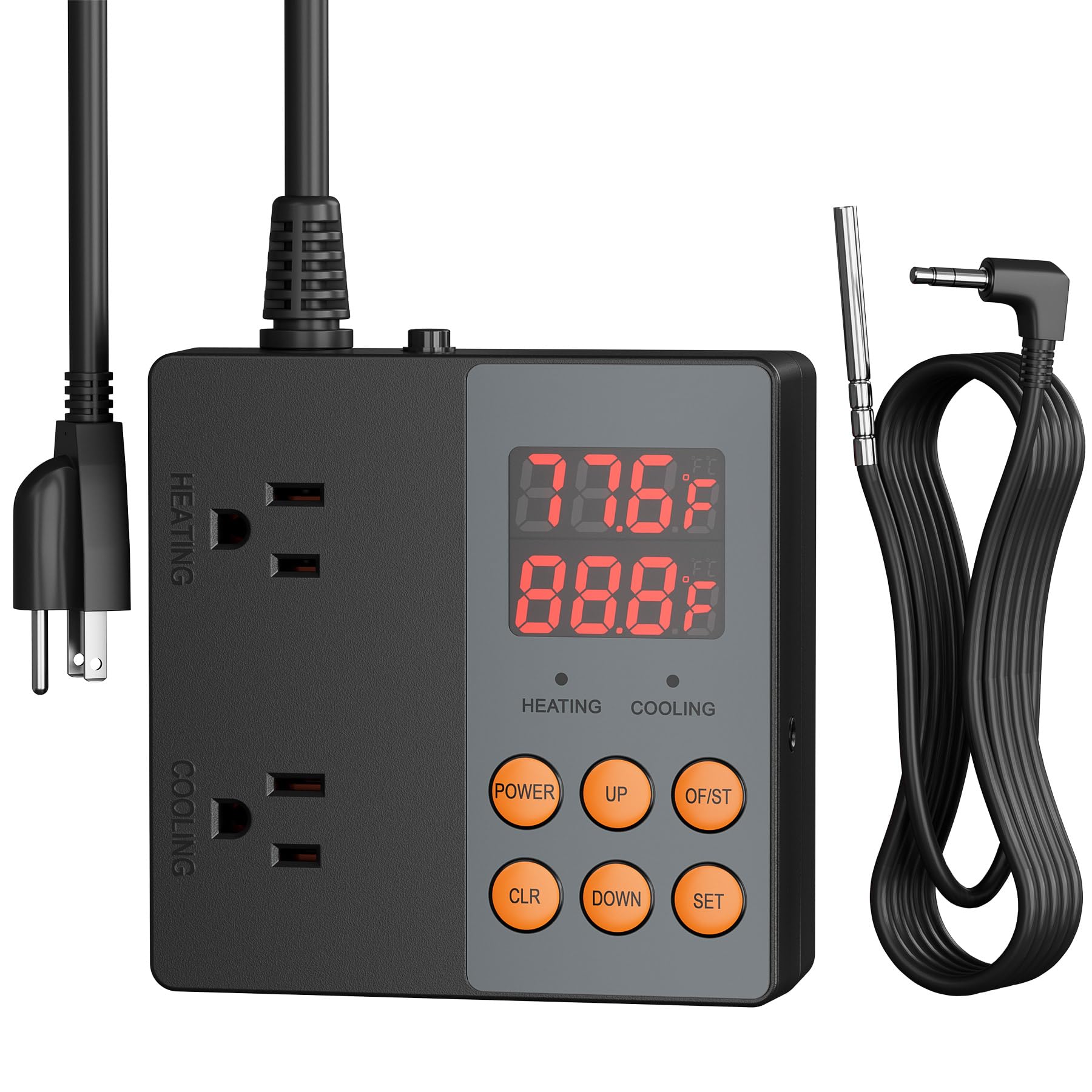
Rating: 4.5 ★ | Price: $ | Outlets: 2 heat/cool | Max Load: 1875W | Probe Type: Waterproof probe | Control Interface: Button menu | Safety Alarms: High/low & overload
With a 1875W capacity, the BN-LINK T9 handles large heaters and chillers that would overload lesser controllers — a clear advantage for big tanks, greenhouses, or any setup drawing near 15 amps. It costs less than any competitor at this power level, which makes it an easy choice when raw wattage is the priority.
This dual-outlet thermostat works well for aquarium owners with high-wattage heating or cooling needs, as well as greenhouse and reptile enclosures where robust power handling matters. The initial programming can be confusing — the manual is not the most intuitive — so plan to spend a few minutes with the instructions during setup. Once configured, it holds temperature reliably across a wide range of applications.
The waterproof probe with a 71-inch cable allows flexible placement inside the tank, and the adjustable differential plus high/low alarms give fine-grained control. For outdoor use, the display can be hard to read in direct sunlight, but this is less of an issue indoors or when the controller is shaded.
Pros
- Highest power capacity among budget controllers — supports 1875W heaters and chillers.
- Reliable performance across varied uses, from aquarium chillers to greenhouse heaters.
- Waterproof probe with a long 71-inch cable for flexible tank placement.
Cons
- Programming can be confusing due to a non-intuitive manual, especially for first-time users.
- Display may be hard to read in direct sunlight, limiting easy monitoring outdoors.
If you need a controller for a large tank or high-wattage setup and don’t mind a brief learning curve, the BN-LINK T9 offers unmatched power capacity at a budget price.
Best for Freshwater Beginners
WILLHI WH2408

Rating: 4.5 ★ | Price: $ | Outlets: 1 heat or cool | Max Load: 1200W | Probe Type: Food-grade IP waterproof | Control Interface: Dual knobs | Safety Alarms: Power loss memory, fuse
The WILLHI WH2408 stands out for its straightforward dual-knob interface – no menus, no programming, just dials for heating and cooling setpoints. This makes it the most accessible option for newcomers who want simple temperature regulation without wading through digital settings. Unlike dual-stage controllers that handle both heating and cooling simultaneously, this unit controls one device at a time (heating OR cooling), which is fine for basic freshwater tanks but limits flexibility for more complex setups.
This controller targets freshwater aquarium owners, greenhouse users, and reptile keepers who prioritize ease of use over advanced features. The food-grade waterproof probe works well in freshwater but will corrode in saltwater – strictly a freshwater tool. Additionally, the internal breaker can trip under sustained loads near 1000W, so it’s best paired with modest heaters (typical for tanks under 50 gallons). For those running larger heaters or needing dual-stage control, a more capable model like the top pick is a better fit.
Accuracy holds within 1°F across both heating and cooling modes, and the controller remembers your settings after a power outage. The resettable fuse adds protection, though the breaker may trip if you push the wattage limit. Overall, the tradeoff is clear: you sacrifice multi-device control and saltwater durability for unmatched simplicity.
Pros
- Intuitive dials make setup quick and menu-free.
- Accurate temperature maintenance within 1°F for both heating and cooling.
- Retains target settings after power loss – no recalibration needed.
- Affordable entry-level price for budget-conscious freshwater keepers.
Cons
- Single outlet restricts control to one device at a time – cannot manage heating and cooling simultaneously.
- Analog dials provide less precise setpoint control than digital models – fine-tuning may require trial and error.
For freshwater beginners who value straightforward setup above all else, the WILLHI WH2408 delivers exactly that – just keep expectations modest on load capacity and skip saltwater entirely.
Best for Backup Controller
DIGITEN DTC151

Rating: 4.4 ★ | Price: $$ | Outlets: 1 heat or cool | Max Load: 1650W | Probe Type: NTC wired sensor | Control Interface: Button menu | Safety Alarms: High/low alarm
The DIGITEN DTC151 delivers 1650W of power, enough to drive large heaters or chillers without overload, and its calibration adjusts in 0.1° increments for fine tuning. High/low alarms and a compressor delay add protection for chiller setups. For a backup or high-wattage application, this is a capable single-outlet controller.
This controller fits the aquarium keeper who needs a cost-effective secondary device or a way to manage a powerful heater. The screen dims after 20 seconds, requiring a button press to read, and some units have stopped working within a year or two, so it is not intended as the primary controller on a sensitive reef tank where absolute reliability is required.
The calibration flexibility is genuinely useful — you can match it to a reference thermometer and expect it to hold within a degree. Its mid-range price also makes it an accessible option for secondary control. For a purely heating or cooling application with occasional monitoring, this controller offers good value.
Pros
- Fine 0.1° calibration matches reference thermometers.
- 1650W capacity handles large heaters and chillers.
- Works beyond aquariums for smokers, greenhouses, and RV water supply.
Cons
- Single outlet controls heating OR cooling, not both — not for dual-stage setups.
- Not recommended as primary controller for sensitive reef tanks.
Best as a backup or for high-wattage loads where you can monitor it occasionally — not the first choice for a primary tank controller.
Best for Freshwater Beginners
WILLHI WH2408
Rating: 4.5 ★ | Price: $ | Outlets: 1 heat or cool | Max Load: 1200W | Probe Type: Food-grade IP waterproof | Control Interface: Dual knobs | Safety Alarms: Power loss memory, fuse
The WILLHI WH2408 stands out for its dual-knob analog interface – no menus, no buttons to hold, just turn the dial to your target temperature. This simplicity makes it the quickest controller to set up, especially compared to digital models that require navigating settings. While the top pick offers dual-stage and saltwater protection, this unit keeps the focus on freshwater tanks and straightforward operation.
This controller is aimed at freshwater aquarium owners who want a reliable primary or backup thermostat without extra complexity. The probe is food-grade but not saltwater-rated, so reef tanks are off-limits. Additionally, the internal breaker can trip under sustained loads above 1000W, meaning it pairs best with standard heaters in smaller tanks rather than high-wattage setups.
Temperature regulation holds within 1°F across both heating and cooling modes, and power loss memory ensures your settings persist after an outage. The single outlet limits you to controlling one device at a time – you cannot run a heater and chiller simultaneously, but for most freshwater tanks that is not an issue.
Pros
- Intuitive dual-knob dials for effortless temperature adjustment.
- Accurate ±1°F control for both heating and cooling.
- Power loss memory retains settings after an outage.
Cons
- Single outlet – cannot control separate heating and cooling devices at the same time.
- Integrated breaker may trip under sustained high-wattage loads above 1000W.
For a budget-friendly, no-fuss temperature controller in a freshwater tank, the WH2408 delivers where simplicity matters most – just avoid high-wattage heaters and salt water.
Best for Nano Tanks
boxtech BT-G50

Rating: 4.3 ★ | Price: $ | Outlets: 1 integrated | Max Load: 50W | Control Interface: Digital buttons | Safety Alarms: Dry-run/overheat codes
The boxtech BT-G50 combines a 50W heater and digital controller in one compact unit, ideal for small tanks from 3 to 12 gallons. Its external display shows current temperature continuously, and the overall footprint leaves ample room in nano aquariums. However, this product is an all-in-one heater, not a standalone temperature controller with submersible probe and outlet control. If you need a device to manage separate heaters or cooling fans, the integrated design won’t accommodate that. Additionally, some units have displayed E1 error codes after extended use, so periodic checking is advisable. For a simple, budget-friendly heating solution in a nano tank, it works adequately, but it does not match the intent of this guide seeking a standalone thermostat.
Pros
- Digital external display shows real-time temperature – sleek and easy to read from across the room.
- Compact size fits well in nano tanks without crowding the space.
Cons
- Integrated heater cannot be reused as a standalone controller for other heaters.
- E1 error codes may appear after several months of use, requiring attention.
This heater serves nano tanks well, but for anyone needing a standalone temperature controller for larger or multiple heaters, this integrated design misses the mark.
Best for Budget Nano Tanks
HITOP 100W Heater

Rating: 4.6 ★ | Price: $ | Outlets: 1 integrated | Max Load: 100W | Control Interface: Digital buttons
This HITOP heater offers a digital display and external controller at a budget price, making it a practical choice for nano and small tanks (12-30 gallons). Setup is plug-and-play with a clear LED readout. However, as an integrated heater-controller, it lacks the redundancy and flexibility of a standalone thermostat; if the heater element fails, the entire unit must be replaced. Additionally, the temperature sensor can drift, and overheating may occur, adding caution for sensitive setups. For a simple, low-cost heating solution in a small tank, it delivers, but it does not replace a dedicated controller.
Pros
- Good value for a digital heater with external display.
- Easy to set up with a clear LED display.
Cons
- Not a standalone controller – integrates heater and thermostat, so heater failure means full replacement.
- Temperature accuracy can drift, and overheating may occur.
This heater works well for a budget small tank where cost is the priority and you accept the integrated design – but for precise control and safety, a standalone thermostat is recommended.
Best for Outdoor Use
DIGITEN DTC-310

Rating: 4.7 ★ | Price: $$ | Outlets: 1 heat/cool | Max Load: 1200W | Probe Type: IP65 integrated | Control Interface: Multi-display | Safety Alarms: High/low alarm
The DIGITEN DTC-310’s IP65 waterproof housing lets it survive rain, splashes, and greenhouse humidity without a secondary enclosure — a rare feature among aquarium controllers. Setup involves learning a three-display interface, which most owners find manageable after the first attempt. However, this controller was designed for ponds and birdbaths, not for primary aquarium use. Its track record is short: with a modest user base, durability beyond a few months of use remains undocumented, and the single outlet handles either heating or cooling at a time — not both. For a fish tank that needs consistent temperature control with proven long-term reliability, the higher-reviewed dual-stage models are a better fit.
Pros
- Rugged IP65 waterproof design handles rain and humidity without extra protection
- Manageable setup once you learn the three-display system
Cons
- Long-term durability data is limited — the user base is small and units haven’t been tested beyond a few months
- Single outlet only supports heating or cooling at a time — not both
Best for outdoor applications like birdbaths or greenhouses where waterproofing matters more than dual-stage control or a long reliability history.
How to Choose
The most important decision is whether you need a heating-only controller or a dual-stage model that can also manage cooling — your tank’s temperature stability depends on it.
Number of Outlets: Heating vs. Cooling
A controller with only heating outlets is cheaper and simpler, but if you ever add a chiller or cooling fan, you’ll need to replace the unit. Dual-stage models let you manage both from one box, but cost slightly more. For fish that need tight temperature ranges, like discus or reef corals, dual-stage provides a safety net.
Power Capacity: Matching Your Heater and Chiller
Each controller has a maximum wattage rating, typically 1200W or 1875W. Exceeding that can trip internal breakers or damage the unit. For a typical 50-gallon tank with a 300W heater, 1200W is plenty. For large tanks (125+ gallons) with multiple heaters or a chiller, a 1875W controller like the BN-LINK T9 handles the load without issues.
Probe Type: Accuracy and Corrosion Resistance
The probe is the controller’s eyes. Plastic probes work fine in freshwater but can corrode in saltwater within months. Corrosion-resistant probes, like the Inkbird ITC-308S’s, last years in reef tanks. Also consider whether the probe is replaceable — some integrated probes force you to buy a whole new controller if they fail.
Control Interface: Ease of Setup
Some controllers use simple dials (set high and low temperatures), while others rely on menus and buttons. Dials are nearly foolproof but offer less precision. Button-based models allow 0.1-degree calibration but often have confusing manuals. If you dislike tinkering, a dial-based controller like the WILLHI WH2408 saves frustration.
Safety Features: Alarms and Redundancy
Over-temperature and sensor-failure alarms are essential for preventing cooked fish. Some models also include compressor delay to protect chillers. Dual-probe controllers, like the Inkbird ITC-306A, can detect if one probe drifts and alert you. These features add peace of mind but aren’t needed for every tank.
FAQ
Why does my aquarium temperature controller keep beeping in the middle of the night?
The beeping is likely a temperature alarm triggered by a rapid change, such as a heater cycling or a cooler room temperature. Check that your set differential is wide enough (usually 0.5-1°F) and that the probe is not in a direct flow from the filter. If the alarm persists, the probe may be faulty and needs replacement.
Can I use a reptile heat mat controller for my fish tank?
Reptile controllers often use a different probe type and may not be waterproof. Most are not rated for continuous submersion, which can lead to corrosion and inaccurate readings. Stick to aquarium-specific controllers with submersible probes for reliable temperature control.
Do I still need a heater thermostat if my aquarium heater has a built-in thermostat?
Yes. Built-in thermostats are the first line of defense, but they can fail, leaving your heater stuck on. A standalone controller acts as a secondary cutoff, preventing overheating. It’s the most affordable insurance for your fish.
How often do aquarium temperature controller probes fail in saltwater?
Standard plastic probes often fail within 6-12 months in saltwater due to corrosion. Corrosion-resistant probes (like the Inkbird ITC-308S’s) can last 2-3 years. Regardless, check your probe annually against a separate thermometer and replace if readings drift by more than 0.5°F.