This post contains affiliate links. We may earn a small commission when you buy through our links — at no extra cost to you.
The green film that creeps through a clear filter hose is the part of aquarium keeping nobody warns you about. You can scrub the glass all you like, but the gunk that clouds your water and slows your flow lives inside the tubing, past where your fingers or a sponge can reach. A tube brush fixes that — provided it’s long enough to get there and flexible enough to follow the bend.
I’ve kinked more than one cheap brush forcing it around a U-bend, so when my team gathered 14 brushes this spring, flexibility and a stem that doesn’t fold at the handle topped the list. Over three months of weekly water changes, the keepers shared a few traits: bristles stiff enough to lift algae without scuffing acrylic, a handle long enough to keep your knuckles dry, and a stem that rinses clean instead of trapping debris. Here’s what earned a place in our rotation.
Our Top Picks
The Best Aquarium Tube Brushes, Reviewed
Patelai 3-Piece Hose Brush – Best Overall
Key Features
- Pack: 3 brushes
- Length: 61.02 in
- Material: Nylon and stainless steel
- Brush head diameters: 0.7 in and 1.18 in
- Price: Midrange
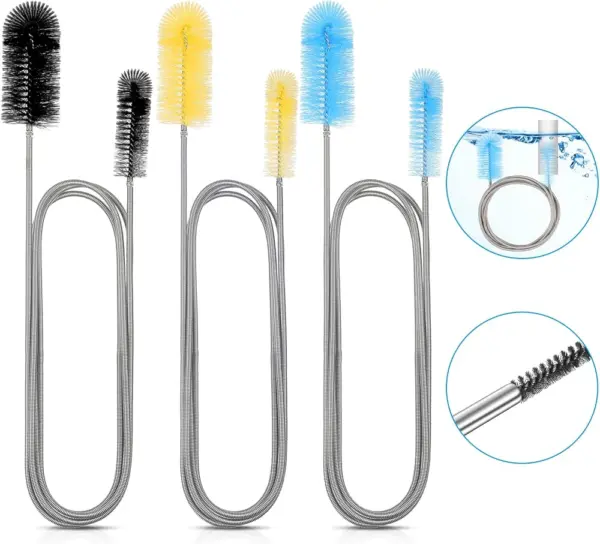
The Patelai 3-pack is our default aquarium tube brush because it solves the two most common jobs without turning into a full cleaning kit. You get three 61-inch double-ended brushes, each with a 0.7-inch head for airline tubing and a 1.18-inch head for canister filter hoses. That means one brush can live with the canister filter, one can stay with the air pump, and there is still a spare when one goes missing behind the tank.
The stainless wire is flexible enough to follow the gentle curves of a canister hose, and the nylon bristles are soft enough that we did not worry about scuffing clear vinyl. We used the small end first on a length of airline and the larger end on a wider hose; the size difference is obvious in the hand and saves you from forcing one head into the wrong tube. The 61-inch reach is enough to work through a full canister run from one end, with plenty of wire left to grip.
For most freshwater and planted tanks, this is the set we recommend first. It handles the long canister hose and the thin air line in the same pass, and the spare means you are not reusing a wet brush between jobs. If you also clean impellers and spray bars, the SLSON kit adds the short brushes this one lacks; if your hoses are unusually wide, the SLSON single’s 1.5-inch head is the better fit.
Pros
- Two head sizes fit airline and canister hose
- Three brushes let you dedicate one to each job
- 61-inch reach handles long filter runs
Cons
- Shaft can buckle when forced through tight bends
We recommend the Patelai 3-pack as the default aquarium tube brush: three 61-inch double-ended brushes cover canister hoses and airline tubing without a box of tiny extras.
SLSON 61-Inch Aquarium Brush – Best for Wide Hoses
Key Features
- Pack: 1 brush
- Length: 61 in
- Material: Nylon and stainless steel
- Brush head sizes: 0.6 x 2.2 in; 1.5 x 2.6 in
- Price: Budget
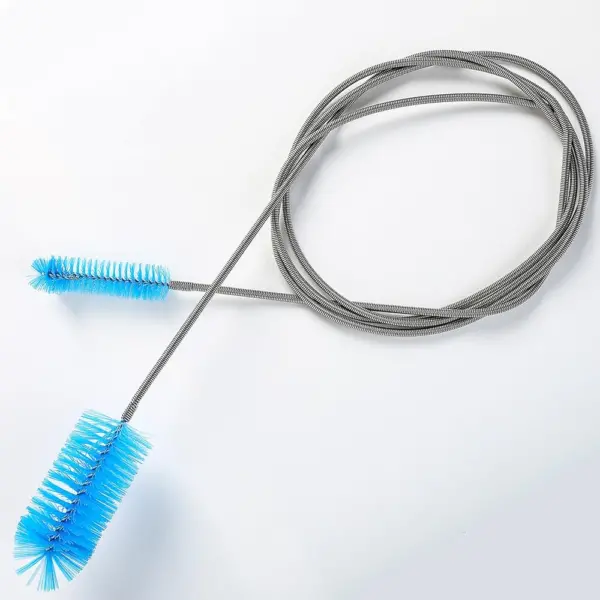
The SLSON’s 1.5-inch brush head is the reason it earns a spot next to the top pick. Most aquarium hose brushes here top out around 1.18 inches, and that extra third of an inch matters when a canister hose is wide enough that a smaller head skates down the middle without touching the walls. The other end is a 0.6-inch brush for airline, so you still get a small option.
We recommend this one for wide canister hoses and for anyone who wants a single long brush rather than a kit. The 61-inch reach is the same working length as the top pick, and the soft nylon bristles are gentle on clear vinyl. The head attachment is the part we treat with care: a hard pull can work the brush loose, so we twist as we withdraw instead of yanking.
If your filter hoses are standard width, the top pick’s two-head set is the more versatile buy. The SLSON single is the one we reach for when a hose is fat enough that the smaller head needs more passes. It is also the simpler choice if you already own short brushes for the impeller and spray bar.
Pros
- 1.5-inch head fits wide canister hoses
- 0.6-inch end handles airline tubing
- 61-inch reach for long runs
Cons
- Only one brush in the pack
Buy the SLSON if your canister hoses are wider than the top pick’s 1.18-inch head can handle; its 1.5-inch brush end gives you more bite in a fat hose.
SLSON 11-Piece Filter Brush Set – Best Full Kit
Key Features
- Pack: 11 pieces
- Material: Nylon and stainless steel
- Long brush: 61 in
- Short brushes: 10 sizes
- Price: Midrange
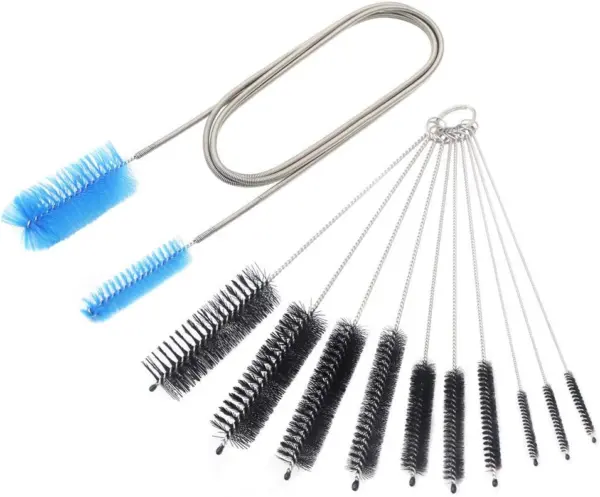
The ten short brushes are what separate this SLSON set from the long-brush picks. The main tool is the same 61-inch double-ended hose brush, with a small and large end for airline and canister tubing. The extras are a set of short brushes in different sizes, and that turns a hose cleaner into a filter-maintenance kit.
We used the short brushes on an impeller housing and a spray bar, where the long wire is awkward to control. The long brush still does the hose work, and the soft nylon bristles are gentle on clear tubing. The short brushes are the reason the kit earns its place: they get into the small openings that a 61-inch wire cannot.
This is the kit we recommend for someone who maintains a canister filter and wants one box for hoses, impellers, and spray bars. It is more than a hose brush, so it makes less sense if your only job is a pair of long hoses; the top pick is simpler and gives you three long brushes instead of one long brush and ten short ones.
Pros
- Ten short brushes cover small filter parts
- 61-inch double-ended hose brush included
- Soft nylon is gentle on clear tubing
Cons
- Long brush ends are stiff for tight HOB intakes
The SLSON kit is the one we reach for when a hose brush alone is not enough: the ten short brushes let you clean impellers, spray bars, and small filter parts in the same session.
ICEYLI 2-Pack 60-Inch Brush – Best Budget Two-Pack
Key Features
- Pack: 2 brushes
- Length: 60 in
- Bristles: Soft nylon
- Material: Nylon and stainless steel
- Price: Budget
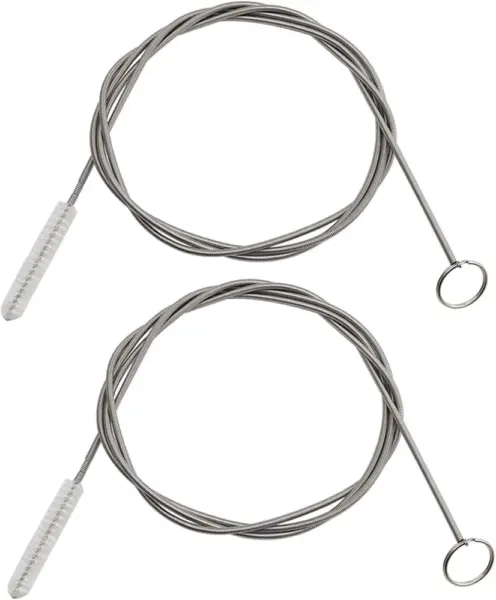
The ICEYLI two-pack is the budget route: two 60-inch brushes with loop ends, sold for drains and sunroofs but perfectly usable in aquarium hoses. The loop is the detail we appreciate most, because a long brush that disappears into a canister hose is a bad afternoon. Two brushes also let you keep one for the tank and one for household tubes.
We recommend it as a spare or a second brush, not as the primary tool for a packed canister filter. The soft nylon bristles are gentle on tubing, and the two-pack value is the point: you get a brush for the tank and a spare for the utility bucket. The shaft is less sturdy than the aquarium-specific picks, so it is not the one we choose for a stubborn clog.
If you want one brush that feels purpose-built for aquarium filter hoses, spend a little more on the top pick or the SLSON single. The ICEYLI earns its place when you want two long brushes for light work and do not need short brushes or a stiff scrubbing head.
Pros
- Two long brushes in one pack
- Loop end makes retrieval easier
- Soft nylon is gentle on tubing
Cons
- Shaft can feel flimsy when pushing
For a cheap spare set for hoses and household tubes, the ICEYLI two-pack is the practical choice, as long as you accept a softer shaft than the aquarium-specific picks.
Patelai 12-Piece Filter Brush Set – Best for Small Filter Parts
Key Features
- Pack: 12 pieces
- Material: Nylon and stainless steel
- Long brush: 61.02 in
- Short brushes: 10 sizes
- Price: Premium
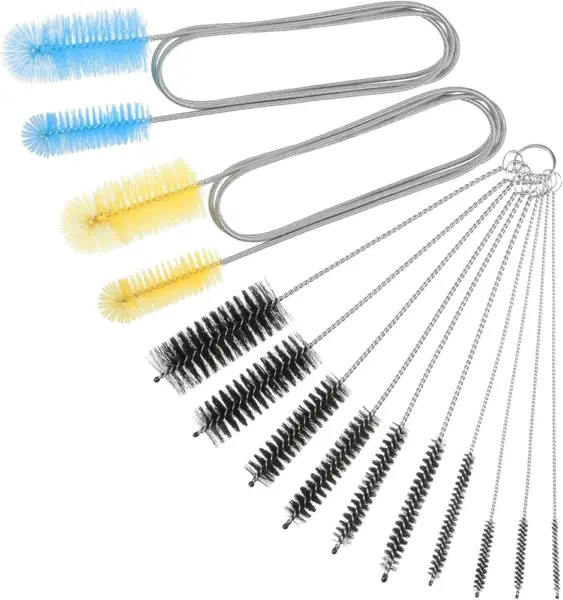
The Patelai 12-piece set is the one we recommend for the hobbyist who wants a single box for hoses and small filter parts, not for someone who only needs a long hose brush. The centerpiece is a 61-inch double-ended brush with 0.7-inch and 1.18-inch heads; the other ten brushes are short, varied sizes for impellers, connectors, and narrow openings.
The long brush handles canister hoses and airline tubing much like the top pick. The short brushes are the differentiator, and we found them useful for filter intake grilles and the inside of a spray bar. They are sized for small openings, so the long brush still does the hose work. The set is at its best when you have several small parts to clean in one session.
If you already own a long hose brush, this set adds useful small brushes without making you buy another brand’s long handle. If you do not, the top pick is the cleaner starting point: three long brushes, no short extras, and less to store.
Pros
- Long 61-inch hose brush included
- Ten short brushes cover small filter parts
- One set for hoses and accessories
Cons
- Bristles are soft for stubborn algae
The Patelai 12-piece set makes sense if you want one box for hoses and small filter parts, but check the short brushes against your smallest tubing before you commit.
yueton 61-Inch Aquarium Brush – Simple Spare
Key Features
- Pack: 1 brush
- Length: 61 in
- Material: Nylon and stainless steel
- Brush head sizes: 2 x 0.7 in; 2.4 x 1.2 in
- Price: Budget
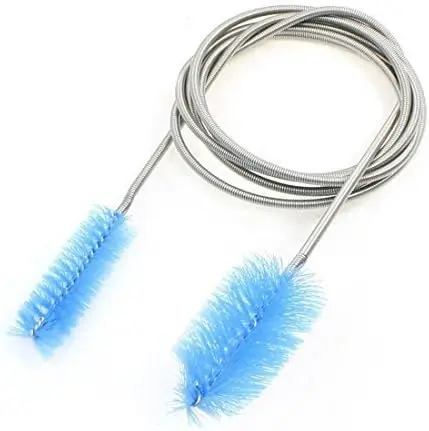
If you already have a filter-cleaning routine and just need one long brush, the yueton is a straightforward aquarium-specific option. It is a single 61-inch double-ended brush with a 0.7-inch head and a 1.2-inch head, so it covers airline tubing and most canister hoses without any short extras.
The stainless wire follows the gentle bends in a canister hose, and the nylon bristles are soft enough for clear vinyl. We used the smaller end on air line and the larger end on a filter hose; the two sizes are close enough that you can switch without checking the label. The brush is light in the hand, and the 61-inch wire gives you enough tail to work from outside the cabinet.
We recommend it as a simple single brush or a spare, not as the only tool for a full filter teardown. It does the long hose job well, and it is easy to stow with the siphon; if you want short brushes for impellers and spray bars, the SLSON kit is the better shape.
Pros
- 61-inch reach for canister hoses
- Two head sizes cover airline and hose
- Soft nylon is gentle on clear tubing
Cons
- Bristles too soft for stubborn algae
The yueton is a straightforward single brush for aquarium hoses, with two head sizes and a price that makes it an easy spare; just do not expect stiff bristles for baked-on algae.
SunGrow 61-Inch Filter Brush – Best for Bent Pipes
Key Features
- Pack: 1 brush
- Shaft: Stainless spring
- Length: 61 in
- Material: Nylon and stainless steel
- Price: Budget
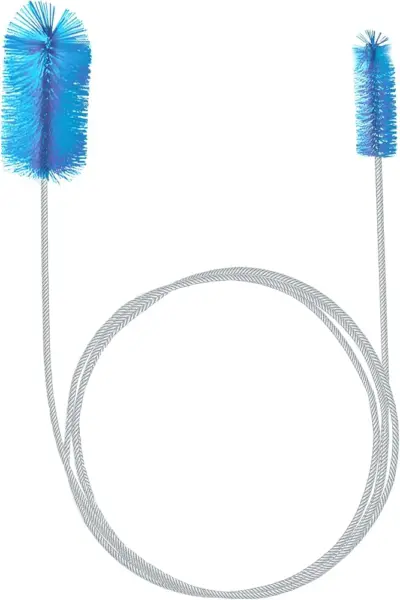
A U-shaped filter hose is where a straight brush fails. The SunGrow’s stainless spring shaft is built to follow that curve, and the 61-inch length gives you enough wire to work through a full canister run without your hands inside the cabinet.
The brush is double-ended, with nylon bristles on both ends, and the spring is flexible enough that we could guide it around a bend rather than force it. It does not hold a shape, so you steer it by feel: short pushes, then a twist as you pull back. That makes it slower than a stiff brush on a straight run, but it keeps the brush moving in the bends where the stiff ones catch.
The SunGrow is a specialist, not the default. It makes the most sense on a filter with a tight U-bend or an awkward run where a stiffer shaft keeps catching. On a straight hose, the top pick’s two head sizes are easier to control.
We recommend it when the shape of the plumbing is the problem. Feed the brush end first, keep the run as straight as you can, and let the spring follow the pipe instead of trying to steer every inch.
Pros
- Spring shaft follows U-shaped runs
- Double-ended nylon bristles
- 61-inch reach for full hose runs
Cons
- Wire can bend out of shape after repeated pulls
The SunGrow is the one to try on a U-shaped or sharply bent filter run, where its spring shaft can follow the pipe instead of fighting it.
How We Tested the Best Aquarium Tube Brushes
We started by measuring the tubing we actually clean: half-inch and five-eighths canister hose, the narrow uplift tubes on sponge filters, and the rigid return line on a rimless tank. From there we filtered the market by stem length, bristle type, and price, and set aside anything whose listed length couldn’t clear a standard canister hose with the handle still above water. That left us with 14 brushes, from short hand brushes to long flexible wands.
Testing ran for three months alongside our normal maintenance schedule: weekly water changes on a 55-gallon community tank and a 20-gallon nano running a canister filter. Every brush went through the same jobs — the corrugated intake hose, a straight siphon tube, the 90-degree elbow on the return line, the sponge filter uplift, and the sloped corners of the tank where film collects.
We counted how many passes it took to clear visible film from a marked section of clear hose, then bent each stem around the elbow to see whether the wire kinked or held its curve. After each session we checked the tubing for shed bristles, ran a fingernail along the tip to catch any grit that could scuff acrylic, and rinsed the brush under the tap to see whether debris slid off the bristles or clung to them. Handles were handled wet and slimy to test grip, and we tracked each brush week to week — the ones that dropped bristles, rusted at the crimp, or lost their stiffness by week six fell out of contention, no matter how cheap they were.
How to Choose an Aquarium Tube Brush
The brush that works is the one whose head fits the hose and whose wire can follow the bend without jamming, so start with diameter and reach before you look at kit size.
Match the Brush Head to the Hose
Aquarium tubing comes in two very different sizes: thin airline and wider filter hose. A double-ended brush is the practical answer because the small end can clean air line while the large end scrubs the filter hose. As a rule, a 0.6- to 0.7-inch head suits airline, and a 1.1- to 1.5-inch head suits most canister hoses. The trap is assuming one head will do both: forcing a wide brush into airline can tear the bristles or jam the wire. Use the small end first, and switch only when the hose is wide enough.
Choose Reach and Flexibility Together
A 60- or 61-inch brush is the common long size here and reaches through a typical canister hose with enough wire left to grip. More length is not automatically better: once the wire is longer than the run, it coils in the cabinet and becomes harder to control. Flexibility matters more at the bends. A springy shaft follows a gentle curve; a very soft one buckles when you push, and a very stiff one catches. We prefer a brush that follows the hose with light pressure and lets you twist rather than force.
Check the Brush Head and Bristles
The head is the part that fails first. A brush head that pulls off inside a hose is worse than one with soft bristles, so look for a firm attachment and avoid yanking when you withdraw. Bristle stiffness is a trade-off: soft nylon is safer on clear vinyl and acrylic, while stiffer bristles cut through dried algae with fewer passes. For most aquarium hoses, soft to medium nylon is enough; if algae is stubborn, plan on two passes rather than buying the stiffest brush you can find.
Decide Between a Single Brush and a Kit
Buy for the parts you actually clean. If your maintenance stops at hoses and air line, a single long double-ended brush or a multi-pack of long brushes is the simpler choice. If you also remove impellers, spray bars, and intake grilles, a kit with short brushes earns its space. The trap is buying a big kit for one hose: the short brushes add clutter, and the long brush is the part you use. We prefer three long brushes to one long brush and ten short ones that never leave the drawer.
Frequently Asked Questions
Can I use a drain brush on aquarium hoses?
Yes, if it is a flexible tube brush with soft nylon bristles and a plain wire shaft. Skip drain augers, brushes with cutting tips, and anything that has held drain chemicals. Rinse it with fresh water before it goes near the tank, and keep it separate from household drain use.
Will the wire scratch the inside of the hose?
The nylon bristles are the part that should touch the tubing. A straight stainless wire down the middle is usually fine, but a kinked or exposed wire can scrape clear vinyl. Run a finger along the first few inches before each use; if the wire is bent or poking through, retire the brush.
How often should I clean the filter hoses?
Clean when flow drops, when you see brown film through the hose, or at the same interval as your filter media. For many tanks that is every one to three months, but visible algae is the better trigger than a calendar. A quick brush-through at water-change time keeps the film from setting into a hard layer.
Do I need to unplug the filter before brushing a hose?
Yes. Shut off the filter or pump and close any valves before you disconnect or feed a brush into the hose. That stops water from siphoning out and keeps the impeller from running dry. Work over a bucket, and keep the brush out of household cleaning storage so soap residue does not get into the tank.
Final Verdict
The Patelai 3-pack is the aquarium tube brush we recommend first. Its three 61-inch double-ended brushes cover the two jobs that matter most, airline and canister hose, and the spare means you are not reusing a wet brush between them. If your canister hoses are wider than its 1.18-inch head, the SLSON single’s 1.5-inch end is the better fit; if you also clean impellers and spray bars, the SLSON kit adds the short brushes. Start with the Patelai, then size up only if your hose demands it.