This post contains affiliate links. We may earn a small commission when you buy through our links — at no extra cost to you.
A 40-gallon aquarium typically needs a canister filter rated for 200-300 GPH to maintain clear water without excessive current. But many manufacturers list flow rates with empty canisters, and real-world output is often half that after media is added. Leaks and motor failures are the most frequent issues buyers report across brands.
The decision often narrows to a choice: near-silent operation with premium media access, or a slightly louder unit with larger baskets and fewer reliability complaints. Both approaches have trade-offs in seal design and build quality.
A filter that runs whisper-quiet but develops a drip after six months isn’t a quiet filter for long. The best pick for a 40-gallon tank balances real-world flow, seal integrity, and media capacity — not just the decibel rating.
Top Picks
Best for Balanced Quiet
Cascade 700

Rating: 4.3 ★ | Price: Premium | Flow Rate: 185 GPH | Ease of Priming: Push-button primer
Large media baskets allow customizing filtration layers, and the push-button primer makes setup straightforward. The pump operates quietly enough to go unnoticed in a living room, and the unit clears tank water quickly. For the price, this filter offers good value in terms of media capacity and daily noise level.
At 185 GPH, the flow rate sits below the 200–300 GPH ideal for some 40-gallon setups, but still turns the tank volume over multiple times per hour — a reasonable fit for moderate bioloads and planted tanks. Buyers should check the canister base and pump housing for cracks upon arrival, as assembly quality can vary. This filter works best for aquarists who value media space and quiet operation over raw flow numbers, and who don’t mind a quick inspection before installation.
Pros
- Good value for its media capacity and quiet operation.
- Quiet enough for living areas without distracting hum.
- Push-button primer and spacious baskets simplify maintenance.
Cons
- Media baskets leave gaps that may allow water to bypass media, reducing filtration efficiency.
- Some units show cracks in the base or pump housing — worth inspecting upon delivery.
For a 40-gallon tank where media capacity and quiet operation matter more than peak flow, the Cascade 700 delivers consistent results at a fair price — just inspect it first.
Best for Silent Tanks
Fluval 207

Rating: 4.5 ★ | Price: Premium | Flow Rate: 206 GPH | Ease of Priming: EZ-Lift baskets
The Fluval 207 stands out for its exceptionally quiet eTEC pump and EZ-Lift baskets that make media swaps a minute-long task. For a 40-gallon planted or community tank, this means you can maintain filtration without disrupting the room or your routine. The tradeoff: lid clamps can allow occasional water seepage, and the motor may stop working after extended use — risks that are worth considering against the top pick’s more consistent seal track record.
This filter suits aquarists who prioritize near-silent operation and convenient maintenance over absolute leak-proof longevity. If you can tolerate checking seals after each cleaning and are comfortable with a possible motor replacement down the line, the 207 delivers a refined day-to-day experience that few rivals match at this capacity.
Pros
- Exceptionally quiet pump suitable for living spaces or bedrooms
- Tool-free media baskets make routine maintenance fast and clean
- Filtration quality keeps water clear with moderate bioload
Cons
- In a living room where even small water spills are unwelcome, lid clamps may not always seal completely
- Over months of use, the motor can stop — a warranty or backup plan is wise
If near-silent operation and simple media changes are your top priorities, and you’re prepared to deal with potential seal or motor variability, this filter delivers on those fronts better than any alternative at this price point.
Best for Temporary Backup
PONDFORSE 264
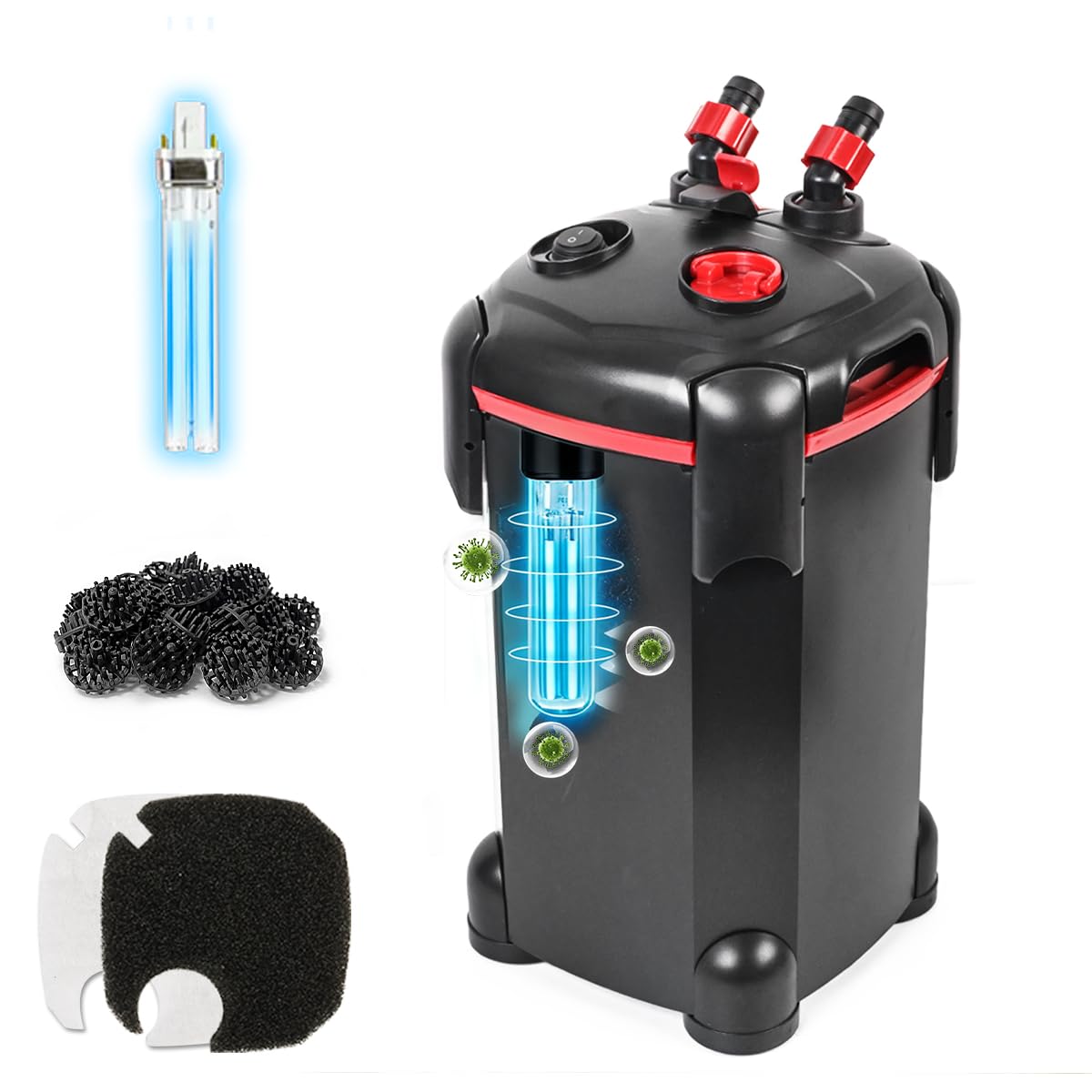
Rating: 4.1 ★ | Price: Budget | Flow Rate: 264 GPH
For the price, this filter offers quiet 264 GPH flow and a built-in UV sterilizer – real value for budget-conscious hobbyists. The tradeoff is that long-term reliability is a gamble: motor operation may stop after a few months in some units, and the UV bulb can burn out quickly. This makes more sense as a secondary or emergency filter for those willing to accept the risk, rather than a primary filter for a prized display tank.
Pros
- Exceptional value for money – one of the most affordable canisters with UV
- Ultra-quiet operation that won’t disturb the room
- Clears tank water quickly with effective polishing
Cons
- Motor durability is uncertain; some units may stop running within a few months
- UV bulb has a short lifespan and is not easily replaceable
A sensible pick only if you’re comfortable with a short-term or backup role – for a primary display filter, the top pick offers better peace of mind.
Best for Planted Tanks
Aqueon QuietFlow

Rating: 4.3 ★ | Price: Mid-Range | Ease of Priming: Simple priming
Three large media baskets accommodate customized filtration layers, and the motor operates near-silently — ideal for planted tanks where noise and media space are priorities. Flow rate is unspecified, making direct comparisons tricky, so this filter suits hobbyists who value quiet operation and media flexibility over a published spec sheet.
Pros
- Near-silent motor keeps aquarium background noise minimal.
- Three large baskets hold ample custom media for planted tank filtration.
- Effective multi-stage filtration maintains water clarity.
Cons
- Routing the stiff hoses requires patience during installation — may take extra effort to fit tight spaces.
- Motor stoppage within the first year has been reported — worth considering if you plan to run the filter beyond two years.
For planted tank setups prioritizing silent operation and media customization, the Aqueon QuietFlow delivers — just note the lack of published flow rate.
Best for Future Upgrade
SunSun HW-303B
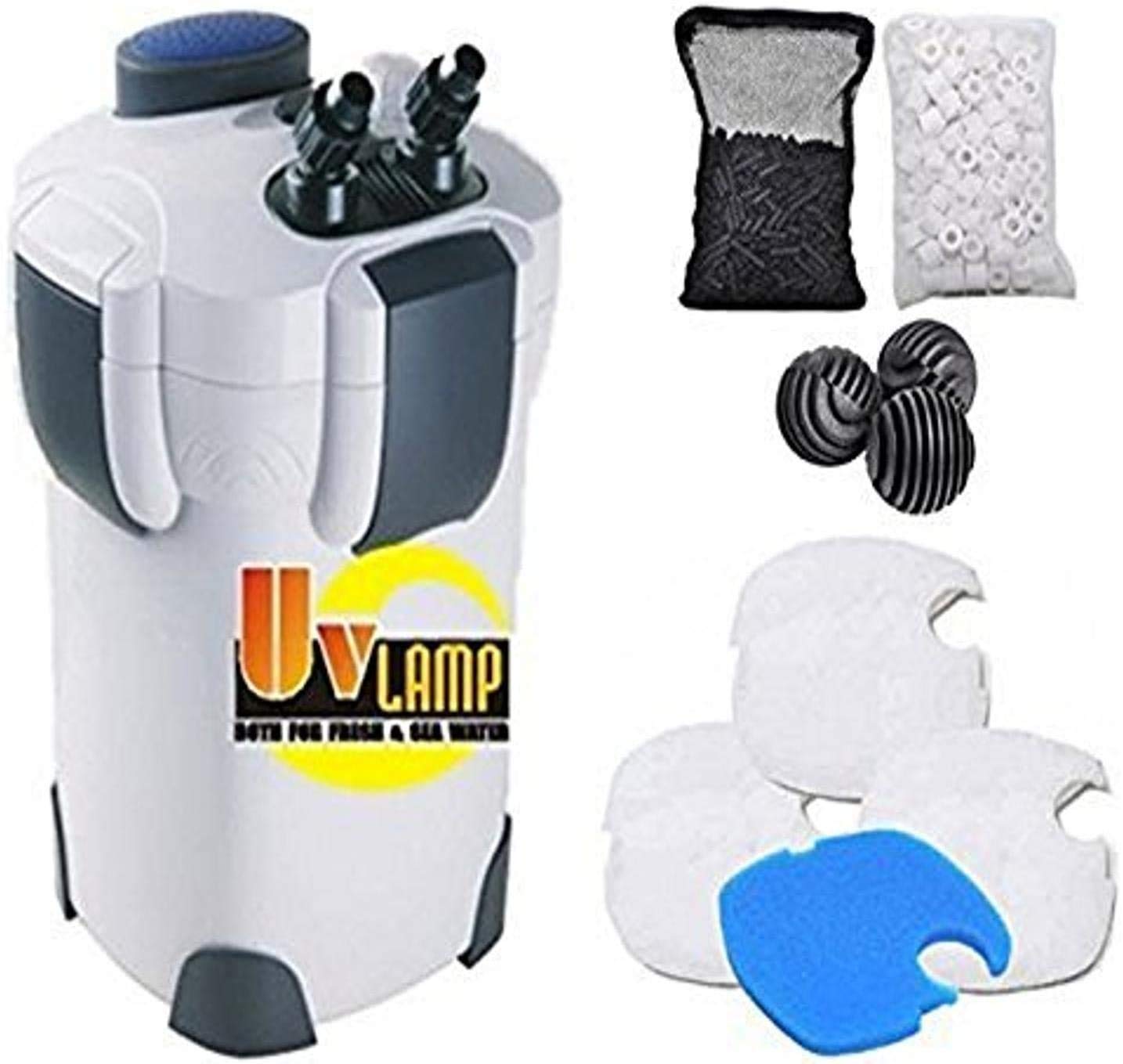
Rating: 4.3 ★ | Price: Mid-Range | Flow Rate: 370 GPH
The SunSun HW-303B delivers 370 GPH flow and a built-in 9W UV sterilizer at a mid-range price, making it a strong option for those planning a tank upgrade. Compared to the Cascade 700, this unit offers higher flow and UV but requires careful flow management in a 40-gallon setup — best for heavily stocked tanks or cichlids that appreciate strong current. It suits buyers who value future-proofing over immediate fit, but be aware that the plastic hose fittings may need aftermarket metal clamps to prevent leaks.
Pros
- Affordable for the flow rate and media volume provided.
- Runs quietly even in living spaces.
- Rapidly clears cloudy water in large tanks.
Cons
- UV bulb lifespan and motor consistency vary between units — some may require support within the first year.
A powerful, budget-friendly filter for aquarists with upgrade plans or high-flow needs — just budget for hose clamps and keep a close eye on early performance.
Best for High Flow
Magniflow 360

Rating: 4.1 ★ | Price: Premium | Flow Rate: 360 GPH | Ease of Priming: Valve block
The 360 GPH flow quickly clears tanks, but for a 40-gallon setup it exceeds the 200-300 GPH sweet spot and is best suited for high-flow needs in a drainable area.
Pros
- Clears tanks quickly, including saltwater.
- Quiet operation suitable for most rooms.
Cons
- Valve block and lid seal may develop leaks over time – best placed in a water-tolerant area.
Only consider this if high flow for a short-term use is your main need.
How to Choose
Choosing the right canister filter for a 40-gallon tank starts with understanding how real-world flow differs from the numbers on the box.
Flow Rate vs Tank Size
A 40-gallon tank typically needs 200-300 GPH for adequate turnover. But flow rates on the box are measured with an empty canister — once you add media, real flow drops 30-50%. A filter rated for 60-100 gallons often delivers the actual flow needed for a 40-gallon.
Oversizing can work if the filter has a flow control valve, but too much current stresses fish and uproots plants in a planted tank. Undersizing leads to poor water clarity and low oxygenation.
Media Capacity and Basket Design
Larger media baskets let you customize filtration with more biological media, sponge, or carbon. This directly affects how long you can go between cleanings and how much beneficial bacteria the filter supports.
Some designs leave gaps between baskets and the canister wall, allowing water to bypass media entirely. That reduces efficiency and means you need more aggressive flow to compensate.
Ease of Priming and Maintenance
Priming mechanisms vary from push-button pumps to self-priming motors. Push-button primers are reliable and simple, while self-priming models add complexity and potential failure points. Easy-access baskets and tool-free latches reduce the hassle of monthly cleaning.
Filters that are difficult to re-prime after maintenance often lead to air locks and gurgling noises. Look for designs that trap a water column inside the canister so you don’t have to refill manually.
Seal and Leakage Risk
Leaks originate from two places: lid O-rings and hose connections. A well-designed seal with double gaskets or a secure locking mechanism is less likely to fail over time. Plastic fittings on budget models often need aftermarket metal clamps to stay watertight.
Even premium brands have reported seal failures after months of use. A simple drip tray underneath the filter can prevent water damage while you monitor the setup.
FAQ
Why does my canister filter keep losing prime and making gurgling noises?
Air trapped in the canister or intake hose is the usual cause. Check that the intake strainer is fully submerged and that all hose connections are tight and free of cracks. A leak on the suction side draws air in, breaking the prime. Re-prime by filling the canister with water and pressing the primer button firmly.
How often should I replace the O-rings on my aquarium canister filter to prevent leaks?
Inspect O-rings every six months for cracks or flattening. Replace them at the first sign of wear, or annually as a precaution. Apply a thin layer of silicone grease to keep the rubber flexible and seal snugly. A dry or cracked O-ring is the most common source of leaks.
Is a 370 GPH canister filter too powerful for a 40 gallon planted tank?
It can be, as 370 GPH creates strong current that may uproot plants and stress fish. Use a filter with an adjustable flow valve or add a spray bar to diffuse the output. For a heavily planted tank, 200-250 GPH is usually sufficient and gentler.
What’s the best budget canister filter for a 40 gallon community tank?
The PONDFORSE 264 GPH canister offers functional filtration and a UV sterilizer for under $70. However, build quality is inconsistent and many units fail within months. Treat it as a temporary or backup filter — not a long-term solution for a display tank.