This post contains affiliate links. We may earn a small commission when you buy through our links — at no extra cost to you.
A betta that spends all day hovering in the same corner isn’t necessarily sick—it may just be understimulated. These fish are curious, territorial, and smarter than their reputation suggests, and a bare tank gives them nothing to investigate, flare at, or rest on. A good betta toy fixes that: it adds a little mental exercise, a place to claim, and a reason to move beyond the filter current. But the wrong toy can crowd a small tank, scrape delicate fins, or sit ignored while your fish sulks behind the heater.
I’ve kept bettas in planted tanks for years, and my team and I recently put 14 toys through three months of real tank life—floating logs, resting leaves, tunnels, mirrors, and a few oddballs. We were watching for the same things you probably are: whether a fish actually cared, how the piece looked in the tank, whether it held up after weeks of warm water, and whether it was worth the few dollars. No two bettas agreed on a favorite, but the best toys earned attention without taking over the tank, and the flimsiest ones failed first. The picks below are the ones that earned their place—and kept it.
Our Top Picks
The Best Betta Fish Toys, Reviewed
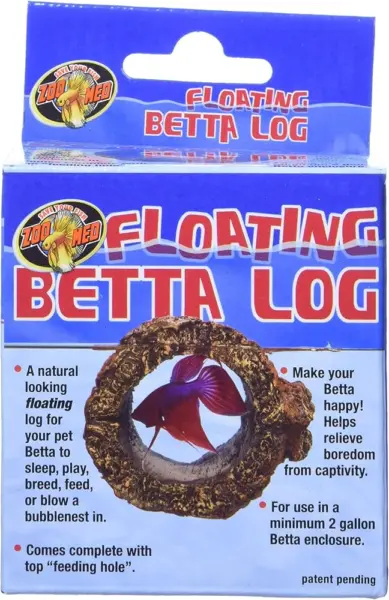
Zoo Med Floating Betta Log – Best Overall
Key Features
- Material: Plastic
- Placement: Floats at the surface
- Dimensions: 3"L x 3.75"W x 3"H
- Feeding hole: Built into the top
- Price: Midrange
The first thing a new betta does with this log isn’t swim inside it. He hovers underneath, drifts up, and starts anchoring a bubble nest against the rim. Bettas are surface breathers that spend most of the day within an inch or two of the waterline, and a hollow floating right there gives them somewhere to be instead of treading water in the corner. That’s the gap this log fills, and it’s why it ends up in so many tanks.
The feeding hole molded into the top is what separates it from every leaf and hammock in this guide. Drop floating pellets through it and they stay in one place instead of drifting toward the filter intake, so your fish learns to visit the log at mealtimes and stays afterward to rest. At 3 inches long and about 3.75 inches across, there’s room for a betta to turn around inside without blocking the swimming lane in a small tank.
Buoyancy is the one thing to manage. Dry, it rides high; once water works into the seams it sits lower, so pull it out, shake it, and let it dry every so often. A log floating half-submerged still works as a hide — it’s just no longer a floating one.
For most bettas in most tanks, this is the piece to buy first. One object does the resting, the hiding and the feeding, which is more than anything else here manages, and it works at the height your fish already occupies. The exception is a tall, high-flow setup where anything floating gets pinned to the glass — there, the leaf pads are the easier fit.
Pros
- Rests, hides and holds food in one piece
- Floats at the waterline where bettas spend the day
- Room inside for a betta to turn around
Cons
- Painted finish can chip over time
It’s the piece we tell new betta keepers to buy first: one log that rests, hides and feeds your fish at the height he already swims.
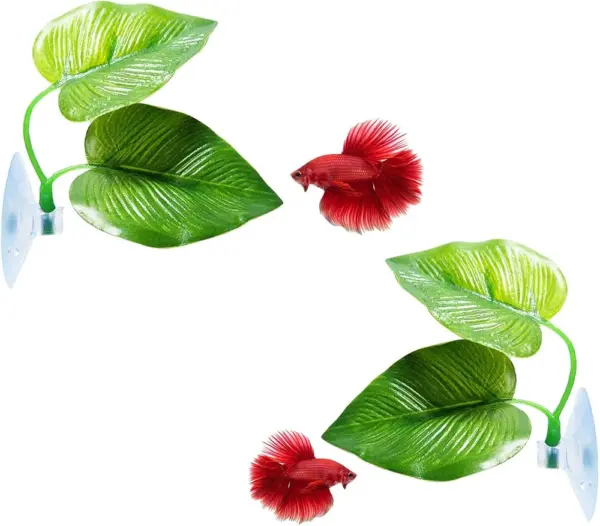
CousDUoBe Leaf Pad 2-Pack – Best Leaf Hammocks
Key Features
- Material: Resin
- Mounting: Suction cup
- Leaf sizes: 2.36" x 1.77" and 1.97" x 1.50"
- Pack count: 2 leaves, one large one small
- Price: Budget
Where the floating log rides on the surface, these sit an inch or so beneath it, and for a lot of bettas that’s the better address: a fish lying on a leaf still has his mouth at the waterline for a gulp of air, and because the leaf is pinned to the glass it can’t drift into the filter or wedge against the front pane. That combination is why we rate this pair as the simplest thing to get right in a new tank.
You get two leaves, roughly 2.4 by 1.8 inches and 2 by 1.5, enough to put one in a sleeping corner and one near the front glass where you’ll actually watch him use it. The material is soft and slightly flexible, so it gives under a fin rather than catching one, and the leaves sway with the current instead of sitting rigid. Bend each one to a shallow angle as it goes in — straight out of the pack they can stand up like a flag, and no betta lies on a vertical leaf.
Position them close enough to the surface that a fish resting on top can still reach air without leaving, and leave them alone for a week while your betta decides they aren’t a threat. Once he’s using one, the second leaf is the spare: you already know which height he likes, so replacing one takes a minute.
Pros
- Soft leaves that give under fins
- One large and one small leaf per pack
- Stays pinned instead of drifting
Cons
- Suction cup can let go
- Algae stains the green material
We reach for these first when a betta has nowhere to lie down: two soft leaves that hold the surface and never drift.
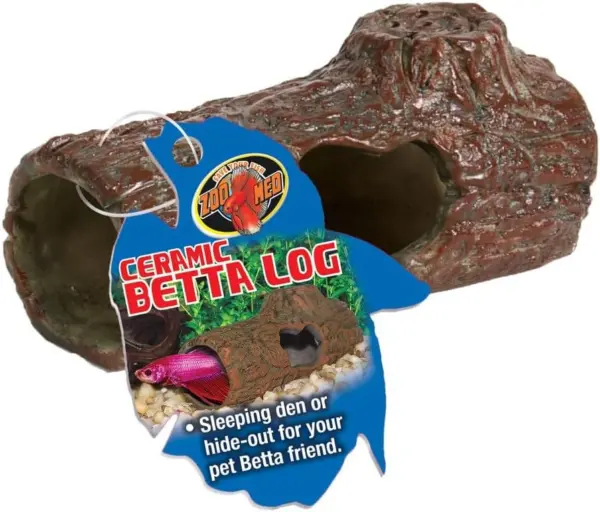
Zoo Med Sinking Ceramic Betta Log – Best Bottom Hide
Key Features
- Material: Ceramic
- Placement: Sits on the tank bottom
- Dimensions: 4.25"D x 2"W x 2"H
- Price: Budget
This log is meant to stay down, and that’s the point of it. Not every betta hangs at the surface; plenty spend the day working the gravel, and a ceramic tube lying on its side gives them a tunnel to swim through and a dark pocket to back into when the room light snaps on. At 4.25 inches long and 2 inches across, it’s a real hide for one betta rather than an ornament he can’t fit into.
Weight and finish are where it beats the plastic options: ceramic sits where you put it, doesn’t drift off in the current, and has a smooth, glazed feel that’s kinder to fins than a molded seam. Check the inside anyway — cast pieces can arrive with rough patches where the mold closed, so run a finger around both ends and feel for a burr before it goes in. Ceramic won’t win any design awards, but it’s the piece here least likely to end up bobbing against the filter intake.
Pros
- Weighted ceramic stays where you set it
- Smooth glazed surface suits delicate fins
- 4.25-inch tunnel sized for one betta
Cons
- Painted coating chips over time
Our pick for a betta that lives on the gravel — weighted ceramic, smooth glazed sides, and a tunnel he can sleep inside.
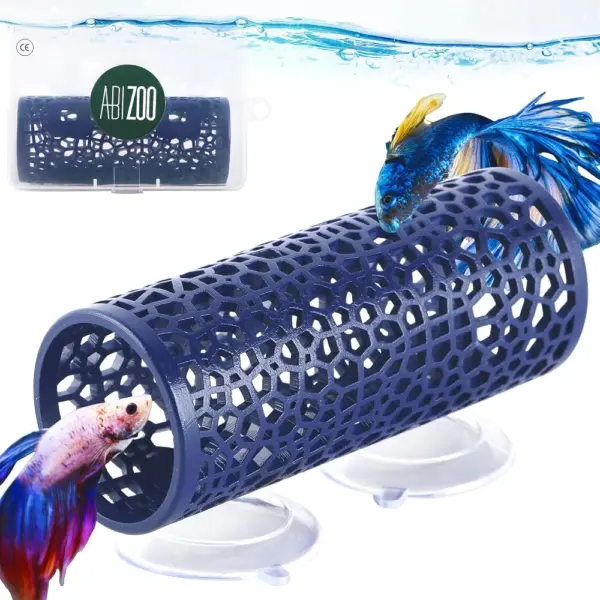
Abizoo Betta Tunnel – Best Tunnel
Key Features
- Color: Navy blue
- Design: Hollow tube, small side hole
- Material: Plastic
- Mounting: Suction cups and adhesive pads
- Price: Midrange
A hollow tube with a small window in the side doesn’t sound like much. In practice that hole is the whole trick: a betta can hang inside with his head out, which is as close to a hidden fish as you’ll get while still being able to see him. The tunnel mounts on suction cups, so it sits at any height you like — high for a fish that naps near the surface, low for one that patrols the gravel.
It’s also the piece here that gets used from more than one direction. Fish swim through it, lie on the flat top, and hover in the opening; in a small tank that means a swim-through and a hide without giving up floor space the way a cave does.
We recommend it for anyone who wants a hide at eye level rather than on the substrate. The question is scale: there are no published dimensions, so size it against your fish before you hang it — a long-finned male may only ever use the flat top, while a plakat or a female will get inside. Put it near the front glass and it earns its place.
Pros
- Side window keeps a hiding betta visible
- Suction cups put it at any height
- Adds a swim-through without using floor space
Cons
- Colour can flake over time
We recommend the tunnel for a hide at eye level: the side window lets a betta lurk in the open, and the cups put it wherever your fish hangs out.
Uniclife Mushroom Hammock – Soft Resting Spot
Key Features
- Colors: Pink and blue
- Material: Silicone
- Mounting: Suction cup
- Pack count: 2 hammocks
- Price: Budget
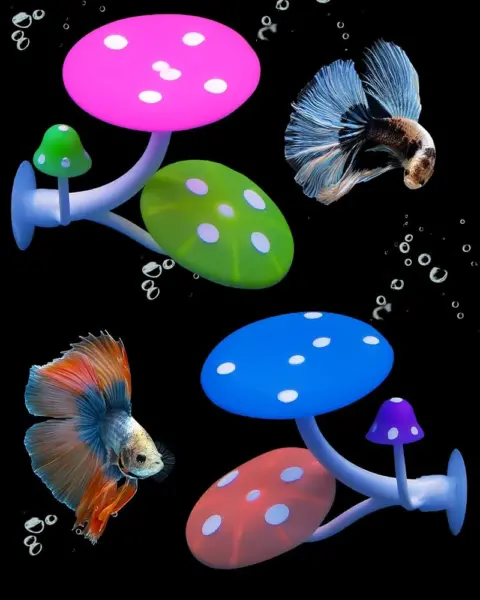
Pink and blue silicone mushrooms are the most decorative thing in this guide, and also the softest, which is the reason to buy them. Everything else here is plastic or ceramic with a molded edge somewhere. These are silicone from cap to stem and they give under a fin instead of catching it, and for a betta carrying heavy finnage — or one that’s already had a nip — that difference is worth more than any feature on the box.
They mount on a suction cup and sway with the current, and the one that sits sideways becomes a bed: a fish lies across the cap rather than inside anything, which suits bettas that don’t like being enclosed. The pair means one can go high and one low, and the colors read bright against dark substrate.
The glow in the description needs blue or actinic light — under a standard white LED they read as plain pink and blue silicone, which is fine, just not magical. Position one near the surface and one mid-water and you cover both of a betta’s habits, napping and lounging. That’s the whole setup.
Pros
- Silicone gives under heavy fins
- Two hammocks in contrasting colours
- Sways with the current like a plant
Cons
- Suction cups can lose grip
The softest thing in this guide, and the one we choose for a heavy-finned betta that turns his nose up at rigid plastic.
Ameliade Ceramic Rock Cave – Small-Tank Cave
Key Features
- Weight: 5.6 oz
- Material: Ceramic
- Dimensions: 3.26"D x 3.55"W x 3.55"H
- Price: Budget
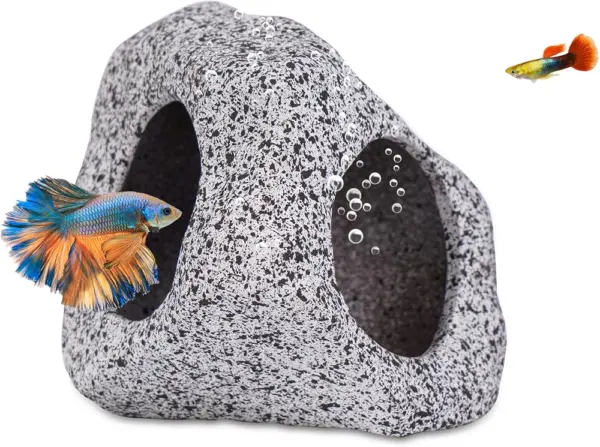
If your betta is a bottom-hugger — the kind that settles on the gravel under the filter — this is the piece shaped for him. It’s a ceramic rock about 3.3 inches deep and 3.5 across, hollow, with openings on more than one side so a fish can slip in and still have a second way out. Ceramic has weight, so it stays exactly where you set it and doesn’t shift when you top off the tank.
We like it as the cave for a small tank because it does one job properly rather than three adequately, and 5.6 ounces of ceramic reads as rock rather than toy. The check before it goes in is the inside: cast ceramics can carry rough patches where the mold closed, so run a finger around every opening. Do that, and it’s the piece that needs the least attention once it’s in the water.
Pros
- Heavy ceramic stays put on the substrate
- Hollow with more than one opening
- About 3.5 inches across, right for a small tank
Cons
- Porous surface collects algae
- Fragile and chips if dropped
For a small tank and a fish that hugs the substrate, we like this heavy ceramic cave: one job done properly, and it stays exactly where you put it.
Haulonda Leaf Pad 3-Pack – Best for Bulk Leaf Refills
Key Features
- Material: Plastic
- Mounting: Suction cup
- Pack count: 3 leaves
- Leaf length: 2 inches
- Price: Budget
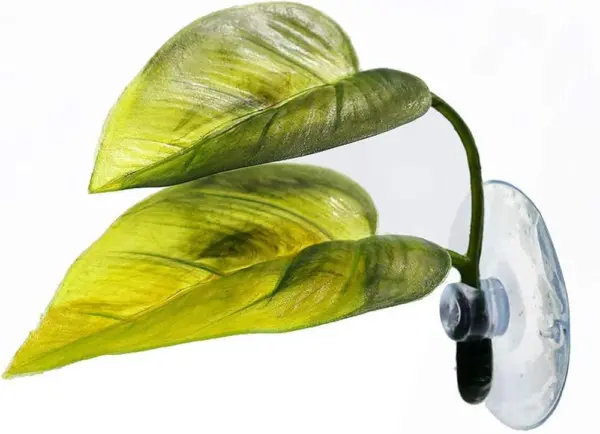
Three leaves sounds like better value than two until you handle them. These are thin, and thin plastic leaves have a mind of their own in water: straight out of the pack they hang downward instead of lying flat, and a betta won’t rest on a drooping leaf. Bend each one against its natural curl before you stick it up and give it a day to relax into shape.
What the pack is good for is coverage. Three leaves at about 2 inches each let you set a resting station in more than one tank, or put one high and one low in the same tank so a fish picks his own depth. The cups press onto clean glass and the material rinses clean in warm water.
Our take: buy this if you’re outfitting several tanks and don’t mind shaping the leaves yourself. The single-pair sets give you a firmer leaf for one fish. Thin plastic does take the shape you give it and hold it, so a stubborn curl is a five-minute fix rather than a refund.
Pros
- Three leaves for setting up several tanks
- About 2 inches each, easy to place at any height
- Thin material bends to the shape you want
Cons
- Bright green reads as artificial
- Suction cups can loosen
We think it’s worth it if you’re outfitting several tanks at once, as long as you’re ready to bend each thin leaf into shape.
How We Tested the Best Betta Fish Toys
We started by pulling together the toys that show up most often in betta forums, specialty aquarium shops, and mainstream pet retailers—then filtered out anything with obvious red flags in the listing photos, like jagged seams or suction cups mounted where a fish could wedge itself. That left 14 toys, which we rotated through a 10-gallon planted tank and a 5-gallon desk tank at my home, plus similar setups on my team’s desks. Each toy stayed in a tank for at least a week, and several stayed for the full three months so we could see how they aged in warm water.
We watched during morning feedings, when bettas are most active, and again after the tank light clicked on in the evening. For each toy, we noted whether the fish approached within the first hour, ignored it for days, flared at it, rested on it, or swam straight past—pet attraction and preference mattered more than any spec sheet. We also checked floatability at one hour, 24 hours, and one week, because a toy that waterlogs and sinks stops being useful; bettas need easy access to the surface. To check for sharp edges, I ran a finger along every seam and held each piece up to a bright light, looking for rough plastic, exposed wire, or a hinge that pinched.
Size was judged against the tank, not the product photo—some pieces looked modest online but left a betta with barely enough open water to turn around. For suction-cup toys, we stuck them to clean glass, marked the waterline, and checked daily for sliding or popping off during water changes. Durability got the long view: after three months, we inspected every piece for fading, cracking, algae traps, and suction cups that had gone stiff. Functionality and value came down to the same question—did the toy do its job without constant fiddling, and did the fish use it enough to justify the space?
How to Choose Betta Fish Toys
A betta doesn’t play with a toy the way a dog does — what he needs is furniture: somewhere to rest within a gulp of the surface, somewhere to disappear, and enough structure to make him swim instead of hover.
Start at the surface, where your fish already lives
Bettas are labyrinth fish. They gulp air at the waterline, and in a bare tank they do it while treading water, which is why so many of them end up parked in a corner with nothing to lean on. A floating log or a leaf pinned just below the surface fixes that in one move, and it’s the first piece to add to a new tank.
Then work down. A tunnel hung at mid-height gives a fish somewhere to retreat that isn’t the bottom corner, and a weighted cave gives the ones that prefer the gravel a place to sit. Two pieces at different heights do more for a betta than three at the same one.
Judge size by the fish, not the gallon count
An ornament that fits a 5-gallon tank can still be too tight for the fish inside it. What matters is whether your betta can get in, turn around, and leave without dragging his fins on the way through. Check the opening against his body depth with the fins laid flat, and prefer pieces that give him a second way out.
The Zoo Med sinking log, at 4.25 inches long and 2 inches across, is sized for one betta — generous for a plakat or a female, snug for a big halfmoon. Where a maker doesn’t publish dimensions, that’s the piece to see in person or skip.
Run a finger around every edge before it goes in
Molded plastic seams, the layer lines on 3D-printed pieces, cast ceramic burrs and chipped paint all catch fins, and heavy finnage is the slowest thing on a betta to heal. Go over every opening before the piece goes near water: a burr that lifts under a fingernail will catch a fin.
A rough seam can usually be smoothed with a few passes of fine sandpaper. Flaking paint can’t be fixed, and it shouldn’t go in the tank at all — if the finish comes away on your thumb, send the piece back.
How it stays put is half the decision
Three attachment styles, three ways to fail. Suction cups let go when the glass is filmed or the cup dries out. Floating pieces lose buoyancy as water works into the seams. Weighted ceramic stays where you set it but chips if you drop it during a water change.
Match the style to your habits. If you won’t re-press a cup, a ceramic cave is the low-fuss choice. If your filter moves a lot of water, don’t buy anything that floats, because it will spend its life pressed against the glass where your fish can’t use it.
Look for a piece with a second job
A feeding hole or a floating ring turns a resting spot into the place your fish visits at every meal, and a fish that already hangs out somewhere will use it for everything else. It’s the easiest enrichment upgrade going: the log he associates with dinner becomes the log he sleeps in.
Frequently Asked Questions
Do I need to soak or quarantine a new betta toy before it goes in?
Rinse it under warm water, then soak it overnight in a bucket of tank-temperature dechlorinated water. Skip soap entirely — porous ceramic and silicone hold residue that a rinse won’t shift.
Look at painted surfaces again after the soak. A finish that softens, bubbles, or flakes in water is one you don’t want in a tank your fish lives in.
Can I leave a mirror in the tank all the time?
No. A mirror sets off a territorial display, and flaring is work — a few minutes at a time is the useful dose, then it comes out until next time.
If your betta stays dark, clamps his fins, or goes off his food afterward, that fish shouldn’t have a mirror at all. Some bettas simply ignore one, and that’s fine too.
How do I get algae off a hammock or log?
Take the piece out during a water change, rinse it in warm water, and scrub the surface with a soft toothbrush or your thumb. No soap, and no bleach unless the maker publishes a soak-and-rinse routine you can follow exactly.
Silicone and pale plastic usually keep a green tint after cleaning. That’s cosmetic and not a reason to replace the piece.
My betta is ignoring his new toy. What now?
Give it a week in one spot before you decide. Bettas are cautious about anything new and often come around on their own schedule; moving it every day resets that clock.
If he still won’t touch it, change the height or the material. A soft leaf or silicone gets used by fish that walk away from rigid plastic.
Final Verdict
For most bettas, buy the Zoo Med Floating Betta Log and stop there. It sits where your fish already spends his day, it hides him, and the feeding hole gives him a reason to come back — three jobs from one piece, which nothing else here manages.
If your tank runs a lot of current, or your betta is a committed bottom-hugger, go the other way: the CousDUoBe leaves pinned below the surface for a surface fish that wants a bed rather than a cave, and the ceramic sinking log for one who lives on the gravel.