This post contains affiliate links. We may earn a small commission when you buy through our links — at no extra cost to you.
A small tank forgives very little. Five or ten gallons heat up fast, swing in chemistry fast, and leave fish with nowhere to hide, so the plants in one are doing real work — soaking up waste and breaking up sight lines. The problem is that most plants sold for aquariums are sized for tanks three times bigger, and one that arrives as a bag of brown threads has already lost. The right ones fill a small tank without swallowing it and keep the water steadier between changes.
I’ve kept a ten-gallon on my desk for years, and the size on the label is a suggestion — a plant sold as small can double in height in six weeks under decent light. Over the past four months, my team and I bought 16 plants and portions from online sellers and a couple of local shops, planted them in five- and ten-gallon tanks, and watched which ones stayed the size they were sold as. What separated the good ones wasn’t exotic: healthy roots, honest color, no hitchhikers. The picks below earned their place in a tank too small to hide a mistake.
Our Top Picks
The Best Aquarium Plants for Small Tanks, Reviewed
Anubias Nana Petite Potted – Best Overall
Key Features
- Cold limit: Do not order below 30°F
- Plant type: Live, potted
- Leaves per pot: 20 to 30
- Price: Midrange
Planting a small tank runs into the same wall every time: the plant is the wrong size. Most of what’s sold to beginners is already six inches tall in the bag, and in eight or nine inches of water it fills the tank within a month — which defeats the point of a tank you can actually see into.
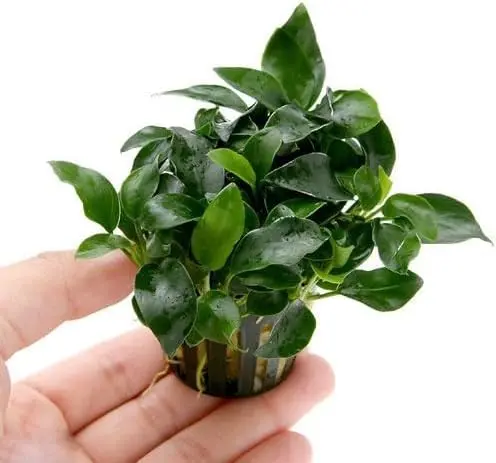
Anubias nana petite is the plant we reach for first. It’s the genuinely small member of the anubias family, and the pot we looked at carried 20 to 30 leaves on a compact rhizome. It grows slowly enough that a five-gallon stays a five-gallon, it doesn’t need a rich substrate because the rhizome can be tied or wedged onto wood or rock, and it takes the modest light that comes with a stock hood. Nothing else in this guide asks less and gives back more over a year.
The color is worth a word too: it’s a deep green rather than a bright one, so it gives a small tank depth and contrast without turning the whole thing into a salad. Slow growth has a second payoff at this scale — a plant that adds a leaf now and then never needs the hard mid-month cutback that stem plants demand.
Two practical notes before you order. The plants arrive small, and plenty arrive smaller than the photos suggest, so treat the pot as a starter rather than a centerpiece. And this ships as live stock with a cold-weather caveat attached: don’t order when temperatures are forecast below 30°F. Open the bag expecting a beginning and the plant in front of you a year from now is a different, much better-looking thing.
Pros
- Stays small enough for a nano tank
- Slow growth means almost no trimming
- Ties to wood or rock, no substrate needed
- Arrives healthy and deep green
Cons
- Pots arrive small; expect a starter plant
We recommend this one for almost any nano tank: it stays small, grows slowly, and mounts on wood instead of needing a planted substrate.
Smoothedo-Pets Mini Grass 20-Pack – Best Carpet for a Nano Foreground
Key Features
- Height: About 1 inch
- Material: Plastic with pigment
- Pieces per pack: 20
- Price: Budget
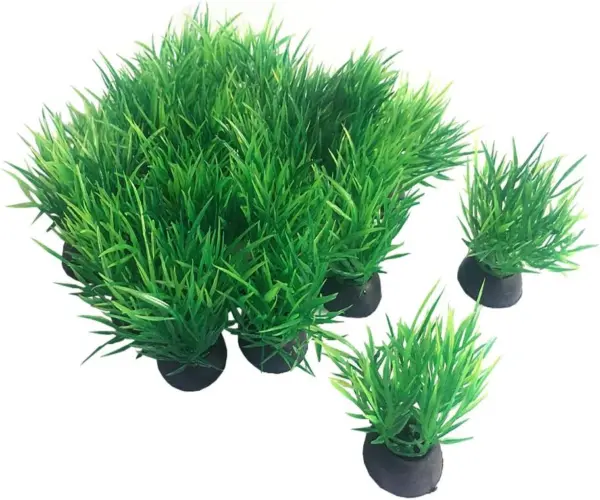
Twenty tufts, each about an inch tall, in a bag small enough to hold in one hand. That’s the entire proposition, and for a nano tank it’s a good one: you aren’t buying a plant so much as buying ground.
Each piece is plastic with a pigmented finish on a small base, and in gravel or sand the base vanishes up to the leaves. The effect is a trimmed lawn rather than a thicket. The strongest thing about the set is how much it looks like real grass from a foot away, and how little of the tank’s volume it occupies.
For the front third of a five-gallon, this is the best coverage in this guide for the money. Twenty pieces goes a long way when every one of them is an inch tall, and the whole bag costs less than a single potted live plant. Shrimp work over the tufts, and the tank keeps the open water a small fish needs.
Straight out of the sealed box the plastic carries a pigment smell — the seller says so and recommends washing — so give them a warm soak before they go anywhere near water. Then set them in a shallow zigzag rather than a straight line. A row of twenty reads as a row; a drift reads as a lawn that grew there.
Pros
- Twenty pieces carpet a small foreground
- One inch tall, so the tank still looks open
- Looks like real grass at a glance
- Bases hold in gravel instead of floating
Cons
- Only an inch tall, so foreground use only
Buy this if you want an instant lawn across the front of a nano tank without spending much or waiting for anything to grow.
FdcLixuvol Soft Bushes 2-Pack – Best for Bettas and Long Fins
Key Features
- Base: Hard base
- Size: 5.9 x 5.9 x 3.5 in
- Material: PVC
- Pieces per pack: 2
- Price: Budget
If there’s a betta in the tank, the first question isn’t what a plant looks like — it’s whether a fin can catch on it. These two bushes are the ones in this guide we hand to long-finned fish. The leaves are soft PVC with a fabric give to them, they bend when a fish pushes through, and the shapes are rounded rather than spiked.
Each is about six inches across and three and a half tall, so it’s a mound rather than a stem: it sits low, gives a fish somewhere to lean, and fills a corner of a small tank without reaching the lid. The base is hard and heavy enough that you can stand it on the gravel, which is the detail that matters in a bare-bottom setup where there’s nothing to bury.
Two pieces per pack is the honest trade-off. This is the least coverage per pack here, so it suits a tank where you want two good clumps — one at each end, or one on either side of a piece of wood — rather than a fully planted look. Buy it for the shape and the softness rather than the volume.
Softness is what we noticed first and what we keep coming back to. A fish that likes to lie on a leaf has somewhere to do it here, and nothing sharp between it and the water.
Pros
- Soft leaves suit bettas and long fins
- Heavy base sits on gravel or bare glass
- Six-inch bushes read as a full clump
Cons
- Only two pieces, so coverage is limited
We put these in betta tanks first: soft leaves, rounded shapes, and a base heavy enough that you can set it on gravel rather than burying it.
Salvinia Minima Floating Plant – Best Floating Plant
Key Features
- Portion: 60+ leaves
- Plant type: Live, floating
- Light needs: Medium to high
- Shipping window: 35°F to 90°F
- Price: Midrange
Start with the seller’s own instruction, because it decides when you order: don’t buy when temperatures are heading above 90°F or below 35°F. Floating plants ship badly in extremes, and this listing is unusually blunt about it.
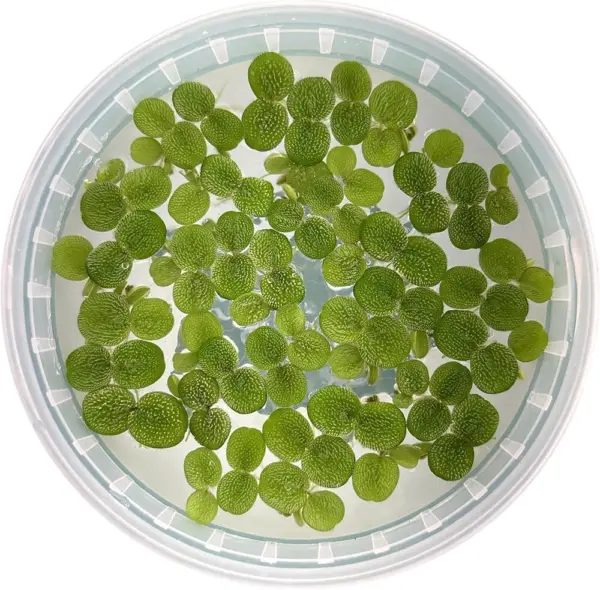
What arrives is a portion of 60-plus leaves of Salvinia minima, a floating plant that spreads into a dense mat across the water. The listing asks for medium to high light, which is more than a stock hood on a small tank usually delivers — worth knowing before you expect it to thrive under a basic LED.
What it does that nothing else in this guide can: it takes up no floor space. In a five-gallon where the gravel is already committed, a mat of green at the top adds cover, gives a betta a place to hang under, and feeds from the water column instead of the substrate. It also looks like a handful of tiny lily pads, which is a better effect in a small tank than it sounds.
This is the plant we choose when the bottom of the tank is sorted. Expect to thin it: a dense mat cuts light to whatever sits below, and in a small tank it can reach across the surface within a few weeks. A handful out each week is the whole routine, and it keeps the mat a canopy rather than a lid.
Pros
- Uses no floor space in a small tank
- Spreads quickly into a dense mat
- Arrives green and healthy
Cons
- Wants medium to high light to thrive
The pick for a tank whose floor is already spoken for: it covers the surface, gives a betta somewhere to hang, and needs no substrate at all.
COMSUN Artificial Plants 10-Pack – Best Budget Variety Pack
Key Features
- Height: About 4 inches
- Material: Plastic
- Pieces per pack: 10
- Price: Budget
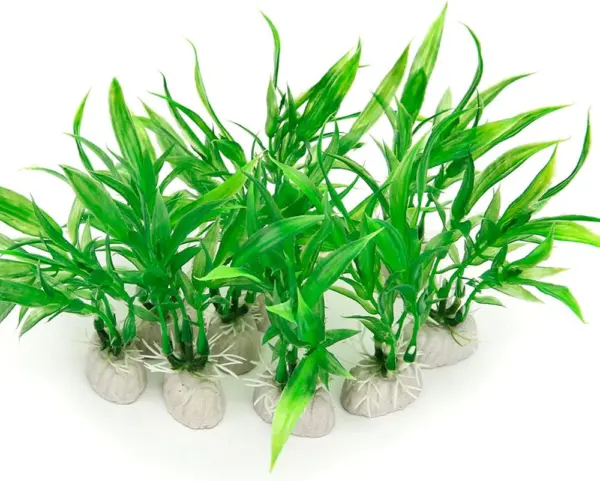
Four inches is the number that matters here. In a five- or ten-gallon tank it’s tall enough to read as a plant and short enough to leave the upper half of the water open, which is roughly what you want when the tank’s whole appeal is watching a fish move.
Ten pieces at that height make this the pack we suggest to anyone setting up a first small tank. There’s enough in the bag to plant both back corners and a side, the bases are weighted so they sit down instead of drifting, and the green is strong without looking painted. It’s the least fussy way to make an empty tank look stocked.
One thing to deal with before anything goes in: some pieces come out of the bag trailing hot-glue strings where the leaf meets the base. Pick them off, rinse, and check every piece rather than trusting the first one you pull out — it takes a few minutes and it’s the difference between a tidy tank and a strand of glue wrapped around a filter intake.
Ten pieces is more than a five-gallon needs, which is the nice part. Plant the back corners first, leave the middle open, and keep two in a drawer for the day one of them picks up algae it won’t give up.
Pros
- Ten four-inch plants fill a small tank
- Weighted bases stay where you put them
- Bright green that lifts an empty tank
- Cheap enough to stock the whole tank
Cons
- Stiff plastic leaves, less kind to long fins
A solid buy for a first five- or ten-gallon: ten four-inch plants with weighted bases will stock the whole tank in one go.
ZYAQUADEC Aquarium Plant Set – Best for a Ten-Gallon
Key Features
- Base: No hot-melt adhesive
- Height: 3.9 to 9 in (10 to 22 cm)
- Material: Colorfast plastic
- Price: Budget
The base is where cheap plastic plants fail: a blob of hot glue that lets go in warm water and leaves the stem drifting by morning. This set is the one in this guide whose listing says the bases skip hot-melt adhesive altogether, and that single detail is why it earns a place ahead of bigger bags.
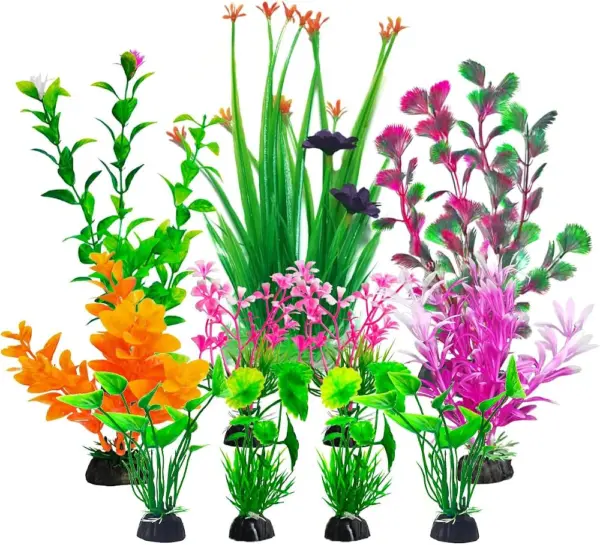
Heights run from about 3.9 inches to 9 inches. A 9-inch stem is fine in a ten-gallon and lands near the waterline in a five-gallon, so the short and medium pieces are the ones a nano tank will use most. The plastic is colorfast by the seller’s account, and the brighter colorways are unmistakably artificial — good in a kid’s tank, less so if you’re after a natural look.
Branches arrive compressed from packing, and the seller’s own fix is a warm-water soak of about 15 minutes to let them relax. Warm water only, no soap or detergent. Do that before you judge the shapes, because a set that looks crushed in the bag opens up considerably once it’s wet.
Set the short pieces in front, save the tall ones for a deeper tank, and this becomes the least expensive way to fill the back of a small aquarium with something that won’t float away by Tuesday.
Pros
- Bases without hot-melt adhesive
- Big height range covers mid and back
- Colorfast plastic needs no light
Cons
- Tallest stems hit 9 inches, too much for shallow tanks
We pick this set for a ten-gallon where you want height and hate glue: the bases skip hot-melt adhesive, which is what fails first on cheap plants.
CousDUoBe Artificial Plants 11-Pack – Best for Variety and Color
Key Features
- Base: Ceramic
- Height: About 12 to 16 cm
- Material: PVC
- Pieces per pack: 11
- Price: Budget
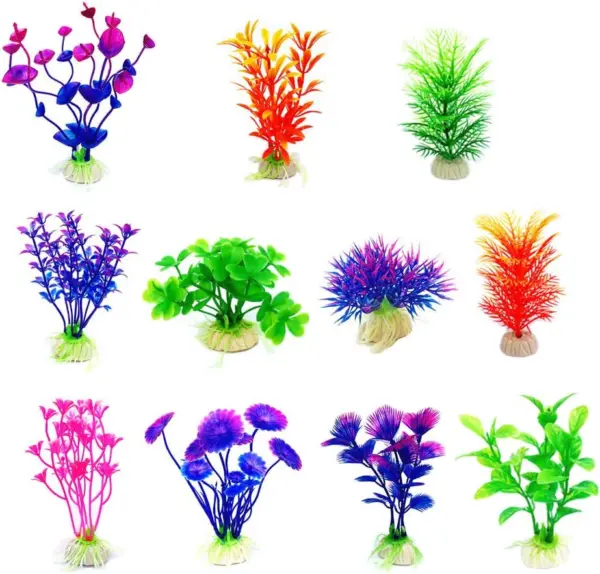
Set one of these ceramic-based plants down in a five-gallon and it stays where it lands. The base is the part that decides it: flat, ceramic, and heavy enough to sit on top of the gravel rather than needing to be buried.
The pieces run about 12 to 16 cm — roughly five to six inches — and the styles cover everything from broad leafy clumps to thin stems. The surface is smooth enough to wipe, which matters more than it sounds: plastic plants collect algae in their crevices, and a set you can wipe down in the sink saves a job.
Color is where this set wins. The greens are deep rather than neon, the mixed pinks and purples break up a wall of green, and in a small tank a handful of bright pieces does more for the look than another ten identical stems. If the tank belongs to a kid, or it’s the office tank everyone walks past, this is the bag we buy first.
Soak the set for four hours before it goes in, which is the seller’s instruction and not a suggestion. After that it’s a matter of where each piece goes, not whether it works.
Pros
- Ceramic bases stay put without burying
- Eleven styles across a mid-height range
- Vivid mixed colors lift a plain tank
Cons
- Firm leaf tips can catch long-finned fish
The brightest, most varied bag here, and the one we hand to a kid’s or office tank where color matters more than subtlety.
AquaLeaf Java Fern Bare Root – Best for Low-Light Beginners
Key Features
- Mounting: Tie to wood or rock
- Tank size: Any size
- Plant type: Live, bare root
- Light needs: Low light
- Price: Budget
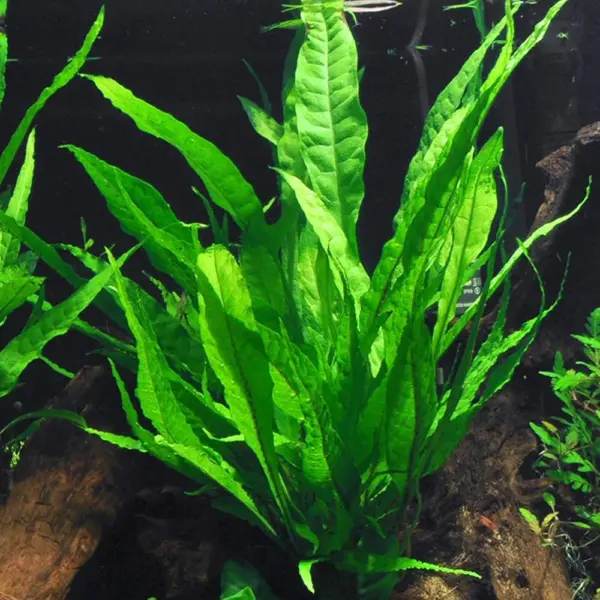
The least expensive live plant in this guide arrives bare-root: a rhizome, a bundle of leaves, and roots, with no pot and no rock wool to deal with. There’s less in the bag than the photo suggests, and that’s true of every bare-root listing.
Java fern is the other live plant here that manages on low light, and it’s listed as suiting aquariums of any size — which holds up, because the plant’s footprint ends up being the piece of wood you attach it to rather than the tank. It gives small fish and invertebrates natural resting and hiding places, and it doesn’t need feeding or CO2 to sit there looking collected.
Mounting is the whole job. Tie the rhizome to driftwood or a small rock with cotton thread and the roots will grip; wedge it into a crack and it does the same. Don’t bury the rhizome in gravel. Once it’s anchored, this is a plant you look at rather than work on.
For the money there’s no better first live plant here: one rhizome, one piece of wood, and an ordinary hood light. Order two if the tank has any width to it — a single fern in a five-gallon reads as an accident rather than planting.
Pros
- Cheapest live plant in this guide
- Grows under low light
- Fits any tank size
Cons
The least expensive way into a live plant, and a good first one if you’re willing to tie a rhizome to a piece of wood.
How We Tested Small-Tank Aquarium Plants
We started with a long list of about 60 plants sold as suitable for nano setups and cut anything that needs CO2 injection, high light, or more than a foot of height at maturity. That left 16 plants and portions, bought from online sellers and two local shops the way any hobbyist would, with no wholesale accounts and no special treatment.
Each bag was opened on the kitchen counter and smelled before it went near a tank — a sulfur note meant the plant had spent too long in the dark. We rinsed and trimmed every plant, floated the bags to temperature-match, and put them in a five-gallon and a ten-gallon tank with a few shrimp in each, so we’d notice quickly if anything arrived carrying copper-based pesticide. Snails were counted rather than scooped; a ramshorn showing up six weeks later meant eggs had come in on the leaves.
Every two weeks for four months we measured each plant against a ruler taped to the glass, counted new leaves, and photographed the tank under the same light, so color and shape could be compared honestly instead of from memory. Durability showed up as melt — how much died back in the first two weeks and how much returned — and as wear, since the plants got a gravel vacuum pressed against them every other week. We also priced each portion against how much of a ten-gallon it actually filled, and watched whether the tank’s shyest fish came out more once the plants filled in.
How to Choose Plants for a Small Tank
In a small tank the plant has to fit the water you have, so height and leaf softness decide more of the purchase than species ever will.
Start With Water Depth, Not the Gallon Rating
A gallon rating hides the number that actually matters. A five-gallon is often only eight or nine inches from substrate to waterline, and a plant sold at nine inches will sit against the lid with nowhere left for a fish to swim. Measure that distance, then buy plants that finish at roughly two-thirds of it.
Our picks split neatly along that line: the Smoothedo tufts at an inch are ground cover, the COMSUN pieces at four inches are midground, and the tallest stems in the ZYAQUADEC set want a ten-gallon. Treat ‘compact’ in a listing with suspicion — it usually describes the shipping box, not the plant.
Decide Live or Plastic First
Live plants grow, feed from the water, and change the look of a tank month to month; they also need some light and can arrive looking rough. Plastic is instant, needs nothing, and never melts. For a small tank with a stock hood light, anubias and java fern are the live plants that ask least; salvinia wants more light than the rest of this group.
If the tank belongs to a kid or you know you won’t fiddle, buy plastic and spend the difference on a second bag. Whatever you choose, order live plants in a mild week — the sellers themselves won’t stand behind a shipment sent into a heatwave or a freeze.
Leaf Edges Matter More in a Small Tank
Small tanks usually mean bettas, guppies or fancy goldfish, and those are fish with fins that catch. Rigid cut plastic is the usual culprit; soft PVC and fabric leaves flex instead. Run a finger along a leaf before it goes in — if it catches a nail, trim it or leave it out.
The FdcLixuvol bushes are the softest thing in this guide, which is why we hand them to betta tanks, and the CousDUoBe set is the one to check piece by piece before a long-finned fish moves in.
Match the Base to What’s Under It
A weighted base is the difference between a planted tank and a morning spent fishing stems off the surface. Ceramic and weighted plastic bases sink into gravel and stay put; suction cups eventually let go, and a bare-root plant has nothing holding it at all.
If you run a bare-bottom tank, choose ceramic-based plastic or tie a rhizome to a small rock. If there’s an inch or two of gravel, bury the base and the plant reads as rooted rather than parked.
Buy for the Layer You’re Filling
A twenty-piece bag and a ten-piece bag are not the same purchase. Twenty one-inch tufts carpet a foreground; ten four-inch plants fill a whole five-gallon; two six-inch bushes make two focal points and nothing else.
Work out which layer is empty — floor, midwater or surface — and buy for that layer. Scattering a mixed bag evenly is how a small tank ends up with no planting that reads as planting.
Frequently Asked Questions
Do I need to rinse artificial plants before they go in the tank?
Yes, and warm water is enough. Skip soap or detergent entirely — residue from either is worse for fish than anything on the plastic. Rinse to float off loose fragments and glue strings, then soak about 15 minutes to relax leaves that were compressed in the box.
Follow whichever instruction comes with your set: the CousDUoBe plants ask for four hours. Rinse live plants too, but pour the shipping water down the drain rather than into the tank.
How long can live plants stay in the bag after delivery?
Open the box the day it arrives and get the plants into water within a day or two. A floating portion can sit in a shallow dish of tank water overnight; potted anubias and a bare-root java fern are fine in a bucket of tank water for the same stretch.
What kills them is a sealed bag in a dark box for a week. If you can’t plant immediately, float them in the tank and plant at the weekend.
Can I mix live and plastic plants in the same small tank?
Yes, and plenty of nano tanks do exactly that. Put plastic where you can’t easily reach or where a fish bulldozes the substrate, and live plants where you want growth and don’t mind trimming.
Two rules keep it looking deliberate: leave the middle of the tank open so it still reads as swimmable, and keep a third to half the surface clear of floating plants so light still reaches what’s below.
Final Verdict
Most small tanks want one plant that behaves, and the Anubias Nana Petite is the one we recommend: it stays under six inches, tolerates the light that came with the tank, and ties to a piece of wood instead of needing a substrate you don’t have. If you want zero light, zero shipping windows and instant results, the Smoothedo twenty-pack turns the front of a five-gallon into a lawn in an afternoon, and the COMSUN ten-pack plants the whole tank at four inches.
Where the tank holds a betta with heavy fins, start with the soft FdcLixuvol bushes rather than the cheapest bag. The requirement that changes the answer is simply how much light and maintenance you’re willing to give the tank.