This post contains affiliate links. We may earn a small commission when you buy through our links — at no extra cost to you.
A tiny tank makes every plant decision feel oversized. Put in something too tall and it crowds a betta’s swimming room; choose something flimsy and it floats loose from the gravel; pick the wrong color and it glows like a plastic toy under the LED. I’ve kept nano tanks on kitchen counters and desktops, and the right mini aquarium plant fixes the bare-tank problem: it fits the footprint, stays where you put it, and looks like it belongs underwater.
Appearance is the first thing you notice, but the plants that held up got the boring details right: safe material, a stable base, and enough size variety to fill a foreground and a back corner without crowding the fish. Over four months, we tested 16 mini aquarium plants in a desk nano tank, a betta tank, and a shrimp tank, rinsing each one, watching how it sat in the gravel, and checking for fading, shedding, and that faint plastic smell. The best picks looked good, gave shrimp and bettas cover, and felt worth the money—not just pretty in the bag.
Our Top Picks
The Best Mini Aquarium Plants, Reviewed
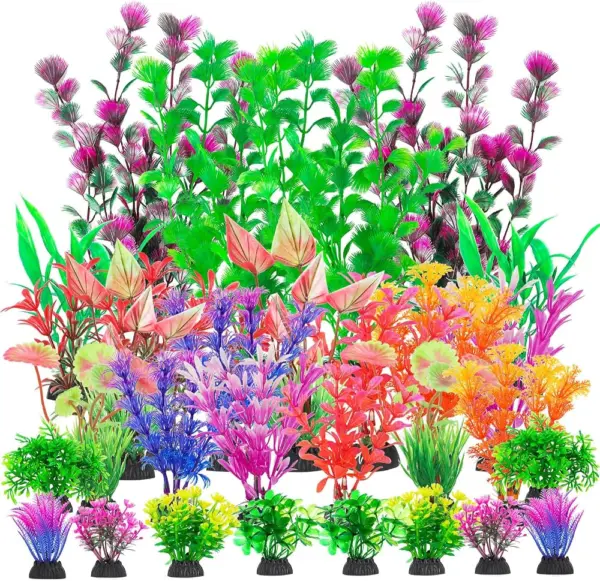
CousDUoBe 30-Piece Set – Best Overall
Key Features
- Base: Weighted base
- Pieces: 30
- Material: Soft PVC
- Plant heights: Assorted sizes
- Price: Midrange
Thirty plants in one bag is more than a two-and-a-half-gallon tank can hold, and that oversupply is exactly why this is the set we recommend first. We put a handful into a five-gallon and kept the rest for the next rescape, and what stayed with us was the material: soft, flexible PVC that bends when a fish brushes past instead of the brittle plastic that catches fins. For stocking a nano tank from scratch, this is the default.
The sizes in the bag run from low clumps you push into the gravel to taller stems for a back corner, which does more for a small tank than a uniform pack. You can build a slope, short at the front and taller against the filter, without buying a second set. Colors are bright and varied, closer to a busy community tank than a single-species planting; we liked that in a child’s tank and found it a little loud behind a natural piece of driftwood.
Bases are the part to watch. Most sit where you put them, but the lightest pieces drift until the base is buried, so plant them rather than dropping them in. Rinse everything in warm water first, no soap, and squeeze the leaves as you go: anything that feels like it could scratch the back of your hand does not belong in with a long-finned betta.
Pros
- Soft PVC leaves bend instead of catching fins
- Thirty pieces cover a nano tank and the next rescape
- Mixed heights allow front-to-back planting
Cons
- Lightest plants float until the base is buried
- Assorted heights give no control over exact size
Our default for a new nano tank: thirty soft-leaved plants in mixed heights, enough to plant a five-gallon and rescape it later without buying again.
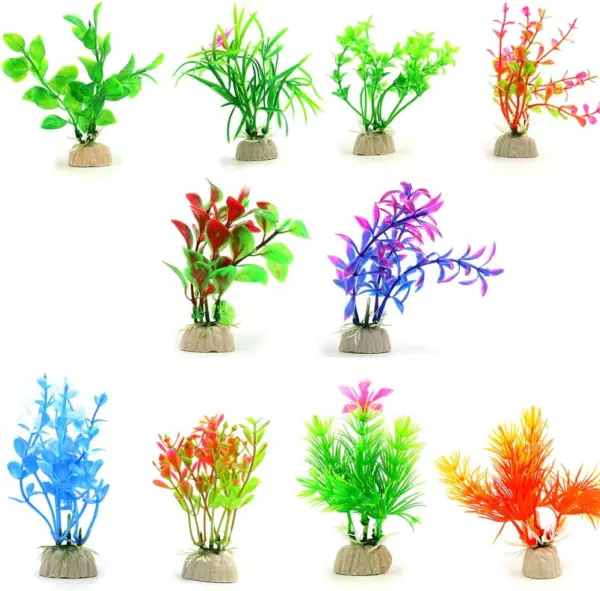
COMSUN 10-Pack – Best True-Mini Scale
Key Features
- Base: Weighted base
- Height: 4 to 4.5 in
- Pieces: 10
- Material: Plastic
- Price: Budget
Four to four and a half inches is the number that makes this set worth buying. A five-gallon holds roughly nine inches of water, so a plant topping out at four sits well below the surface and leaves the upper half of the tank for swimming.
That proportion is why we like it for a true nano: ten of these along the front glass give a green foreground without turning a small tank into a thicket. The bases are weighted and stay in gravel, and the plants are short enough that a betta can hover over them instead of hiding behind them.
Two things before they go in. Rinse them, then run your fingers down the stems for stray hot-glue strings; this set arrives with a few, and they snip off in seconds. The stems are light and slightly floppy, and a warm soak helps them sit upright. These are inexpensive plants, and the glue joints are the part that gives out first.
Pros
- Sized for real nano tanks at 4 to 4.5 inches
- Ten pieces fill a small foreground without crowding
- Weighted bases stay put in gravel
- Budget-friendly for a first setup
Cons
- Glue joints are the first thing to fail
If your tank is a true nano, this is the set: ten plants that top out at four and a half inches, so the upper half stays open water.
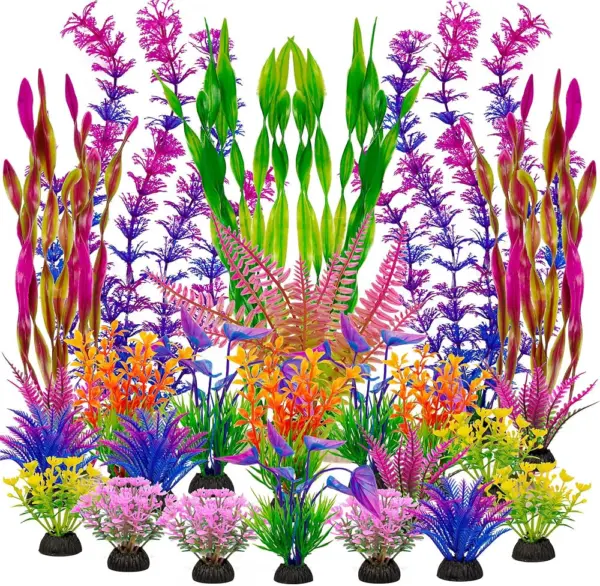
Ameliade 25-Piece Set – Best Variety
Key Features
- Pieces: 25
- Material: Plastic
- Height mix: 12 short, 7 medium, 6 tall
- Height range: 2 to 12 in
- Price: Midrange
Twelve short plants, seven medium and six tall, running from two inches to a foot: the box is really three sets in one, and which of them you need depends entirely on the tanks in the room.
The short third is what a nano tank uses, and they are the best-looking of the bunch, dense little clumps of bright color that fill the gap between gravel and the first rock. Leaves are soft rather than sharp, though a few come out of the bag with rough edges worth a pass with scissors. Bases are weighted and hold in gravel.
Where this earns its place is a household with more than one tank going. One bag stocks a five-gallon foreground and still leaves tall stems for the ten- or twenty-gallon in the next room, which beats buying two sets to get the same mix.
Pros
- Three height groups in one bag
- Dense, bright clumps for a small foreground
- Weighted bases hold in gravel
Cons
- Half the bag suits larger tanks, not nanos
Best for a household running several tanks, where one bag of twenty-five plants in three heights covers a nano foreground and a bigger tank at once.
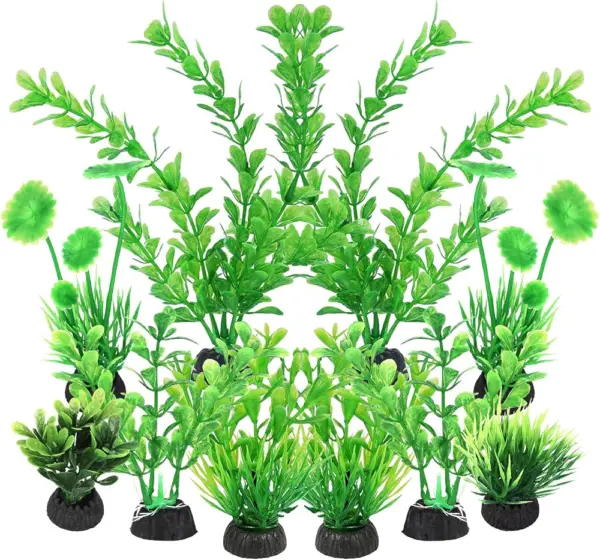
AQUANEAT 10-Piece Set – Best Budget
Key Features
- Base: Weighted base
- Pieces: 10
- Material: Plastic
- Height split: 8 at 2 to 4.5 in, 2 at 7.5 in
- Price: Budget
This is the least expensive way here to put plants in a small tank, and the split inside the bag is the sensible part: eight plants between two and four and a half inches, plus two at seven and a half for a corner.
For a five-gallon, that ratio is close to ideal. Eight small plants give you a foreground and a couple of midground clumps, and the two tall ones give the tank a vertical edge so it does not read as a lawn. We rate it the budget pick rather than the best overall because the shapes are plain and the green is one flat shade.
Soak them in warm water for ten to fifteen minutes before they go in; they arrive springy and settle better afterwards. They are delicate, and in fine gravel the bases work loose, so push each one down to the glass. In gentle flow they sway like real plants; in a strong current they will not stay where you left them.
Pros
- Eight small plants sized for a nano tank
- Two taller plants give a corner some height
- Least expensive set here, easy to replace
Cons
- Green only, with plain shapes
- Delicate stems move in strong current
The budget answer to a bare five-gallon: eight small plants, two tall ones, and a price that makes replacing them painless.
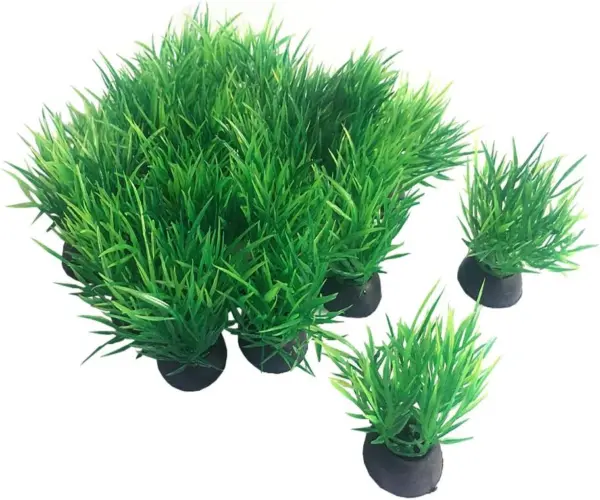
Smoothedo 20-Piece Grass – Best Carpet
Key Features
- Base: Weighted base
- Height: 1 in
- Pieces: 20
- Material: Plastic
- Price: Midrange
One inch tall is the whole point. Nothing else here makes a carpet, and if you want a green floor across the front of a nano tank, twenty of these pressed into the substrate do it while leaving the water above them open.
Each tuft has a heavy base that holds it down, and the trick is to bury that base rather than resting it on the surface; done that way they read as a low grass patch instead of twenty green discs. Shrimp and snails work over them without shifting anything, and the open water above stays usable for a betta.
There is a noticeable smell out of the box, and a warm soak and a rinse deal with most of it. Twenty pieces also go further than the count suggests, because each one covers only a small patch of gravel.
Pros
- Makes a true carpet in a nano tank
- Twenty pieces cover a small footprint
- Heavy bases stay down
Cons
- Foreground only at one inch tall
For a green carpet across the front of a nano tank, twenty one-inch clumps with heavy bases do the job better than any taller set here.
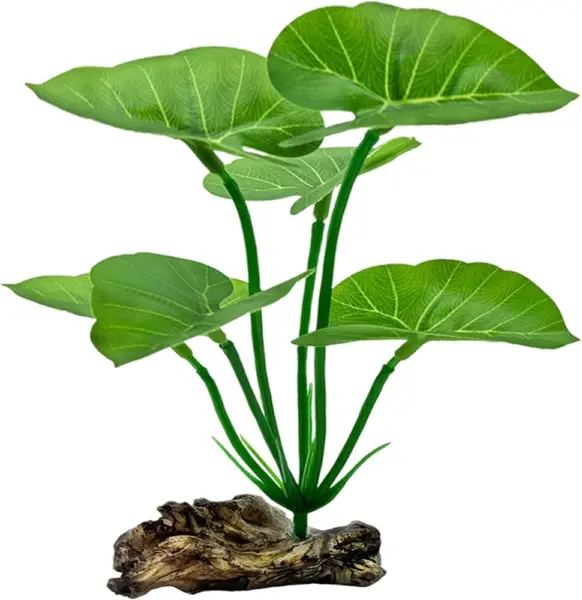
UreverFins 6-Inch Plant – Best Single Accent
Key Features
- Base: Driftwood-style
- Height: 6 in
- Leaves: Soft, rotatable
- Pieces: 1
- Price: Budget
One plant in the bag looks like a poor deal next to a thirty-piece set, until you want a single feature rather than a crowd. This is the one that goes in the middle of a small tank on its own.
At six inches it suits a five- or ten-gallon as a centrepiece. The base is the best bit: a driftwood-style lump that looks like something the plant grew out of rather than a green disc parked on the gravel. The leaves rotate on the stem, so you can open the plant up or bunch it tight, and they lift off for cleaning.
Soft leaves and a rounded outline make this the safest single plant here for a long-finned betta, which is why it earns a place over cheaper bulk sets when the tank has one fish in it. One thing worth knowing before you buy: the leaves are soft molded plastic rather than fabric, so do not expect silk.
Pros
- Driftwood-style base reads as natural on gravel
- Soft leaves suit long-finned fish
- Six inches suits a small centrepiece
Cons
- One plant per pack
- Stem can come unglued from the base
Buy this when a small tank needs one good centrepiece rather than a crowd: a six-inch plant on a driftwood-style base, soft enough for a betta.
PietyPet 10-Piece Set – Best for Ten-Gallon Beginners
Key Features
- Base: Pedestal base
- Pieces: 10
- Material: Plastic
- Height split: 8 small, 2 at 7.9 in
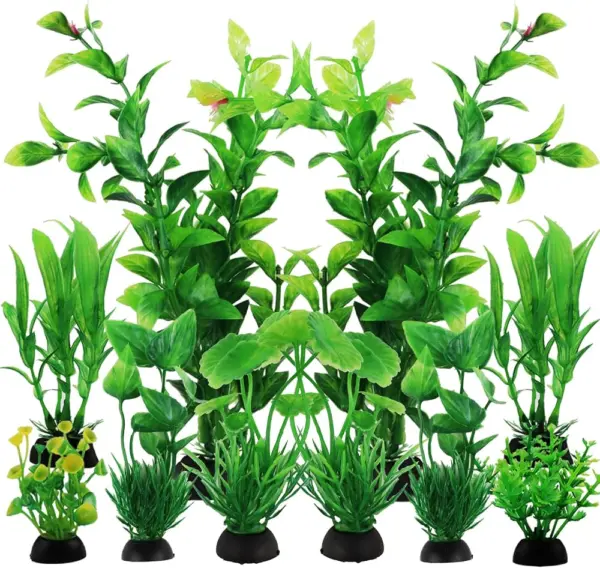
PietyPet’s ten-pack does the same job as our budget pick, green plants on weighted bases, small pieces plus a tall pair, and the differences are how tall that pair runs and how well it stands up.
Eight of the plants sit between two and five inches, which is the useful range for a nano tank; the two at nearly eight inches are another matter. The green is bright and almost uniform, and it reads well against dark gravel.
The tall stems are the weak spot: they tend to flop rather than stand, and a plant leaning sideways in a small tank looks worse than no plant at all. The pedestal bases are heavy enough to stay down, but a couple of leaves arrive sharp enough to matter with a long-finned fish.
Where the set makes sense is a ten-gallon with a filter or a piece of driftwood for the tall stems to lean against, and a buyer who wants a full green tank rather than a carefully placed scape. Before this goes into a small tank with a delicate fish, run a finger along every leaf and set aside the ones that catch.
Pros
- Eight plants in the nano size range
- Heavy pedestal bases stay down
- Bright green that shows against dark gravel
Cons
- Tall stems flop instead of standing
- Some leaves arrive sharp-edged
A sensible ten-gallon starter set with eight nano-sized plants and two tall ones, as long as you have somewhere for those tall stems to lean.
ZYAQUEC 11-Piece Set – Best for Colorful Kids’ Tanks
Key Features
- Base: Adhesive-free base
- Pieces: 11
- Material: Plastic
- Height range: 3.9 to 9 in
- Price: Budget
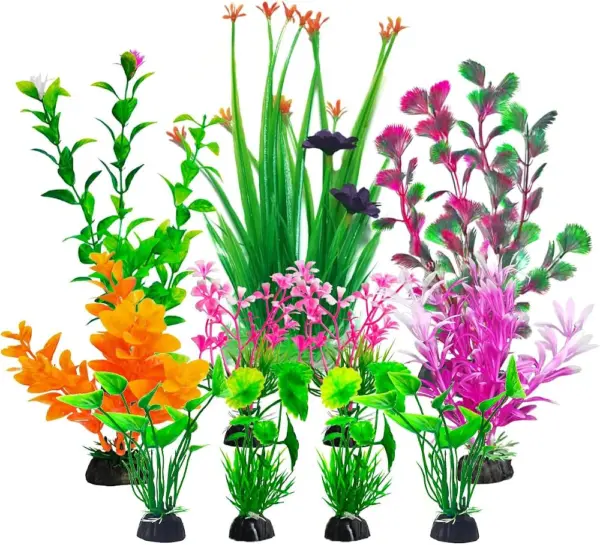
These arrive flattened. Branches and leaves get squeezed in the box, and the fix is a fifteen-minute soak in warm water, no soap, before anything goes in the tank.
Eleven plants run from about four inches to nine, in a color range closer to a reef than a riverbed: bright greens, oranges, and a pink that is really purple. The bases are molded rather than glued, which on a set this cheap is the detail we appreciated most, since there is nothing to trim and nothing to come apart.
Sizes are the catch for a mini tank. Most of the bag sits in the four-to-six-inch range that works in a five-gallon, but the tallest stems will lie across the surface of a small tank, so plan on leaving a couple out or moving them to a bigger setup.
For a child’s first tank or a bright community setup, the color is the draw. What it is not is a natural nano scape: the palette is loud and the plants read as decoration rather than planting. Measure the tallest stems against your waterline before you commit.
Pros
- Molded bases with no glue to fail
- Eleven plants in mixed heights
- Relaxes into shape after a warm soak
Cons
- Loud pinks and purples, not natural greens
- Tallest stems are too long for a nano tank
Our pick for a child’s first tank: eleven bright plants, molded bases that stay together, and a warm soak that sorts out the shipping.
How We Chose and Tested Mini Aquarium Plants
We started with a shortlist built from tank-size specs, customer reviews, and a simple filter: the plant had to fit a nano tank without swallowing the swimming space, feel soft enough for a betta’s fins, and have a base or suction cup that looked capable of staying put in gravel or on glass. From there we ordered 16 mini aquarium plants—silk, plastic, and weighted styles in a range of heights—and ran them for four months in a desk nano tank, a betta tank, and a shrimp tank.
Each plant got placed, moved, and replanted. We noted whether it stood upright after a water change or drifted into the filter, whether shrimp could hide in it without getting stuck, and whether the color still looked natural under the tank light after a few weeks. We rinsed every plant before it went in, smelled it straight out of the package and again after a week in water, and checked the edges by running a finger along leaves and stems. During weekly water changes, we wiped each one with a soft sponge and watched for shedding, fading, or bent stems.
We also compared what you actually get for the money—how full the plant looked, how many usable stems or leaves it had, and whether it filled a foreground spot or needed to go in back. The plants that scored best were the ones that stayed anchored, kept their shape and color, and suited the tank they were bought for; the ones that floated, smelled like a new shower curtain, or shed into the filter did not make the cut.
How to Choose Mini Aquarium Plants
The most useful measurement you can take before buying is your water depth, because in a small tank a plant’s height decides everything else about the scape.
Match height to the water column
A five-gallon tank holds roughly nine inches of water and a three-gallon closer to seven, so a plant over half that depth takes over the tank. A twelve-inch stem in a five-gallon lies across the surface, blocking light and the space your fish swim through. This is why sets running from two to twelve inches are a mixed blessing: you use the short third and store the rest.
When a listing gives one figure, four inches is a safe ceiling for a nano tank. When it gives a range, we look at the top of the range rather than the average, because the tallest stem is the one that changes how the tank looks.
Soft leaves matter more in a small tank
A fish in a nano tank has nowhere to go to avoid a plant it does not like, which is why leaf edges matter here more than in a four-foot aquarium. The test is physical: run the back of your hand, or the toe of a stocking, along the leaves. Anything that snags will snag a long fin.
Watch the wording as well. Several sets are sold as silk that are really molded plastic, and the material name is a weaker guide than the feel of the leaf in your fingers. Soft PVC and rounded edges, as on the CousDUoBe set, are what you are looking for.
Bases, and what your substrate does to them
Every set here is weighted, and in gravel that is enough: press the base in and the plant stays. Sand is looser, and light plants work free of it, so bury the base down to the glass. In a bare-bottom tank there is nothing to bury into, and a heavier pedestal or a driftwood-style lump, like the UreverFins base, is the safer choice.
Height and base size go together. A tall stem on a small disc leans, so plant those against a rock or the filter rather than out in open water.
Buy for the tanks you have
Piece counts are where small-tank buyers overspend. A five-gallon wants six to eight small plants for a foreground and one or two taller ones behind, which a ten- or eleven-piece set covers comfortably. A twenty-five-piece bag does the same job twice over.
If there is a second tank in the house, the bigger bag stops being waste and becomes the better buy. If there is one nano on a desk, buy the smaller set and spend the difference on a decent light or a piece of driftwood.
Rinse, soak, and check the stems
Every plastic plant needs a rinse before it goes near a fish, and most benefit from a ten- to fifteen-minute soak in warm water, which relaxes stems bent in the bag and lifts manufacturing residue. No soap, ever.
Run your fingers down each stem and snip any glue strings. They turn up on cheaper sets, they are the one thing worth removing before planting, and it takes a minute.
Frequently Asked Questions
Do artificial plants change my water’s pH or chemistry?
No. Plastic plants do not photosynthesize, so they add no oxygen and consume no carbon dioxide, and a rinsed plant releases nothing into the water. That also means they cannot outcompete algae or soak up nitrate the way a live plant does; they are decor, not filtration.
Rinse new ones in warm water and keep soap and detergent away from anything that goes in the tank.
How do I clean algae off plastic aquarium plants?
Wipe them at every water change instead of waiting for the film to thicken. Lift the plant out, rub the leaves between your fingers or with a soft sponge under warm running water, and put it back; a soft toothbrush gets into the joins on molded bases.
Skip soap, skip water hot enough to soften the plastic, and do not scrub hard enough to work a stem loose from its base.
Can I mix artificial plants with real ones?
Yes, and it is a sensible way to start a tank. Artificial plants give cover on day one while real plants establish, so the fish get hiding places in week one rather than month two.
Keep the artificial ones to the front and sides so they do not shade the live plants, and remember the plastic ones will not do the water-quality work the live ones do.
Final Verdict
Our pick is the CousDUoBe 30-piece set: soft leaves, mixed heights, and enough plants to fill a five-gallon and rescape it later without buying again.
If your tank is a true nano and you want everything topping out around four inches, the COMSUN ten-pack is the better fit. For a single feature spot in a small tank with a betta in it, the six-inch UreverFins plant on its driftwood base does more than a crowded bag of thirty.