This post contains affiliate links. We may earn a small commission when you buy through our links — at no extra cost to you.
A reef tank can look perfect at 9 a.m. and be flirting with disaster by mid-afternoon in July. That’s when most of us start searching for a chiller—not because we want more gear, but because the water is climbing and the corals are telling us about it. A small chiller pulls that heat back down and holds it there, so your livestock isn’t riding a daily temperature roller coaster. The good ones do it without sounding like a window air conditioner or leaving a puddle under the stand. We’ve spent eight months running 10 small chillers in real home setups, and the differences in noise, footprint, and heatwave performance are not subtle.
I learned that a chiller rated for your tank volume isn’t automatically right—ambient room temperature, pump heat, and how long you run the lights all change the math. What I care about now is whether a unit holds a setpoint overnight, starts quietly after a power blink, and comes with instructions that don’t require a forum thread to decode. The picks below survived that scrutiny.
Our Top Picks
The Best Small Aquarium Chillers, Reviewed
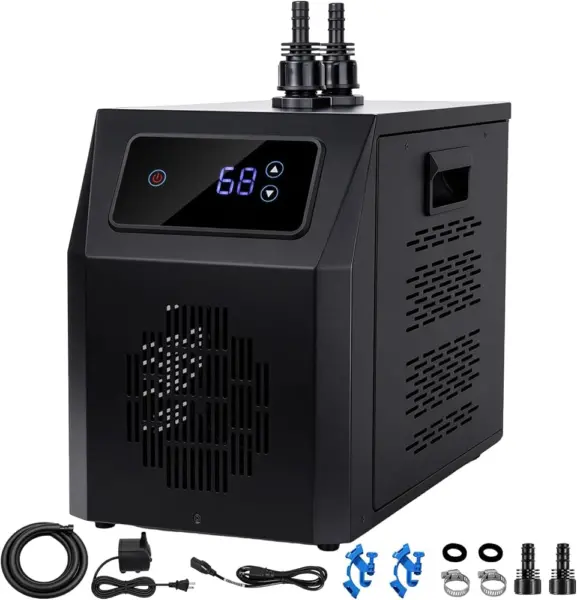
Fitnet 42-Gallon Chiller – Best Overall
Key Features
- Weight: 29.8 lb
- Tank size: 42 gal / 160 L
- Compressor: 1/10 HP
- Cooling coil: Titanium
- Price: Midrange
The gallon number on a chiller box is a ceiling, not a target. A 42-gallon rating means the unit can hold a tank that size at its set point in ordinary room conditions; it does not promise a fast pull-down, and it does not cover a 42-gallon tank with a glass lid in a sun-baked apartment. Keeping that distinction in mind is why the Fitnet came out ahead here — it is rated 42 gallons / 160 liters, and it is the one we kept coming back to for tanks in the 30-to-40-gallon range, where a small chiller is genuinely working for a living.
Inside, the case for it is a titanium heat exchanger and a digital touch panel. Titanium is what makes a chiller safe to run on saltwater and reef tanks, and it is the part you never want to see replaced. The panel takes about a minute to learn, and the cooling is the most convincing in this group: quick to pull a warm tank down, then steady, including tanks kept in rooms that heat up in the afternoon. That combination, at midrange money, is what makes it the default.
Our one complaint is the paperwork. The instructions are the weakest part of the package, so if you have never plumbed a chiller before, plan on ten minutes with a video rather than the manual — the F1 and F2 settings make sense once someone shows you. It is also the heaviest unit here at 29.8 pounds, so give it a shelf or the floor rather than a flimsy stand. Neither point is a reason to look elsewhere; they are the price of a compressor this size.
Pros
- Most convincing cooling in this group
- Titanium exchanger handles saltwater and reef tanks
- Touchscreen makes set points quick to change
Cons
- Heaviest unit in this group at 29.8 lb
For tanks up to about 40 gallons, this is the small chiller we point to first — the cooling here is the most convincing in the group, and the titanium exchanger takes saltwater without drama.
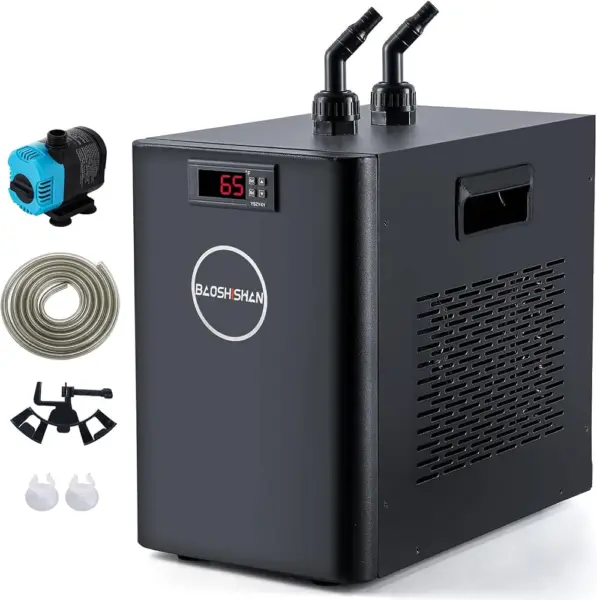
Baoshishan 42-Gallon Chiller – Best Complete Kit
Key Features
- Noise: 45-50 dB
- Weight: 28.7 lb
- Flow rate: 800 L/h
- Tank size: 42 gal
- Price: Upper midrange
What arrives in the box is the argument here. Alongside the chiller you get a stainless-shaft pump rated at 800 liters per hour, the hose, and clamps to hold the joints together — and that pump will lift water three meters, more head than most small chillers’ bundled pumps manage. If you have ever ordered a chiller and then spent a weekend hunting barb fittings that match, the completeness is worth real money.
The unit itself is a 1/10 HP compressor rated for 42 gallons, quoted at 8 to 10°F of pull-down and a working range of 68 to 78°F. Noise is listed at 45 to 50 dB a meter away, and that matches the impression it leaves: a low compressor hum with a fan underneath, the sound of a mini fridge one room over. The case is 13.4 by 7.9 by 11.8 inches, so it tucks beside a stand rather than demanding a corner of its own. Freshwater, saltwater and hydroponic setups are all in scope, and the stainless shaft is there to keep the pump from rusting from the inside.
Taken as a package, this is the one we point to when someone wants to order once and be done: chiller, pump, hose, clamps, all compatible on arrival. The manual is a step behind the hardware — it runs in Celsius and does not quite line up with the panel in front of you — so set your target from the display and treat the paper as a rough guide rather than instructions.
Pros
- Pump, hose and clamps in the box
- Three meters of pump lift
- Quiet 45-50 dB compressor
- Rated for fresh, salt and hydroponic water
Cons
- Bundled pump is the likeliest failure point
For a one-order, one-box install this is the chiller we recommend — the complete kit and three meters of lift make placement easy, and it is quiet enough for a living room.
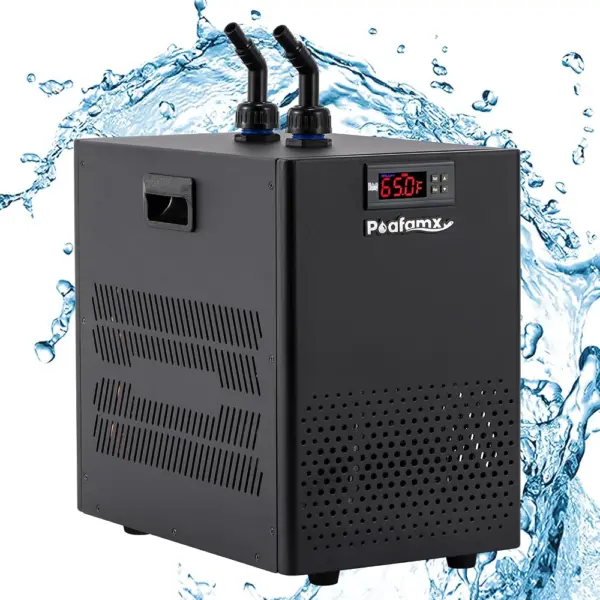
Poafamx 26-Gallon Chiller – Best for Nano Tanks
Key Features
- Weight: 22.1 lb
- Tank size: 26 gal
- Compressor: 1/13 HP
- Temperature range: 65-80°F
- Price: Midrange
Axolotl keepers are the reason this spec sheet exists, and it tells you exactly who it is for: 20 to 30 gallons, held between 65 and 80°F. Read that range carefully, because it is a design choice rather than a limitation of size — this is a chiller tuned to hold a small tank steady in a warm room, not one built to drag a tank down into the low sixties.
For a 20-to-30-gallon setup, that focus pays off. We appreciated the honesty of the rating — nobody here is claiming 100 gallons — and the rest of the package is tidy: a titanium evaporator that is fine in fresh or salt water, a one-year warranty, and a footprint of 13.4 by 7.9 by 11.8 inches at 22.1 pounds, which sits on a shelf without reinforcement. Setup is a short job, and the controls fall under the hand within a couple of days.
Two things to plan for. The front and side vents plus the twin rear fans mean it needs air behind and beside it, and the heat it lifts out of the tank ends up in the room, so a closed cabinet is the wrong home. And if your target is 62°F for a cold-water species, this is not the tool: the Fitnet in this guide holds lower, and paying for a chiller that stops at 65°F is an expensive way to learn that.
Pros
- Sized honestly for 20-30 gallon tanks
- Titanium evaporator for fresh or salt water
- One-year warranty and a 22.1 lb body
Cons
- Stated range stops at 65°F
The pick for a 20-to-30-gallon tank that needs to sit in the high sixties or seventies — small, warranted for a year, and rated honestly for the water you actually have.
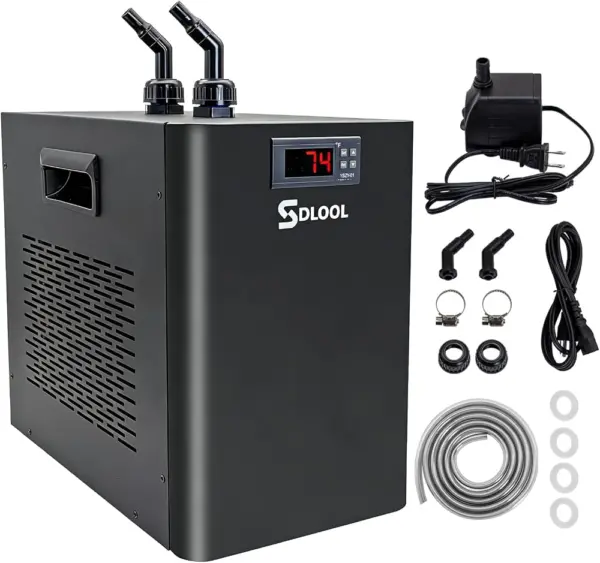
SDLOOL 42-Gallon Chiller – Best Budget
Key Features
- Noise: Under 40 dB
- Weight: 27.7 lb
- Tank size: 42 gal / 160 L
- Compressor: 1/10 HP
- Price: Budget
Cheapest in this group, and rated for the same 42 gallons as the rest of the 1/10 HP crowd. We liked that the money went into the working parts — an R134a compressor and a titanium tube — rather than into packaging and a polished manual. If the budget is the deciding factor and you are comfortable doing your own plumbing, this is the sensible place to land.
The numbers are the same shape as everything else here: 42 gallons / 160 liters, a quoted noise figure under 40 dB, and a case of 13.4 by 7.9 by 11.8 inches at 27.7 pounds. What you do not get is hand-holding. The setup assumes you know what a chiller loop should look like, so confirm what is in the box before you order and budget for a pump and hose if you do not already own them.
The other thing worth knowing is who buys these. The unit turns up in cold-plunge setups as often as in fish rooms, which tells you the thermostat is a general-purpose one rather than something built around a species’ needs. For a quarantine tank, a shrimp rack or a summer emergency, that is fine; for fine control at the low end, it is not what this is for.
Pros
- Lowest price in this group
- R134a compressor and titanium tube
- Under-40 dB noise rating
Cons
- Setup guidance assumes prior chiller experience
The budget route into a 42-gallon compressor chiller — worth it if you already know how to plumb a loop and want the lowest price in this group.
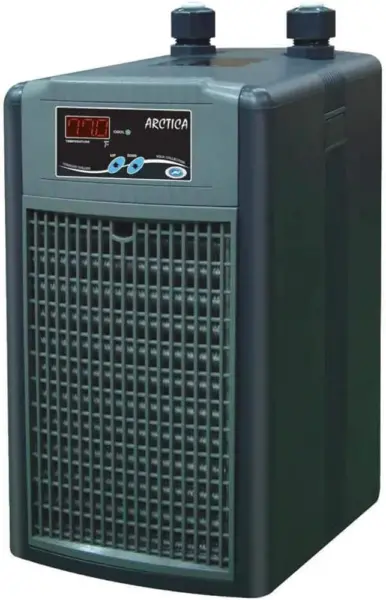
JBJ Arctica 1/15 HP – Best Premium Pick
Key Features
- Weight: 25 lb
- Warranty: 1 year limited
- Compressor: 1/15 HP
- Dimensions: 12 x 16 x 15 in
- Price: Premium
One-fifteenth of a horsepower is the smallest compressor in this group, and the Arctica is designed around that rather than apologising for it. In-line plumbing, titanium coils, and a 12 by 16 by 15 inch body — this is the chiller for a tank where 1/10 HP is more machine than the water needs, and where a bigger unit spends its day cycling on and off.
In use it does the one job it is asked to do, holding a small volume within a couple of degrees of the set point without much fuss. We were struck by how quiet it is: quiet enough that you cannot reliably tell from the next room whether the compressor is running, which is a compliment and also a warning. There is a failure mode worth knowing — the unit can carry on running while it stops chilling — so a separate thermometer in the tank is your real instrument, not the sound of the machine.
We hesitated over the price. It is the most expensive chiller here by a wide margin and it has the smallest compressor, so what you are paying for is the design, the footprint and a long-standing name rather than capacity. Order a spare fuse with it: they let go in a power surge, they are easy to swap, and getting the exact rating from the manufacturer beats guessing at a hardware store.
Pros
- Smallest compressor here for very small systems
- Quiet enough to sit beside a desk
- Titanium coils and in-line plumbing
Cons
- Most expensive chiller in this group
For a very small system where 1/10 HP is overkill, this is the premium answer — quiet, in-line and compact, with a price that only makes sense on a small tank.
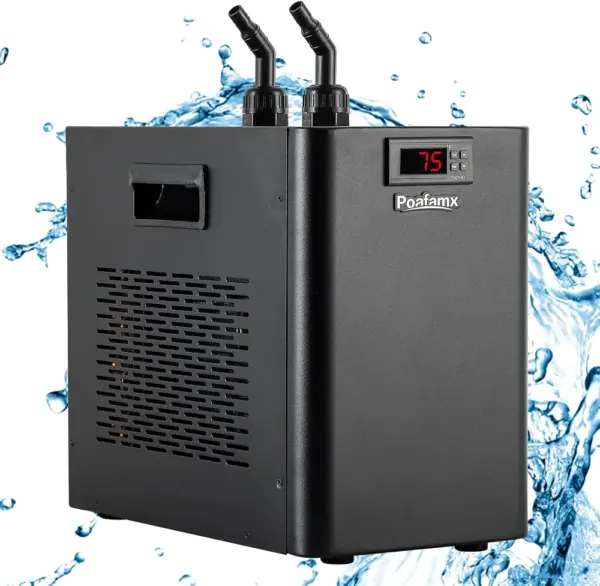
Poafamx 42-Gallon Chiller – Best for High-Flow Returns
Key Features
- Pump: 264 GPH
- Noise: Under 40 dB
- Weight: 27.5 lb
- Tank size: 42 gal / 160 L
- Price: Upper midrange
Two hundred sixty-four gallons per hour is the highest-flow pump in this group, and that is the reason to pick this Poafamx over the 26-gallon version. If your chiller sits in a sump loop or feeds a manifold, the extra volume gives you margin before flow drops off. What you do not get is much head — the rated maximum lift is 1.2 meters — so plan on keeping it near tank level rather than down in a basement.
The core is the familiar 1/10 HP, 42-gallon formula, and there is a lot to like in the way it is put together: a titanium evaporator, a quoted noise figure under 40 dB, a one-year warranty, and a case only 12.6 inches wide, which is the friendliest footprint here for a tight stand. Installation is a short job with no special tools, and the clamps and thickened wiring are the kind of small thing you notice only when they are missing.
Our reservation is the temperature side. This unit is happiest holding a tank in the sixties and seventies, and pulling a hot tank down is a slower job than the Fitnet makes of it — give it a ventilated spot, keep the room reasonable, and let it work rather than expecting a crash cool. For steady holding on a tank that is already near target, none of that matters.
Pros
- Highest-flow pump here at 264 GPH
- Narrow 12.6-inch case fits tight stands
- One-year warranty and titanium evaporator
Cons
- Slow to pull a hot tank down
The one to pick when your return line needs volume — the highest-flow pump in this group wrapped around a workmanlike 42-gallon chiller that holds steady once it is at target.
How We Tested Small Aquarium Chillers
We started by pulling together every small chiller we could find that was rated for tanks between roughly 20 and 75 gallons, then narrowed the field by footprint, controller type, and whether the manufacturer published a clear flow-rate and heat-load chart. That left us with 10 units, which we ran for eight months across a 40-gallon mixed reef in a living room, a 20-gallon nano in a home office, and a quarantine tank in a basement fish room. Each one lived through at least one summer heatwave and a handful of routine maintenance days.
Setup was timed solo, with a stopwatch, from unboxing to stable temperature—and we noted whether the manual actually explained priming, plumbing, and controller calibration or just assumed we already knew. We checked every connection for leaks immediately after filling, then again at 48 hours and once a week for the first month; any drip, seep, or salt creep around a fitting got logged. Noise was measured with a decibel app at three feet from the unit, but we also paid attention to the pitch—a low hum disappears into a living room, while a whine carries through a wall.
Cooling performance got the hardest test: we logged water temperature every 15 minutes through a simulated heatwave (lights on, room at 82°F, no air conditioning) and watched how tightly each chiller held its setpoint overnight. We also pulled the plug mid-cycle to see how quickly and quietly each unit restarted, and we ran them continuously to catch any decline in performance or build quality—cracked fittings, noisy fans, controllers that drifted. Value came down to whether the unit did all of that without needing constant fiddling; reliability and durability showed up in the small things, like whether the fan guard stayed tight and the instructions still made sense a month in.
How to Choose a Small Aquarium Chiller
Buy for the room the tank sits in, not for the number on the tank’s own sticker — a chiller’s gallon rating assumes ordinary household temperatures, and every degree your room adds comes off the top.
Size the Rating Against Your Room, Not Your Tank
A chiller is rated in gallons at a stated set point and a reasonable room temperature, which is why the same 42-gallon unit that holds a tank easily in spring looks marginal in a heat wave. Add up the water you actually have — tank volume minus rock, sand and equipment — and then be honest about your hottest fortnight.
If the room climbs into the high eighties, buy a size above your volume or accept that the unit will run long and settle a degree or two above target. Under-sizing is the most common way people end up disappointed in a chiller that is working exactly as designed.
Decide Where the Heat Goes
A compressor chiller moves heat out of the water and into the air around it, the same way a small fridge warms the back of a cabinet. In an enclosed stand that heat has nowhere to go, the compressor runs longer, and the tank ends up fighting the machine.
Leave the vents clear at the front, sides and back, and pick a spot where the exhaust cannot drift back over the water. This is where a narrow case earns its keep: the 12.6-inch-wide Poafamx slots into places a wider body cannot, and the Fitnet’s near-thirty-pound weight rules out a flimsy stand.
Plumbing: Pump Lift, Hose Size and Missing Parts
Pump lift decides where the chiller can live. A bundled pump rated to three meters, as on the Baoshishan, can push water up from floor level; one rated to 1.2 meters, as on the Poafamx 42, wants to sit at or near tank height. Check the hose barb size before the box arrives rather than after.
Then decide between a manufacturer’s kit and your own pump. A kit saves a weekend of fitting-hunting; a pump you already trust is one less unknown in the loop. Either way, add hose clamps and a spare length of hose.
Controls, Manuals and the Two Settings That Trip People Up
Expect the controls to be the least finished part of any chiller at this size. Celsius-first displays and F1/F2 menu codes are normal, and the printed sheet often describes a slightly different unit than the one in the box.
Budget ten minutes with a setup video and learn two things before you fill the loop: how to switch between Fahrenheit and Celsius, and how to set the on/off temperature swing. If the built-in thermostat overshoots more than you like, an external controller fixes the accuracy problem and the interface problem at once.
Frequently Asked Questions
Can a fan or frozen bottles do the same job?
Sometimes, and it is worth finding out before you spend anything. A fan cools by evaporation and loses effectiveness in humid weather; frozen bottles swing the temperature and need replacing several times a day.
Run your setup through the hottest afternoon you expect and check the tank’s peak with a separate thermometer. If it holds target with a fan, you do not need a chiller. If it climbs and stays there, ice will not keep up.
Does a chiller replace my heater?
No. A chiller only removes heat, so a heater stuck on will still cook the tank, and a chiller cannot warm anything. Run both, and set the chiller’s target a degree or two above the heater’s so the two do not fight each other.
The pairing matters most in spring and autumn, when a warm afternoon and a cold night land in the same week.
Do I have to run it all year?
No. Most people run a chiller from late spring through early autumn and unplug it once the room stops getting warm. Before storage, drain the loop and the pump, clean the coil, and let everything dry with the ports open.
A chiller stored with stagnant water sitting in the loop is one you spend the first warm weekend of the following year cleaning.
Final Verdict
If you want one decision and no drama, we point you to the Fitnet: it cools the most convincingly of the six, handles saltwater with a titanium exchanger, and its panel makes sense inside a minute. For a 20-to-30-gallon tank that never needs to go below the mid-sixties, the Poafamx 26 does the same job in less space with a year of warranty behind it.
And if you prefer to order once and have everything arrive together, the Baoshishan kit is the one that shows up complete.