This post contains affiliate links. We may earn a small commission when you buy through our links — at no extra cost to you.
The first time I swapped the rattling hang-on-back on my 55-gallon for a canister, what struck me wasn’t the water — it was the silence. A canister works nothing like the filter hanging on the rim: it sits on the floor, siphons water down, pushes it through stacked trays of foam and biomedia, and returns it under pressure. That design buys more media in less noise, which is why a well-run canister tank looks polished rather than merely clear.
The catch is that the flow rating on the box is optimistic — load the trays and a filter rated for 100 gallons moves noticeably less water than advertised. Over eight months, my team ran ten canister filters on tanks from a 29-gallon community setup to a 125-gallon cichlid tank, watching for the things that decide whether you keep one: impeller hum at midnight, trays that lift out without a fight on cleaning day, seals that stay dry past month six, water that holds its clarity between changes, and what the media actually costs to keep running.
Our Top Picks
The Best Aquarium Canister Filters, Reviewed
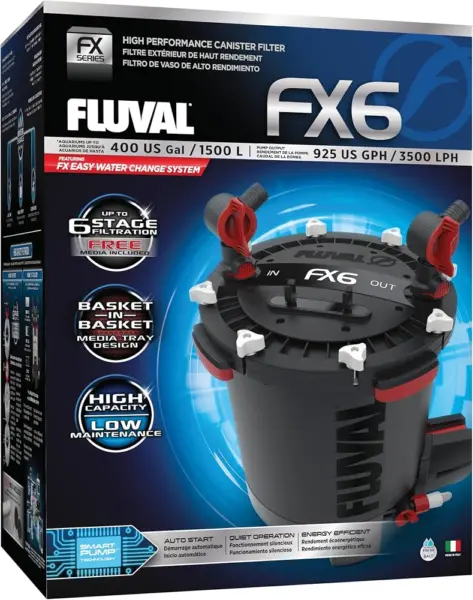
Fluval FX6 – Best Overall
Key Features
- Warranty: 3 years
- Flow rate: 925 GPH (3,500 L/h)
- Max tank size: 400 gallons
- Media capacity: 1.5 US gallons (5.9 L)
- Price: Premium
The FX6 is the biggest filter in this group by every measure: a 400-gallon rating, 925 gallons per hour, and 1.5 gallons of media in removable, stackable baskets. What earns it the top spot is not any one of those numbers but the reserve they add up to. A canister running near its limit loads up fast and slows down between cleanings; this one keeps pushing on a heavily stocked tank, which is exactly where a smaller filter starts to struggle.
Two details we ended up caring about more than the flow figure. Every 12 hours the pump shuts itself off for a minute to purge trapped air, which is the usual source of the burping and rattle that builds up in canisters over time. And the outlet doubles as a drain — attach a hose and the pump empties the tank for a water change, so nobody is carrying buckets down a hallway.
Servicing is where you pay for it. The lid is held by eight separate knobs, and undoing them is the slowest part of a clean. In exchange the media stack lifts out by its handle in one piece, and there is enough media volume that you are opening it every few months rather than every few weeks. It measures roughly 21 by 16 inches and weighs 19.9 pounds dry, so it wants a floor or a deep cabinet rather than a shelf.
The three-year warranty is the longest here, though it excludes the impeller, impeller cover and motor seal — normal for the category, and worth knowing before you assume a worn pump is a free replacement. Self-priming is the quiet luxury: add water, plug in, and the pump clears its own air instead of leaving you working a siphon by hand with a length of hose.
Pros
- Enormous media volume for heavy stock
- Self-primes and purges air every 12 hours
- Output doubles as a water-change drain
- Longest warranty in this group
Cons
- Motor and impeller failures are the long-term risk
For a tank of 100 gallons or more with heavy stock, we think the FX6 is the canister to beat here: more media, more headroom, and the longest warranty.
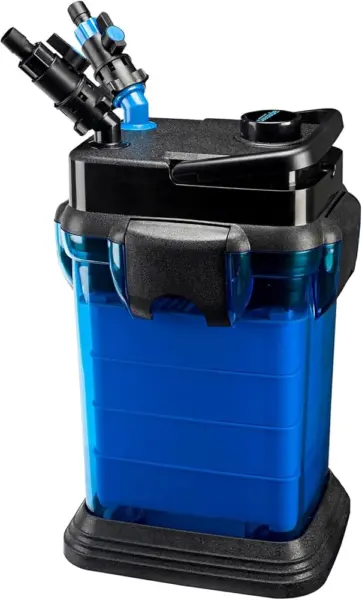
Penn-Plax Cascade 1200 – Best Value for Large Tanks
Key Features
- Flow rate: 315 GPH
- Dimensions: 11.5 x 11 x 20.5 in
- Max tank size: 150 gallons
- Media baskets: 4 stackable trays
- Price: Midrange
Capacity per dollar is the Cascade 1200’s whole argument. Three hundred and fifteen gallons per hour and a 150-gallon rating put it in flagship territory on paper, and four deep stackable baskets mean it is not a small filter wearing a big number. For a large tank on a midrange budget, it is the sensible buy.
The baskets are the design detail we like most. Each tray has its own handle, the box includes floss pads, a coarse bio-sponge and a bag of carbon, and there is room left to add ceramic rings if you want more biological media. A cartridge system locks you into bought refills; here you decide what goes in the trays, which is why this one stays useful as your stock changes.
Setup asks for patience. Priming is a push-button pump on the lid, and getting the siphon moving can take several rounds of pressing before water flows — fill the canister first and it goes faster. The dual 360-degree taps are genuinely useful, letting you swing a hose aside rather than wrestling it, but the lid has to seat squarely or water seeps around the sides, so check the gasket before you fill.
Flow is the number to watch afterwards. It starts strong and tapers as the trays load, which is normal, but it means the floss wants rinsing before the whole canister packs solid. Clean the top tray on schedule and the spray bar keeps its pressure; leave it for six months and you will wonder where the current went.
Pros
- Four stackable baskets take custom media
- 150-gallon capacity at a midrange price
- 360-degree taps make hose work easier
- Quiet in normal running
Cons
- Tubing and tray plastic feel brittle
Our value pick: the Cascade 1200 gives a 150-gallon tank genuine four-basket filtration for midrange money.
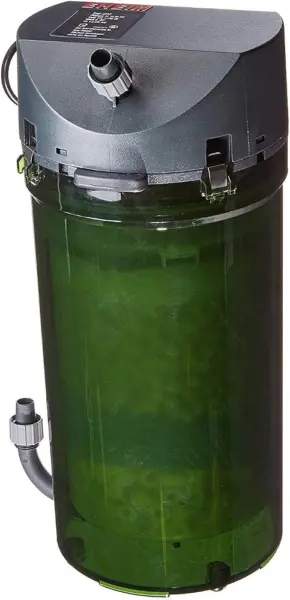
Eheim Classic 2213 – Best for Quiet, Small Setups
Key Features
- Weight: 4.5 lb
- Warranty: 2 years
- Hose fittings: Spray bar and valves
- Included media: Mech and Substrat Pro
- Price: Midrange
There is almost nothing to the Classic 2213 — a 4.5-pound canister, a pump head, and a box that already contains Eheim’s Mech and Substrat Pro media along with a spray bar, valves and hose. Setup means cutting that hose to length yourself, which is obvious the second time and baffling the first.
The sealing ring is the detail we keep coming back to. It is silicone and it is fixed into the pump head rather than floating loose, so there is no gasket to drop in the sink or refit the wrong way round when you close the canister after cleaning. On a filter you open regularly, that is the difference between a five-minute job and a wet one.
Quiet is the other reason it belongs here. On a bedroom or office tank the pump is a hum you stop hearing, and the spray bar spreads the return across the surface instead of dumping it in one place. What it is not is a high-turnover filter: this is a small canister, and a long return run or a tank full of messy fish will use up what it produces. Match it to a modest setup and it does fine.
Two years of warranty is shorter than Fluval’s, and the hose connection at the bottom of the canister is the part to be gentle with when you lift it out — it is the spot that looks fragile. Neither is a reason to skip it. What you are buying is a filter that asks for one careful afternoon and then very little after that.
Pros
- Silicone ring stays fixed to the pump head
- Runs silently enough for a bedroom
- Media included, nothing extra to buy
Cons
- Instructions barely cover the hose routing
Our pick for a quiet, modest setup: the Classic 2213 is the filter you stop noticing, and it arrives with the media already in the box.
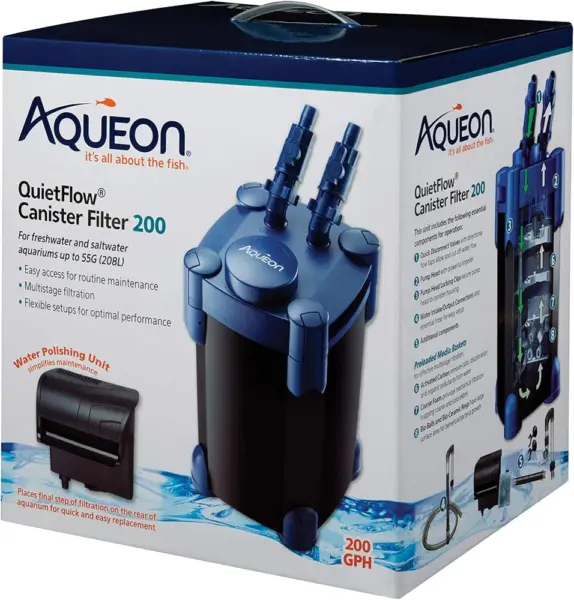
Aqueon QuietFlow 55 – Best for 55-Gallon Tanks
Key Features
- Warranty: 1 year
- Media type: Foam, carbon, cartridge
- Max tank size: 55 gallons
- Return options: Spray bar, water director, polisher
- Price: Budget
Fifty-five gallons is the ceiling, which makes the QuietFlow the smallest canister in this group — and for plenty of tanks that is the point. On a 40 to 55-gallon setup it is the sensible middle ground: more media and more turnover than a hang-on-back, without the cabinet-hogging bulk of a 400-gallon unit.
Noise is its strongest suit, and it is fixable in one move. Send the return through the water director and drop the outlet below the water line instead of running the spray bar at the surface, and the pump stops being something you notice from the couch. Run it submerged and the tank reads as silent from across the room.
Three returns come in the box: a spray bar, a water director, and a polishing unit that hangs on the back and pulls a final pass through a cartridge. We like having the choice, because the return is where most setups end up too noisy or too current-heavy for their fish, and the polisher is worth running after you have disturbed the substrate.
The canister’s own trays take loose media, so floss and rings can come from anywhere, and that keeps a 55-gallon cheap to run. First setup is a two-person job mostly because the tubing wants persuading into place; fill the canister before you switch on and the pump has less air to clear.
Pros
- Quiet once the return sits underwater
- Three return options in the box
- Loose-media trays keep running costs down
Cons
- Polishing unit needs Aqueon cartridges
- One-year warranty is the shortest here
For a 40 to 55-gallon tank, we found the QuietFlow the easiest canister here to live with day to day.
How We Tested Aquarium Canister Filters
We started with roughly 30 canister filters sold at major retailers and narrowed the field by media volume, rated flow, footprint, and whether replacement parts like O-rings and impellers were actually in stock — a filter you can’t buy a seal for in two years is a filter you’ll be replacing. That left ten units, which ran continuously for eight months on tanks ranging from a 29-gallon community setup to a 125-gallon cichlid tank, plus a pair of quarantine tanks where the flow had to stay gentle enough not to blow around a stressed fish.
Noise got measured, not eyeballed. Each unit ran in a living room and then a bedroom, with decibel readings taken from three feet away in a quiet room, and we noted whether what we heard was a low pump drone or the higher rattle of a loose impeller. For water clarity, we photographed the same corner of each tank every week and timed how quickly the water cleared after feeding and after a gravel vacuum. Cleaning day meant hauling each filter to a bathtub, timing full disassembly, counting how many trays had to come out, and whether the media baskets had to be emptied before they’d lift free.
Every time a unit came apart and went back together, we ran a paper towel along the O-ring seam and across the cabinet floor 24 hours later to catch weeping. We cut power to each filter to see whether it restarted on its own or needed priming by hand. We assembled each one from its manual alone, without prior familiarity, and marked the pages we had to reread. Then we priced the whole picture — the unit, replacement pads, and any media it required — because a cheap canister with proprietary cartridges isn’t cheap for long.
How to Choose an Aquarium Canister Filter
The gallon rating printed on the box is the least useful number on it; the flow that actually reaches the tank, and the volume of media pushing it, is what keeps water clear.
Buy turnover, not the headline gallon rating
Most keepers aim for four to five full turnovers an hour at the outlet, which means the rated flow needs headroom over that figure — every inch the return climbs and every loaded tray takes some of it away. The Fluval FX6’s 925 gallons per hour is measured at the pump, not at the spray bar, and its listed 21-inch maximum lifting height is the honest limit of the return run. Pick a filter whose rating comfortably exceeds your tank’s volume, then keep the hose short and the bends few.
Media volume decides how often you open it
Two canisters with identical flow can demand very different amounts of your time. A deep basket stack — 1.5 gallons of media in the FX6, four trays in the Cascade 1200 — holds more biological media and takes longer to clog, so you service it less often. Cartridge systems trade that away for convenience and an ongoing bill. Choose baskets unless you genuinely prefer dropping in a ready-made cartridge.
Seals, taps, and where the thing lives
Leaks are the failure that actually hurts, and they usually start at the lid gasket or a hose joint rather than the pump. Before you fill anything, check that the seal is seated and the lid sits squarely. Taps matter more than they sound: the Cascade’s 360-degree valves let you shut off and swing a hose aside for cleaning, and the Eheim’s silicone ring is fixed into the head so it cannot be refitted crooked. Stand the canister in a shallow tray, on a floor that can take a spill.
Priming and the noise question
Getting water moving separates a calm afternoon from a frustrating one. Self-priming pumps do it for you, a push-button primer usually takes a few attempts, and a plain siphon needs the canister filled before you start. Noise is mostly the return rather than the pump: an outlet running below the water line is quieter than a spray bar breaking the surface, which is why the Aqueon’s water director earns its place in the box.
Warranty cover and the parts that wear
Cover runs from one year on the Aqueon to three on the FX6, and all of them exclude the wear parts — impeller, seals, sometimes the motor. Since those are the components most likely to need replacing, treat a spare impeller as a running cost rather than a warranty claim, and confirm the impeller and seal are available before you commit to a filter you plan to keep for a decade.
Frequently Asked Questions
Can a canister filter sit above the aquarium?
No. Most canisters are fed by a siphon from the tank, so they have to sit below the water line. The maximum lifting height on the box — 21 inches on the Fluval FX6 — describes how far the return can climb, not how high you can raise the canister. Put it on the floor or a low shelf, keep the hose run short, and leave yourself room to lift the lid.
Does cleaning the filter kill the beneficial bacteria?
Not if you rinse the biological media in tank water. The bacteria live on the rings and sponges, and a bucket of water taken during a water change is all they need; tap water and a full media swap are what set a cycle back. Squeeze the sponges, swill the rings, replace only the carbon, and stack everything back in the same order.
Is a canister filter overkill for a small tank?
Below roughly 40 gallons, a good hang-on-back does the same job with less plumbing to leak. Canisters start earning their cabinet space from about 55 gallons up, or sooner if the tank is heavily stocked — the Aqueon QuietFlow tops out at 55 gallons and is the smallest filter here. If you are undecided between two sizes, put the difference into media rather than flow.
Will a canister filter keep up with a turtle tank?
Yes, and it is the setup where a canister proves itself, because a large media stack means fewer teardowns than a powerful hang-on-back demands. Size up one step from the tank’s own rating, rinse the mechanical floss often, and keep the carbon fresh, since turtles produce waste in volume. The FX6’s 400-gallon rating and the Cascade’s four trays suit that workload.
Final Verdict
The Fluval FX6 is the filter to buy when the tank justifies it: from roughly 100 gallons up, or for any tank carrying big, messy fish, its media volume and headroom do work the smaller filters here cannot match.
Below that, the Cascade 1200 covers a 150-gallon tank for midrange money and leaves budget for media, while the Aqueon QuietFlow is the quietest route to a canister under a 55-gallon stand. Between two close calls, take the bigger media stack — it is the part you will still be grateful for a year from now.